

INSIDE THE ARRANGEMENT
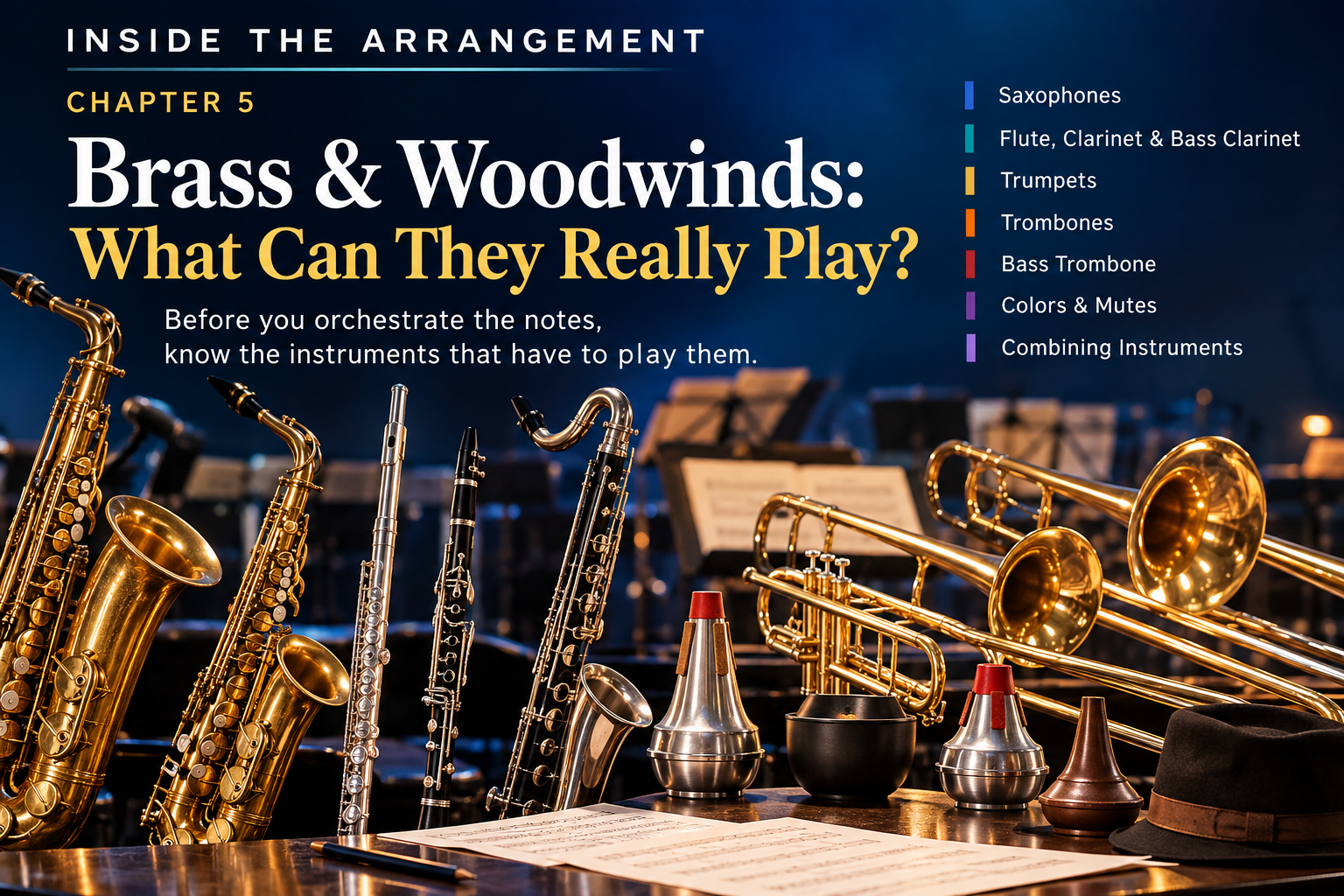
Knowing an instrument’s range is not the same as knowing how to write for it. In Chapter 5 of Inside The Arrangement, we explore the practical registers of saxophones, woodwind doubles, trumpets and trombones—and how register, mutes and instrumental combinations shape the colors of a big-band arrangement.
Chapter 5 — Brass & Woodwinds: What Can They Really Play?
Before you orchestrate the notes, know the instruments that have to play them.
We have built the foundation of our arrangement.
The bass provides harmonic direction and movement.
Piano and guitar help establish harmony, rhythm and color.
The drums provide pulse, energy and interaction with the entire ensemble.
Now it’s time to turn our attention to the instruments that will give a big-band arrangement much of its character, power and color:
The brass and woodwinds.
But before we start writing saxophone solis, trumpet voicings, trombone backgrounds or powerful brass tuttis, there is a fundamental question every arranger needs to understand:
What can these instruments actually do?
At first, the answer seems simple.
Look at a range chart.
Find the lowest note.
Find the highest note.
Stay somewhere between the two.
Unfortunately, it isn’t quite that simple.
Because knowing the range of an instrument is not the same as knowing how to write for it.
⸻
RANGE IS ONLY THE BEGINNING
A range chart tells us which notes an instrument can theoretically produce.
That’s useful information.
But for an arranger, it isn’t enough.
A note may be technically possible but uncomfortable.
Another note may be perfectly comfortable but have the wrong character for the musical passage.
A note that works beautifully for an experienced professional may be unreliable for a student or developing player.
And some registers require specialists.
The most obvious example in a big band is the lead trumpet.
So when I’m writing an arrangement, I don’t only ask:
Can the instrument play this note?
I also ask:
Who is going to play it?
How difficult is it in this musical context?
And what will it sound like?
That gives us three useful ways of thinking about range.
1. Comfortable / Core Register
This is the part of the instrument where most competent players can perform reliably and where the instrument generally speaks naturally.
2. Advanced / Professional Register
These notes are absolutely usable, but the demands on the player increase.
Dynamics, articulation, endurance, tempo and the surrounding musical material all become increasingly important.
3. Specialist / Extreme Register
These notes may be possible—and sometimes spectacular—but they require the right player.
They should be used because the music needs them, not simply because a range chart says they exist.
And that brings us to an important distinction:
Range tells us which notes are available.
Register tells us what happens to the sound when we use them.
Not every register has the same character.
Let’s look at the instruments.
⸻
1. THE SAXOPHONES
The standard big-band saxophone section usually gives us five chairs:
Alto 1
Alto 2
Tenor 1
Tenor 2
Baritone
On paper, these instruments have substantial ranges.
But again, the question isn’t simply how high or low they can play.
Where do they sound best for what I want to achieve?
An alto saxophone in its middle register can sound warm, clear and flexible.
Move upward and the sound becomes increasingly brilliant and penetrating.
A tenor saxophone can move from a rich, warm character into a much stronger and more projecting upper register.
The baritone saxophone gives us tremendous weight at the bottom of the section, but it can also be surprisingly agile and powerful higher in its register.
The arranger therefore isn’t merely choosing pitches.
We are choosing character.
And there is another reason the saxophone section is particularly interesting.
The players sitting behind those five saxophones may give us considerably more than five instrumental colors.
⸻
2. THE DOUBLERS — FLUTE, CLARINET & BASS CLARINET
In professional big-band and studio writing, saxophone players are frequently asked to double on other woodwind instruments.
Common doubles include:
Flute
Clarinet
Bass Clarinet
And depending on the music and personnel, other woodwind doubles may also be available.
This gives the arranger an enormous palette of colors.
But it also introduces an important practical consideration:
A great saxophonist is not automatically an equally great flutist or clarinetist.
Professional woodwind doublers spend years developing those additional instruments.
So before writing a demanding flute passage into an alto chair simply because the player also owns a flute, consider who will actually perform the arrangement.
The same principle we used throughout the previous chapters applies here:
What does the player need—and what can I reasonably ask the player to do?
The reason for using doubles shouldn’t simply be:
Because they’re available.
It should be:
Because I want that sound.
A flute can add lightness and transparency above a saxophone texture.
A clarinet can blend beautifully into a saxophone section while introducing a different character.
A bass clarinet can add a dark, warm color underneath tenor and baritone saxophones.
These aren’t merely extra instruments.
They are additional colors.
And color is becoming increasingly important to our arrangement.
⸻
3. THE TRUMPETS
Now we arrive at an instrument where understanding the difference between possible and practical becomes especially important.
Trumpets can be brilliant.
Powerful.
Warm.
Soft.
Aggressive.
Lyrical.
And, in the right hands, extraordinarily exciting in the upper register.
But this is exactly where a range chart can get an inexperienced arranger into trouble.
A chart may show us that a very high note is possible.
Fine.
But:
For whom?
A professional big band normally has clearly differentiated trumpet chairs, and the lead trumpet has a particularly demanding role.
The lead player is often responsible for the upper register and for defining much of the articulation, phrasing and energy of the brass section.
That player is a specialist.
So we should be careful about making statements such as:
“The trumpet can play this high.”
A more useful question is:
Which trumpet player am I writing this for?
And there is another factor:
One high note is not the same as living in the high register.
A strong player may comfortably produce an isolated upper-register note.
That doesn’t mean we should write sixteen bars continuously at that level.
Range and endurance are connected.
So are range and dynamics.
Range and articulation.
Range and tempo.
Range and what came immediately before.
The arranger has to consider the entire passage—not just its highest note.
Possible doesn’t automatically mean practical.
⸻
4. THE TROMBONES
The trombone presents us with another interesting problem.
Again, knowing the available notes is only the beginning.
The instrument is controlled partly through the movement of the slide.
That means two notes may both be perfectly comfortable individually while a rapid passage between them becomes considerably more demanding.
Tempo matters.
Articulation matters.
Slide movement matters.
The shape of the musical line matters.
So when writing for trombone, we need to ask more than:
Are all these notes within the range?
We also need to ask:
Does this line actually lie well on the instrument?
That is an important distinction.
Playable notes do not automatically create a playable line.
As with trumpet, register also changes character.
The middle register can give us a warm, full brass sound.
Moving upward can add brilliance, intensity and excitement.
Moving lower can add increasing weight.
And then we reach an instrument that deserves to be considered separately.
⸻
5. THE BASS TROMBONE
It is tempting to think of the bass trombone as simply:
Trombone 4, but lower.
That seriously underestimates the instrument.
The bass trombone can provide enormous depth and authority to the bottom of a brass section.
Used well, it can transform the weight of an entire voicing.
It can reinforce the bottom of the trombone section.
It can combine with baritone saxophone.
It can interact with bass.
And it can provide a powerful foundation underneath full brass writing.
But once again, the lowest possible note is not automatically the best note.
We need to understand where the instrument speaks naturally, where it produces its characteristic weight and what we are asking the player to sustain.
The bottom of the brass section is not simply a place to put the lowest available note.
It is part of the orchestration.
And now we’re beginning to move from range toward something much more interesting.
⸻
FROM RANGE TO COLOR
So far we have asked:
What can the instruments play?
But an arranger needs to ask another question:
What do I want them to sound like?
This is where instrumentation becomes truly exciting.
Because an instrument doesn’t have one sound.
Register changes the sound.
Dynamics change the sound.
Articulation changes the sound.
And with brass instruments, we have another powerful tool:
Mutes.
⸻
BRASS MUTES — CHANGING THE COLOR
A trumpet or trombone doesn’t have to play open all the time.
Different mutes can dramatically change its character.
Among the colors an arranger may choose are:
Straight Mute
Cup Mute
Harmon Mute
Plunger
Playing into a hat
Each produces a different effect.
And I think it’s important to understand what we’re doing here.
A mute isn’t simply a device for making an instrument quieter.
A mute is an orchestration choice.
A cup-muted brass passage has a completely different character from the same passage played open.
A Harmon-muted trumpet can create an intimate, concentrated and immediately recognizable color.
A plunger can introduce an expressive, almost vocal quality.
Playing into a hat can soften and alter the projection of the instrument.
So once again, our question shouldn’t be:
Which mute can I use?
It should be:
What sound does the music need?
⸻
NOW LET’S START MIXING THE COLORS
Once we understand the individual instruments, their registers and some of their available colors, another fascinating question appears:
What happens when we combine them?
A trumpet and trombone playing together don’t simply create “more brass.”
A flute combined with muted trumpets can create a completely different texture.
Clarinet combined with saxophones changes the character of the woodwind section.
Baritone saxophone and bass trombone can create considerable weight at the bottom of an ensemble.
Trumpets and saxophones can add brilliance to one another.
And the same musical idea can sound completely different depending on which instruments carry it.
Think about some possibilities:
Trumpets + Trombones
Power, brilliance and weight.
Saxophones + Brass (Tutti)
A fusion of reed and brass colors that can produce anything from warmth to enormous ensemble power.
Flute + Muted Trumpets
A lighter and more unusual color—very different from either sound alone.
Clarinet + Saxophones
A natural way of changing the character of a saxophone texture without completely abandoning its reed quality.
Baritone Saxophone + Bass Trombone
A powerful combination when we want additional weight at the bottom.
And these are only starting points.
Two instrumental colors combined can create a new color of their own.
This is one of the most fascinating parts of arranging.
But it also leads us into a subject that deserves considerably more space than we have left in this chapter.
⸻
BUT THAT ISN’T ORCHESTRATION—YET
We now know more about the instruments available to us.
We understand that a theoretical range is not the same as a practical range.
We know that register changes character.
We know that professional and specialist players allow us to extend what is realistically possible.
We know that woodwind doubling expands our palette.
And we know that mutes and instrumental combinations can dramatically alter color.
But we still haven’t answered one of the biggest questions an arranger faces:
Who should play what?
Suppose I have a melody.
Should five saxophones play it?
Trumpets?
Trombones?
Flute and muted trumpets?
Should I double it in octaves?
Should the sections play together?
Should one section carry the melody while another provides a background?
How should the notes of a chord be distributed through the ensemble?
And how do I turn the notes I hear in my head into a convincing big-band sound?
Now we’re talking about:
ORCHESTRATION.
And I don’t want to squeeze that subject into the end of this chapter.
It deserves a chapter of its own.
⸻
COMING NEXT
Chapter 6 — Orchestration: Who Plays What?
We now know our instruments.
We know more about their practical ranges, their registers, their strengths and their limitations.
We have also started exploring their colors.
Now we need to put them to work.
In Chapter 6, we’ll take the next step and ask:
Who plays the melody?
Who supports it?
Which instruments should be combined?
How should we distribute the notes?
When should sections blend—and when should they remain separate?
Voicing Techniques (e.g. "What is Drop 2 or Drop 2 & 4)
And perhaps most importantly:
How do we make the arrangement sound like the music we hear in our head?
Because instrumentation tells us what instruments we have.
Orchestration is deciding what to do with them.