

INSIDE THE ARRANGEMENT
A great drum part is more than slash marks. Discover how the right balance of ensemble cues, dynamics, written figures and creative freedom gives the drummer exactly what they need—and helps the entire big band perform more efficiently.
Chapter 4 — The Drums
Beyond the Slash Marks: Writing a Drum Part That Actually Works
A page full of slashes may tell the drummer where the measures are.
It doesn’t necessarily tell the drummer what the arrangement is doing.
At the other extreme, writing out every single hi-hat, ride cymbal, snare and bass drum note can be just as problematic.
So where is the right balance?
For me, a good drum part comes down to one basic principle:
Write what matters. Show what is happening.
Then leave room for the drummer to play.
Let’s return once again to Just Take It Easy and look at how I approach the drum part.
⸻
THE DRUMMER NEEDS A ROADMAP
When I write a big-band drum part, I don’t want to dictate every single bar.
A good drummer already knows how to play time.
I don’t need to tell an experienced player exactly where every ride-cymbal note belongs or prescribe every detail of the groove.
What the drummer does need to know is what is happening inside the arrangement.
For example:
Are the saxophones playing the melody?
Is there a trumpet solo?
Are the trombones playing important rhythmic kicks?
Is the full band playing a powerful tutti passage?
Are we entering the shout chorus?
Is there a break?
Is there an important dynamic change?
That information can completely change the way a drummer approaches a passage.
A simple written indication such as:
Saxes with Melody
or
Trumpet Solo
or
Shout Chorus
immediately gives the player musical context.
The drum part becomes a roadmap of the arrangement, rather than merely a collection of measures.
⸻
WRITE THE IMPORTANT FIGURES
There are moments when simply writing slashes is not enough.
If the trombones are playing important rhythmic kicks, I want the drummer to see those figures.
If the whole band is playing a powerful tutti passage, I want the rhythmic structure of that passage clearly represented in the drum part.
Why?
Because now the drummer can support, set up and reinforce what the ensemble is doing.
A trombone figure might suggest an appropriate response or setup on the bass drum.
A powerful tutti passage might call for a completely different approach, perhaps involving snare, cymbals and strong ensemble accents.
But there is an important distinction:
I am showing the drummer the band figure.
I am not necessarily orchestrating every drum stroke.
That is where good drum notation becomes particularly useful.
Example 4.1 — Drum Part with Ensemble Figures and Cues:
Look at Example 4.1.
Most of the part is deliberately left open. But whenever the drummer needs specific information, it appears on the page:
ensemble figures, instrumental cues, dynamics and even instructions about how certain figures should be played.
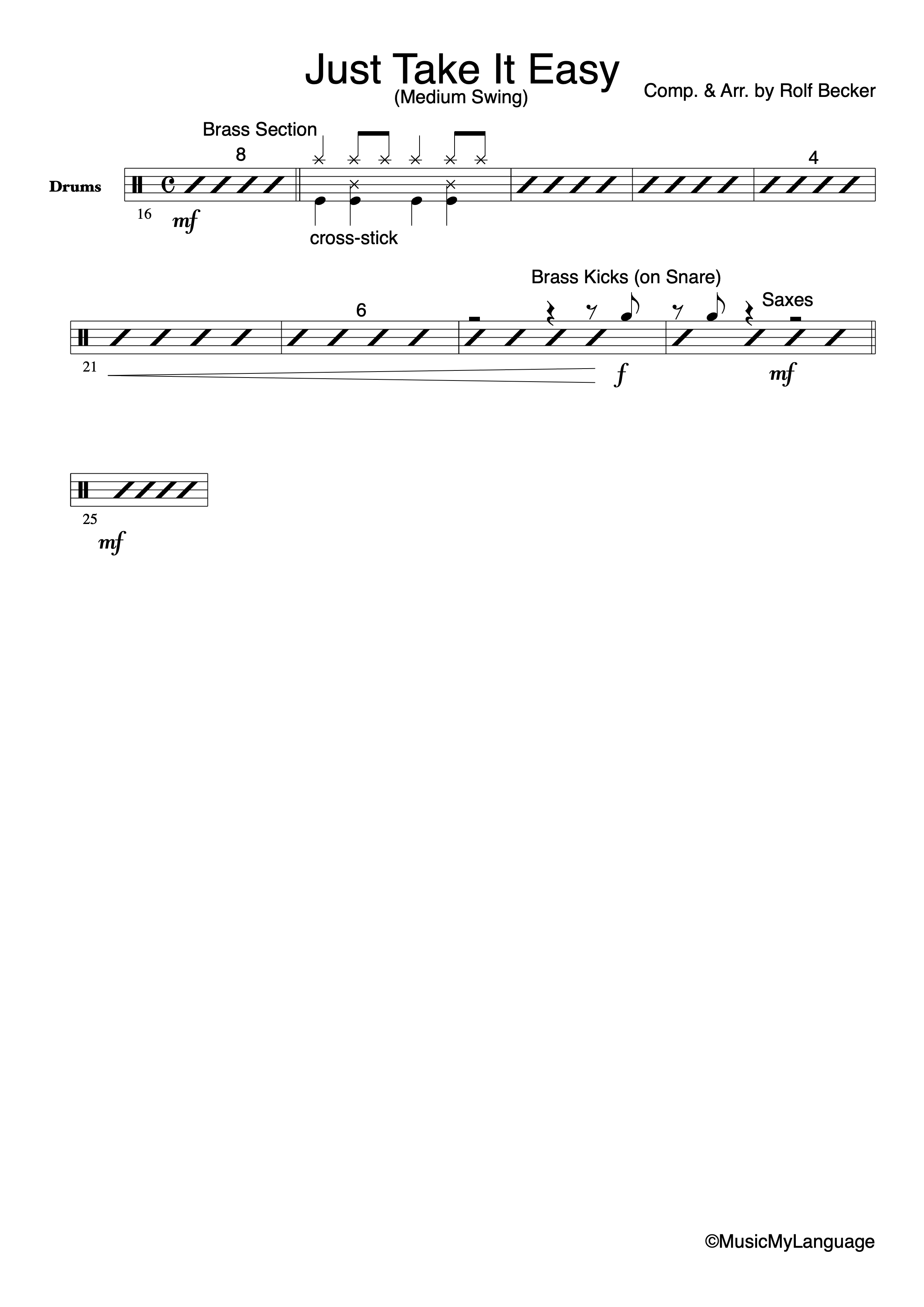
Drum Part with Ensemble Figures & Cues
The drummer isn’t being told what to play every second.
The drummer is being told what matters.
Audio Example 4.1 — Drum Part in Context:
Listen while following the notation above. Notice how the written figures provide the necessary ensemble information
while the open measures leave the drummer free to maintain the groove and shape the performance.
⸻
DON’T WRITE EVERYTHING
This is where arrangers can easily go too far.
If every bar contains fully written snare, bass drum, cymbal and hi-hat notation, we may actually make the part less useful.
The drummer’s attention becomes occupied with reproducing our notation rather than listening and reacting to the band.
And that can remove exactly what we want from a good rhythm-section player:
musical creativity.
Of course, there are situations where detailed notation is necessary.
If I need a very specific rhythmic effect, I write it.
If a fill must lead precisely into an ensemble entrance, I make that clear.
If a rhythmic figure is fundamental to the arrangement, the drummer should see it.
But if the drummer simply needs to play time for eight bars, why write eight bars of detailed drum notation?
Give the player the style, the musical context and the important information.
Then let the drummer play.
This is the same principle we encountered with piano and guitar in Chapter 3:
What does the player need?
Not:
How much can I possibly write on the page?
⸻
LESS NOTATION DOESN’T MEAN LESS INFORMATION
This distinction is important.
An uncluttered drum part should not be a vague drum part.
In fact, the best drum parts often contain less notation but more useful information.
That includes:
Dynamics.
Ensemble figures.
Important kicks.
Breaks and setups.
Changes of style or feel.
And written information about what is happening elsewhere in the band.
A drummer who sees Shout Chorus understands something that four bars of anonymous slash notation cannot communicate.
A drummer who sees Trumpet Solo immediately understands the musical hierarchy.
A drummer who sees an important brass figure can prepare for it before it happens.
The page should help the drummer understand the arrangement.
Less notation. More information.
⸻
BUT THE DRUMMER HAS TO BE ABLE TO READ IT
There is another side to this.
If we provide a carefully prepared drum part containing rhythmic figures, kicks, dynamics, cues and structural information, the drummer must be able to interpret that information.
Reading is therefore an important professional skill for a drummer working with written big-band arrangements.
And then, of course, jazz history gives us one rather spectacular exception.
AND THEN THERE WAS BUDDY RICH…
Buddy Rich was one of the most extraordinary big-band drummers in jazz history.
Yet Rich famously did not rely on conventional music reading in the way we would normally expect from a big-band drummer.
His extraordinary ears and musical memory allowed him to absorb complex arrangements by listening and retain an astonishing amount of musical information.
Henry Adler attempted to teach Rich to read music, but Rich’s performing and touring schedule repeatedly interrupted the process.
Musicians who worked with him also described his remarkable ability to hear an arrangement and remember its structure.
In other words, Buddy Rich could do something most musicians simply cannot.
So unless your drummer happens to possess Buddy Rich’s extraordinary musical memory…
give them a drum part they can read.
⸻
THE DRUM PART IS PART OF THE ARRANGEMENT
This brings us back to something that has been developing throughout Inside The Arrangement.
The rhythm section is not a collection of independent musicians.
It is one musical system.
The bass player needs to understand harmonic direction.
The guitarist needs to understand the rhythmic and harmonic framework.
The pianist needs to know where there is room to contribute—and where there isn’t.
And the drummer needs to understand what the entire band is doing.
That is why I don’t consider the drum part an afterthought that gets created after the “real” arranging is finished.
The drum part is part of the arrangement.
The clearer that part communicates the architecture of the music, the easier it becomes for the drummer to interact with the ensemble.
And the more efficiently the entire band can rehearse.
⸻
THE BALANCE
So what does a good big-band drum sheet actually need?
Not every note.
And certainly not just endless slash marks.
It needs the right information at the right moment.
Write the figures that matter.
Show the drummer what is happening in the band.
Include the dynamics.
Make the important kicks, breaks and transitions clear.
And wherever detailed notation is unnecessary, leave enough space for the drummer’s experience, musicality and creativity.
Because ultimately, a good drum part doesn’t tell the drummer how to play every beat.
It tells the drummer what matters.
Less notation. More information.
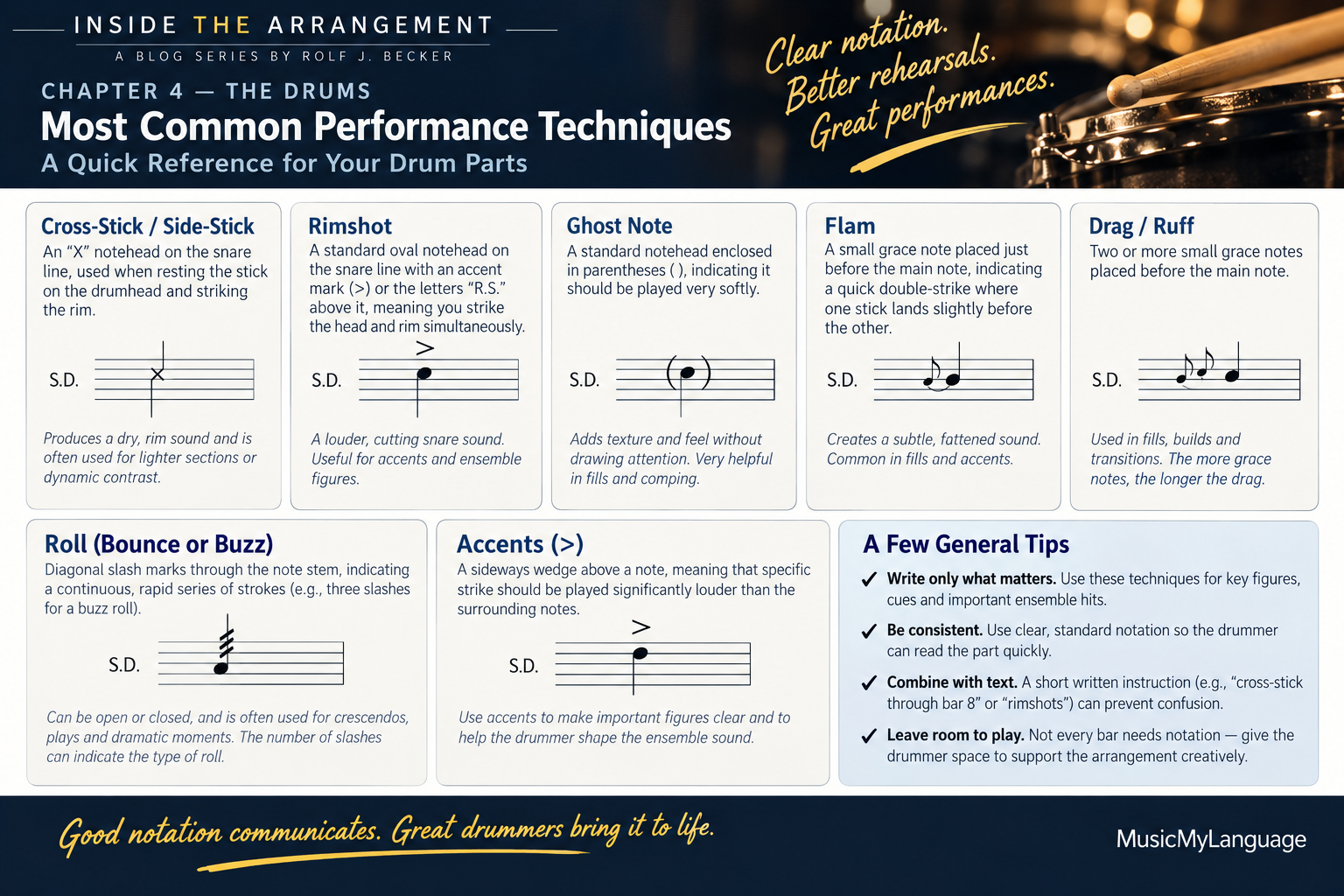
Most Common Performance Techniques
Coming Next
Chapter 5 — Brass & Woodwinds: What Can They Really Play?
We have built the foundation of the arrangement.
Bass, piano, guitar and drums have established the harmony, pulse, groove and rhythmic framework.
Now it’s time to turn our attention to the instruments that will give the arrangement much of its character, power and color:
The brass and woodwinds.
But before we start writing voicings and combining sections, there is a fundamental question every arranger needs to understand:
What can these instruments actually do?
What is the practical range of a trumpet, trombone or saxophone?
Which registers sound comfortable and natural—and which become demanding or potentially unreliable?
And just because a note exists in an instrument’s theoretical range, does that mean we should write it?
Then there is another essential consideration:
Not every register has the same sound.
A trumpet in its middle register has a very different character from a trumpet high above the staff.
A tenor saxophone can move from warm and full to increasingly powerful and penetrating as we change register.
And the same principle applies throughout the brass and woodwind sections.
Understanding range therefore isn’t only about knowing which notes are possible.
It’s about understanding what those notes will sound like.
And once we understand the individual instruments, another fascinating question appears:
What happens when we combine them?
Trumpets with trombones.
Saxophones with brass.
Flutes with muted trumpets.
Clarinet with saxophones.
And other options.
Different registers, doublings and instrumental combinations can transform exactly the same musical idea into completely different sounds and colors.
In Chapter 5, we’ll explore the practical possibilities and limitations of brass and woodwind instruments, their useful ranges, and how combining them begins to create the orchestral colors of a big-band arrangement.
Because before deciding what notes to write, an arranger needs to understand who is going to play them.