

Inside The Arrangement
What makes a great bass line? Explore the essential choices between “In 2” and “In 4,” discover basic walking bass patterns, and learn how the bass works with the rhythm section to bring an arrangement to life. Includes practical sheet music and audio examples.
Chapter 2
The Bass Line: Choose the Right Bass Line and You’re Golden
You can write a great melody. You can find beautiful chords. You can even have a killer drum groove.
But choose the wrong bass line — and somehow the whole arrangement just doesn’t sit right.
The bass is one of the most important links between harmony and rhythm.
It supports the chord progression, locks in with the drums, gives the music direction and, perhaps most importantly, helps determine how the entire arrangement feels.
And there isn’t just one way to do it.
As a composer or arranger, you have several basic approaches to choose from.
In this chapter of Inside The Arrangement, I’ll introduce some of the most useful ones, accompanied by audio examples and sheet music,
so you can both see and hear the difference.
But before we get to the notes, there is one important principle:
A great bass line doesn’t work alone.
The bass player needs solid support from the other rhythm-section players. Drums, piano and guitar all contribute to the groove and harmony.
When they work together, the bass line doesn’t merely support the melody - it helps carry the entire arrangement.
So, let’s get started.
⸻
1. Playing “In 2”
When musicians say that the bass is playing “in 2,” it basically means that the bass emphasizes two notes within a 4/4 measure,
usually giving the music a spacious two-beat feeling.
It is simple - but simple does not mean boring.
There are several ways to create an effective in 2 bass line.
Root notes only
The simplest version is to play the root of the chord on beats 1 and 3.
This clearly establishes the harmony and gives the rest of the rhythm section plenty of space.
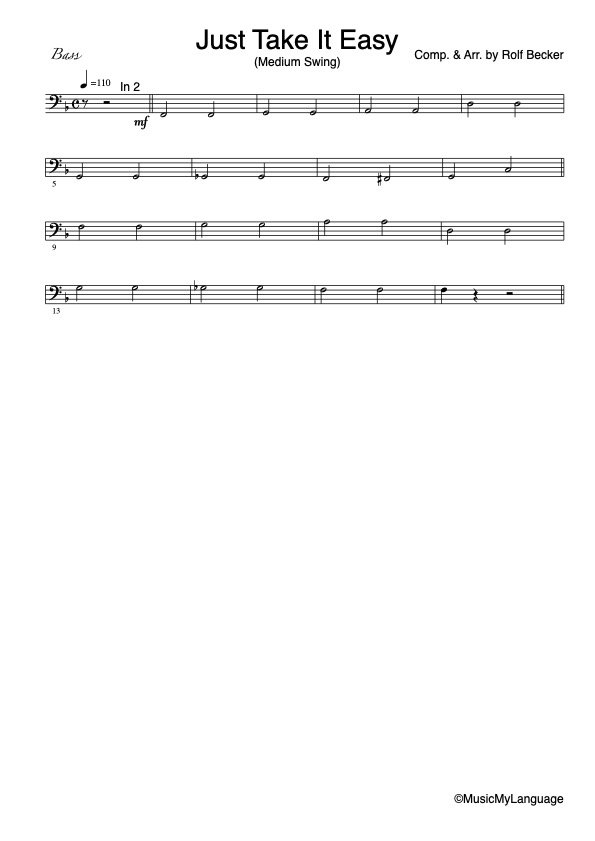
Root Notes Only
For better audible results please use headphones / proper in ears
Root notes — changing octaves
Now take the same basic idea but alternate between different octaves of the root.
The harmonic information hasn’t changed, but the line immediately has more movement.
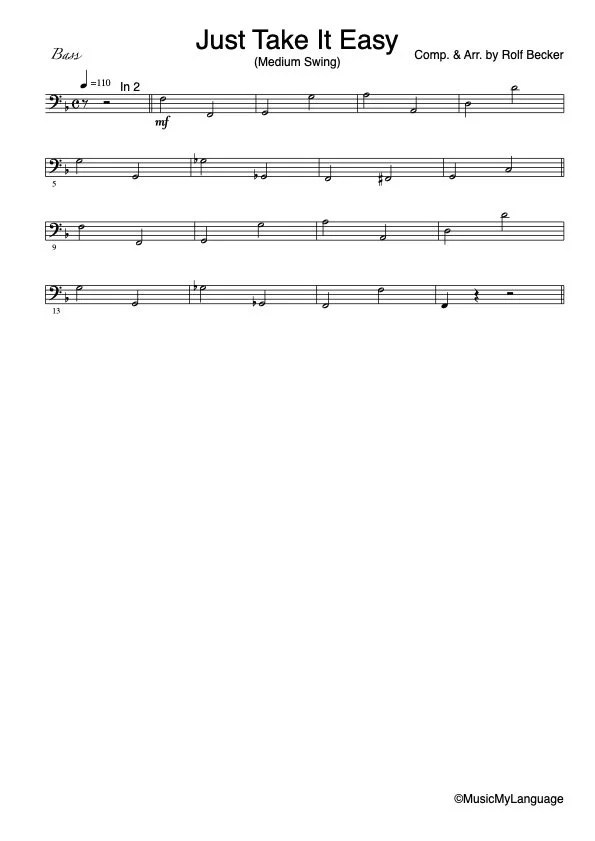
Root Notes / Changing Octaves
Root and fifth
Another classic approach is to alternate between the root and fifth of the chord.
It is still harmonically simple, but the fifth adds another dimension and creates a stronger sense of motion.
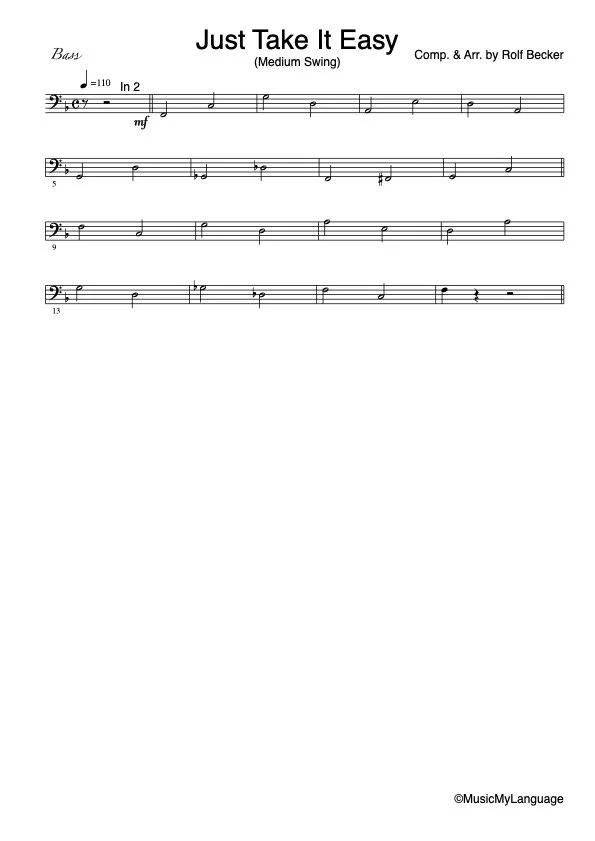
Root & Fifth
Root and fifth — with a little rhythmic movement
We can make the same idea more interesting by introducing a small rhythmic phrase around beats 1 and 2.
Now the bass is beginning to do more than simply state the harmony. It starts contributing its own rhythmic character to the arrangement.
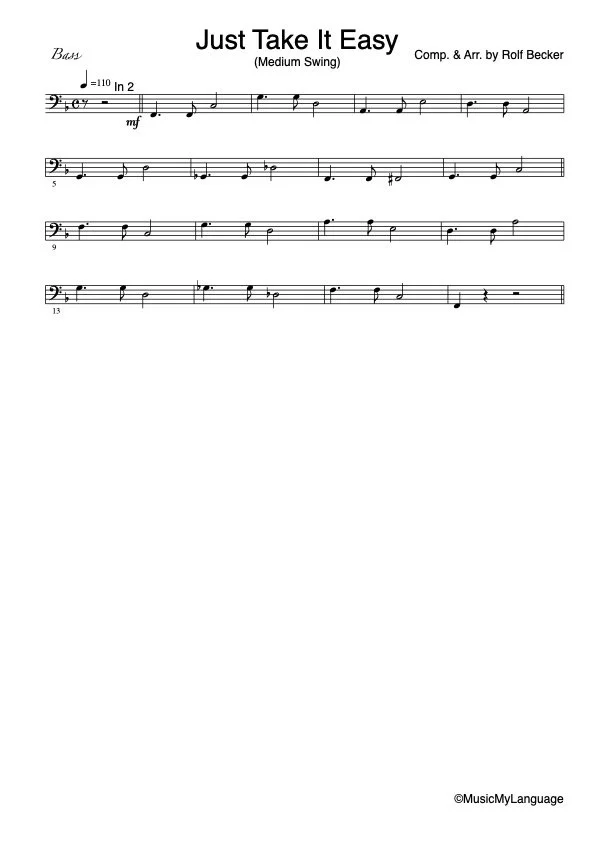
Root & Fifth with little Rhythmic Movement
Mixing “In 2” and quarter-note movement
Here is another useful variation.
Instead of maintaining exactly the same pattern in every measure, try a two-bar phrase:
Bar 1: two half notes
Bar 2: four quarter notes
The bass is still creating an overall in 2 character, but the second measure introduces forward motion.
This is a very simple arranging device — and a very effective one.
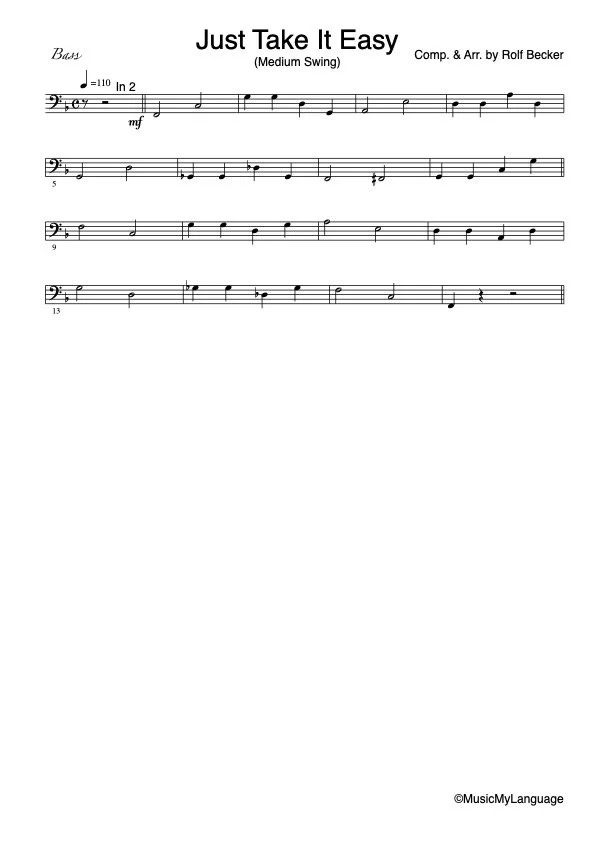
Mixing “In 2” and Quarter Note Movement
⸻
2. Playing “In 4” — The Walking Bass Line
Now things start moving.
When the bass plays four quarter notes in a 4/4 measure, we call this playing “in 4.”
In jazz, this is commonly associated with the walking bass line.
And this is where understanding harmony becomes particularly important.
A good walking bass line shouldn’t simply play the root four times:
1 – 1 – 1 – 1
That would establish the chord — but after a while it would become rather boring.
Instead, the bass player uses chord tones, scale tones and passing notes to create a melodic line that connects one chord to the next.
This is also why the bass player needs a rhythm section that clearly supports the correct chords and chord progression.
The better the harmonic foundation, the more naturally the bass can create movement through the harmony.
Here are a few basic patterns to get started.
1 – 1 – 5 – 5
Root – Root – Fifth – Fifth
A very straightforward pattern and a good starting point for understanding the sound of four quarter notes against the harmony.
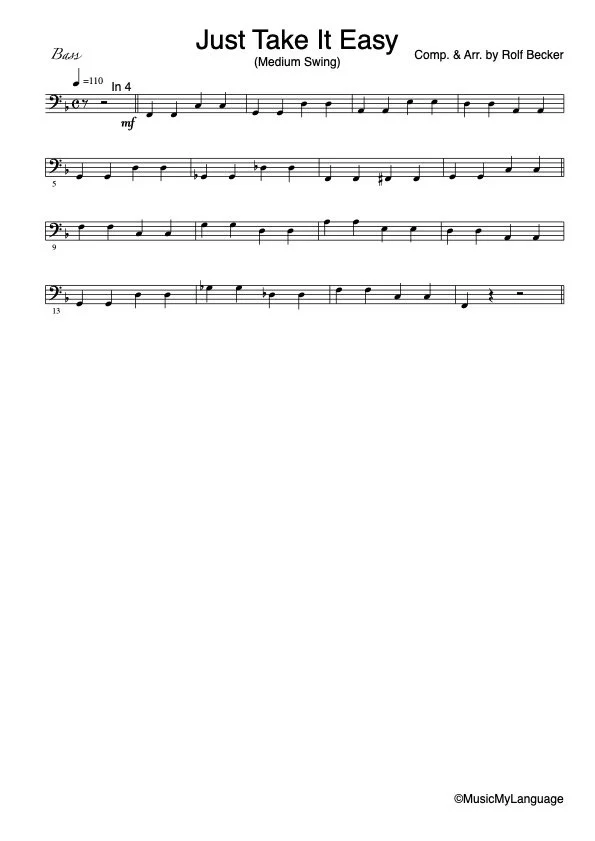
In 4 : 1/1/5/5/ Walking Bass
1 – 2 – 3 – 5
Root – Second – Third – Fifth
Now we are beginning to hear the line as something melodic rather than simply a sequence of chord root & fifth.
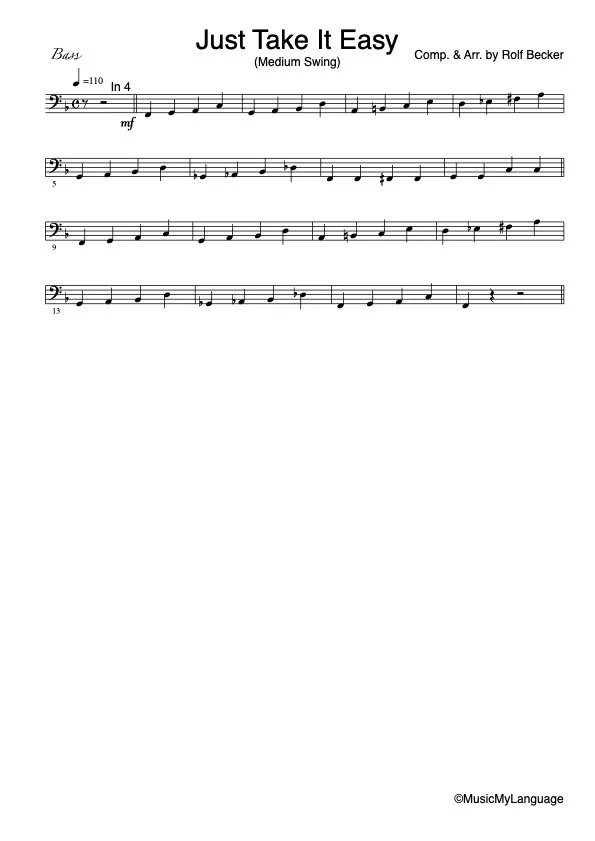
In 4: 1/2/3/5 Walking Bass
1 – 2 – 3 – 1
Root – Second – Third – Root
Another simple way of moving through the scale while keeping the root as a strong reference point.
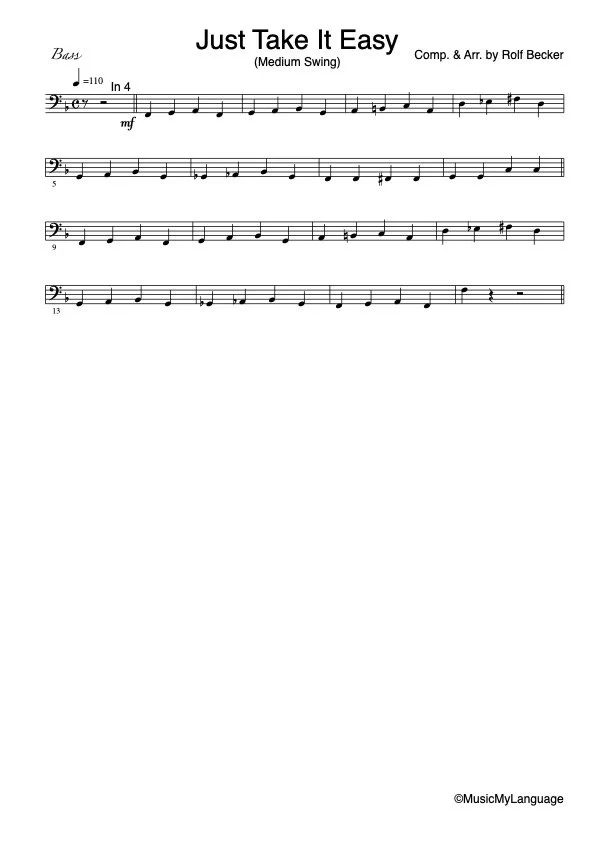
In 4: 1/2/3/1/ Walking Bass
1 – 7 – 6 – 5
Root – Seventh – Sixth – Fifth
Here the line moves downward, creating a completely different sense of direction.
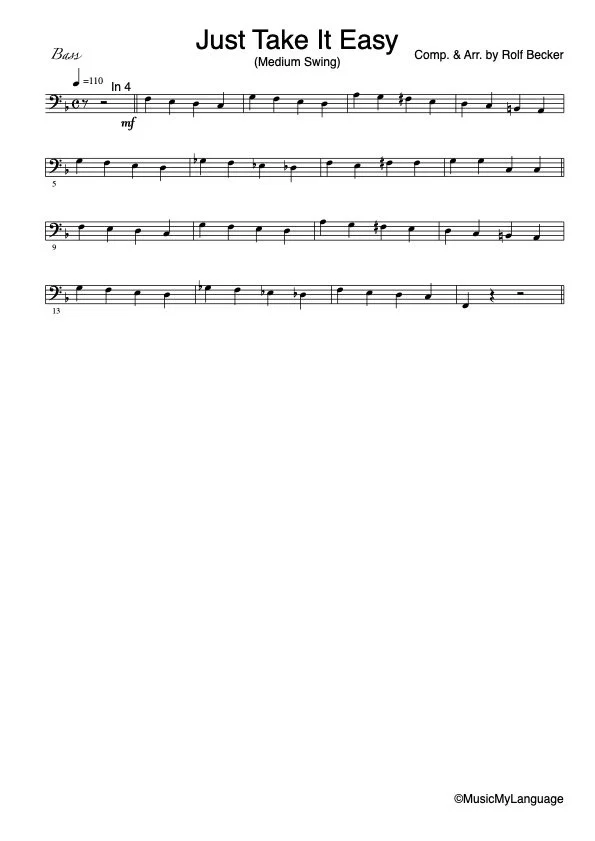
In 2": 1/7/6/5/ Walking Bass
These aren’t rules.
Think of them as building blocks (or pattern).
Once you understand what they do, you can combine them, change their direction and adapt them to the chord progression.
⸻
What If the Chord Lasts Longer?
This is where things become even more interesting.
Suppose one chord lasts for two complete measures.
Playing exactly the same four-note pattern twice isn’t your only option.
You can create a longer melodic journey through the harmony.
For example:
1 – 7 – 6 – ♭6 | 5 – 4 – 3 – 2
Suddenly eight quarter notes form one continuous line.
And notice something important: the bass isn’t simply describing the chord anymore.
It is creating direction.
That is one of the secrets of a good walking bass line.
Every note should make you want to hear where the next one is going.

In 4: 2 Bar Sample
⸻
Should You Write the Bass Line Out?
This depends entirely on who is going to play your arrangement.
An experienced professional jazz bassist usually doesn’t need every quarter note written out.
Give an experienced player a lead sheet or bass part containing the chord progression and tell them:
“In 2.”
or
“Walk in 4.” (or just “In 4”)
…and they will know what to do.
In fact, allowing a good bass player some freedom can often produce a more natural result than trying to notate every single note yourself.
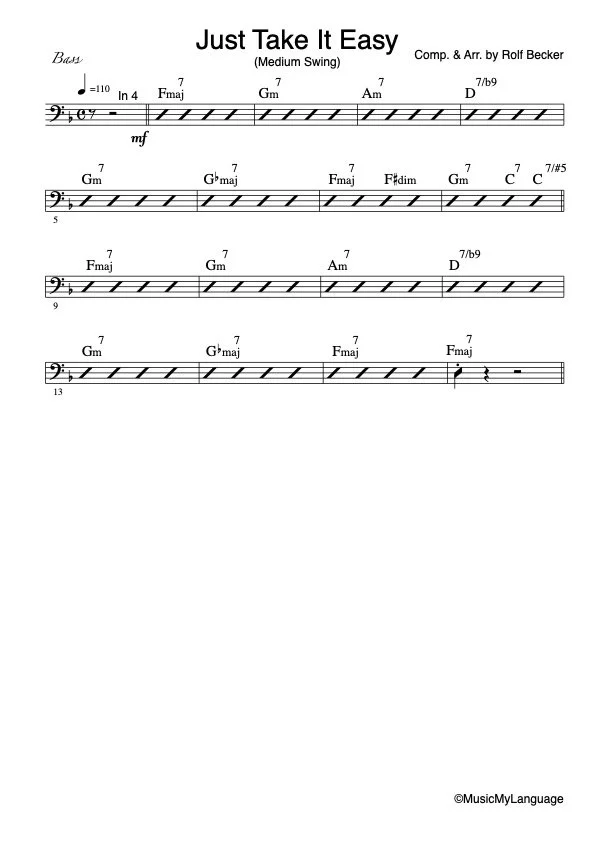
Bass (Lead) Sheet for Professionals
But there is an important exception.
Writing for Student Bands
If you’re arranging for a school ensemble, developing jazz band or educational publisher, I recommend a different approach.
Write out a suitable bass line and include the chord symbols above it.
I would also mark the intended feel — for example:
In 2
or
Walking in 4
Why both?
Because you’re doing two things at the same time.
You’re giving a developing bass player something they can perform successfully right now,
while also showing them how a bass line relates to the underlying chord progression.
Eventually, they may stop needing the written notes.
And that’s exactly what you want.
⸻
The Bigger Picture
The bass line is only one part of the rhythm-section puzzle.
A great bass player needs to know where the harmony is going.
The drummer needs to support the feel.
And piano and guitar have to provide the right harmonic and rhythmic framework without getting in the bass player’s way.
When all of those elements fit together, something wonderful happens:
The rhythm section stops sounding like four musicians playing individual parts.
It starts sounding like one instrument.
And that brings us perfectly to the next chapter of Inside The Arrangement:
Chapter 3: What Do the Piano & Guitar Players Do?
We’ll look at chord voicings, rhythmic comping, how piano and guitar can support the bass and drums -
and, just as importantly, how to keep them from stepping on each other’s toes.
See you in the next chapter.
Rolf Becker
Composer · Arranger · Conductor
MusicMyLanguage — Learn. Practice. Perform.
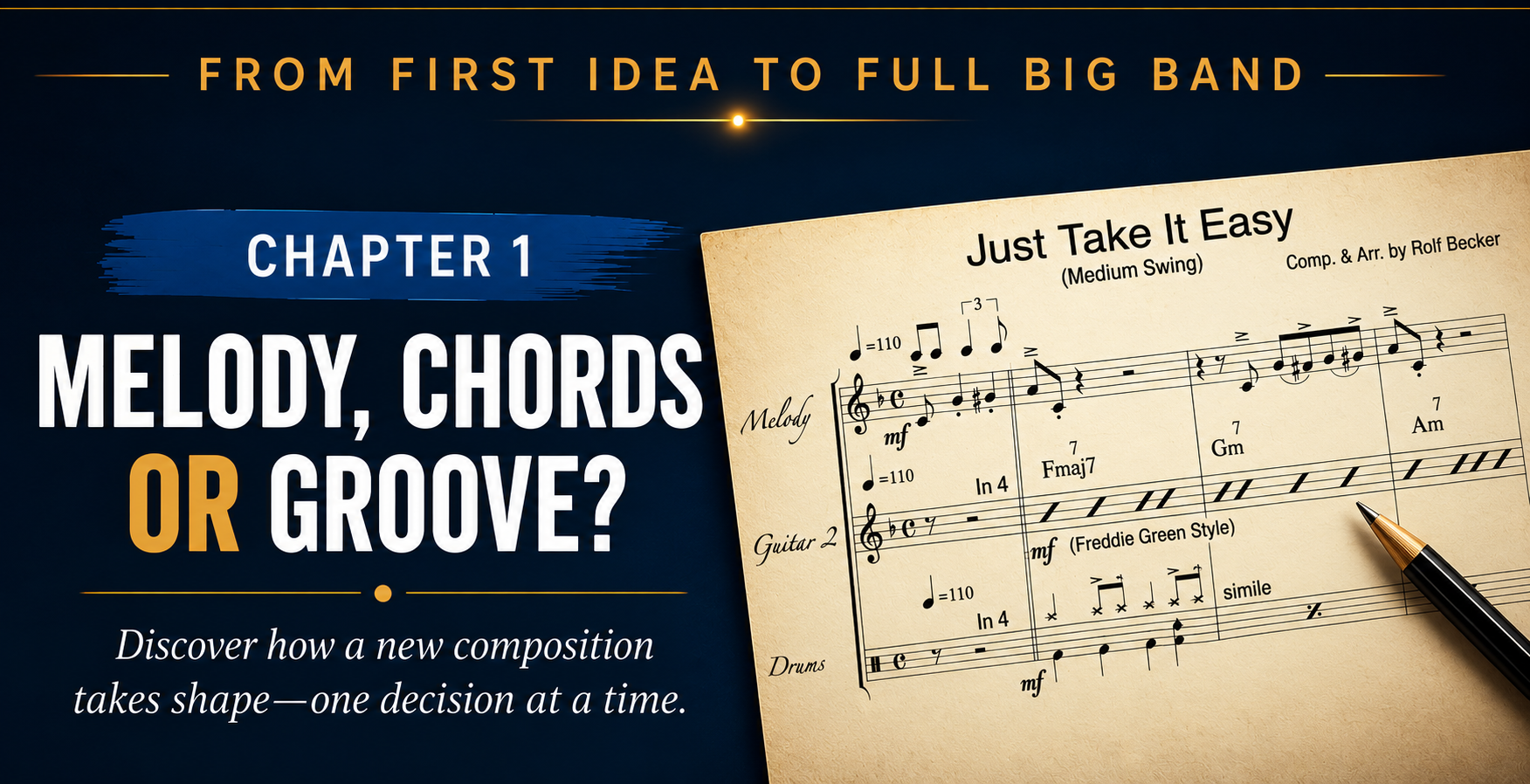
INSIDE THE ARRANGEMENT
What comes first when composing a new tune — melody, chords or groove? Follow “Just Take It Easy” from its first musical idea to a complete big-band arrangement in this new step-by-step series, with audio examples along the way.
From First Idea to Full Big Band
Chapter 1 — What Comes First: Melody, Chords or Groove?
How does a new composition actually begin?
With a melody?
A chord progression?
A bass line?
Or simply a groove that makes you want to play?
The answer is:
Any of them can come first.
There is no single formula for composing an instrumental tune.
Sometimes a melody suddenly appears in your head.
Sometimes you discover a chord progression that creates exactly the atmosphere you’re looking for.
And sometimes everything starts with a rhythm or groove.
For this new Inside the Arrangement series, however,
I don’t want to talk about composition and arranging only in theory.
I’m going to show you.
We’ll take one of my original compositions and follow it step by step
from its basic musical idea through harmony,
rhythm-section writing and orchestration,
until eventually it becomes a full big-band arrangement.
The tune is called:
“Just Take It Easy”
It’s a medium-swing composition inspired by the classic Count Basie big-band tradition.
Tempo: Medium Swing — ♩ = 110
The complete composition has an AABA form,
but we’ll begin with only the first 16 bars.
Why?
Because before we start adding instruments, voicings, backgrounds and orchestration,
I want you to hear what happens to the music when we change just one element at a time.
⸻
The First Ingredient: Melody
Let’s begin with the most exposed version possible.
Just the melody.
No chordal accompaniment.
No walking bass.
No drums.
No big band.
When a melody is heard on its own, there’s nowhere for it to hide.
Listen to its rhythmic character. Notice the short phrases and the spaces between them.
Listen to the repetition and development of the musical idea.
And ask yourself:
What harmony would you hear underneath this melody?
Don’t look for the “correct” answer yet.
Just listen.
🎧 AUDIO EXAMPLE 1
“Just Take It Easy” — Melody Only
⸻
Now Let’s Add Harmony
The melody gives us our horizontal musical line.
Harmony adds the vertical dimension.
For Just Take It Easy, I chose a harmonic progression that supports the relaxed swing character
while still providing enough movement and color to make the melody interesting.
But instead of immediately adding the entire rhythm section,
let’s hear what happens when we add only the harmonic framework.
For this example, the chords are supported by Freddie Green-style guitar accompaniment
- the classic four-to-the-bar approach associated with the Count Basie rhythm section.
Listen again to exactly the same melody.
This time, notice how differently individual melody notes can feel once you hear the harmony underneath them.
A note that sounded neutral on its own may suddenly create tension.
Another may sound completely settled.
And the movement from one chord to the next starts giving the melody direction.
🎧 AUDIO EXAMPLE 2
“Just Take It Easy” — Melody + Chords
⸻
Melody and Chords Aren’t Two Separate Things
This is an important point.
When composing, I don’t think of melody and harmony as two completely independent layers.
They communicate with each other.
A melody note can suggest a particular chord.
But the opposite is also true:
A chord can change the way we hear a melody note.
And there is another element that can dramatically change both of them.
The bass.
Changing the bass note underneath a chord can alter its color, direction and function
- even when the notes above it remain unchanged.
We’ll explore that much more closely in the next chapter.
For now, however, something is still missing.
We have melody.
We have harmony.
But we don’t yet have the complete feel of the tune.
⸻
Enter the Rhythm Section
Now let’s add the rhythm section.
This is where Just Take It Easy really begins to reveal its personality as a swing tune.
The harmonic pulse is joined by a walking bass line and drums establishing the swing feel.
Listen to the same 16 bars again.
Nothing fundamental has happened to the melody.
But the musical experience has changed considerably.
Suddenly there is forward motion.
There is pulse.
There is interaction.
There is groove.
🎧 AUDIO EXAMPLE 3
“Just Take It Easy” — Melody + Rhythm Section
⸻
Listen Again — But Differently
Now go back and compare the three examples.
Melody
→ Melody + Chords
→ Melody + Rhythm Section
The melody hasn’t changed.
So what has?
Almost everything around it.
This is one of the most important lessons in arranging.
An arrangement isn’t simply about adding more instruments.
It’s about deciding what each additional musical element contributes.
Sometimes adding something makes the music stronger.
Sometimes removing something does.
And sometimes one carefully chosen bass note can have more impact than adding an entire section of instruments.
⸻
What Comes First?
So let’s return to our original question.
Melody, chords or groove?
There is no universal answer.
You can start with a melodic fragment.
You can sit at the piano and discover a chord progression.
You can create a bass line.
You can hear a drum groove.
You might even begin with nothing more than a rhythmic figure.
The important thing is to recognize when you have found an idea worth developing.
Then ask:
What does this idea need next?
Not:
What can I add?
But:
What does the music need?
That small difference in thinking becomes increasingly important as an arrangement grows.
Because eventually we’ll have many more possibilities at our disposal:
Saxophones.
Trumpets.
Trombones.
Piano.
Guitar.
Bass.
Drums.
Different registers.
Different voicings.
Different combinations.
Different colors.
But before we get anywhere near the full big band, we need to make sure that the foundation is right.
And that takes us to the bottom of the arrangement.
⸻
Coming Next: The Bass Line
Choose the Right Bass Line and You’re Golden
In the next chapter of Inside the Arrangement,
we’re going to take these same 16 bars of Just Take It Easy and look underneath the melody and chords.
We’ll examine the walking bass line.
Why this note?
Why not simply play the root of every chord?
How can the bass connect one chord to the next?
Where can we use chord tones, passing notes and chromatic approaches?
And how much of a bass line should an arranger actually write?
We’ll see it in the score and hear it in the music.
Because a good bass line doesn’t merely tell us what chord we’re playing.
It helps tell us where the music is going.
And when you choose the right bass line…
you’re golden.
To be continued in Chapter 2 of Inside the Arrangement — From First Idea to Full Big Band.