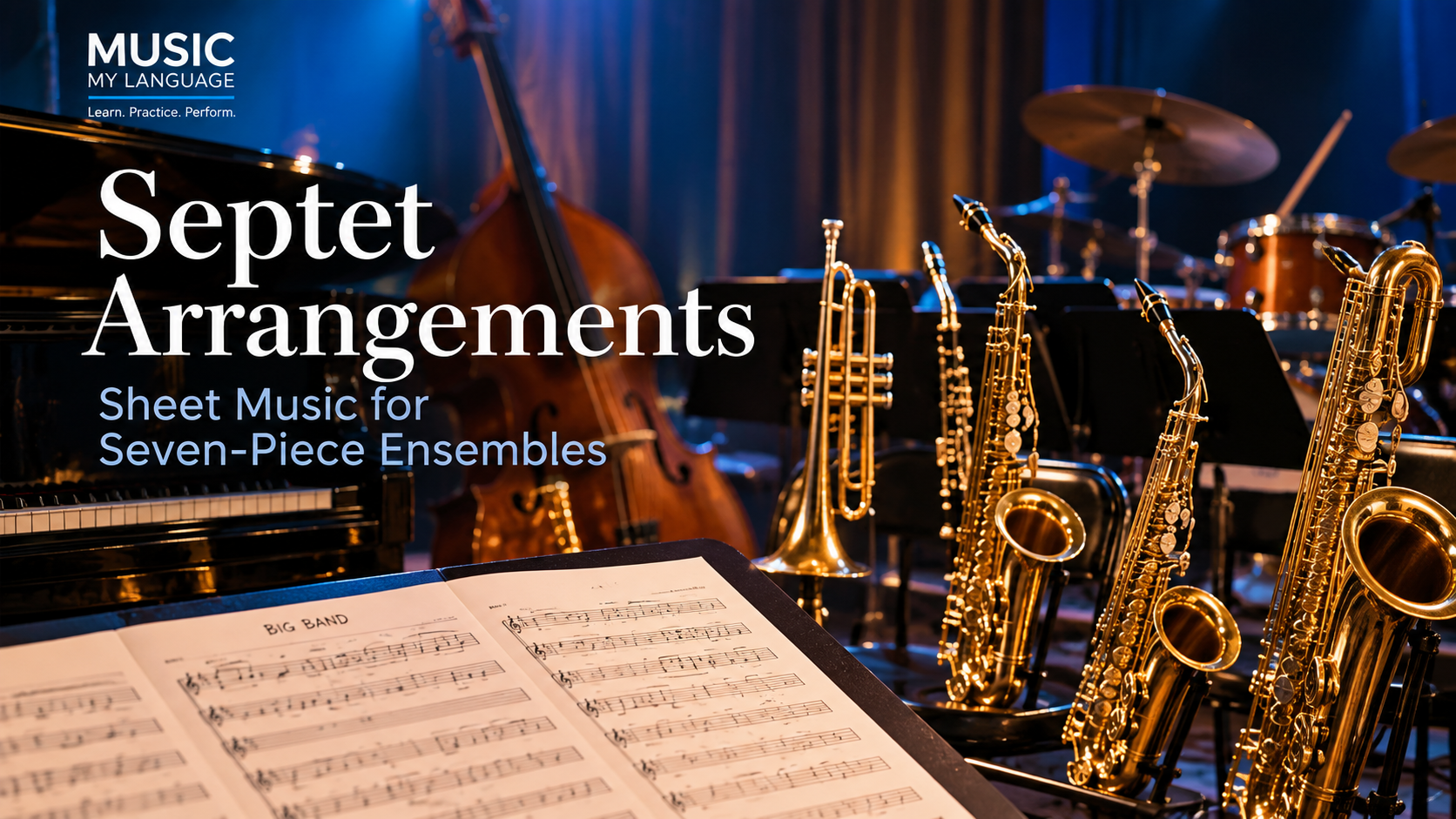
Septet Arrangements Sheet Music for Seven-Piece Ensembles
Discover how a seven-piece jazz ensemble can create a rich, powerful sound with just four horns and rhythm section. Explore professional septet arranging, instrumentation and the MusicMyLanguage Septet Series.
Finding professionally written music for a seven-piece jazz ensemble can be surprisingly difficult. There is an enormous amount of repertoire available for traditional jazz combos and full big bands, but considerably less material written specifically for an ensemble that sits between those two formats.
That is where septet arrangements sheet music can offer something distinctive: enough instrumental color for substantial ensemble writing, while retaining the flexibility, transparency and individual character of a smaller jazz group.
The MusicMyLanguage Septet Series was created around exactly this idea — not as a reduced big band, but as an ensemble format with its own musical possibilities.
Why the Septet Format Works
A well-written septet should never sound like a big band with ten musicians missing.
The strength of the format comes from using the available instruments intelligently.
The MusicMyLanguage Septet Series uses:
Trumpet • Alto Saxophone • Tenor Saxophone • Baritone Saxophone • Piano • Bass • Drums
This provides a four-horn front line supported by a complete rhythm section.
With four horns, an arranger can move between unison and octave passages, harmonized ensemble writing, independent lines, contrapuntal textures, background figures and featured solo voices. The rhythm section provides the harmonic and rhythmic foundation while interacting directly with the horn writing.
The result is an ensemble that can sound compact and intimate in one passage, then surprisingly full and powerful in the next.
A guitarist can also be added if desired, using the Piano Lead Sheet as a harmonic and structural reference. In this way, the basic septet can expand naturally without changing the fundamental concept of the arrangement.
Four Horns — Many Possibilities
Writing effectively for Trumpet, Alto Saxophone, Tenor Saxophone and Baritone Saxophone requires a different approach from conventional big-band orchestration.
There is no need to imitate four trumpets, four trombones and five saxophones. Instead, the arranger can take advantage of the individual colors of the four instruments.
Unison writing can produce remarkable clarity and energy. Octaves can broaden a melodic statement without making it heavy. Harmonized passages can create density and warmth, while contrapuntal writing allows individual instruments to move independently.
Register is equally important.
The Trumpet can add brilliance and definition at the top of the ensemble. Alto and Tenor Saxophones provide contrasting middle-register colors and can move easily between melodic and harmonic functions. The Baritone Saxophone supplies depth, but it does not have to remain permanently at the bottom of the harmony. It can become an independent melodic voice, participate in rhythmic figures or move into its upper register when the orchestration calls for a different color.
This flexibility is one of the most interesting aspects of arranging for a four-horn front line.
Creating Impact with Seven Musicians
The goal of a septet arrangement should not simply be to make seven musicians sound like seventeen.
It should be to make seven musicians sound complete.
That distinction matters.
Effective arranging comes from contrast: unison against harmony, sparse textures against full ensemble passages, sustained backgrounds against rhythmic figures, and individual voices against collective statements.
Articulation and dynamics become especially important. When four horns phrase together precisely, even a relatively simple passage can have considerable impact. Conversely, reducing the orchestration to a single horn over the rhythm section can create space before the full ensemble returns.
The rhythm section is equally important. Piano, Bass and Drums should not feel like generic accompaniment attached underneath the horns. Their parts should reflect the character of the arrangement and support its rhythmic structure, dynamics and stylistic direction.
That interaction between horns and rhythm section is what turns a collection of seven individual parts into an ensemble.
Inside the MusicMyLanguage Septet Series
I developed the MusicMyLanguage Septet Series as a dedicated arranging format for musicians who want substantial jazz ensemble writing without requiring traditional big-band instrumentation.
The first release in the series is Duke Ellington’s “In A Mellow Tone.”
The arrangement begins with a unison introduction based on the final eight bars of the tune. The melody initially appears in unison before the horn writing opens up, using written backgrounds and increasingly active ensemble passages. Later sections develop into more demanding ensemble writing, including tightly voiced horn passages and sixteenth-note figures.
View “In A Mellow Tone” on Sheet Music Plus
The second release is Quincy Jones’s “Quintessence.”
Here the Alto Saxophone remains at the center of the arrangement. Trumpet, Tenor Saxophone and Baritone Saxophone create changing backgrounds around the featured Alto, including chordal textures, double-time figures and staggered “bell” effects. Near the end, the ensemble steps away and the Alto Saxophone is given a cadenza before the final statement.
View “Quintessence” on Sheet Music Plus
These first two arrangements demonstrate an important principle behind the series: the instrumentation remains consistent, but the orchestration should respond to the character of each composition.
A Valuable Format for Developing Ensemble Skills
The septet format can also be particularly useful in an educational environment.
Because every horn has an individual function, players become very aware of intonation, articulation, balance, rhythmic precision and blend. There are fewer opportunities to disappear inside a large section.
That can be musically valuable.
Players learn not only to perform their own notes, but to understand where those notes sit within the complete arrangement. Is the part carrying the melody? Is it the top or inner voice of a chord? Is it providing a counterline? Is it supporting another featured instrument?
Those are fundamental ensemble skills that remain important whether a musician later performs in a small combo, a big band or another professional ensemble.
The same qualities make the format attractive for experienced musicians. Four horns and rhythm section provide enough orchestral variety for sophisticated writing while retaining the responsiveness and communication of a small group.
What to Look for in Professional Septet Arrangements
Not every piece of seven-piece ensemble music is conceived specifically for the format.
A good septet arrangement should use its instrumentation intentionally rather than simply removing parts from a larger score.
Look at the horn writing. Does each instrument have a clear function? Do the ranges make musical sense? Is there sufficient contrast between unison, harmonized and independent writing? Does the orchestration change as the music develops?
The rhythm section deserves the same attention.
Piano, Bass and Drums should contribute to the identity of the arrangement rather than simply receiving generic chord symbols and repetitive notation. In jazz writing, the relationship between the rhythm section and the horns is fundamental to the feel of the chart.
It is also worth examining how improvisation is handled. Background figures, transitions, send-offs and ensemble responses can give improvised sections shape without restricting the soloist.
Above all, a successful arrangement should feel as though it was conceived for the musicians who are actually playing it.
Where to Find MusicMyLanguage Septet Arrangements
The MusicMyLanguage Septet Series is published through ArrangeMe, Hal Leonard’s self-publishing platform, with arrangements distributed through authorized sheet-music retailers. The published listings identify the arrangements, instrumentation, score and parts, and digital-download format.
The series currently includes:
In A Mellow Tone — Duke Ellington
MusicMyLanguage Septet Series — Arrangement No. 1
Quintessence — Quincy Jones
MusicMyLanguage Septet Series — Arrangement No. 2
Both are scored for:
Trumpet • Alto Sax • Tenor Sax • Baritone Sax • Piano • Bass • Drums
Additional arrangements will continue to expand the MusicMyLanguage Septet Series.
One Ensemble Size — Its Own Musical Identity
A septet does not need to be treated as a compromise between a jazz combo and a big band.
It can be its own ensemble.
Four horns provide enough range and contrast for substantial arranging, while Piano, Bass and Drums retain the flexibility and interaction of a traditional jazz rhythm section. Used thoughtfully, those seven instruments can move from transparent small-group textures to powerful ensemble passages within the same arrangement.
That is the idea behind the MusicMyLanguage Septet Series: arrangements written around the strengths of the instrumentation rather than around what the ensemble does not have.
For directors, educators and professional musicians looking for septet arrangements sheet music, the format offers another distinctive way to explore jazz ensemble writing — compact in instrumentation, but rich in musical possibilities.