

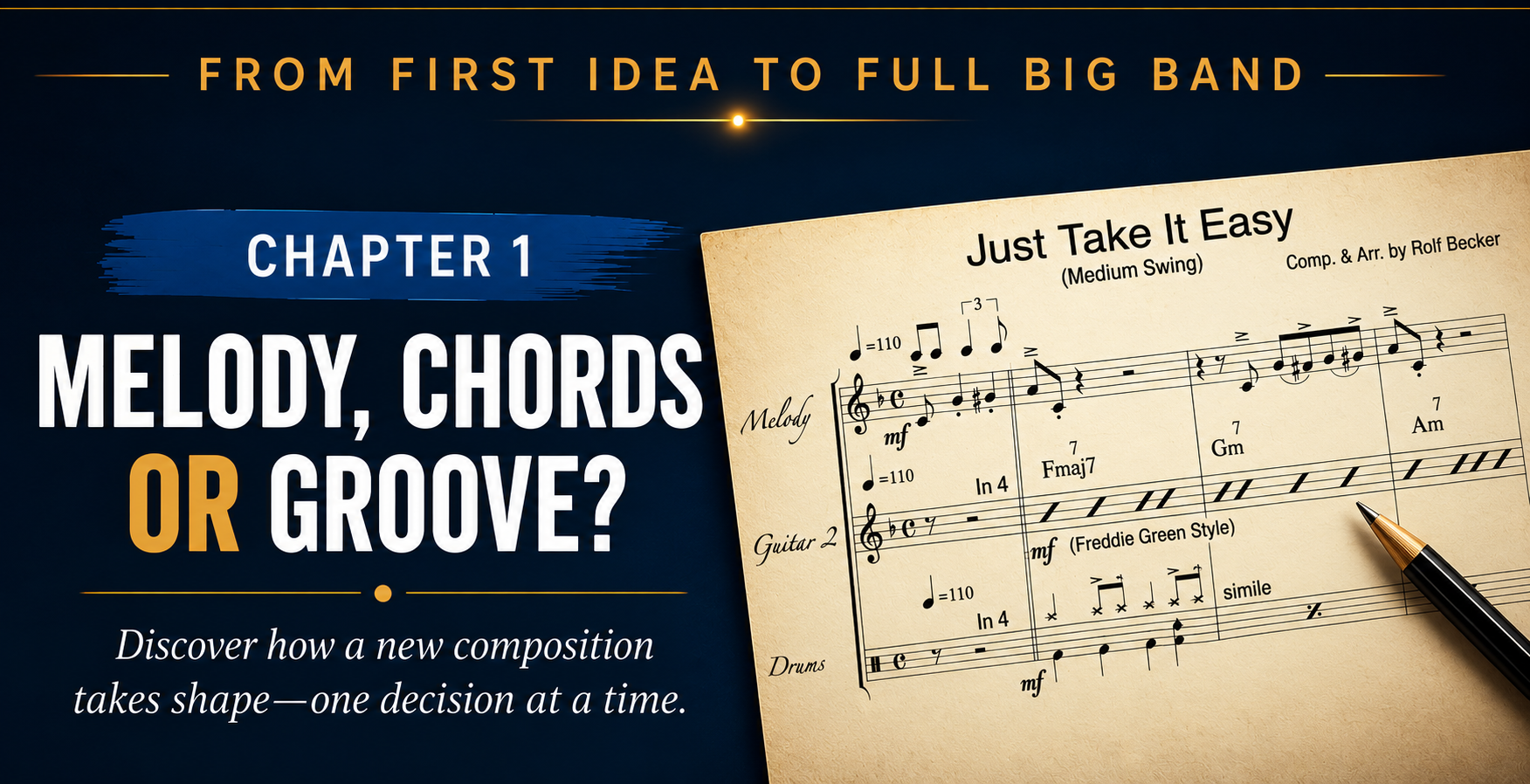
INSIDE THE ARRANGEMENT
What comes first when composing a new tune — melody, chords or groove? Follow “Just Take It Easy” from its first musical idea to a complete big-band arrangement in this new step-by-step series, with audio examples along the way.
From First Idea to Full Big Band
Chapter 1 — What Comes First: Melody, Chords or Groove?
How does a new composition actually begin?
With a melody?
A chord progression?
A bass line?
Or simply a groove that makes you want to play?
The answer is:
Any of them can come first.
There is no single formula for composing an instrumental tune.
Sometimes a melody suddenly appears in your head.
Sometimes you discover a chord progression that creates exactly the atmosphere you’re looking for.
And sometimes everything starts with a rhythm or groove.
For this new Inside the Arrangement series, however,
I don’t want to talk about composition and arranging only in theory.
I’m going to show you.
We’ll take one of my original compositions and follow it step by step
from its basic musical idea through harmony,
rhythm-section writing and orchestration,
until eventually it becomes a full big-band arrangement.
The tune is called:
“Just Take It Easy”
It’s a medium-swing composition inspired by the classic Count Basie big-band tradition.
Tempo: Medium Swing — ♩ = 110
The complete composition has an AABA form,
but we’ll begin with only the first 16 bars.
Why?
Because before we start adding instruments, voicings, backgrounds and orchestration,
I want you to hear what happens to the music when we change just one element at a time.
⸻
The First Ingredient: Melody
Let’s begin with the most exposed version possible.
Just the melody.
No chordal accompaniment.
No walking bass.
No drums.
No big band.
When a melody is heard on its own, there’s nowhere for it to hide.
Listen to its rhythmic character. Notice the short phrases and the spaces between them.
Listen to the repetition and development of the musical idea.
And ask yourself:
What harmony would you hear underneath this melody?
Don’t look for the “correct” answer yet.
Just listen.
🎧 AUDIO EXAMPLE 1
“Just Take It Easy” — Melody Only
⸻
Now Let’s Add Harmony
The melody gives us our horizontal musical line.
Harmony adds the vertical dimension.
For Just Take It Easy, I chose a harmonic progression that supports the relaxed swing character
while still providing enough movement and color to make the melody interesting.
But instead of immediately adding the entire rhythm section,
let’s hear what happens when we add only the harmonic framework.
For this example, the chords are supported by Freddie Green-style guitar accompaniment
- the classic four-to-the-bar approach associated with the Count Basie rhythm section.
Listen again to exactly the same melody.
This time, notice how differently individual melody notes can feel once you hear the harmony underneath them.
A note that sounded neutral on its own may suddenly create tension.
Another may sound completely settled.
And the movement from one chord to the next starts giving the melody direction.
🎧 AUDIO EXAMPLE 2
“Just Take It Easy” — Melody + Chords
⸻
Melody and Chords Aren’t Two Separate Things
This is an important point.
When composing, I don’t think of melody and harmony as two completely independent layers.
They communicate with each other.
A melody note can suggest a particular chord.
But the opposite is also true:
A chord can change the way we hear a melody note.
And there is another element that can dramatically change both of them.
The bass.
Changing the bass note underneath a chord can alter its color, direction and function
- even when the notes above it remain unchanged.
We’ll explore that much more closely in the next chapter.
For now, however, something is still missing.
We have melody.
We have harmony.
But we don’t yet have the complete feel of the tune.
⸻
Enter the Rhythm Section
Now let’s add the rhythm section.
This is where Just Take It Easy really begins to reveal its personality as a swing tune.
The harmonic pulse is joined by a walking bass line and drums establishing the swing feel.
Listen to the same 16 bars again.
Nothing fundamental has happened to the melody.
But the musical experience has changed considerably.
Suddenly there is forward motion.
There is pulse.
There is interaction.
There is groove.
🎧 AUDIO EXAMPLE 3
“Just Take It Easy” — Melody + Rhythm Section
⸻
Listen Again — But Differently
Now go back and compare the three examples.
Melody
→ Melody + Chords
→ Melody + Rhythm Section
The melody hasn’t changed.
So what has?
Almost everything around it.
This is one of the most important lessons in arranging.
An arrangement isn’t simply about adding more instruments.
It’s about deciding what each additional musical element contributes.
Sometimes adding something makes the music stronger.
Sometimes removing something does.
And sometimes one carefully chosen bass note can have more impact than adding an entire section of instruments.
⸻
What Comes First?
So let’s return to our original question.
Melody, chords or groove?
There is no universal answer.
You can start with a melodic fragment.
You can sit at the piano and discover a chord progression.
You can create a bass line.
You can hear a drum groove.
You might even begin with nothing more than a rhythmic figure.
The important thing is to recognize when you have found an idea worth developing.
Then ask:
What does this idea need next?
Not:
What can I add?
But:
What does the music need?
That small difference in thinking becomes increasingly important as an arrangement grows.
Because eventually we’ll have many more possibilities at our disposal:
Saxophones.
Trumpets.
Trombones.
Piano.
Guitar.
Bass.
Drums.
Different registers.
Different voicings.
Different combinations.
Different colors.
But before we get anywhere near the full big band, we need to make sure that the foundation is right.
And that takes us to the bottom of the arrangement.
⸻
Coming Next: The Bass Line
Choose the Right Bass Line and You’re Golden
In the next chapter of Inside the Arrangement,
we’re going to take these same 16 bars of Just Take It Easy and look underneath the melody and chords.
We’ll examine the walking bass line.
Why this note?
Why not simply play the root of every chord?
How can the bass connect one chord to the next?
Where can we use chord tones, passing notes and chromatic approaches?
And how much of a bass line should an arranger actually write?
We’ll see it in the score and hear it in the music.
Because a good bass line doesn’t merely tell us what chord we’re playing.
It helps tell us where the music is going.
And when you choose the right bass line…
you’re golden.
To be continued in Chapter 2 of Inside the Arrangement — From First Idea to Full Big Band.