

Small Big Band Arrangements for Sale: What to Look For
Discover what makes a Small Big Band arrangement work — from instrumentation and voicing to balance, playability and professional scoring.
Finding small big band arrangements that retain the energy, color, and impact of a larger ensemble is not simply a question of reducing the number of players.
A smaller instrumentation changes the way an arranger thinks about voicing, register, balance, dynamics, and the function of every individual instrument. With fewer musicians available, every line becomes more exposed and every orchestration decision becomes more important.
That is precisely what makes the Small Big Band format so interesting.
Rather than trying to imitate a full big band with missing chairs, a well-written Small Big Band arrangement should be conceived for the musicians who are actually going to perform it.
## Defining the MusicMyLanguage Small Big Band
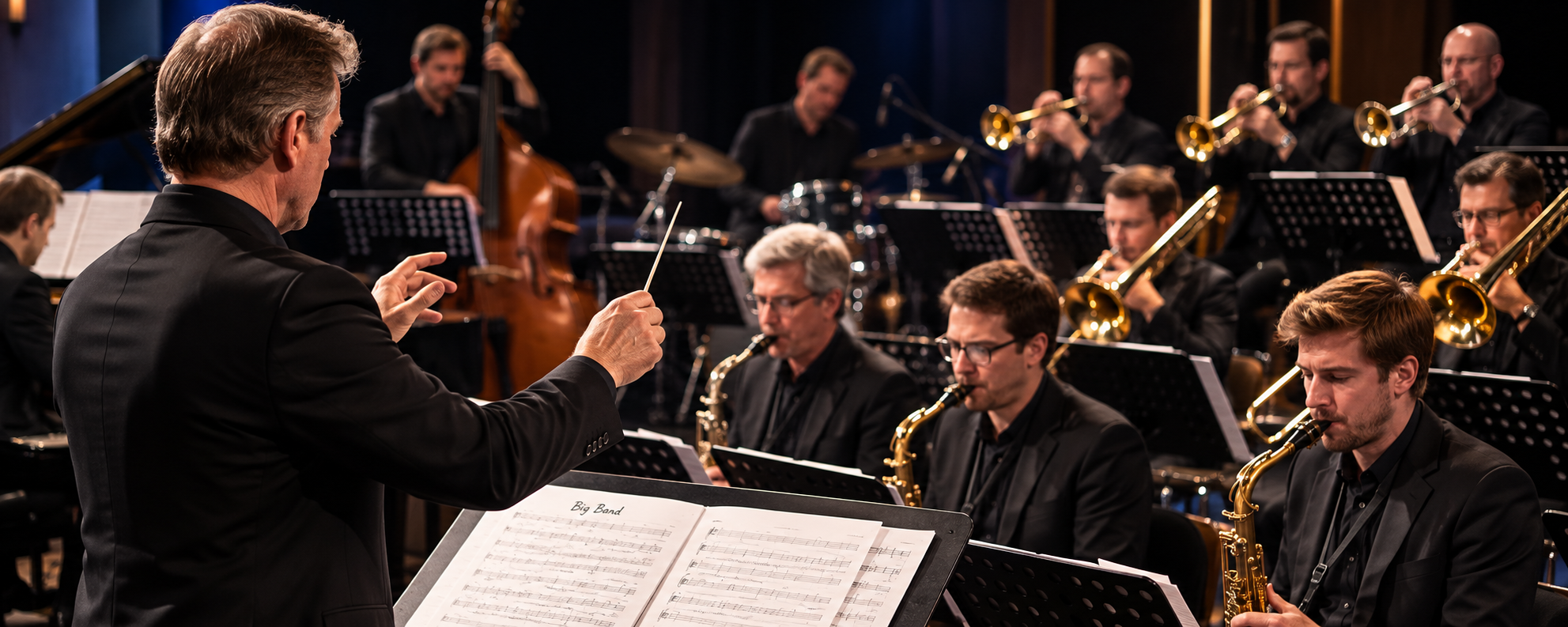
For the MusicMyLanguage Small Big Band Series, I use a clearly defined instrumentation:
3 Saxophones • 3 Trumpets • 3 Trombones • Piano • Bass • Drums
This provides three distinct horn sections together with a complete rhythm section while requiring considerably fewer musicians than a traditional large big band.
The objective is not simply to make the ensemble smaller. The objective is to use those available instruments intelligently enough to retain the characteristics we associate with big band writing: power, contrast, harmonic color, rhythmic precision, and sectional interplay.
### Small Big Band Voicings
Writing for fewer horns requires a different approach to voicing.
In a larger big band, an arranger has more individual voices available and can distribute harmony across wider sections. With a reduced instrumentation, every note has to contribute more directly to the musical result.
Sometimes unison or octave writing creates the strongest statement. At other times, compact harmonic voicings produce the necessary density. Contrasting the saxophones, trumpets, and trombones can create the impression of a much larger palette without simply having everybody play all the time.
The important question is therefore not how many notes can be included in a voicing, but which notes and instrumental combinations best communicate the musical idea.
### Balancing Power with Practicality
A smaller ensemble does not necessarily have to sound small.
Register plays an important role. Writing constantly at the extremes of an instrument can create unnecessary technical demands without producing a better musical result. Effective scoring places musicians where their instruments speak naturally and uses extreme registers when the musical effect genuinely requires them.
Dynamics are equally important. A convincing forte is created through orchestration and balance, not simply by asking every player to play louder.
This principle is central to my Small Big Band arrangements: achieving power, color, and musical impact through efficient scoring rather than sheer numbers of musicians.
## Evaluating Professional Scoring and Playability
When looking at small big band arrangements for sale, the title of the tune is only one consideration.
I would also look carefully at the score itself.
Does the instrumentation suit your ensemble? Are the instrumental ranges sensible? Is the notation immediately understandable? Are articulations and dynamics consistent? Does the rhythm section receive enough information to understand the intended style without being unnecessarily restricted?
These details directly influence what happens when the music reaches the rehearsal room.
### Clarity in Notation and Phrasing
Good notation should communicate musical intention as efficiently as possible.
Articulations should be consistent between related horn lines. Dynamic markings should clarify the architecture of the arrangement. Rhythmic notation should be readable, and phrasing should help musicians understand where a line is going.
In a reduced ensemble this becomes particularly important because individual voices are more exposed.
If three trumpets are playing a harmonized figure, for example, inconsistent articulation immediately affects the section sound. The same applies to saxophone phrasing, trombone attacks, releases, accents, and dynamics.
The arranger's responsibility is to give musicians enough information to understand the musical intention without cluttering the page with unnecessary instructions.
### Stylistic Authenticity in Reduced Formats
Instrumentation may change, but musical style still has to remain convincing.
Swing, funk, Latin, ballad, bebop, pop, and contemporary jazz each require their own approach to articulation, rhythmic placement, harmony, orchestration, and rhythm-section writing.
Reducing the number of musicians does not remove those stylistic requirements.
For me, this is one of the most interesting aspects of arranging for Small Big Band: deciding how to preserve the character of the music with fewer instrumental resources.
The answer is rarely simply to remove parts from a larger score. The arrangement has to be reconsidered so that the reduced ensemble feels complete in its own right.
## The Rolf Becker Approach to Small Big Band Charts
My approach comes from decades of working as a composer, arranger, conductor, and performing musician.
That experience has repeatedly reinforced one principle:
A good arrangement should help the musicians make music. It should not stand in their way.
What appears sophisticated on a computer screen or in a full score is not automatically effective in rehearsal or performance. Ultimately, the arrangement has to work when real musicians put it on their stands.
### Craftsmanship in Every Section
For me, arranging is a continuous process of musical decision-making.
Should this passage be harmonized or played in unison?
Does the melody need the brilliance of trumpets, the warmth of trombones, the flexibility of saxophones, or a combination of sections?
Should the rhythm section support the horns or temporarily become the principal musical voice?
Would another background figure strengthen a solo, or simply compete with it?
These decisions shape the character of an arrangement far more than the number of instruments on stage.
With fewer musicians, those decisions become even more visible. There is less room for unnecessary doubling and less reason to write material merely to keep every player busy at every moment.
### Suitability for Live Performance
I write these arrangements with live performance in mind.
That means considering balance, instrumental ranges, rhythmic clarity, breathing, transitions, dynamics, and the relationship between the horn sections and rhythm section.
The aim is not to remove musical challenge. Good repertoire should challenge musicians.
But difficulty should serve the music rather than exist simply for its own sake.
The MusicMyLanguage Small Big Band catalog includes both original compositions and arranged repertoire, with each chart approached specifically from the perspective of this compact ensemble format.
## Small Big Band and Other Ensemble Options
Not every ensemble requires the same format.
For groups that want the sectional character of a big band with fewer musicians, the Small Big Band provides a practical alternative to the traditional full-size ensemble.
For still smaller groups, the [Septet Series](https://www.music-my-language.com/mml-septet-series) uses Trumpet, Alto Sax, Tenor Sax, Baritone Sax, Piano, Bass, and Drums.
The musical challenge is different again: four horns must create contrast, harmonic movement, and ensemble power while leaving sufficient space for the rhythm section.
Organizations with a particular instrumentation or repertoire requirement can also consider [custom ensemble commissions](https://www.music-my-language.com/ensemble-commissions), where the music can be written around the actual musicians available.
## Original Repertoire Versus Arranged Repertoire
Small Big Band writing can work particularly well when the music is conceived for the format from the beginning.
An original composition allows every musical idea to be developed around the available instrumentation. Melody, harmony, backgrounds, sectional writing, solos, and transitions can all grow naturally from the ensemble itself.
Arranged repertoire presents a different challenge.
Here the objective is to retain the musical identity of the source while translating it convincingly into a smaller instrumentation.
That does not necessarily mean reproducing every detail of a larger original arrangement. Sometimes the most effective solution is to identify what gives the music its character and rebuild those essential elements for the available forces.
The result should sound intentional rather than reduced.
## Small Big Band Arrangements in Music Education
A compact ensemble can also be valuable in an educational environment because every musician has an important musical role.
With fewer players in each section, balance, articulation, intonation, rhythmic precision, and listening become immediately noticeable.
This creates useful opportunities for directors to work on ensemble fundamentals while still rehearsing genuine performance repertoire.
### Sight Reading and Ensemble Development
Clear, professionally prepared notation is particularly valuable when developing sight-reading skills.
Musicians should be able to identify the structure of a chart quickly: introductions, themes, backgrounds, solo sections, transitions, dynamics, articulations, and endings.
The broader [Music Library](https://www.music-my-language.com/music-library) contains repertoire for different ensemble formats, allowing directors and musicians to explore material according to their particular requirements.
Sight reading improves through regular exposure to well-written musical material. The objective is not merely to read the correct notes, but to recognize style, phrasing, articulation, dynamics, and musical function as quickly as possible.
### Connecting Rehearsal to Performance
Ultimately, an arrangement has to move beyond the rehearsal room.
A successful chart should give musicians something worth developing over repeated rehearsals and provide an audience with a convincing musical experience when it reaches the stage.
That connection between rehearsal and performance is central to the way I approach arranging.
Technique, balance, articulation, dynamics, and stylistic accuracy are not separate academic exercises. They are tools musicians use to communicate the music.
## Exploring the MusicMyLanguage Small Big Band Catalog
The dedicated [Small Big Band Charts](https://www.music-my-language.com/small-big-band-charts) page brings together the available repertoire in the series.
When considering a chart, look at the instrumentation, musical style, character of the arrangement, and whether it fits the players and performance situation you actually have.
A smaller ensemble should never be treated simply as a compromise.
With thoughtful orchestration, clear notation, effective voicing, and an understanding of how the instruments work together, a Small Big Band can produce remarkable power, color, and musical variety.
That is the principle behind the MusicMyLanguage Small Big Band Series.
Buy Big Band Charts Online That Fit Your Ensemble
Choosing the right big band chart goes far beyond picking a great tune. Discover what to look for in instrumentation, playability, notation, style and arranging craftsmanship before buying your next chart.
Finding the right chart is about more than choosing a tune your ensemble might enjoy. When you buy big band charts online, you are investing rehearsal time, musical energy, and budget into material that needs to work for the musicians who will actually perform it.
A convincing audio demo or a well-known title can certainly attract attention, but neither tells you everything you need to know about an arrangement. Instrumentation, ranges, notation, balance, stylistic accuracy, solo opportunities, and the overall construction of the chart can make the difference between an enjoyable rehearsal process and one spent solving unnecessary problems.
I have spent decades composing, arranging, performing, and conducting ensembles in different countries and musical environments. One principle has remained consistent throughout that experience: a good arrangement should help the musicians make music. It should not stand in their way.
Here are some of the things I consider particularly important when choosing professional big band charts.
Assessing Instrumentation Before You Browse
Before buying an arrangement, start with one very practical question:
Who is actually going to play it?
Traditional big band instrumentation is relatively standardized, but not every ensemble works with the same lineup. Professional bands, school ensembles, university groups, community bands, project ensembles, and smaller jazz groups can all have different requirements.
Checking the instrumentation before purchasing therefore saves considerable rehearsal time later.
Standard vs. Reduced Instrumentation
A traditional big band commonly uses five saxophones, four trumpets, four trombones, plus rhythm section. That instrumentation produces the characteristic power and range of colors associated with the classic big band sound.
But a smaller ensemble does not necessarily have to sound small.
Good arranging can create considerable power, contrast, and harmonic color with fewer musicians. The important question is not simply how many instruments are available, but how effectively those instruments are used.
That philosophy is central to my own Small Big Band writing. Rather than treating reduced instrumentation as an incomplete traditional big band, I write specifically for the smaller format so that the available horns and rhythm section function as a complete ensemble.
If that format suits your group, you can explore the MusicMyLanguage Small Big Band Charts.
For an even more compact setting, the MusicMyLanguage Septet Series is based around four horns plus rhythm section.
Check the Actual Parts
Instrumentation is only the beginning. Look at the individual parts whenever previews are available.
Which instrument carries the melody? Where are the demanding passages? Are there exposed lines? What are the upper and lower ranges? Is a particular player expected to improvise?
These questions become especially important when programming music for a specific ensemble.
A technically excellent arrangement can still be the wrong arrangement for your band if one essential part sits consistently outside a player’s comfortable range or requires a stylistic ability that the player has not yet developed.
The best purchase is therefore not necessarily the most impressive chart. It is the chart that allows your ensemble to sound impressive.
Matching Difficulty Levels to Ensemble Skill
Difficulty labels can be useful, but they should be treated as a starting point rather than an absolute measurement.
Terms such as easy, intermediate, advanced, or professional can mean different things to different publishers and arrangers. The score itself tells you much more.
Look Beyond the Grade
When assessing a chart, examine the musical demands behind the difficulty label.
A passage may contain relatively few notes and still be challenging because of its range, articulation, rhythmic placement, dynamics, or stylistic requirements.
Conversely, a passage containing many notes may sit naturally on the instrument and be surprisingly comfortable to play.
Range is particularly important in brass writing. A trumpet part that remains unnecessarily high for long periods can become tiring regardless of how simple the rhythms appear.
The same principle applies throughout the ensemble. Good scoring considers not only whether a note can be played, but whether the entire part can be performed musically and consistently.
Rhythm, Articulation and Phrasing Matter
Jazz notation contains much more information than pitches and rhythms.
Articulations, accents, dynamics, note lengths, phrasing and stylistic conventions all influence the final result. Clear notation helps musicians understand what the arranger intends without requiring the conductor to explain every phrase during rehearsal.
This is particularly important in swing, funk, Latin music and other rhythmically defined styles.
For me, professional notation is not decoration added after the arrangement has been completed. It is part of the arrangement itself.
The score should communicate the music as clearly as possible.
Consider the Improvisation Requirements
If a chart contains open solo sections, check how those sections function.
Who can solo? Are the chord changes clearly presented? How long can the section continue? Does the ensemble have something musically useful to play behind the soloist?
An open solo section can be one of the most exciting moments in a jazz arrangement because it allows every performance to develop differently.
But the written arrangement still needs to provide a strong framework around that freedom.
Navigating Big Band Sheet Music Shops and Libraries
Buying sheet music online gives musicians and directors access to an enormous amount of repertoire. That is an advantage—but it also makes evaluation increasingly important.
A large catalog does not automatically mean that every chart will suit every ensemble.
Look at the Arrangement, Not Only the Song
One of the easiest mistakes when buying sheet music is choosing primarily by title.
You recognize the tune. Your musicians know it. Perhaps your audience knows it too.
But you are not really purchasing the song—you are purchasing an arranger’s interpretation of that song.
Two arrangements of the same composition can be completely different in instrumentation, difficulty, form, harmonic language, stylistic direction and rehearsal demands.
Whenever possible, examine the score preview and listen to the available audio example.
Ask yourself whether the arrangement itself—not merely the composition—is right for your ensemble.
The MusicMyLanguage Music Library brings together the different arranging formats and series available through MusicMyLanguage, making it easier to explore repertoire according to ensemble type and musical concept.
Read the Product Information Carefully
Before purchasing through any sheet-music platform, check exactly what is included.
Instrumentation, score and parts, arrangement format, available previews and the applicable purchasing or licensing conditions should be clear before you make a decision.
Where arrangements are sold through external publishing platforms, their respective purchase and licensing conditions apply.
This is particularly important for conductors and institutions building a repertoire library intended for repeated use.
Selecting Professional Big Band Charts by Style
A good jazz arrangement needs more than correct notes.
It needs a convincing understanding of style.
Swing, bebop, funk, Latin jazz, ballads and contemporary styles each require different approaches to rhythm, articulation, voicing, orchestration and phrasing.
Stylistic Authenticity Matters
A swing chart should feel like swing before the conductor has to explain it.
A funk chart needs an effective relationship between drums, bass, piano or guitar and the horn figures.
A Latin arrangement needs rhythmic clarity and an understanding of how its different layers interact.
This is where arranging becomes more than distributing notes among instruments.
The arranger is creating relationships between the sections of the ensemble.
Saxophones, trumpets, trombones and rhythm section each have their own character, but the arrangement needs to make them function as one musical organism.
Identifying Quality Arranging Craftsmanship
When looking at a score, pay attention to the details.
Are articulations consistent? Are dynamics meaningful? Are backgrounds written to support rather than obscure a soloist? Does the orchestration create contrast? Does the arrangement build somewhere, or simply repeat the same texture?
Also consider musical balance.
Not every instrument needs to play all the time. Sometimes the most effective arranging decision is to leave space.
Professional arranging is therefore not about putting as many notes as possible onto the page. It is about knowing which notes are necessary, who should play them, and when they should happen.
That principle becomes especially important with smaller ensembles, where every voice has a clearly audible function.
When to Commission Custom Big Band Arrangements
Published charts can cover a tremendous range of repertoire, but there are situations where a custom arrangement makes more sense.
Perhaps your ensemble has unusual instrumentation. You may have a particular soloist or vocalist you want to feature. You might need a specific duration, musical concept, opening number, finale, or arrangement built around the character of an event.
In those situations, commissioning an arrangement allows the music to be designed around the project rather than forcing the project to fit an existing chart.
MusicMyLanguage offers custom ensemble commissions for projects requiring an arrangement or original musical concept tailored to a particular ensemble.
A custom arrangement can also be useful when an existing musical idea needs to be transformed for a different ensemble format—provided, of course, that the necessary arranging and performance rights are available.
The important point is that instrumentation becomes part of the creative process from the beginning.
Building a Sustainable Repertoire Collection
A good music library should not simply contain a large number of titles.
It should contain music you genuinely want to perform.
Over time, those charts become part of an ensemble’s musical identity.
Balance Your Programming Needs
A useful repertoire collection contains contrast.
Fast and slow pieces. Swing and straight-eighth styles. Powerful ensemble charts and pieces featuring individual soloists. Familiar repertoire alongside less expected choices.
The exact balance depends on the purpose of the ensemble.
A professional concert band may have different priorities from a school ensemble, a community big band, a university jazz orchestra or a project band assembled for a particular event.
What they all share is the need for repertoire that works musically in performance.
Build a Library You Can Return To
Some arrangements are performed once and disappear into the archive. Others become charts musicians and conductors want to revisit.
Those are particularly valuable.
A well-written chart can reveal more with each performance because the musicians gradually move beyond simply playing the notes and begin concentrating on interaction, phrasing, dynamics, balance and interpretation.
That is when an arrangement becomes more than sheet music.
It becomes repertoire.
Maximizing Value from Your Music Library Purchase
When you buy big band charts online, consider four things before making the final decision:
Instrumentation. Playability. Style. Musical purpose.
Does the chart fit the musicians you actually have? Are the individual parts written intelligently? Does the arrangement communicate its style clearly? And does it serve the musical purpose for which you are buying it?
If those elements are right, rehearsals become more productive and musicians can concentrate on what ultimately matters: making music together.
A strong arrangement should give an ensemble something worth discovering—not merely something to play.
And that is ultimately what I look for in every chart I conduct, perform, or write.