
INSIDE THE ARRANGEMENT
How should piano and guitar work together in a Big Band arrangement without stepping on each other’s toes? In Chapter 3 of Inside The Arrangement, we explore their different roles, using Just Take It Easy as a practical example—from four-to-the-bar guitar comping to sparse piano fills, kicks and voicings that support the ensemble.
Chapter 3
What Do the Piano & Guitar Players Do?
How do piano and guitar serve a band chart and help create a satisfying, functional rhythm section—without stepping on each other’s toes?
The answer depends first on one very important factor:
The musical style of the arrangement.
For this chapter, let’s continue with Just Take It Easy and look at how I approached the piano and guitar parts step by step.
As I mentioned in Chapter 1, the inspiration for this composition came from Frank Foster’s Shiny Stockings, so wonderfully associated with the Count Basie Orchestra.
In that style, the roles of piano and guitar are beautifully clear.
The guitarist provides steady quarter-note chords, helping maintain the “In 4” flow together with the walking bass and drums.
The pianist does something very different.
Instead of constantly filling the harmony, the piano contributes occasional fills, accents and carefully placed chord kicks around the melody.
The result is not two chordal instruments competing for the same musical space.
It is two instruments performing different jobs inside the same rhythm section.
Audio Example 3.1 — Full Big Band: Piano & Guitar in Context
Listen to how piano and guitar perform different roles within the complete arrangement of Just Take It Easy. The guitar maintains the quarter-note swing flow, while the piano adds selective fills and chord kicks around the melody and ensemble figures.
Note: This audio example also accompanies the notation examples below.
⸻
A) THE PIANO
When writing the piano part, I normally think first about how much freedom the pianist should have.
There are three practical approaches.
Option 1 — Guide the Professional Player
For an experienced professional pianist—especially when performing a new or unfamiliar composition—I strongly recommend a two-stave piano part.
The upper stave can contain:
a melody guide
important woodwind or brass figures
fills and kicks that the pianist needs to know about
Example 3.1 —Melody Guide including Ensemble Cues & Piano Lead Sheet
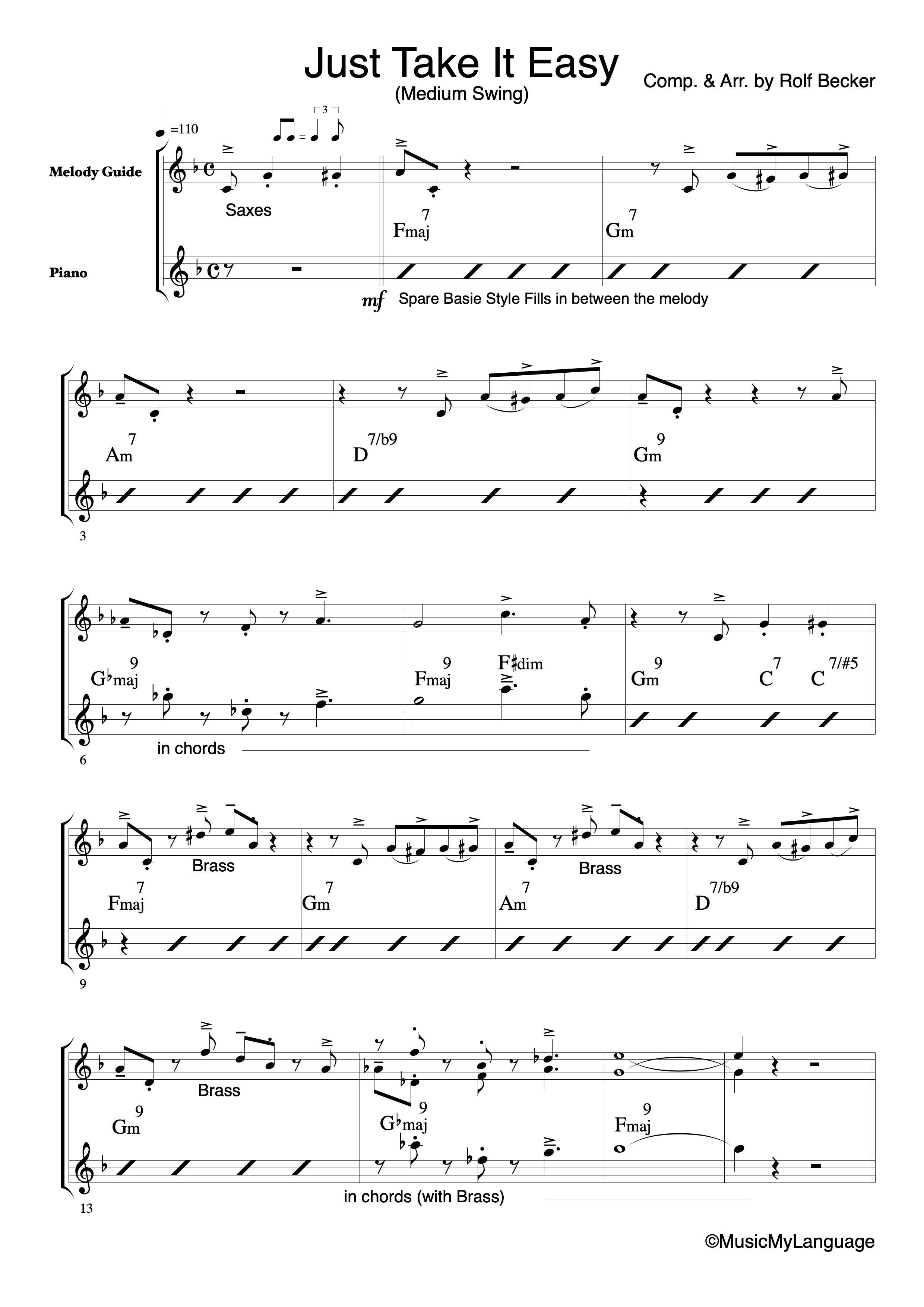
Example 3.1 — Piano Melody Guide and Ensemble Cues
The lower stave can then function more like a chord sheet.
This gives the pianist enough information to understand what is happening in the arrangement while still leaving room to create appropriate fills and chord kicks
For me, this is an important principle.
I don’t want to dictate every note if the player already knows how to create an effective jazz piano part.
I want to provide the information the player needs.
Then I leave room for musicianship.
Important: Anticipated notes should use the chord of the following beat. See, for example,
the anticipated note on beat 4+ in bar 7, leading into bar 8.
⸻
Option 2 — Write It Out
For student or developing ensembles, I would normally take a different approach.
The upper stave still provides the melodic and ensemble information.
But on the lower stave, I can write out the fills, voicings and rhythmic chord figures.
Example 3.2 — Melody Guide & Fully Written Piano Part

Example 3.2 — Melody Guide & Fully Written Piano Part
This removes unnecessary uncertainty and helps the pianist handle the chord progression correctly.
In this situation, the piano part serves two purposes:
It tells the player what to play, while also showing how a functional piano part can be constructed.
I still include the chord symbols above the Melody Guide, even when the piano part is fully written out.
There are two reasons for this:
First, for educational purposes, I want the pianist to understand which chords are actually being played rather than simply reading the written notes.
Second, if a young player is already familiar with most of the chord symbols, they can gradually begin to connect the written voicings with the underlying harmony.
This helps develop harmonic awareness and, eventually, gives the pianist more freedom to interpret the part rather than relying exclusively on the written notation.
⸻
Option 3 — Combine Freedom and Direction
The third possibility is often particularly useful with professional players.
Some passages can be left with chord symbols and freedom.
Other fills or chord figures may be important enough that I want them played exactly as written.
So the piano part becomes a combination of:
written material + chord symbols + ensemble information
Example 3.3 — Melody Guide & Combined Written and Open Piano Part

Example 3.3 — Melody Guide & Combined Written and Open Piano Part
This gives me control where the arrangement requires it, without unnecessarily restricting the pianist everywhere else.
⸻
B) THE GUITAR
The guitar has a different function in Just Take It Easy.
In this Basie-influenced swing style, the guitarist’s main job is to support the quarter-note flow.
Again, there are several ways to notate this.
Option 1 — The Chord Sheet
For an experienced guitarist, a single-stave chord part is normally sufficient.
But I don’t like giving the guitarist only chord symbols with no information about the arrangement.
The part should also indicate what is happening around the player:
saxes carrying the melody
trombones in the background
brass figures
shout chorus
significant breaks
important rhythmic hits
Example 3.4 — Guitar Chord Part with Arrangement Cues
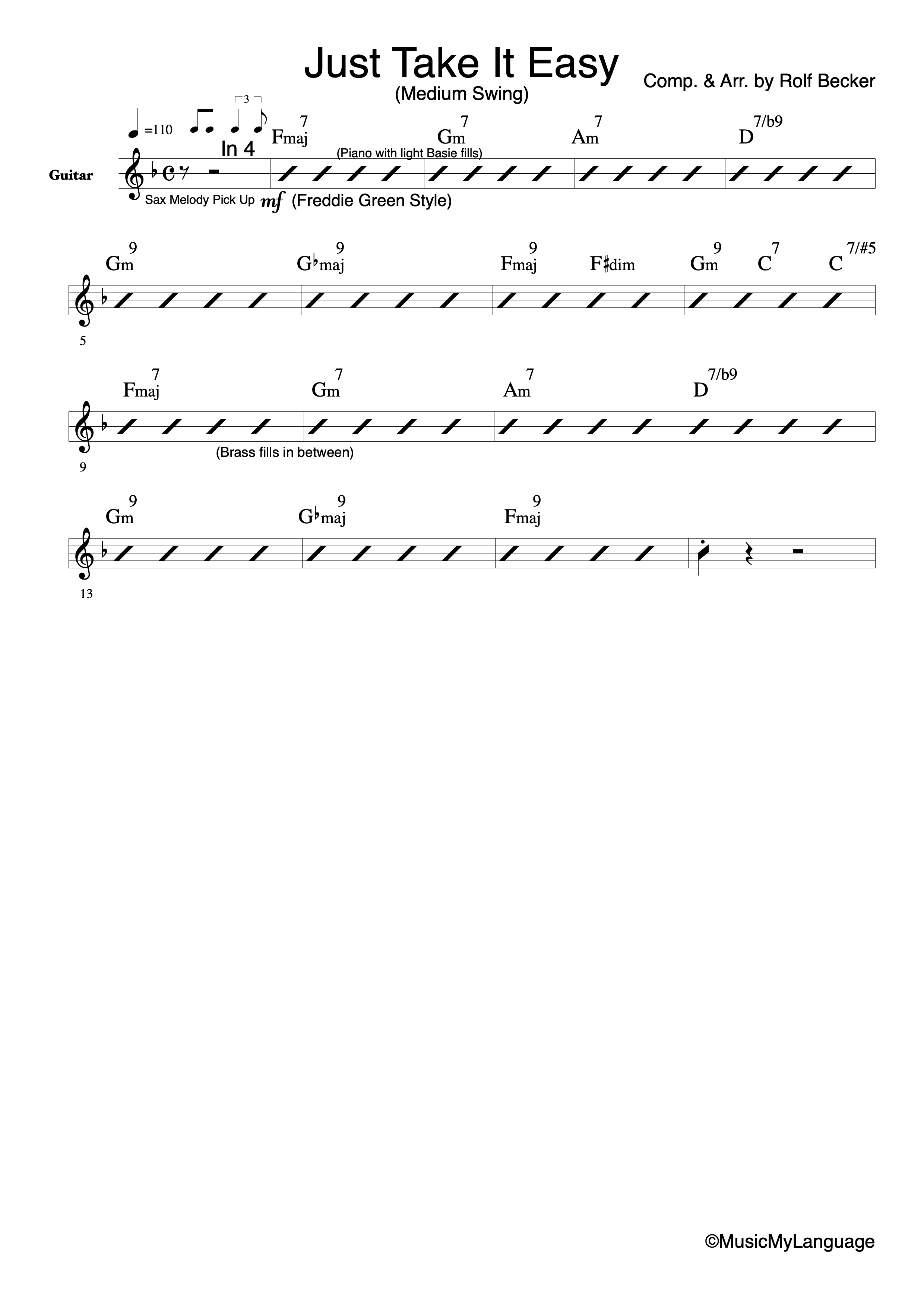
Example 3.4 — Guitar Chord Part with Arrangement Cues
This allows the guitarist to understand not only what chord to play, but also what role the guitar is playing at that moment.
That is much more useful.
⸻
Option 2 — Guitar Doubles the Melody
Sometimes I want the guitar to become part of the orchestration itself.
For example, the guitar may double the melody to create a particular color.
Example 3.5 — Guitar Doubling the Melody
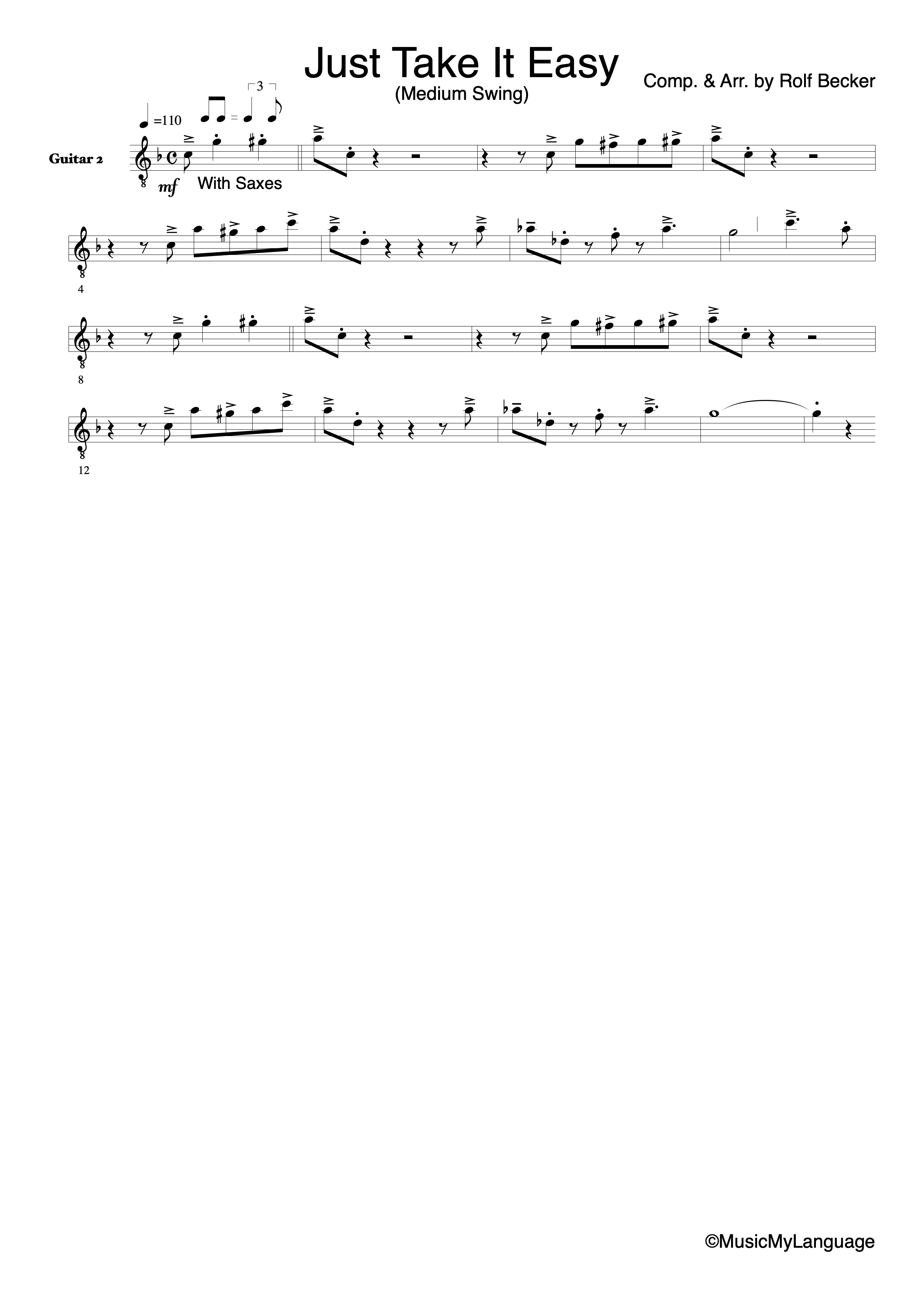
Example 3.5 — Guitar Doubling the Melody
IMPORTANT : The Guitar Sounds One Octave lower than written
Audio Example 3.2.1— Guitar Melody Doubling (With Saxes Only)
Listen to the example without the rest of the band - just Guitar doubling the Sax Section
Audio Example 3.2.2— Guitar Melody Doubling (With Full Orchestra)
Now you can probably hear the Guitar, playing the melody even with the full Big Band
In a published arrangement, I would consider providing both possibilities where appropriate.
Not every guitarist is equally comfortable with sight-reading fully notated melodic material, while others may welcome it.
Giving the player a practical alternative can make the arrangement considerably more usable.
⸻
Option 3 — Combine Melody and Chords
Example 3.6 — Melody Guide including Ensemble Cues & Guitar Lead Sheet

Example 3.6 — Melody Guide including Ensemble Cues & Guitar Lead Sheet
At first glance, this two-stave format looks very similar to Option 1 for the piano: the melody and important ensemble cues provide the guitarist with a clear picture of what is happening in the arrangement.
There is, however, one important difference.
Unlike the piano version, the guitar part does not contain written-out piano-specific chord voicings, fills, or rhythmic figures. Instead, the second stave is reserved exclusively for information relevant to the guitarist.
This keeps the part clean and practical while still allowing the guitarist to see the musical context of the arrangement and understand exactly how the guitar fits into the ensemble.
Again, the decision is based on what the music requires.
Not on the idea that one notation method is automatically better than another.
⸻
What If There Is No Guitarist?
This is a very practical question.
Many ensembles simply don’t have a guitarist.
In that case, the pianist normally needs to take a slightly more active harmonic role.
But that does not necessarily mean playing constantly.
In Just Take It Easy, the walking bass and drums already provide a strong “In 4” foundation.
The pianist can therefore add enough chordal support to maintain the harmonic texture without trying to imitate the guitar part note for note.
All three piano-part approaches discussed above can still work.
The important thing is to understand what has disappeared from the texture—and then decide whether the piano actually needs to replace it.
⸻
Do Piano and Guitar Always Need to Play Together?
No.
And this may be one of the most important lessons in this chapter.
Just because both instruments have chord symbols does not mean both instruments need to play at the same time.
Sometimes the guitar should carry the pulse while the piano leaves space.
Sometimes the piano should provide a fill while the guitar keeps its part simple.
Sometimes one instrument should stop completely.
Space is part of the arrangement.
If both instruments constantly play full chords, rhythmic figures and fills, even perfectly correct notes can create a rhythm section that sounds cluttered.
So the question is not:
Can both instruments play here?
The better question is:
Does the music need both instruments here?
⸻
A Word About Piano Voicing
Chord voicing is a large subject in itself.
Shell voicings, guide tones, rootless voicings, extensions, alterations, drop voicings and many other approaches can dramatically change the sound of a jazz piano part.
That topic would take us far beyond the purpose of this chapter.
There are excellent dedicated resources available for pianists who want to explore voicings in greater depth. For example,
Piano With Jonny presents a structured overview including shell voicings, guide tones, rootless voicings, block chords, drop-2 voicings and quartal voicings.
Additional useful resources include the Jazz Tutorial guides and J.B. Dyas’s Jazz Piano Voicings
For Inside The Arrangement, however, our focus is different.
We are asking:
How does the piano function inside the arrangement?
And that is an arranger’s question.
⸻
The Bigger Picture
Piano and guitar are both harmonic instruments.
But that does not mean they should perform identical jobs.
In Just Take It Easy, the guitar helps establish the quarter-note swing flow.
The piano adds color, punctuation and occasional fills.
The bass connects harmony and pulse.
The drums complete the rhythmic framework.
Each instrument contributes something different.
That is why the rhythm section works.
Good rhythm-section writing is not about giving every player something interesting to do every second.
It is about giving each player the right job at the right moment.
And sometimes the most effective thing a musician can play is:
nothing.
⸻
Coming Next
Chapter 4 — The Drums: Why Is Detailed Drum Notation So Important?
The bass establishes direction.
Piano and guitar shape the harmonic and rhythmic framework.
But there is one instrument that can change the entire character of the arrangement almost instantly:
The drums.
How much should an arranger actually write?
Which ensemble figures should appear in the drum part?
When should the drummer follow the written material—and when should the arranger leave room for interpretation?
And why can a carefully prepared drum part make rehearsals dramatically more efficient?
In Chapter 4, we’ll look at drum notation step by step.
See you in the next chapter.