

Chapter 6 — Beyond Jazz: The Chamber Balls and Shanghai's International Stage
Beyond Shanghai's jazz clubs, Rolf Becker built a remarkable musical career conducting international Chamber Balls, gala productions, and corporate events. From the 2006 European Chamber Ball to the 2016 Frank Sinatra tribute, discover the stories, musicians, and memorable performances behind these productions.
Shanghai Big Band History — A Personal Musical Journey in China
A Different Kind of Stage
When I look back on my musical years in Shanghai, the big bands and jazz clubs naturally occupy a special place in my memories. But there was another side to my professional life in China, one that developed almost simultaneously with my jazz activities and eventually became an important part of my musical journey.
It took me into magnificent hotel ballrooms, international business celebrations, corporate events, and elaborate gala productions.
For many years, I provided orchestras and musical entertainment for the American, European, German, and Swiss Chambers of Commerce in Shanghai, as well as for events organized by the German Consulate and international companies.
These engagements demanded something quite different from leading a jazz orchestra.
At JZ Club, the audience came primarily to listen to jazz. At a Chamber Ball, the music had to serve an entire evening: elegant dinner entertainment, ballroom dancing, familiar popular songs, and sometimes a specially designed musical show.
It was a fascinating challenge for a composer and arranger.
And it gave me the opportunity to demonstrate that a professional orchestra could be much more than a jazz band.
2006 — The Beginning of Another Musical Journey
One of the earliest important engagements was the European Chamber Ball in May 2006.
That year was already an extraordinarily busy period for me. In April, I had presented my Jazzy Mozart production at Shanghai Concert Hall, and a few months later, the JZ All Star Big Band would begin its regular performances at JZ Club.
But the European Chamber Ball belonged to an entirely different musical world.
Instead of presenting a jazz concert, I was responsible for providing music that would complement a sophisticated international social event.
The repertoire had to be versatile. Guests expected familiar melodies, danceable rhythms, and a musical atmosphere that could change naturally as the evening progressed.
Swing and jazz certainly had their place, but so did pop music, Latin rhythms, and traditional ballroom dances.
A successful evening might move from an elegant waltz to a cha-cha, from a romantic ballad to a lively disco number.
For me, this variety was never a disadvantage.
Quite the opposite.
I enjoyed the challenge of arranging music in different styles while maintaining the quality and character of a professional live orchestra.
The European Chamber Ball also brought valuable publicity. A newspaper article from 2006 documented the performance and showed the orchestra on stage.
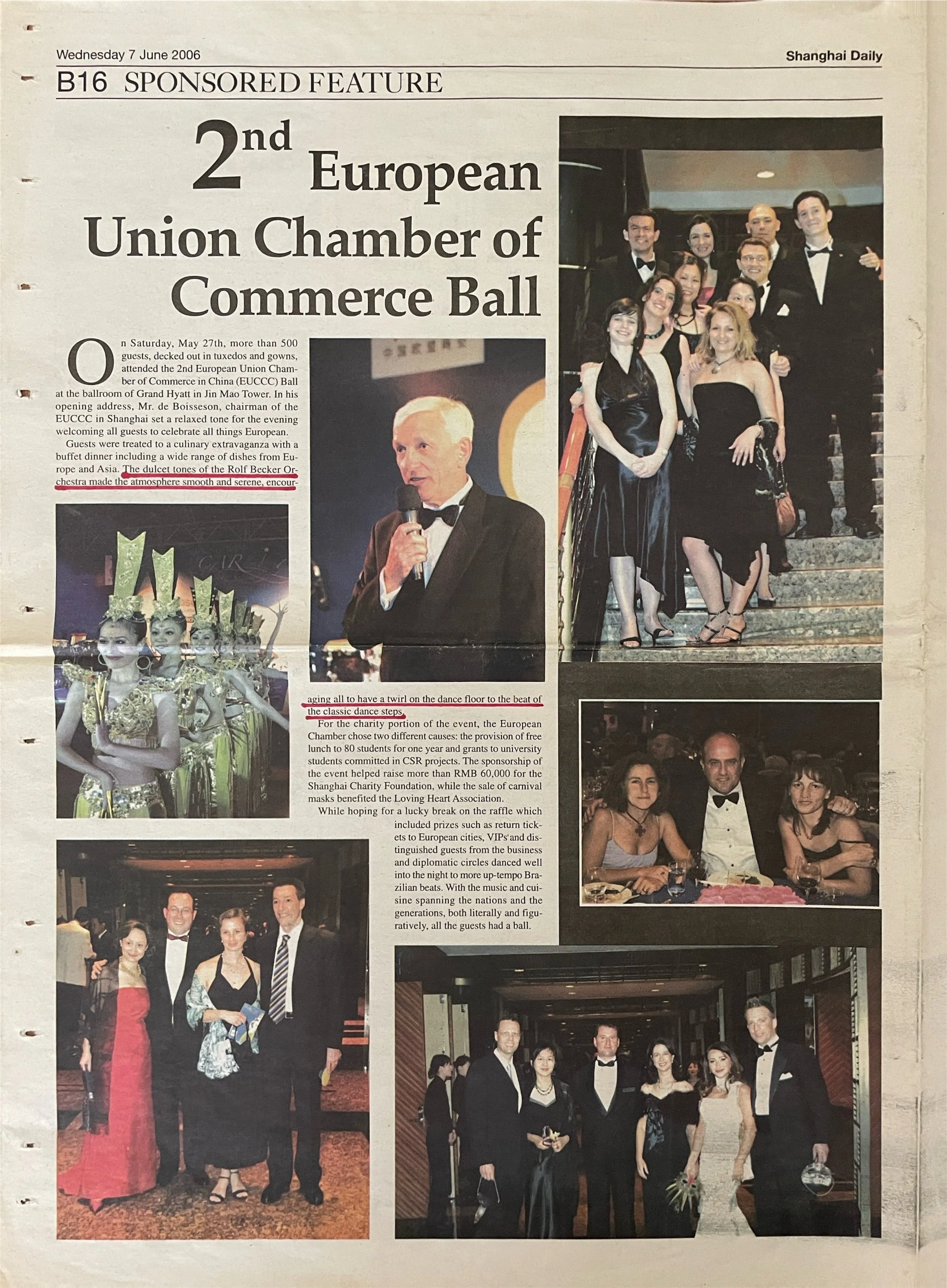
Archival newspaper coverage of the 2006 European Chamber Ball in Shanghai, featuring photographs of guests attending the gala evening. The event was accompanied by live orchestral music conducted by Rolf Becker.
Looking at that article today, I see more than a record of a successful evening. It reminds me how quickly my musical activities in Shanghai were expanding beyond the concert hall and the jazz club.
From the Ballroom to Porsche
Another memorable project followed in September 2006.
Porsche commissioned me to produce music for the Shanghai launch of its new 911 Turbo, held at the prestigious Three on the Bund.
This engagement included the production of a CD.
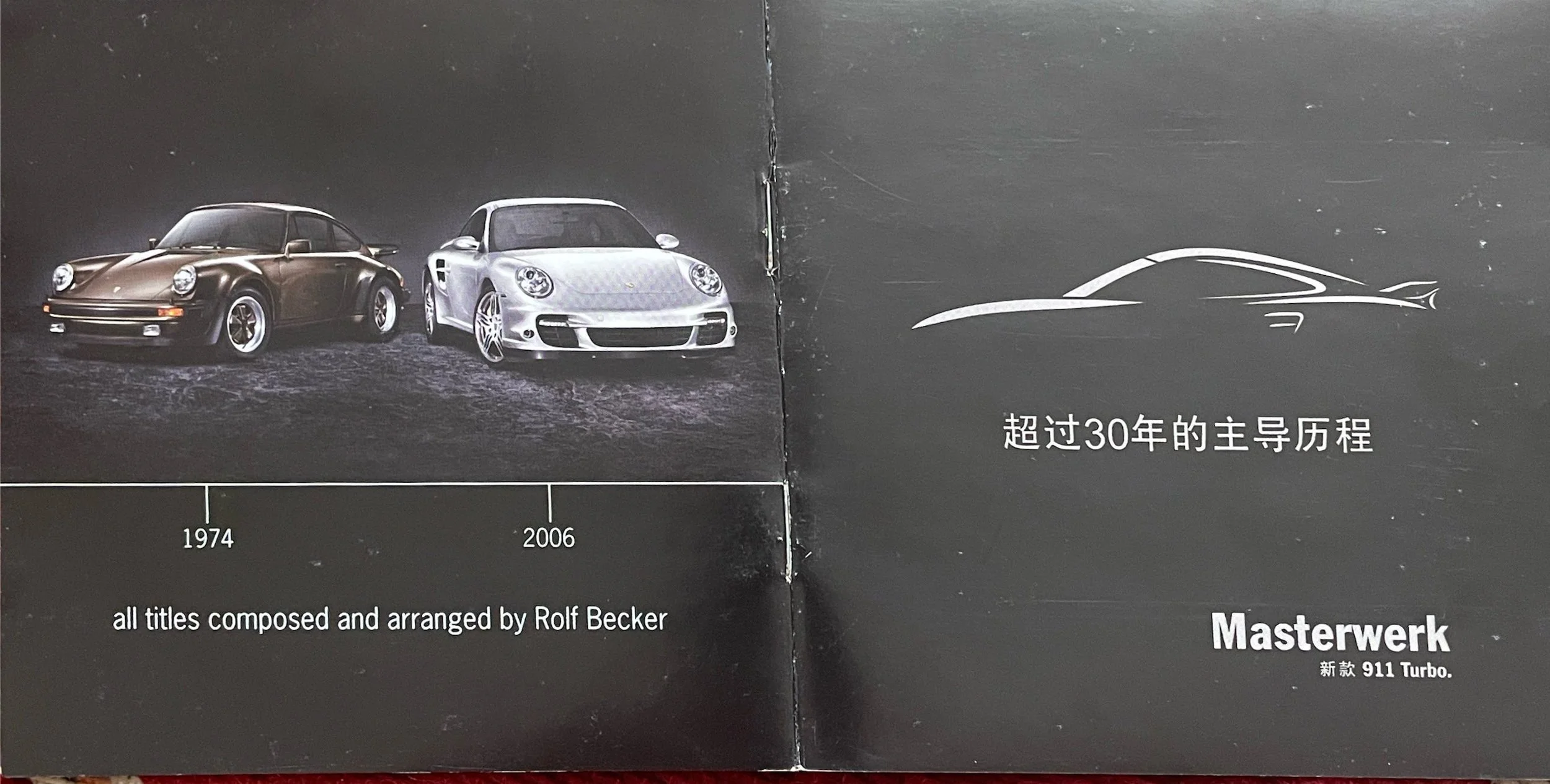
Original artwork from the 2006 Porsche 911 Turbo launch in Shanghai. I was commissioned to compose and arrange the music for this special CD production.
It was another opportunity to combine my work as a composer and arranger with the practical requirements of a high-profile international event.
A corporate presentation has its own musical demands. The music must reflect the character of the occasion, support the atmosphere, and contribute to the overall experience.
The Porsche project was an encouraging example of how my musical work in Shanghai was becoming increasingly diverse.
By then, I was moving regularly between very different musical environments: jazz clubs, concert stages, ballrooms, and corporate productions.
Yet they all had one important element in common.
The music had to be carefully prepared, professionally arranged, and convincingly performed.
The Chamber Balls — More Than Dance Music
Over the following years, my work with the international Chambers of Commerce continued to grow.
The German, European, and Swiss Chamber Balls generally required a broad repertoire of dance and party music.
For these events, I sometimes used names such as Rolf Becker & The Party Gang or Rolf Becker Big Band.
These names were deliberately different from the JZ All Star Big Band.
Although some musicians might participate in both ensembles, the musical concepts were not identical.
The JZ All Star Big Band was a jazz orchestra with a distinctive repertoire and artistic identity.
My event orchestras, on the other hand, had to be stylistically flexible.
A typical evening might include music from the 1970s, contemporary popular hits, Latin dance numbers, swing standards, and traditional ballroom repertoire.
And because I was an arranger, I could adapt the music to the particular instrumentation available.
That flexibility was especially important.
Rather than relying entirely on commercially available arrangements, I could create musical versions tailored to the musicians, the singers, and the requirements of a particular event.
In November 2007, I was invited to provide music for the tenth German Chamber Ball.
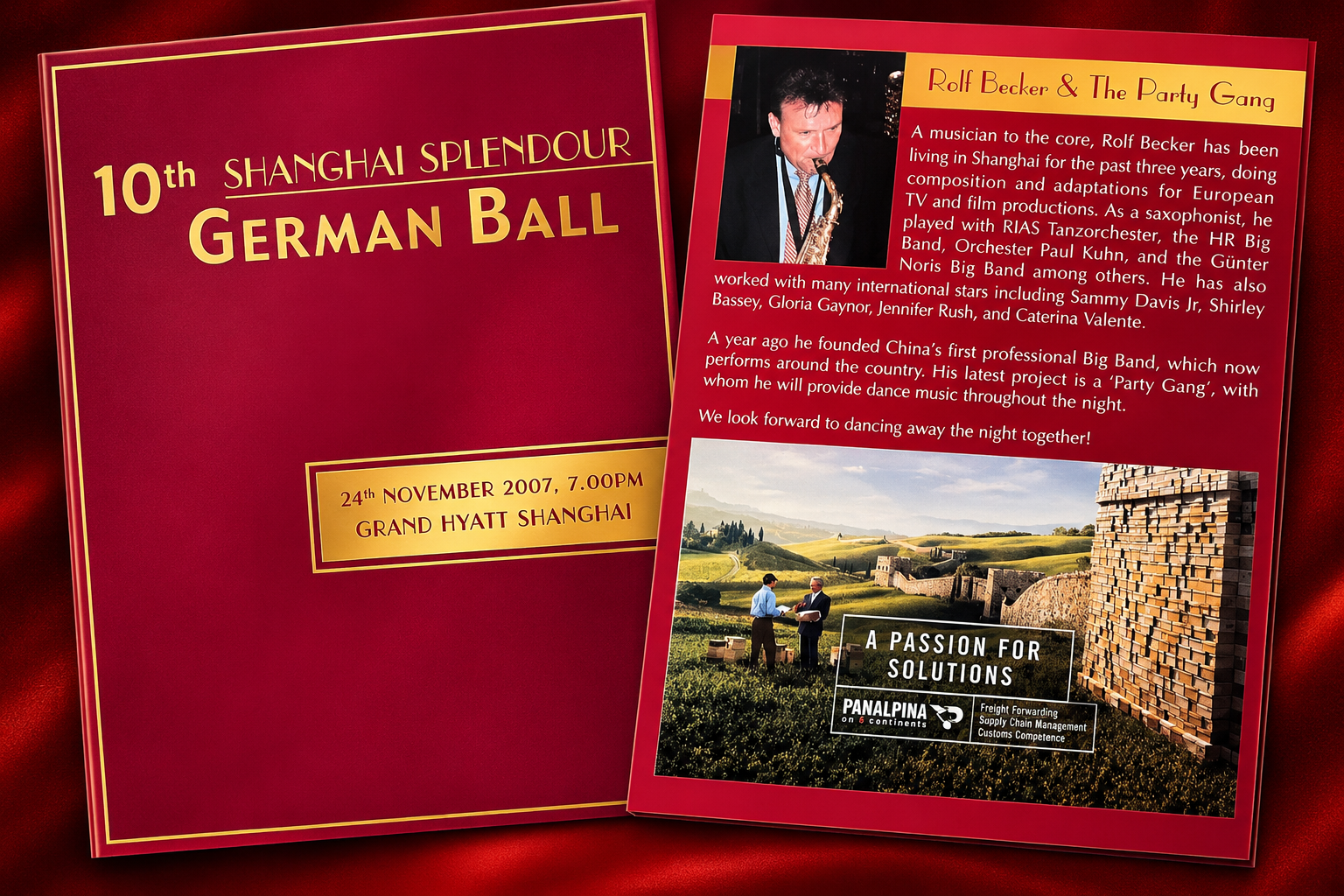
The 10th Shanghai Splendour German Ball, November 24, 2007, at the Grand Hyatt Shanghai. The original program introduced my orchestra, Rolf Becker & The Party Gang, providing dance music throughout the evening.
It was another significant engagement in what would become a long association with Shanghai's German business community.
These evenings were not simply concerts with an audience seated in front of the stage.
They were social occasions, and the orchestra was part of the entire experience.
A good dance orchestra has to understand its audience, recognize the atmosphere in the room, and respond musically.
Sometimes the most successful arrangement is not the most complicated one.
It is the one that makes people want to dance.
The American Chamber — When a Gala Became a Show
My collaborations with the American Chamber of Commerce in Shanghai developed in a somewhat different direction.
While the European and German Chamber Balls generally emphasized dancing and party entertainment, the American Chamber often preferred a more theatrical approach.
Its gala evenings were frequently built around a particular theme.
And this was where my work as a composer, arranger, and musical director became especially interesting.
I had the pleasure of collaborating with Brenda Foster, who headed the American Chamber in Shanghai for several years.
Brenda was a marvelous person to work with.
She understood the importance of creating a memorable evening, and I greatly enjoyed our collaborations.
Instead of simply providing a dance orchestra, I could develop musical programs that supported the chosen theme.
Over the years, these concepts included New York, Show Boat, Mardi Gras, A Sentimental Journey, and USO Club.
Each theme suggested a different musical world.
For an arranger, that opened the door to countless possibilities.
The music could evoke a particular period, location, or atmosphere. Familiar melodies could be presented in new orchestral settings, and singers or instrumental soloists could become part of the larger production.
It was a wonderful combination of entertainment and musical creativity.
2008 — A Sentimental Journey
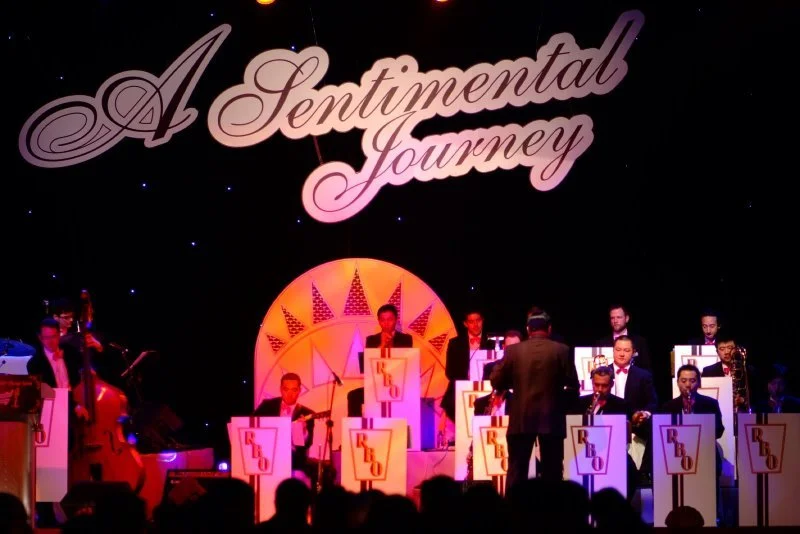
One particularly memorable American Chamber Gala took place in 2008 under the theme A Sentimental Journey.
The title immediately suggests the great era of swing music and the American big bands.
It was a musical world I knew well and one that offered plenty of opportunities for imaginative arrangements.
A surviving photograph from that evening shows the orchestra performing on stage.
I am standing in front of the musicians, conducting, although the camera captured me from behind.
The orchestra shield displays the letters RBO, an abbreviation for Rolf Becker Orchestra.
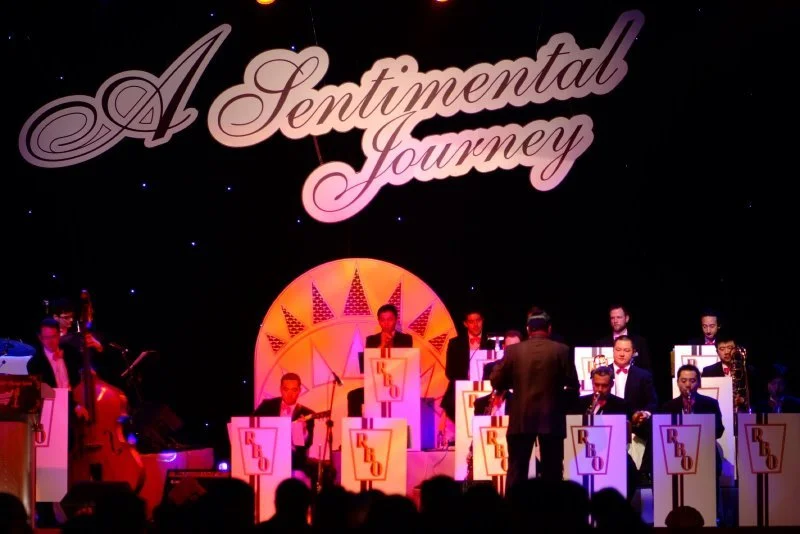
Conducting my Rolf Becker Orchestra at the 2008 American Chamber Gala in Shanghai, “A Sentimental Journey.” The RBO orchestra shields proudly displayed our musical identity.
It is a small but meaningful detail.
The photograph documents not only the performance itself but also the independent musical identity under which I presented my orchestra at these events.
Looking at it today, I remember how much I enjoyed bringing the sound of a live orchestra into these elaborate productions.
There is something special about a full ensemble performing in a ballroom filled with guests, where the music becomes part of a larger celebration.
And there was another important aspect.
These engagements created opportunities for professional musicians in Shanghai to perform in settings where their abilities could be appreciated by audiences who might not normally attend a jazz concert.
March 2009 — An Evening I Could Not Attend
Not every memory from those years is a happy one.
In March 2009, I was scheduled to provide the orchestra for another American Chamber Gala.
The arrangements had already been prepared, and the musicians had been selected.
But shortly before the event, while visiting my parents in Germany, I suffered a stroke.
Suddenly, everything changed.
I was unable to return to Shanghai for the performance.
My wife was confronted with an extremely difficult situation. Apart from the concerns about my health, there was also a professional commitment that needed to be fulfilled.
Somehow, she managed to organize a replacement orchestra.
She contacted Gregory Smith, a respected blues and jazz guitarist and a veteran of Shanghai's music scene, closely associated with the legendary Cotton Club, which sadly no longer exists.
Gregory agreed to take charge of the band.
My wife also managed to get the arrangements I had already written for the event, together with the intended musicians' list, into his hands.
Thanks to their efforts, the music could go ahead without me.
But what happened at the beginning of the gala touched me deeply.
Brenda Foster asked the guests to observe a minute of silence in my honor and to wish me a speedy recovery.
I was thousands of kilometers away, dealing with a completely unexpected medical crisis.
Knowing that people in Shanghai were thinking of me at that moment meant more than I can easily express.
It remains one of the most moving memories of my years working with the American Chamber.
Returning to the International Stage
My recovery required time, and for a while Berlin became our family's temporary home.
Nevertheless, my musical connections with Shanghai remained strong.
As I described in the previous chapter, I eventually resumed selected engagements in China while continuing to live in Germany.
Among the events from that period was the July 2010 topping-out ceremony associated with the German Pavilion at the Shanghai World Expo.
These engagements helped maintain my professional connections during a period when my personal circumstances had changed considerably.
When my family and I returned permanently to Shanghai in 2011, I was able to continue the musical activities that had become such an important part of my life there.
My work for the international business community remained one of those activities.
2013 — USO Club: Return to the Era of Big Band Music
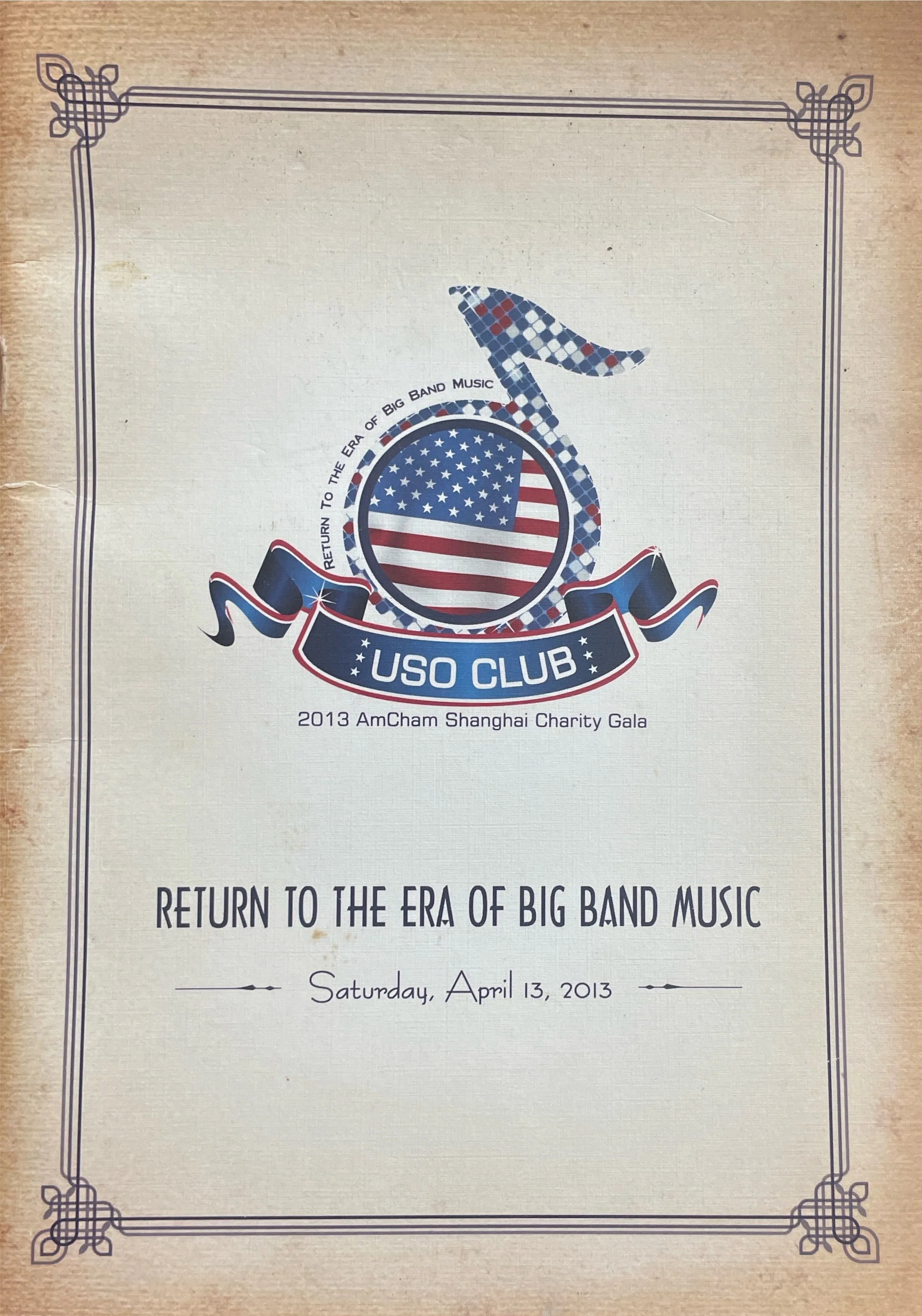
The original program for the American Chamber's “USO Club — Return to the Era of Big Band Music” gala, April 13, 2013. A memorable production featuring my orchestra and Canadian trumpeter Mike Herriott.
One of the most memorable productions came in 2013.
Brenda Foster had told me that this would be her final year as president of the American Chamber in Shanghai.
For this special occasion, she wanted a gala that would evoke the atmosphere of the great American big band era.
The theme was:
USO Club — Return to the Era of Big Band Music
For me, this was an especially attractive assignment.
The USO theme recalled the entertainment culture surrounding American service personnel during the Second World War, when big bands and popular singers played an important role in lifting spirits and bringing people together.
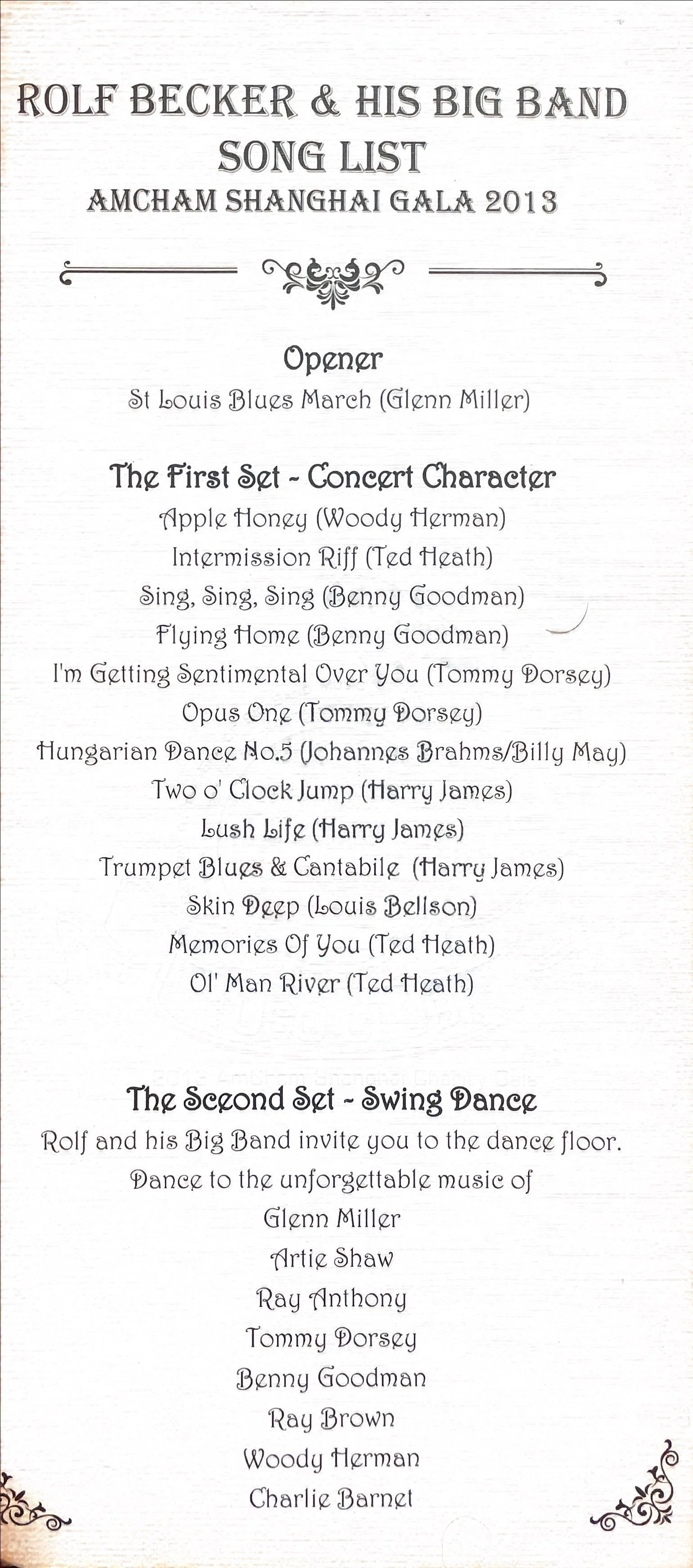
The original repertoire for my 2013 American Chamber Gala, celebrating the golden age of big band music. Our opening concert featured swing classics associated with Glenn Miller, Benny Goodman, Tommy Dorsey, Harry James, Woody Herman and Ted Heath, followed by an evening of unforgettable swing dance music. Besides arranging and conducting the orchestra, I also performed all the clarinet solos myself.
Musically, it offered an opportunity to celebrate the energy, elegance, and excitement of that era.
But I also wanted the orchestra to deliver the kind of powerful brass sound that makes a big band truly thrilling.
For this production, I invited the outstanding Canadian trumpeter Mike Herriott.
Mike was an exceptional musician with the experience and technical ability required for demanding lead trumpet parts.
His professional credits included associations with artists and orchestras connected to Maynard Ferguson, Rob McConnell, Doc Severinsen, Arturo Sandoval, and Michael Bublé.
For an arranger, having a musician of that caliber available is a wonderful opportunity.
It allows you to write with greater confidence, knowing that even the most demanding passages can be performed convincingly.
Mike's contribution helped give the orchestra the brilliant trumpet sound I had imagined for the production.
But Mike wasn't the only one stepping into the spotlight that evening. Besides arranging and conducting the orchestra, I also picked up my clarinet to perform all the clarinet solos myself. It was a wonderful opportunity to return to my roots as an instrumentalist and enjoy the music from within the band. With Mike's brilliant trumpet playing and my clarinet solos, we could bring some of the distinctive sounds of the great swing orchestras back to life. For me, it was one of those special evenings when everything I loved about being a musician came together — arranging, conducting, and performing.
The 2013 gala was particularly meaningful because it also marked the conclusion of Brenda's years leading the American Chamber.
After so many enjoyable collaborations, it felt like a fitting musical celebration of our work together.
A Night with Frank Sinatra — The Final American Chamber Production
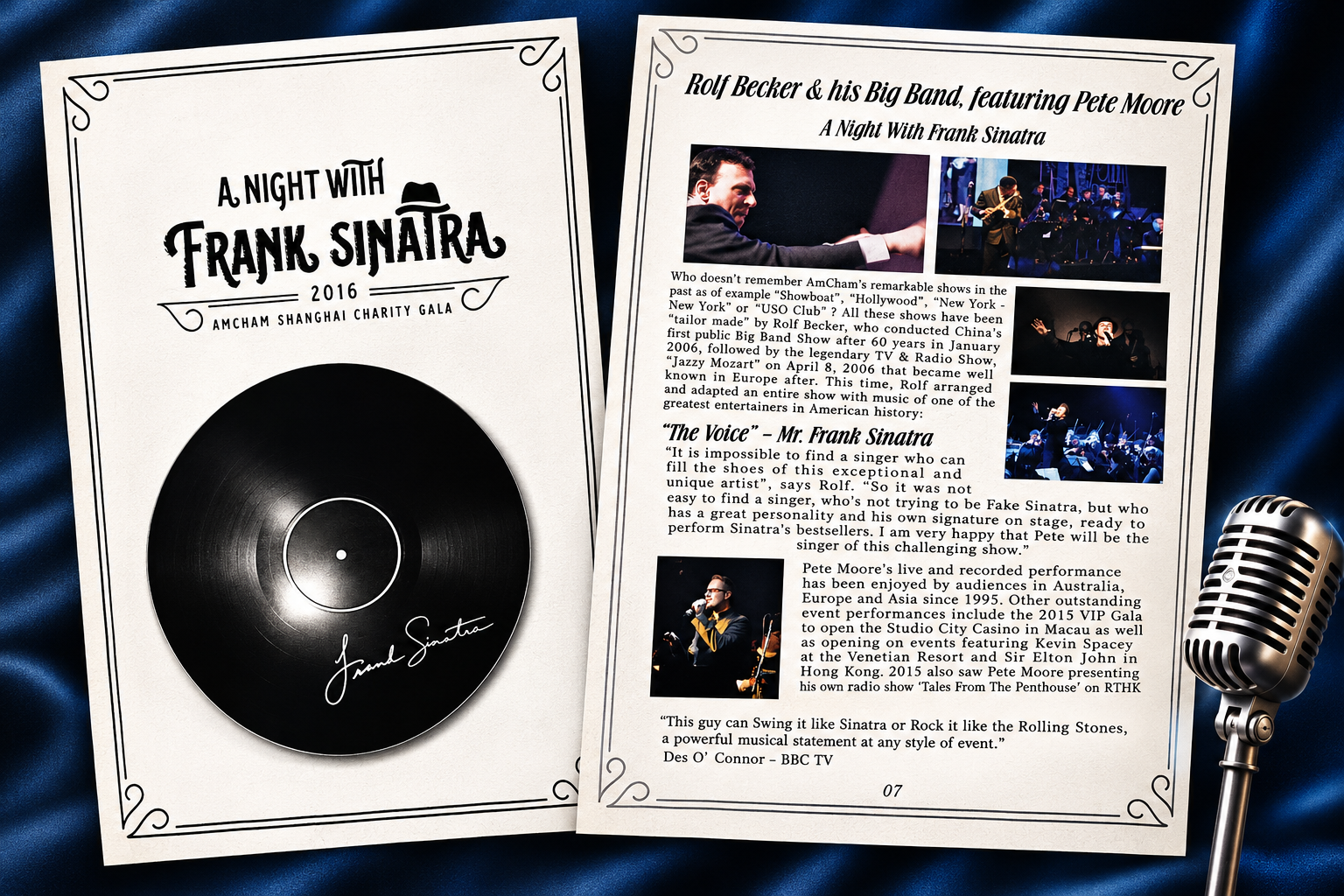
The 2016 AmCham Shanghai Charity Gala, “A Night with Frank Sinatra,” featuring Australian vocalist Pete Moore with my big band. The original program documents our tribute to Sinatra's musical legacy, with specially prepared orchestral arrangements and Pete's distinctive vocal interpretations.
My involvement with the American Chamber's gala productions continued beyond Brenda's presidency.
One of the final projects was A Night with Frank Sinatra, in 2016.
Sinatra's music occupies a special place in the history of popular singing and big band arranging.
His recordings with orchestras led by figures such as Nelson Riddle, Billy May, and Count Basie helped establish a standard of musical sophistication that remains influential today.
For me, Sinatra's repertoire represents a wonderful example of the relationship between a great singer and a great arrangement.
The orchestra does not merely accompany the vocalist.
It contributes to the interpretation, creates dramatic contrasts, and gives the music its distinctive character.
For this production, I invited Australian vocalist Pete Moore to perform Sinatra's legendary songs with my big band. Following in the footsteps of “The Voice” was certainly no small challenge. As I explained in the original gala program, I wasn't looking for someone simply trying to imitate Frank Sinatra. I wanted a singer with his own personality, musical character, and unmistakable stage presence. Pete brought exactly that experience to the production. Having performed internationally for many years, he was equally at home with swing, jazz, and popular music. Together, we set out to celebrate Sinatra's extraordinary musical legacy while allowing Pete to bring his own interpretation to these timeless songs.
That was precisely the kind of musical relationship I had always enjoyed exploring.
Looking back, the Sinatra production also marked the closing of a long chapter in my work for the American Chamber.
What had begun years earlier with themed gala evenings had developed into a series of productions that allowed me to bring together many aspects of my musical experience.
More Than Twenty Years of Musical Memories
My work for Shanghai's international community was never limited to a single organization.
Alongside the Chamber Balls and American Chamber productions, I continued providing music for German Consulate events over many years, with engagements extending into 2018.
Some occasions called for a large orchestra. Others were better suited to a smaller ensemble.
The repertoire could range from traditional ballroom music to jazz, popular songs, and specially arranged concert pieces.
This variety kept the work interesting.
It also reminded me that being a professional musician involves more than specializing in one musical style.
A good arranger needs to understand how music functions in different situations.
A concert audience listens differently from guests at a gala dinner.
A dance floor requires a different musical energy from a theater.
And a corporate celebration may need an entirely different atmosphere from a jazz club.
For me, the challenge was always to find the right musical language for each occasion without compromising the quality of the performance.
Looking Back — One City, Many Musical Worlds
When I think about those years, I realize how fortunate I was to experience so many different aspects of Shanghai's musical life.
I could spend one evening conducting a jazz orchestra, another preparing music for an international gala, and the following day working on arrangements or compositions in my studio.
These activities were not competing interests.
They were different expressions of the same passion.
I loved writing music, working with outstanding musicians, and hearing my arrangements come alive in performance.
The Chamber Balls and gala productions also introduced me to people outside the jazz community, created lasting professional relationships, and provided many wonderful memories.
Some of those memories survive in photographs, newspaper articles, programs, and brochures.
Others exist only in my mind.
Together, they tell another part of the story of my musical years in Shanghai.
And while these grand international evenings were taking place, another story was continuing in parallel.
My long and sometimes complicated relationship with JZ Club had not yet reached its conclusion.
That final chapter would bring me back to a familiar stage on Fuxing Road — the very place where the JZ All Star Big Band had begun ten years earlier.
But that story deserves a chapter of its own.
To be continued…