

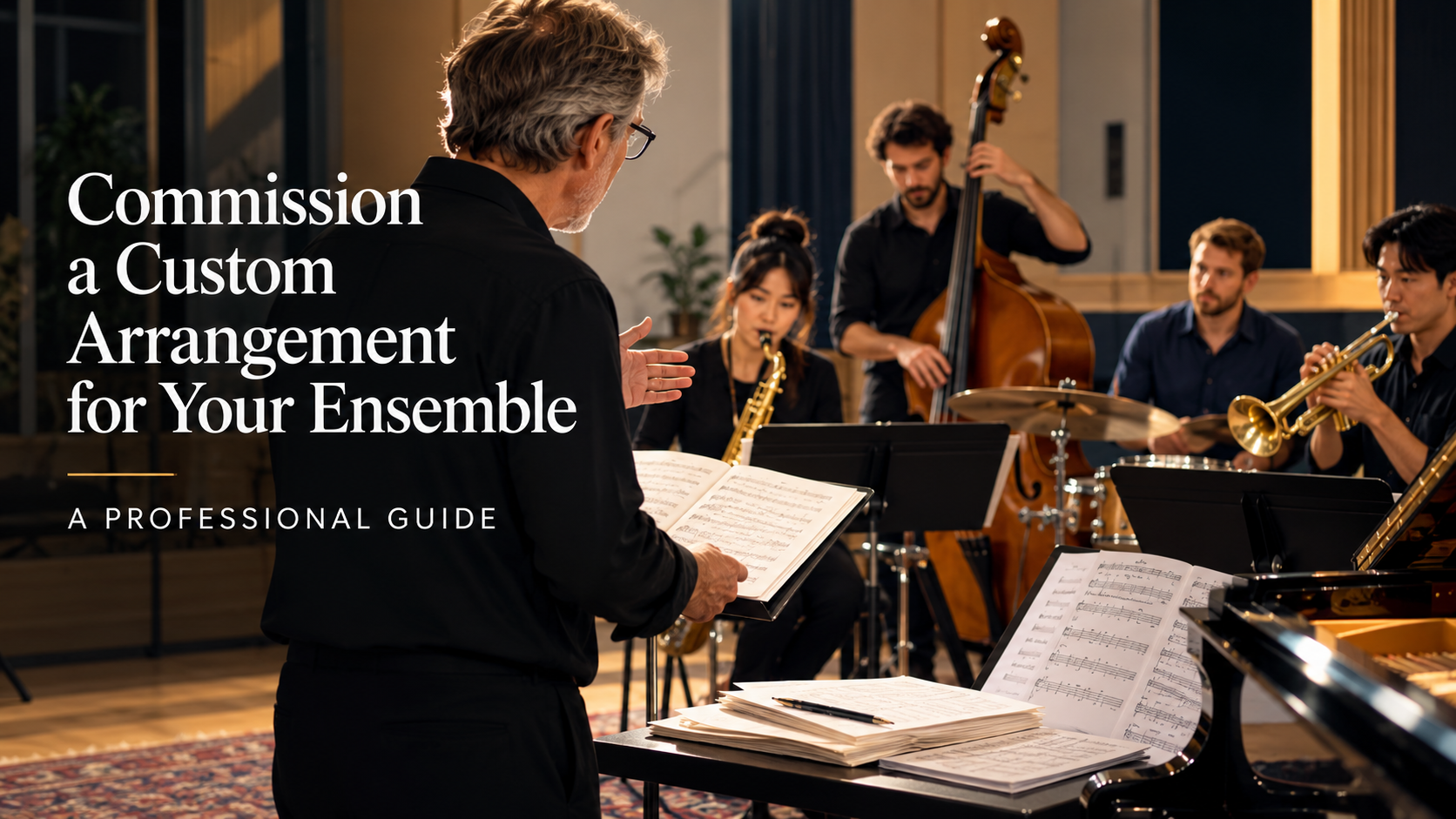
Commission a Custom Arrangement for Your Ensemble: A Professional Guide
Discover how a custom music arrangement can be tailored to your ensemble’s instrumentation, playing level, and artistic goals. Explore the commissioning process with composer and arranger Rolf Becker.
Every musical ensemble has its own character, shaped by its instrumentation, individual musicians, technical abilities, and artistic objectives.
Published arrangements provide an extensive repertoire for jazz ensembles, concert bands, orchestras, and smaller instrumental groups. However, standard instrumentation and predetermined difficulty levels do not always correspond to the needs of a particular ensemble.
A custom music arrangement offers an alternative: music developed around the musicians who will perform it.
Whether adapting an existing composition, arranging music for an unusual combination of instruments, or developing a distinctive concert program, a commissioned arrangement can address practical requirements while creating new artistic possibilities.
Why Commission a Custom Music Arrangement?
A professionally commissioned arrangement begins with the ensemble itself.
An orchestra may require an adaptation for reduced instrumentation. A jazz ensemble may have an unusual balance between brass and woodwinds. A school band may need repertoire that challenges its musicians without exceeding their technical abilities.
In other situations, an ensemble director may wish to feature a particular soloist, explore a different musical style, or create a new interpretation of familiar repertoire.
The purpose of a custom arrangement is not simply to accommodate limitations. It is to use the available musical resources effectively.
A successful arrangement considers instrumentation, instrumental ranges, harmonic balance, technical difficulty, rhythmic complexity, and stylistic authenticity.
These considerations influence how the music is orchestrated and how convincingly the ensemble can communicate its musical ideas.
Step 1: Discover — Understanding Your Ensemble
The first stage of planning a commissioned arrangement is understanding the musicians and the intended performance.
Before developing the score, several questions should be considered:
What is the exact instrumentation of the ensemble?
Are instrumental doublings or alternative instruments available?
What is the technical and musical experience of the performers?
Are there particular soloists to feature?
What musical style and character are desired?
Is the arrangement intended for a concert, recording, educational program, or special event?
Are there specific requirements concerning duration, difficulty, or performance date?
These details establish the musical framework for the project.
For educational ensembles, individual instrumental ranges, articulation requirements, and rhythmic complexity deserve particular attention.
For professional ensembles, the focus may be on a distinctive orchestral sound, sophisticated harmonic writing, featured improvisation, or a particular artistic interpretation.
Understanding these requirements from the beginning helps ensure that the resulting arrangement is musically convincing and practical to perform.
Step 2: Create — Developing the Musical Concept
Once the ensemble's requirements have been established, the next consideration is the musical concept.
An arrangement involves considerably more than assigning an existing melody to different instruments.
The arranger must determine how melodic material, harmonic structures, rhythmic figures, instrumental colors, and formal development will function within the available instrumentation.
For example, adapting a full big-band arrangement for a smaller jazz ensemble requires careful redistribution of musical responsibilities.
A passage originally written for five saxophones, four trumpets, and four trombones cannot necessarily be reproduced by simply omitting instrumental parts.
The arranger must reconsider the voicings, harmonic priorities, melodic lines, and balance between instrumental sections.
In some passages, a reduced number of voices may produce greater clarity. Elsewhere, octave doubling, carefully selected chord tones, or contrapuntal writing may provide the necessary harmonic and orchestral substance.
The objective is to preserve the musical character of the composition while creating a convincing arrangement for the new ensemble.
Musical Style and Artistic Identity
Stylistic understanding is equally important.
A swing arrangement requires attention to articulation, phrasing, rhythmic placement, and the interaction between the ensemble and rhythm section.
A Latin jazz arrangement may require a different approach to rhythmic organization, accompaniment patterns, and instrumental balance.
An orchestral adaptation introduces additional considerations involving instrumental color, register, dynamics, and the relationship between individual sections.
In each case, the arrangement should respect the musical style while allowing room for creative interpretation.
Step 3: Develop — Refining the Arrangement
The development stage brings together musical ideas and practical performance considerations.
As the score takes shape, the arranger evaluates the relationship between instrumental parts, the effectiveness of the orchestration, and the technical demands placed on individual musicians.
Several aspects deserve particular attention.
Instrumental ranges: Each part should reflect the capabilities of the intended performers while maintaining the musical character of the arrangement.
Voicing and balance: Harmonic structures must be distributed effectively to achieve clarity, blend, and the desired orchestral color.
Articulation and phrasing: Accurate musical indications help communicate style and interpretation.
Rhythmic precision: Complex figures must be notated clearly and appropriately for the ensemble's technical level.
Solo passages: Featured instrumentalists should have sufficient musical space, with backgrounds and accompaniment designed to support rather than obscure their contributions.
Rhythm-section writing: Piano, Bass, and Drums require appropriate musical information while retaining the flexibility demanded by the style.
Depending on the scope of the commission and the agreed working process, consultation or feedback may be incorporated during development.
The purpose of refinement is to ensure that the arrangement works as a coherent musical composition and as a practical performance resource.
Step 4: Deliver — Preparing the Score and Instrumental Parts
Professional music preparation is an essential part of the commissioning process.
Even an imaginative arrangement can become unnecessarily difficult to rehearse if the notation is unclear or the instrumental parts are poorly organized.
A properly prepared score should communicate the musical structure accurately, while individual parts should be readable and practical for performers.
Important considerations include:
Correct transposition for the respective instruments
Clear notation of rhythms, articulations, and dynamics
Appropriate rehearsal letters or measure references
Consistent tempo and stylistic indications
Practical page turns and readable page layouts
Accurate correspondence between the score and individual parts
The exact deliverables should be established before the project begins.
Depending on the commission, these may include a conductor score, individual instrumental parts, PDF files, reference audio, or other agreed materials.
Clear documentation and communication help ensure that the completed arrangement can move efficiently from preparation into rehearsal and performance.
Copyright, Permissions, and Commissioning Agreements
Copyright and usage rights are important considerations when commissioning music.
The applicable arrangements depend on the nature of the project, the source material, relevant copyright law, and the terms agreed upon by the parties.
An original composition and an arrangement of an existing copyrighted work may involve different rights and permissions.
For arrangements based on copyrighted material, authorization from the relevant rights holders may be required.
A commissioning agreement should clarify the scope of the work, agreed deliverables, payment terms, schedule, revision arrangements, and intended uses of the finished music.
Questions involving performance, recording, reproduction, distribution, exclusivity, and copyright ownership should be addressed explicitly where relevant.
Commissioning an arrangement does not automatically transfer copyright or grant unrestricted permission to reproduce, distribute, or record the music.
Establishing these matters before work begins helps protect both the commissioning client and the creative professional.
Custom Arrangements for Different Ensembles
Commissioned arrangements can serve a wide range of musical settings.
Jazz Ensembles and Big Bands
A custom jazz arrangement may be developed for a traditional big band, a reduced big band, or an ensemble with nonstandard instrumentation.
The arranger can adapt harmonic voicings, instrumental backgrounds, ensemble passages, and solo features to the available musicians.
This approach is particularly valuable when an ensemble wishes to preserve the character of a particular jazz style while developing its own musical identity.
Small Jazz Ensembles
Smaller groups offer distinctive opportunities for transparency, instrumental interaction, and flexible orchestration.
For example, the MusicMyLanguage Septet Series explores arrangements for Trumpet, Alto Saxophone, Tenor Saxophone, Baritone Saxophone, Piano, Bass, and Drums.
Although the series consists of published arrangements rather than individual commissions, it illustrates how carefully considered instrumentation can create substantial musical variety within a smaller ensemble.
Educational Ensembles
For school bands, youth orchestras, and student jazz ensembles, custom arrangements can help align musical repertoire with educational objectives.
Instrumental ranges, rhythmic demands, articulation, ensemble balance, and opportunities for individual development can all be considered during the arranging process.
The goal is to create music that remains artistically rewarding while being appropriate for the performers.
Professional Performances and Special Projects
Professional ensembles may commission arrangements for concerts, recordings, theatrical productions, special events, or collaborations involving unusual combinations of instruments.
Such projects may require a particular stylistic interpretation, orchestral character, or musical concept that is not available in existing published repertoire.
When Is a Custom Arrangement the Right Choice?
Commissioning music is not necessary for every ensemble or performance.
Published arrangements often provide excellent musical material and may be the most practical option when the instrumentation, difficulty, and artistic requirements already correspond to the ensemble's needs.
A custom arrangement becomes particularly valuable when existing repertoire does not adequately address the intended instrumentation or musical concept.
Before commissioning, it is useful to consider whether the project requires a new orchestration, a different key, an adapted level of difficulty, a featured soloist, or a substantially different musical interpretation.
A clear understanding of the artistic objective helps determine whether an existing publication or a commissioned arrangement is the more appropriate solution.
Planning Your Music Arrangement Commission
Good preparation is essential when approaching a professional arranger.
Begin by identifying the composition or musical concept, the available instrumentation, the intended performers, and the performance context.
Consider the desired duration, musical style, level of difficulty, and any special requirements.
If a performance date has already been established, allow sufficient time for arranging, score preparation, review, and rehearsal.
The time and cost involved will depend on the scale and complexity of the project.
A short arrangement for a small ensemble will generally require a different amount of preparation from a substantial orchestral adaptation or an extended concert work.
A detailed discussion of the requirements provides the most reliable basis for defining the scope of the commission.
Explore MusicMyLanguage Commissioning Services
MusicMyLanguage brings together professional experience in composition, arranging, orchestration, and conducting.
The objective of a commissioned arrangement is to create music that respects the character of the original material, uses the available instrumentation effectively, and supports the artistic intentions of the performers.
Whether you are planning a jazz concert, developing repertoire for an educational ensemble, or considering a special musical project, thoughtful preparation is the foundation of a successful collaboration.
Explore the MusicMyLanguage Ensemble Commissions page for further information about discussing your project.
Frequently Asked Questions
What is a custom music arrangement?
A custom music arrangement is a new musical treatment developed for particular performers, instrumentation, or artistic requirements. It may involve adapting an existing composition, changing its orchestration, or creating a distinctive interpretation for a specific ensemble.
How much does a commissioned arrangement cost?
The fee depends on factors such as ensemble size, duration, musical complexity, orchestration requirements, preparation of scores and parts, and the agreed schedule. A project-specific quotation is generally more meaningful than a fixed price that does not account for these differences.
Can an arrangement be written for unusual instrumentation?
Yes. One of the principal advantages of commissioning an arrangement is the opportunity to develop music for a particular combination of instruments. The arranger can consider the available instrumental ranges, tonal colors, technical capabilities, and desired musical balance.
Can a custom arrangement be adapted to the musicians' abilities?
Yes. Technical difficulty can be considered during the arranging process, including instrumental ranges, rhythmic complexity, articulation, tempo, and ensemble demands. The objective is to create an appropriate balance between musical interest and practical playability.
What materials should I prepare before requesting a commission?
Useful information includes the intended composition or musical concept, exact instrumentation, performer proficiency, desired style, approximate duration, performance context, and deadline. Recordings or examples of the desired musical character may also help communicate the project's artistic direction.
Can I commission an arrangement of a copyrighted composition?
Potentially, but the necessary permissions depend on the composition, its copyright status, the intended use, and applicable law. Permission from the relevant rights holders may be required before an arrangement can be created, distributed, or used in certain ways.
Giving Your Ensemble Its Own Musical Voice
The most successful arrangements combine musical imagination with an understanding of the performers for whom the music is written.
Instrumentation, orchestration, technical demands, harmonic language, and stylistic interpretation all contribute to the final result.
A commissioned arrangement offers the opportunity to bring these elements together around a particular artistic objective.
For ensemble directors, educators, and professional musicians, it can provide a practical and creative way to develop repertoire that reflects the musical identity of their ensemble.
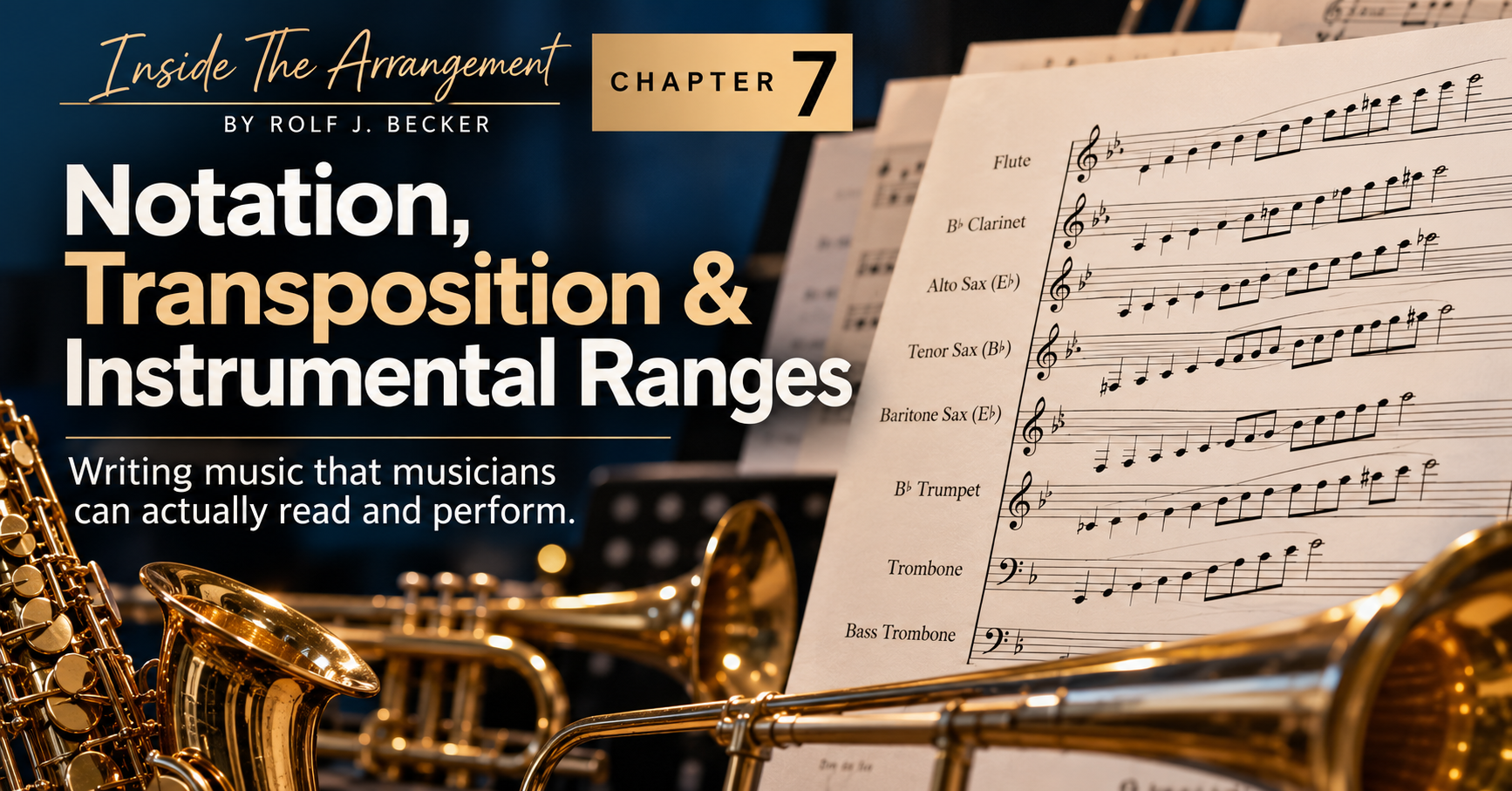
INSIDE THE ARRANGEMENT — Chapter 7 — Notation, Transposition & Instrumental Ranges
A professional Big Band arrangement requires more than great musical ideas. In Chapter 7 of Inside The Arrangement, composer and arranger Rolf J. Becker explores instrument transposition, written versus concert pitch, practical brass and woodwind ranges, and the essential principles of clear, professional music notation.
Writing music that musicians can actually read and perform.
By Rolf J. Becker
A beautiful musical idea deserves a beautifully prepared score.
Throughout my career as a composer, arranger, conductor, and instrumentalist, I have learned that even the most imaginative arrangement can become unnecessarily difficult when its notation is unclear.
Incorrect transpositions, impractical instrumental ranges, inconsistent articulations, or poorly prepared parts can create confusion and waste valuable rehearsal time.
In Chapter 6, we explored how orchestration gives our music its colors.
Now we turn to an equally important question:
How do we communicate those musical ideas clearly to the musicians who will perform them?
1. Concert Pitch vs. Written Pitch
One of the first things every arranger must understand is the difference between concert pitch and written pitch.
Concert pitch is the actual sounding note.
Written pitch is the note displayed in the musician's part.
For example, when a B-flat trumpet player performs a written C, the instrument sounds a concert B-flat.
If we want that trumpet to sound concert C, we must write D.
The same principle applies to B-flat clarinet and the saxophone family, although the precise transpositions differ.
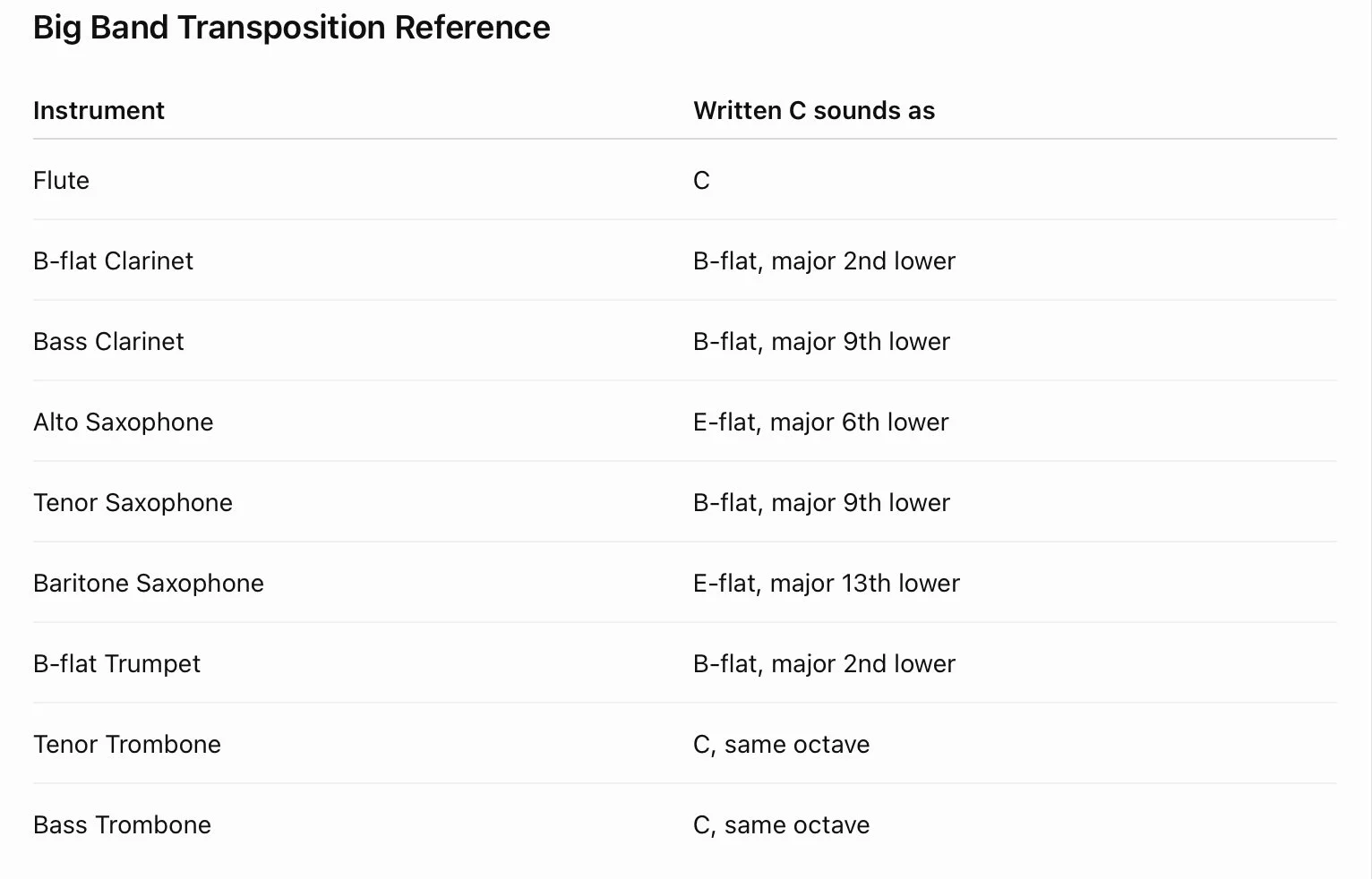
Big Band Transposition Reference (Inside The Arrangement — Chapter 7)
Important: In standard Big Band notation, tenor trombone and bass trombone are written in bass clef at concert pitch.
Although the tenor trombone is commonly described as a B-flat instrument, this refers to its fundamental tubing pitch—not a transposition of its standard bass-clef part.
2. Why Octaves Matter
Transposition involves more than changing the key signature.
The tenor saxophone sounds a major ninth below its written pitch.
The baritone saxophone sounds a major thirteenth below its written pitch.
Both instruments therefore include an octave displacement.
An arranger who overlooks this detail may produce an entirely different register from the one intended.
Modern notation software makes transposition considerably easier, but I strongly recommend understanding these relationships rather than relying exclusively on automatic functions.
Software is a tool. Musical knowledge remains essential.
3. Instrumental Ranges: Possible Doesn't Always Mean Practical
Every instrument has a physical range.
But that doesn't mean every player can perform every note within that range comfortably.
A professional lead trumpet player may perform high notes that would be entirely inappropriate for a developing student.
A professional saxophonist may use altissimo fingerings that an intermediate player has not yet mastered.
And a trombone passage can be difficult because of rapid slide movement, even when every note lies within the instrument's normal range.
For this reason, I distinguish between three levels when preparing arrangements:
Beginner: A conservative register that allows players to develop reliable tone, intonation, and confidence.
Intermediate: A broader range suitable for musicians with established technical skills.
Advanced / Professional: An extended range that may include demanding registers and specialized techniques.
These categories are practical guidelines, not fixed rules.
A Few Important Instrumental Details
Alto and Tenor Saxophones: Their standard written ranges are broadly similar, but their sounding registers differ. Altissimo should not be assumed available to every player.
Baritone Saxophone: Many modern instruments have a written low A, but others stop at low B-flat. Check the available instrument before requiring low A.
Flute: Its usual lowest note is middle C, although a B-footjoint allows written B3. The upper register requires increasing control.
Clarinet and Bass Clarinet: Their registers behave differently, and the bass clarinet's lowest available notes depend on the instrument's extension.
Trumpet: Upper-register endurance matters just as much as the highest note.
Tenor and Bass Trombone: Consider slide movement, valve configuration, articulation, and the demands of the low register.
The most important principle is simple:
Write for the musician, not merely for the theoretical range of the instrument.
4. A High Note Is Not the Whole Story
Consider two trumpet passages.
The first contains one demanding high note at the end of an otherwise comfortable phrase.
The second contains repeated high notes over several measures, played fortissimo.
Both passages may reach the same highest pitch.
Yet their technical demands are entirely different.
Endurance, articulation, dynamics, tempo, and recovery time must all be considered.
This applies to other wind instruments as well.
Good arranging requires an understanding of how musicians experience a passage from beginning to end.
5. Articulation and Dynamics: The Details That Matter
Correct notes and rhythms are only the beginning.
A short accented note produces a different musical result from a tenuto note.
A legato phrase requires a different approach from a passage of repeated marcato accents.
And a written forte does not produce the same perceived volume on every instrument.
These details are especially important in Big Band writing, where the precision of a section depends on consistent articulation and phrasing.
As a conductor, I regularly hear how much difference a unified note release can make.
Sometimes a passage doesn't need to be rewritten.
It simply needs clearer notation.
6. Preparing Professional Individual Parts
An arrangement is not finished when the full score looks correct.
Every individual part must be checked.
I recommend paying particular attention to:
Correct transpositions and sounding octaves
Clear rehearsal marks and measure numbers
Consistent articulation and dynamics
Readable staff size and spacing
Practical page turns
Multimeasure rests and useful cues
Sufficient time for instrument and mute changes
A well-prepared part allows musicians to concentrate on the music instead of correcting avoidable mistakes.
7. The Professional Arranger's Checklist
Before delivering an arrangement, ask yourself:
Are all transposing instruments correctly notated?
Are the written ranges appropriate for the intended musicians?
Have I considered endurance, articulation, and instrument-specific limitations?
Are the individual parts readable and professionally prepared?
Does the score communicate exactly what I want the musicians to perform?
These questions may seem straightforward.
But answering them carefully can make an enormous difference in rehearsal and performance.
Final Thoughts — Respecting the Musician
Professional notation is a sign of respect.
It respects the musician's time, preparation, and technical responsibilities.
It also respects the composition.
Throughout Inside The Arrangement, I have emphasized that arranging is about making musical decisions.
Notation is how we communicate those decisions.
A professional arrangement is not finished when the notes are written. It is finished when the musicians can understand and perform them as intended.
Discover my original Big Band arrangements, small ensemble charts, and educational music in the MusicMyLanguage Music Library.
Explore the complete Inside The Arrangement educational series, where we develop professional Big Band arrangements step by step.
Coming Next — Chapter 8: The Art of Voicing
From Closed Position to Clusters
How do we distribute chord tones among the instruments of a Big Band?
What distinguishes closed voicing from Drop 2 or Drop 4?
How do clusters create tension and color?
And how can voice leading transform a simple harmonic progression into a convincing ensemble sound?
In our next chapter, we'll explore these techniques using practical examples from my original composition Just Take It Easy.
Rolf J. Becker
Composer · Arranger · Conductor
MusicMyLanguage — Learn. Practice. Perform.
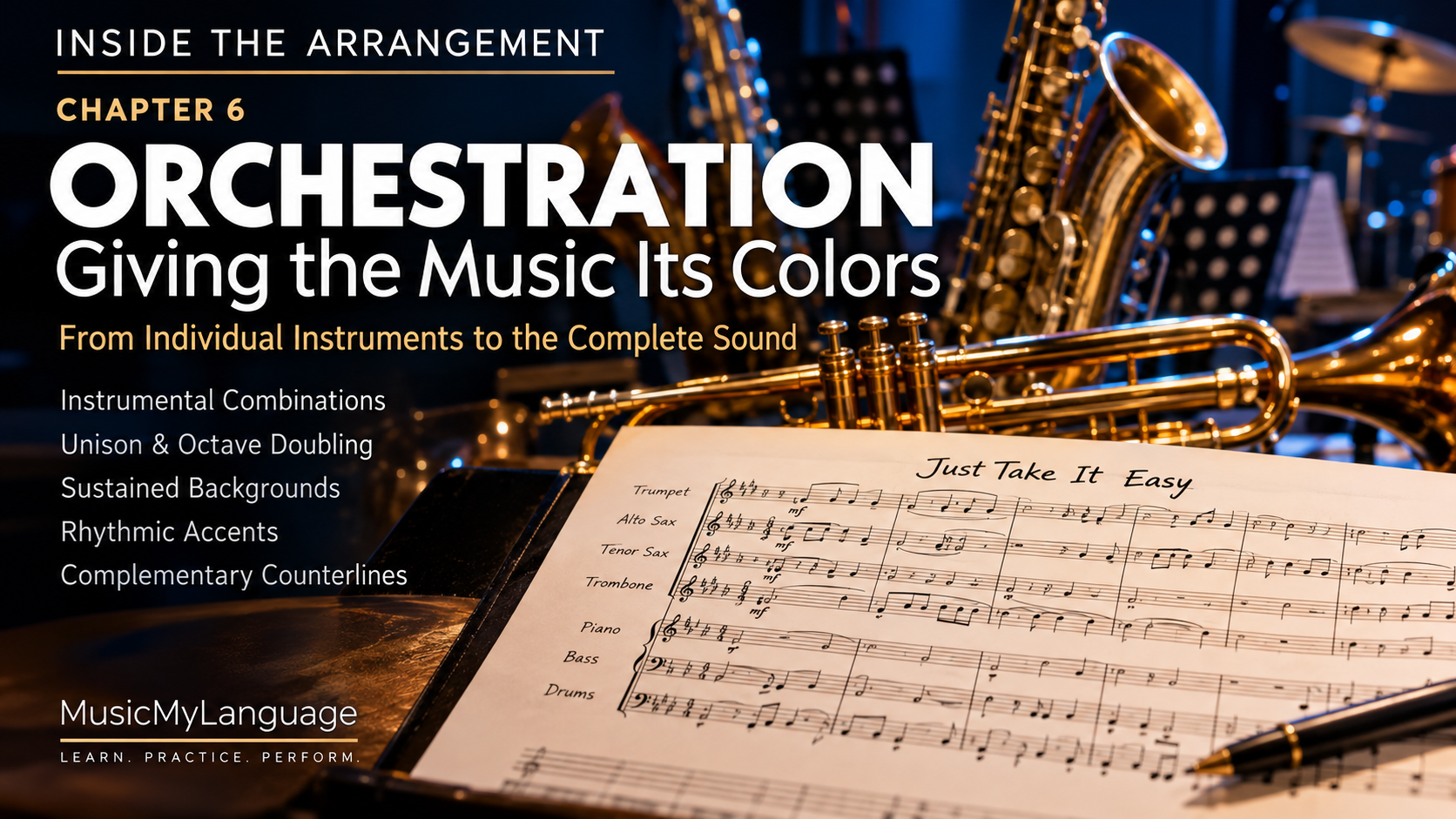
INSIDE THE ARRANGEMENT / Chapter 6 — Orchestration: Giving the Music Its Colors
How does orchestration transform a simple melody into a colorful Big Band arrangement? In Chapter 6 of Inside The Arrangement, composer and arranger Rolf J. Becker explores instrumental combinations, unison and octave doubling, sustained backgrounds, rhythmic accents, and complementary counterlines. Featuring nine practical audio examples from his original composition Just Take It Easy, this chapter demonstrates how thoughtful orchestration brings music to life.
From Individual Instruments to the Complete Sound
In Chapter 5, we explored the individual characteristics of brass and woodwind instruments: their ranges, registers, tonal qualities, and practical limitations.
Now comes one of the most fascinating aspects of arranging.
What happens when we combine those instruments?
A melody played by a single trumpet has a particular personality. Add an alto saxophone in unison, and the sound changes immediately. Combine a trumpet with a tenor saxophone in octaves, and another color emerges.
But orchestration is about much more than assigning a melody to different instruments.
It involves decisions about texture, balance, register, rhythmic activity, and the relationship between individual voices.
Should the melody stand alone? Should other instruments reinforce it? Should we add sustained harmonies, rhythmic accents, or an independent counterline?
Throughout this chapter, we'll continue using my composition Just Take It Easy to demonstrate how these decisions influence the musical result.
1. Orchestration Begins With Listening
Before writing notes for an ensemble, I try to imagine the sound I want to hear.
Is the passage supposed to feel intimate or powerful? Warm or brilliant? Transparent or dense?
The answers influence which instruments I choose and how I combine them.
A common mistake among developing arrangers is to assume that more instruments automatically produce a better result.
They don't.
Sometimes a single instrument playing a well-written melodic phrase can be more expressive than an entire section.
The essential question is not how many musicians are playing.
It's whether their combination serves the musical intention.
2. One Melody — Different Colors
Let's begin with a simple experiment.
We'll take the same melodic passage from Just Take It Easy and assign it to different instrumental combinations.
The melody remains recognizable, but its sound and character change.
Musical Example 6.1 — One Melody, Different Colors
Audio Example 6.1.1 — Trumpet Solo
The trumpet presents the melody without another horn doubling it.
Listen to the clarity of the melodic line, its articulation, and the instrument's distinctive tonal character.
This becomes our starting point for comparing the other versions.
Audio Example 6.1.2 — Alto Saxophone & Trumpet in Unison
Now we combine two instruments with different tonal characteristics.
The trumpet contributes its brass quality, while the alto saxophone introduces a contrasting reed sound.
When the instruments perform the same melodic line in unison, their combined timbres create a blended orchestral color.
Neither instrument needs to change the melody to influence its character.
Audio Example 6.1.3 — Trumpet & Tenor Saxophone in Octaves
In this example, we explore the combination of trumpet and tenor saxophone.
When these instruments are arranged in octaves, the difference in register introduces another dimension to the sound.
Octave doubling can reinforce a melodic line while preserving greater separation between the instruments' registers.
The result depends on register, dynamics, articulation, and the relative balance between the two players.
Listen Again
Compare all three versions.
Which combination gives the melody the strongest presence? Which creates the warmest impression? Which would you choose for a relaxed passage, and which for a more energetic one?
There is no universally correct answer.
The point of this exercise is to develop an awareness of instrumental color.
3. Supporting the Melody — Three Different Approaches
Once we have decided who plays the melody, the next question is:
What should the other instruments do?
One of the arranger's most important responsibilities is to create an effective relationship between the principal melody and the accompanying material.
Let's examine three possibilities using the same passage from Just Take It Easy.
For each approach, I've prepared two recordings.
The first presents the melody and its background without the rhythm section. The second demonstrates the same arrangement within the full-band texture.
Listen to the exposed version first, then compare it with the full band.
Musical Example 6.2.1 — Melody With Sustained Backgrounds
Sustained backgrounds are one of the most effective ways to provide harmonic support without adding excessive rhythmic activity.
While the melody moves, the accompanying instruments hold longer notes or chords.
These sustained harmonies can establish warmth, continuity, and harmonic depth.
They are particularly effective when the melody contains rhythmic movement or pauses that allow the background to remain audible.
Audio Example 6.2.1-1 — Melody With Sustained Backgrounds
Listen to how the sustained harmony supports the melody.
Pay attention to the relationship between the moving melodic line and the comparatively static background.
Audio Example 6.2.1-2 — Sustained Backgrounds With Full Band
Now the rhythm section adds its harmonic and rhythmic foundation.
Notice how the sustained background becomes part of the larger ensemble texture.
The arranger must ensure that the background remains supportive rather than becoming too prominent.
Sustained writing is not necessarily simple writing. Register, harmonic spacing, dynamics, and voice leading all influence its effectiveness.
Musical Example 6.2.2 — Melody With Short Rhythmic Kicks
Instead of sustaining chords beneath the melody, we can introduce short rhythmic accents.
These figures may reinforce the groove, emphasize selected beats, or respond to the melodic phrase.
In jazz arranging, short ensemble figures are often called kicks or hits.
They can create excitement without requiring continuous activity from the accompanying instruments.
Audio Example 6.2.2-1 — Melody With Short Rhythmic Kicks
Listen to the interaction between the melody and the short ensemble accents.
The background now has a more pronounced rhythmic identity.
Audio Example 6.2.2-2 — Rhythmic Kicks With Full Band
With the rhythm section added, the ensemble figures become part of the overall groove.
Notice how the kicks interact with the bass, piano, guitar, and drums.
One important consideration is whether these accents reinforce the rhythmic foundation or unnecessarily compete with it.
An effective rhythmic background should contribute to the music's momentum without obscuring the melody.
Musical Example 6.2.3 — Melody With a Complementary Counterline
Our third approach introduces an independent melodic idea beneath or around the principal melody.
This is commonly called a counterline or countermelody.
Unlike sustained backgrounds, which primarily provide harmonic support, or rhythmic kicks, which contribute accents, a counterline has its own melodic direction.
This creates a musical dialogue between two different lines.
Audio Example 6.2.3-1 — Melody With Complementary Counterline
Listen to how the secondary line moves in relation to the principal melody.
A successful counterline should be interesting enough to contribute something meaningful, but not so dominant that it distracts from the main theme.
Audio Example 6.2.3-2 — Counterline With Full Band
Now listen to the same material within the complete ensemble.
The counterline must find its place alongside the rhythm section and the principal melody.
Register, dynamics, articulation, and rhythmic placement become especially important when two melodic ideas are active simultaneously.
4. What Have We Learned From These Three Approaches?
We have used the same melody and explored three fundamentally different accompanying textures.
Sustained backgrounds create harmonic continuity and support.
Rhythmic kicks introduce punctuation, movement, and energy.
Complementary counterlines establish a second melodic dimension.
None of these approaches is automatically superior.
The correct choice depends on the style, the character of the composition, the surrounding orchestration, and the dramatic development of the arrangement.
An arranger might even use all three techniques within a single composition, provided the transitions are musically convincing.
The important principle is to avoid adding material simply because instruments are available.
Every additional voice should have a musical purpose.
5. Balance, Register, and the Importance of Space
An arrangement can contain excellent melodic ideas, convincing harmonies, and technically correct writing — yet still sound overcrowded.
Why?
Because orchestration is also about deciding what not to write.
If every section plays continuously, the listener may struggle to identify the principal musical idea.
A sustained background may interfere with an important piano fill. A counterline may compete with the melody. A powerful brass figure may overwhelm a delicate woodwind passage.
The solution is not always to rewrite the notes.
Sometimes we simply need to remove a layer, change the register, reduce the dynamics, or leave a few beats empty.
Throughout Just Take It Easy, the relaxed swing character remains an important reference point.
I want the ensemble to sound full when the music requires it, but I also want enough transparency for the melody and rhythm section to breathe.
Space is not the absence of orchestration. It is one of its most important tools.
6. Try It Yourself — An Orchestration Exercise
Choose a short melody of eight bars.
First, write it for a single instrument.
Then experiment with different instrumental combinations. Try unison doubling, octave doubling, and contrasting registers.
Next, create three accompanying textures: sustained harmony, rhythmic accents, and an independent counterline.
Listen to each version with and without the rhythm section.
Don't concentrate only on whether the notes are theoretically correct.
Ask yourself:
What changes in the overall sound?
Does the melody remain clearly audible?
Is the background contributing something meaningful?
Which register produces the most convincing result?
Does the orchestration suit the instruments?
Would removing a voice improve the arrangement?
This exercise can teach more about orchestration than simply filling an entire Big Band score with notes.
7. The Arranger's Decision
Orchestration is not about demonstrating how many techniques we know.
It's about choosing the right musical solution.
A unison melody can be powerful. A carefully placed rhythmic accent can transform a phrase. A sustained chord can create warmth and depth. A counterline can introduce a new melodic perspective.
And even an imaginative orchestration can be ineffective if it appears in the wrong register or at the wrong moment.
The techniques are tools.
The music determines which tools we should use.
Good orchestration isn't about making every instrument heard. It's about making every instrument matter.
Coming Next — Chapter 7: Notation, Transposition & Instrumental Ranges
We've explored how instrumental combinations, backgrounds, and orchestral textures influence the character of a Big Band arrangement.
But once we've decided what the instruments should play, we face another important responsibility:
How do we communicate those musical ideas correctly and effectively?
In Chapter 7, we'll examine the practical details of writing for brass and woodwind instruments.
We'll discuss transposing instruments, including E-flat and B-flat saxophones, trumpets, clarinets, and other common doublings.
We'll also distinguish between the theoretical range of an instrument and the practical range we should consider when writing for beginners, intermediate musicians, and experienced professionals.
We'll look at register, technical difficulty, notation conventions, and the importance of preparing clear, readable parts.
Because even the most imaginative orchestration must ultimately become something that musicians can understand and perform.
And once we've established these foundations, Chapter 8 will take us into the fascinating world of harmonic voicing — from closed-position writing to Drop 2, Drop 4, and clusters.
See you in Chapter 7!
Rolf J. Becker — MusicMyLanguage
Learn. Practice. Perform.
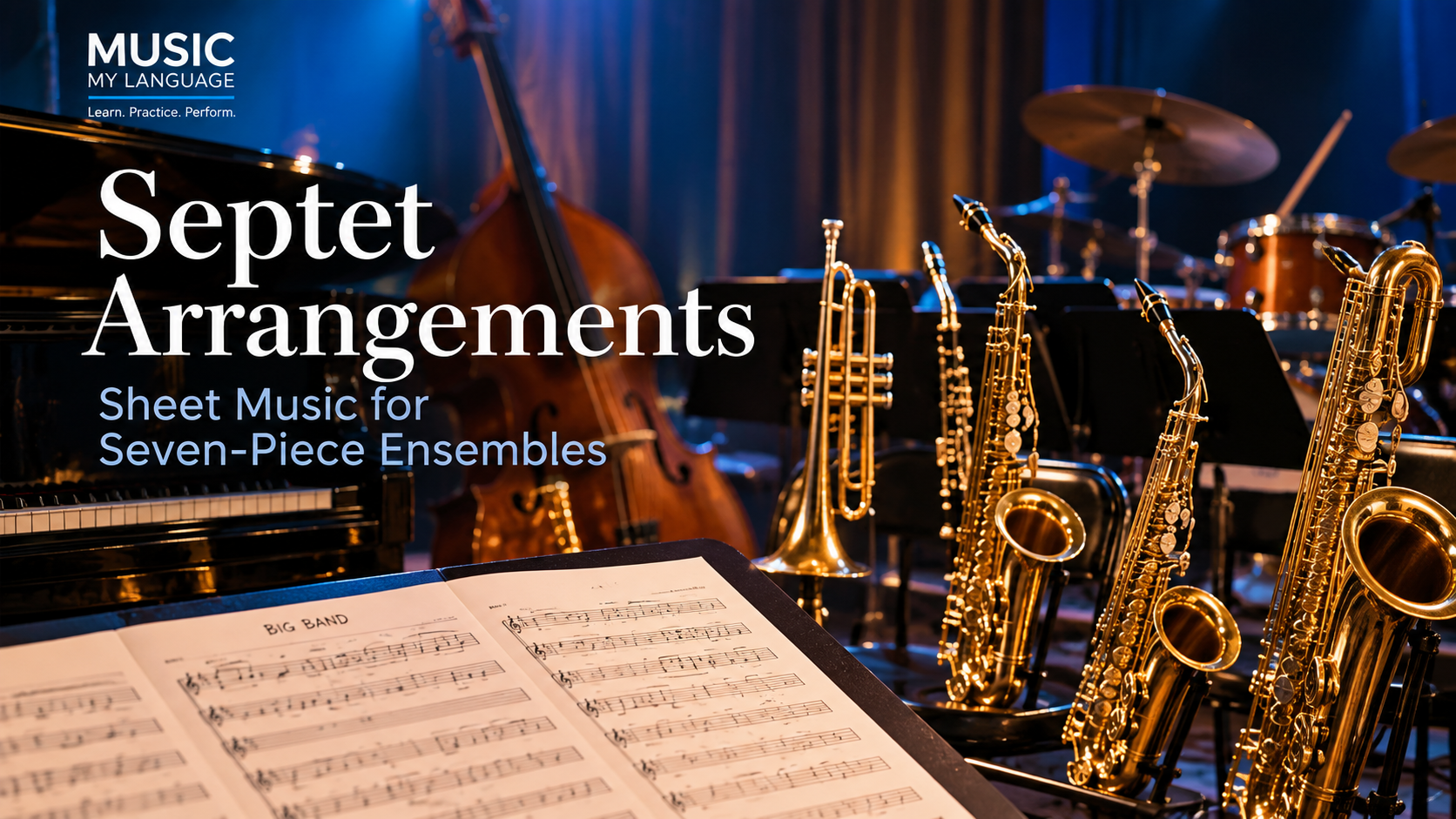
Septet Arrangements Sheet Music for Seven-Piece Ensembles
Discover how a seven-piece jazz ensemble can create a rich, powerful sound with just four horns and rhythm section. Explore professional septet arranging, instrumentation and the MusicMyLanguage Septet Series.
Finding professionally arranged music for a seven-piece jazz ensemble can be challenging. While repertoire for small jazz combos and traditional big bands is widely available, music written specifically for four horns and rhythm section offers a distinctive alternative.
The MusicMyLanguage Septet Series explores the musical possibilities of this instrumentation through arrangements conceived for the ensemble itself—not simply reductions of existing big-band scores.
Why the Seven-Piece Jazz Ensemble Works
The MusicMyLanguage Septet Series uses the following instrumentation:
Trumpet
Alto Saxophone
Tenor Saxophone
Baritone Saxophone
Piano
Bass
Drums
Four horns provide considerable melodic, harmonic, and timbral flexibility, while the rhythm section maintains the responsiveness associated with smaller jazz groups.
The ensemble can move naturally between unison passages, octave doubling, harmonized melodies, contrapuntal lines, rhythmic backgrounds, and featured improvisation.
The objective is not to imitate a larger ensemble, but to create a complete and convincing musical identity with seven musicians.
Four Horns, Distinctive Orchestral Possibilities
Writing for Trumpet, Alto Saxophone, Tenor Saxophone, and Baritone Saxophone requires careful consideration of register, balance, and instrumental character.
The Trumpet can contribute brilliance and definition, while the Alto and Tenor Saxophones offer contrasting melodic and harmonic colors. The Baritone Saxophone provides depth but can also function as an independent melodic voice or participate in upper-register ensemble writing.
These roles are not fixed. Effective orchestration allows each instrument to assume different responsibilities as the arrangement develops.
Unison passages can create rhythmic clarity and intensity. Octave writing broadens a melodic statement, while four-part harmonization introduces richer harmonic textures. Independent lines and contrapuntal passages provide movement without requiring additional instruments.
The greatest variety often comes from changing the orchestration rather than increasing the number of notes.
Creating Contrast and Ensemble Impact
A successful septet arrangement depends on contrast.
A single horn accompanied by Piano, Bass, and Drums can establish an intimate texture. Introducing a second melodic line or a restrained background changes the musical perspective. When all four horns return together, the resulting ensemble passage can have considerable impact.
Articulation, dynamics, phrasing, and balance are particularly important. With only four horns, each individual part remains clearly audible.
The rhythm section is equally essential. Piano, Bass, and Drums should contribute to the musical character, rhythmic direction, and formal development of the arrangement.
Together, these elements create a cohesive ensemble rather than a collection of independent instrumental parts.
Inside the MusicMyLanguage Septet Series
The MusicMyLanguage Septet Series was developed to provide substantial jazz ensemble writing for this particular instrumentation.
In A Mellow Tone — Duke Ellington
The first arrangement in the series opens with a unison introduction derived from the final eight bars of the composition.
The horn writing subsequently expands through harmonized passages, written backgrounds, and increasingly active ensemble figures. Later sections introduce more demanding textures, including closely voiced harmonies and sixteenth-note passages.
The arrangement demonstrates how a familiar jazz composition can be reimagined for four horns and rhythm section while preserving its musical character.
Quintessence — Quincy Jones
The second arrangement features the Alto Saxophone as its principal solo voice.
Trumpet, Tenor Saxophone, and Baritone Saxophone provide changing backgrounds, including chordal textures, double-time figures, and staggered bell-like effects.
Near the conclusion, the ensemble gives way to an Alto Saxophone cadenza before the final statement.
This arrangement demonstrates a different approach to the same instrumentation, emphasizing the featured soloist and the expressive possibilities of carefully constructed backgrounds.
The two arrangements illustrate a central principle of the series: consistent instrumentation does not require identical orchestration. Each composition calls for its own musical treatment.
Educational Benefits of the Septet Format
The septet is also a valuable ensemble format for music education.
Because each horn has a distinct role, performers must pay close attention to intonation, articulation, rhythmic precision, balance, and blend.
Players develop an understanding of how their individual parts contribute to the complete musical texture.
They learn to recognize whether they are carrying the melody, supporting a harmonic structure, playing an independent counterline, or responding to another instrumental voice.
These skills are equally valuable in small jazz ensembles, big bands, and professional performance settings.
For advanced students and experienced musicians, the septet offers sufficient complexity for sophisticated ensemble writing while preserving the direct musical communication of a small group.
What to Consider When Choosing Septet Sheet Music
Before selecting an arrangement, ensemble directors and musicians should examine several practical and musical factors.
Instrumentation: Confirm that the arrangement matches the available ensemble. A seven-piece arrangement is not necessarily written for the same combination of instruments.
Playing difficulty: Consider instrumental ranges, rhythmic complexity, articulation, tempo, and the technical demands of ensemble passages.
Solo features: Identify which instruments are featured and whether improvisation is required or optional.
Rhythm-section writing: Examine the balance between notated material, chord symbols, rhythmic figures, and stylistically appropriate performance freedom.
Score and parts: Check which materials are included in the published edition, especially when a conductor score is required.
Audio previews: When available, listen to the recording or sample to evaluate the arrangement's musical character and suitability for your ensemble.
Choosing an arrangement involves more than finding the correct number of instrumental parts. The music should also match the ensemble's technical ability, artistic objectives, and performance setting.
Explore the MusicMyLanguage Septet Series
The MusicMyLanguage Septet Series brings together arrangements developed specifically for Trumpet, Alto Saxophone, Tenor Saxophone, Baritone Saxophone, Piano, Bass, and Drums.
Visit the MusicMyLanguage Septet Series to explore the arrangements, instrumentation, available audio previews, and purchasing information.
Individual arrangement pages provide the most appropriate starting point for evaluating each publication and following the relevant retailer links.
A Distinctive Musical Identity
The seven-piece jazz ensemble deserves recognition as an independent musical format.
Four horns provide opportunities for substantial harmonic and contrapuntal writing, while the rhythm section preserves flexibility, transparency, and interaction.
The MusicMyLanguage Septet Series is built around these strengths, offering arrangements that explore the full expressive potential of the instrumentation.
For professional musicians, educators, and ensemble directors seeking septet arrangements and sheet music, the series provides a focused approach to jazz ensemble performance.
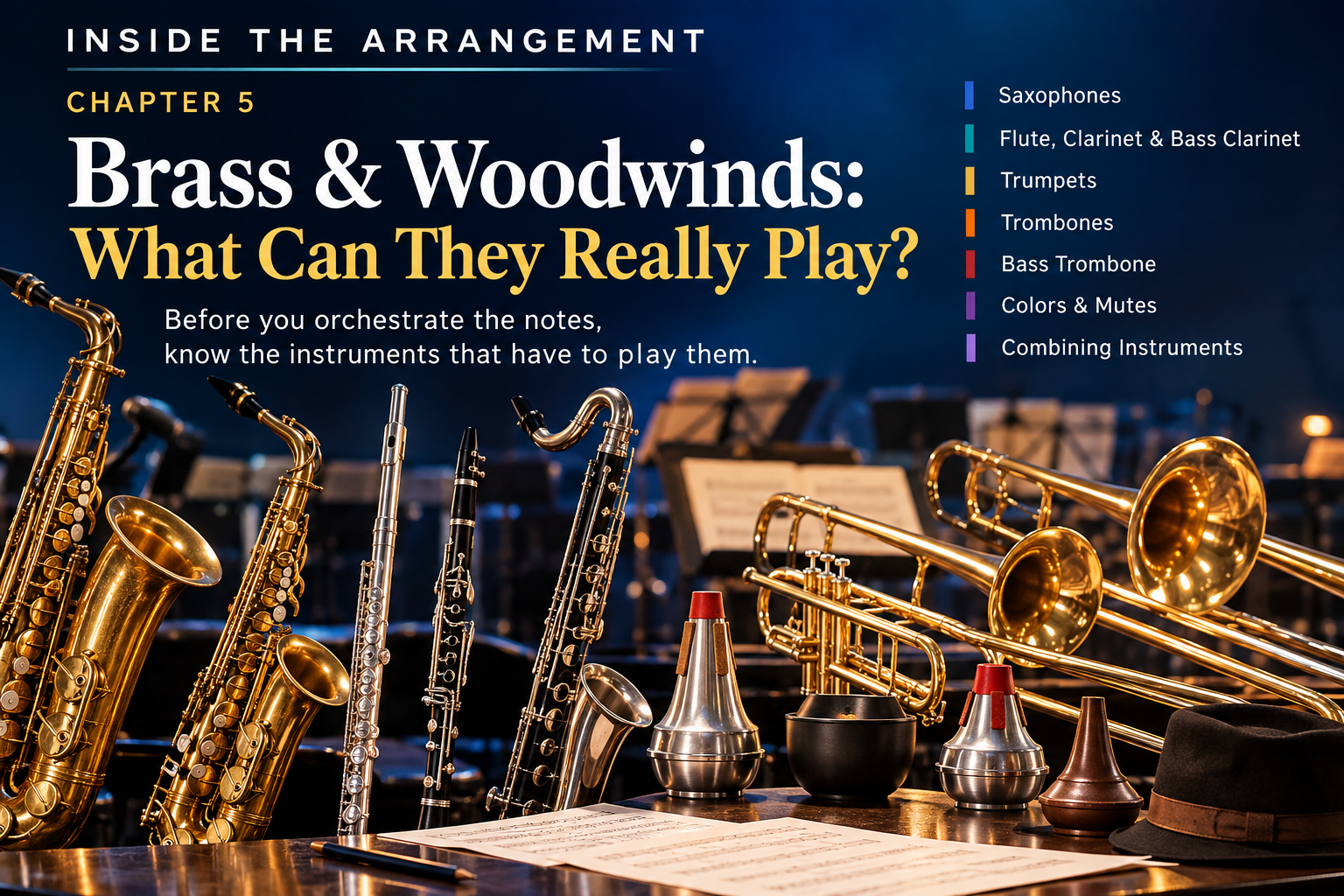
INSIDE THE ARRANGEMENT
Knowing an instrument’s range is not the same as knowing how to write for it. In Chapter 5 of Inside The Arrangement, we explore the practical registers of saxophones, woodwind doubles, trumpets and trombones—and how register, mutes and instrumental combinations shape the colors of a big-band arrangement.
Chapter 5 — Brass & Woodwinds: What Can They Really Play?
Before you orchestrate the notes, know the instruments that have to play them.
We have built the foundation of our arrangement.
The bass provides harmonic direction and movement.
Piano and guitar help establish harmony, rhythm and color.
The drums provide pulse, energy and interaction with the entire ensemble.
Now it’s time to turn our attention to the instruments that will give a big-band arrangement much of its character, power and color:
The brass and woodwinds.
But before we start writing saxophone solis, trumpet voicings, trombone backgrounds or powerful brass tuttis, there is a fundamental question every arranger needs to understand:
What can these instruments actually do?
At first, the answer seems simple.
Look at a range chart.
Find the lowest note.
Find the highest note.
Stay somewhere between the two.
Unfortunately, it isn’t quite that simple.
Because knowing the range of an instrument is not the same as knowing how to write for it.
⸻
RANGE IS ONLY THE BEGINNING
A range chart tells us which notes an instrument can theoretically produce.
That’s useful information.
But for an arranger, it isn’t enough.
A note may be technically possible but uncomfortable.
Another note may be perfectly comfortable but have the wrong character for the musical passage.
A note that works beautifully for an experienced professional may be unreliable for a student or developing player.
And some registers require specialists.
The most obvious example in a big band is the lead trumpet.
So when I’m writing an arrangement, I don’t only ask:
Can the instrument play this note?
I also ask:
Who is going to play it?
How difficult is it in this musical context?
And what will it sound like?
That gives us three useful ways of thinking about range.
1. Comfortable / Core Register
This is the part of the instrument where most competent players can perform reliably and where the instrument generally speaks naturally.
2. Advanced / Professional Register
These notes are absolutely usable, but the demands on the player increase.
Dynamics, articulation, endurance, tempo and the surrounding musical material all become increasingly important.
3. Specialist / Extreme Register
These notes may be possible—and sometimes spectacular—but they require the right player.
They should be used because the music needs them, not simply because a range chart says they exist.
And that brings us to an important distinction:
Range tells us which notes are available.
Register tells us what happens to the sound when we use them.
Not every register has the same character.
Let’s look at the instruments.
⸻
1. THE SAXOPHONES
The standard big-band saxophone section usually gives us five chairs:
Alto 1
Alto 2
Tenor 1
Tenor 2
Baritone
On paper, these instruments have substantial ranges.
But again, the question isn’t simply how high or low they can play.
Where do they sound best for what I want to achieve?
An alto saxophone in its middle register can sound warm, clear and flexible.
Move upward and the sound becomes increasingly brilliant and penetrating.
A tenor saxophone can move from a rich, warm character into a much stronger and more projecting upper register.
The baritone saxophone gives us tremendous weight at the bottom of the section, but it can also be surprisingly agile and powerful higher in its register.
The arranger therefore isn’t merely choosing pitches.
We are choosing character.
And there is another reason the saxophone section is particularly interesting.
The players sitting behind those five saxophones may give us considerably more than five instrumental colors.
⸻
2. THE DOUBLERS — FLUTE, CLARINET & BASS CLARINET
In professional big-band and studio writing, saxophone players are frequently asked to double on other woodwind instruments.
Common doubles include:
Flute
Clarinet
Bass Clarinet
And depending on the music and personnel, other woodwind doubles may also be available.
This gives the arranger an enormous palette of colors.
But it also introduces an important practical consideration:
A great saxophonist is not automatically an equally great flutist or clarinetist.
Professional woodwind doublers spend years developing those additional instruments.
So before writing a demanding flute passage into an alto chair simply because the player also owns a flute, consider who will actually perform the arrangement.
The same principle we used throughout the previous chapters applies here:
What does the player need—and what can I reasonably ask the player to do?
The reason for using doubles shouldn’t simply be:
Because they’re available.
It should be:
Because I want that sound.
A flute can add lightness and transparency above a saxophone texture.
A clarinet can blend beautifully into a saxophone section while introducing a different character.
A bass clarinet can add a dark, warm color underneath tenor and baritone saxophones.
These aren’t merely extra instruments.
They are additional colors.
And color is becoming increasingly important to our arrangement.
⸻
3. THE TRUMPETS
Now we arrive at an instrument where understanding the difference between possible and practical becomes especially important.
Trumpets can be brilliant.
Powerful.
Warm.
Soft.
Aggressive.
Lyrical.
And, in the right hands, extraordinarily exciting in the upper register.
But this is exactly where a range chart can get an inexperienced arranger into trouble.
A chart may show us that a very high note is possible.
Fine.
But:
For whom?
A professional big band normally has clearly differentiated trumpet chairs, and the lead trumpet has a particularly demanding role.
The lead player is often responsible for the upper register and for defining much of the articulation, phrasing and energy of the brass section.
That player is a specialist.
So we should be careful about making statements such as:
“The trumpet can play this high.”
A more useful question is:
Which trumpet player am I writing this for?
And there is another factor:
One high note is not the same as living in the high register.
A strong player may comfortably produce an isolated upper-register note.
That doesn’t mean we should write sixteen bars continuously at that level.
Range and endurance are connected.
So are range and dynamics.
Range and articulation.
Range and tempo.
Range and what came immediately before.
The arranger has to consider the entire passage—not just its highest note.
Possible doesn’t automatically mean practical.
⸻
4. THE TROMBONES
The trombone presents us with another interesting problem.
Again, knowing the available notes is only the beginning.
The instrument is controlled partly through the movement of the slide.
That means two notes may both be perfectly comfortable individually while a rapid passage between them becomes considerably more demanding.
Tempo matters.
Articulation matters.
Slide movement matters.
The shape of the musical line matters.
So when writing for trombone, we need to ask more than:
Are all these notes within the range?
We also need to ask:
Does this line actually lie well on the instrument?
That is an important distinction.
Playable notes do not automatically create a playable line.
As with trumpet, register also changes character.
The middle register can give us a warm, full brass sound.
Moving upward can add brilliance, intensity and excitement.
Moving lower can add increasing weight.
And then we reach an instrument that deserves to be considered separately.
⸻
5. THE BASS TROMBONE
It is tempting to think of the bass trombone as simply:
Trombone 4, but lower.
That seriously underestimates the instrument.
The bass trombone can provide enormous depth and authority to the bottom of a brass section.
Used well, it can transform the weight of an entire voicing.
It can reinforce the bottom of the trombone section.
It can combine with baritone saxophone.
It can interact with bass.
And it can provide a powerful foundation underneath full brass writing.
But once again, the lowest possible note is not automatically the best note.
We need to understand where the instrument speaks naturally, where it produces its characteristic weight and what we are asking the player to sustain.
The bottom of the brass section is not simply a place to put the lowest available note.
It is part of the orchestration.
And now we’re beginning to move from range toward something much more interesting.
⸻
FROM RANGE TO COLOR
So far we have asked:
What can the instruments play?
But an arranger needs to ask another question:
What do I want them to sound like?
This is where instrumentation becomes truly exciting.
Because an instrument doesn’t have one sound.
Register changes the sound.
Dynamics change the sound.
Articulation changes the sound.
And with brass instruments, we have another powerful tool:
Mutes.
⸻
BRASS MUTES — CHANGING THE COLOR
A trumpet or trombone doesn’t have to play open all the time.
Different mutes can dramatically change its character.
Among the colors an arranger may choose are:
Straight Mute
Cup Mute
Harmon Mute
Plunger
Playing into a hat
Each produces a different effect.
And I think it’s important to understand what we’re doing here.
A mute isn’t simply a device for making an instrument quieter.
A mute is an orchestration choice.
A cup-muted brass passage has a completely different character from the same passage played open.
A Harmon-muted trumpet can create an intimate, concentrated and immediately recognizable color.
A plunger can introduce an expressive, almost vocal quality.
Playing into a hat can soften and alter the projection of the instrument.
So once again, our question shouldn’t be:
Which mute can I use?
It should be:
What sound does the music need?
⸻
NOW LET’S START MIXING THE COLORS
Once we understand the individual instruments, their registers and some of their available colors, another fascinating question appears:
What happens when we combine them?
A trumpet and trombone playing together don’t simply create “more brass.”
A flute combined with muted trumpets can create a completely different texture.
Clarinet combined with saxophones changes the character of the woodwind section.
Baritone saxophone and bass trombone can create considerable weight at the bottom of an ensemble.
Trumpets and saxophones can add brilliance to one another.
And the same musical idea can sound completely different depending on which instruments carry it.
Think about some possibilities:
Trumpets + Trombones
Power, brilliance and weight.
Saxophones + Brass (Tutti)
A fusion of reed and brass colors that can produce anything from warmth to enormous ensemble power.
Flute + Muted Trumpets
A lighter and more unusual color—very different from either sound alone.
Clarinet + Saxophones
A natural way of changing the character of a saxophone texture without completely abandoning its reed quality.
Baritone Saxophone + Bass Trombone
A powerful combination when we want additional weight at the bottom.
And these are only starting points.
Two instrumental colors combined can create a new color of their own.
This is one of the most fascinating parts of arranging.
But it also leads us into a subject that deserves considerably more space than we have left in this chapter.
⸻
BUT THAT ISN’T ORCHESTRATION—YET
We now know more about the instruments available to us.
We understand that a theoretical range is not the same as a practical range.
We know that register changes character.
We know that professional and specialist players allow us to extend what is realistically possible.
We know that woodwind doubling expands our palette.
And we know that mutes and instrumental combinations can dramatically alter color.
But we still haven’t answered one of the biggest questions an arranger faces:
Who should play what?
Suppose I have a melody.
Should five saxophones play it?
Trumpets?
Trombones?
Flute and muted trumpets?
Should I double it in octaves?
Should the sections play together?
Should one section carry the melody while another provides a background?
How should the notes of a chord be distributed through the ensemble?
And how do I turn the notes I hear in my head into a convincing big-band sound?
Now we’re talking about:
ORCHESTRATION.
And I don’t want to squeeze that subject into the end of this chapter.
It deserves a chapter of its own.
⸻
COMING NEXT
Chapter 6 — Orchestration: Who Plays What?
We now know our instruments.
We know more about their practical ranges, their registers, their strengths and their limitations.
We have also started exploring their colors.
Now we need to put them to work.
In Chapter 6, we’ll take the next step and ask:
Who plays the melody?
Who supports it?
Which instruments should be combined?
How should we distribute the notes?
When should sections blend—and when should they remain separate?
Voicing Techniques (e.g. "What is Drop 2 or Drop 2 & 4)
And perhaps most importantly:
How do we make the arrangement sound like the music we hear in our head?
Because instrumentation tells us what instruments we have.
Orchestration is deciding what to do with them.
See you in the next chapter.
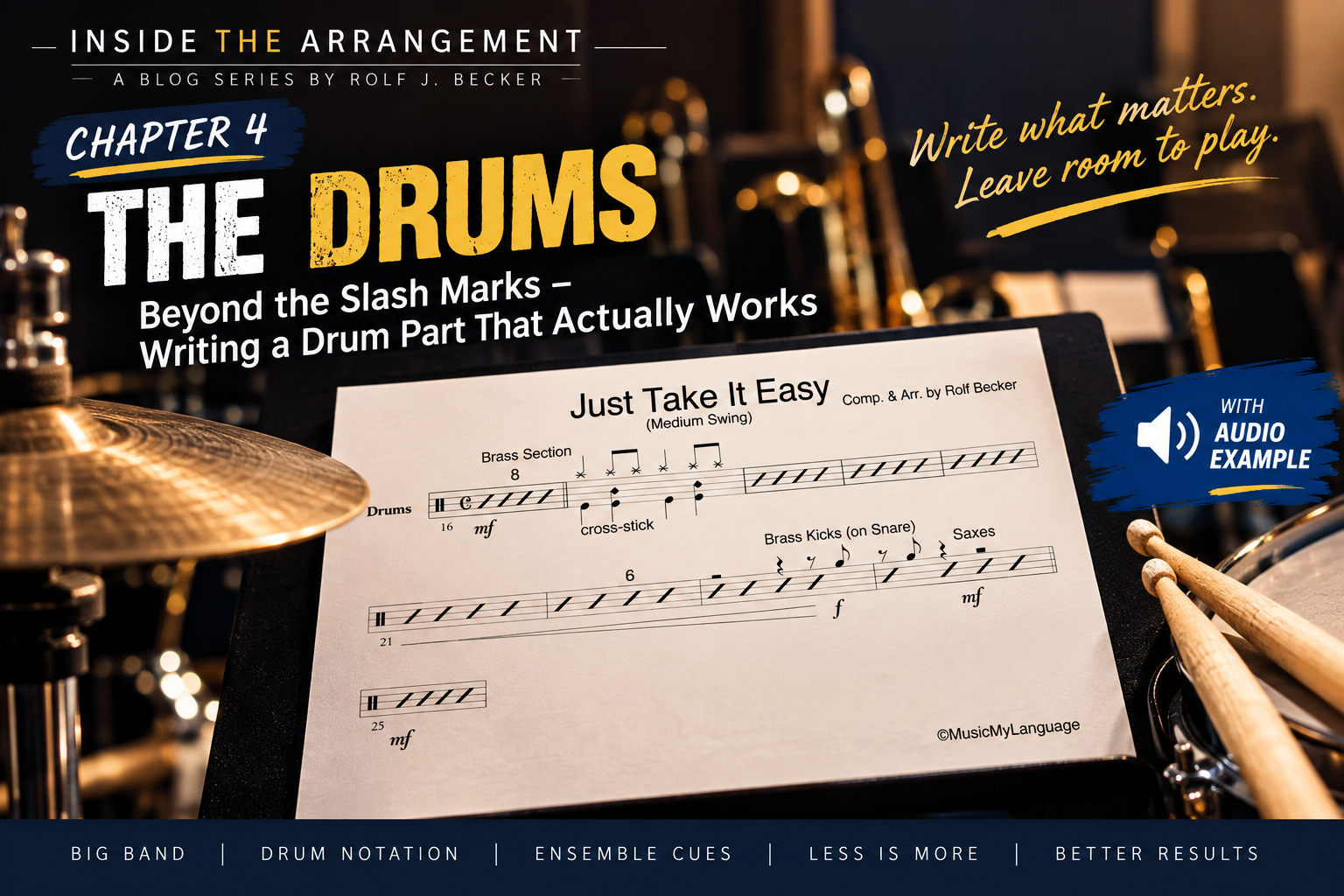
INSIDE THE ARRANGEMENT
A great drum part is more than slash marks. Discover how the right balance of ensemble cues, dynamics, written figures and creative freedom gives the drummer exactly what they need—and helps the entire big band perform more efficiently.
Chapter 4 — The Drums
Beyond the Slash Marks: Writing a Drum Part That Actually Works
A page full of slashes may tell the drummer where the measures are.
It doesn’t necessarily tell the drummer what the arrangement is doing.
At the other extreme, writing out every single hi-hat, ride cymbal, snare and bass drum note can be just as problematic.
So where is the right balance?
For me, a good drum part comes down to one basic principle:
Write what matters. Show what is happening.
Then leave room for the drummer to play.
Let’s return once again to Just Take It Easy and look at how I approach the drum part.
⸻
THE DRUMMER NEEDS A ROADMAP
When I write a big-band drum part, I don’t want to dictate every single bar.
A good drummer already knows how to play time.
I don’t need to tell an experienced player exactly where every ride-cymbal note belongs or prescribe every detail of the groove.
What the drummer does need to know is what is happening inside the arrangement.
For example:
Are the saxophones playing the melody?
Is there a trumpet solo?
Are the trombones playing important rhythmic kicks?
Is the full band playing a powerful tutti passage?
Are we entering the shout chorus?
Is there a break?
Is there an important dynamic change?
That information can completely change the way a drummer approaches a passage.
A simple written indication such as:
Saxes with Melody
or
Trumpet Solo
or
Shout Chorus
immediately gives the player musical context.
The drum part becomes a roadmap of the arrangement, rather than merely a collection of measures.
⸻
WRITE THE IMPORTANT FIGURES
There are moments when simply writing slashes is not enough.
If the trombones are playing important rhythmic kicks, I want the drummer to see those figures.
If the whole band is playing a powerful tutti passage, I want the rhythmic structure of that passage clearly represented in the drum part.
Why?
Because now the drummer can support, set up and reinforce what the ensemble is doing.
A trombone figure might suggest an appropriate response or setup on the bass drum.
A powerful tutti passage might call for a completely different approach, perhaps involving snare, cymbals and strong ensemble accents.
But there is an important distinction:
I am showing the drummer the band figure.
I am not necessarily orchestrating every drum stroke.
That is where good drum notation becomes particularly useful.
Example 4.1 — Drum Part with Ensemble Figures and Cues:
Look at Example 4.1.
Most of the part is deliberately left open. But whenever the drummer needs specific information, it appears on the page:
ensemble figures, instrumental cues, dynamics and even instructions about how certain figures should be played.
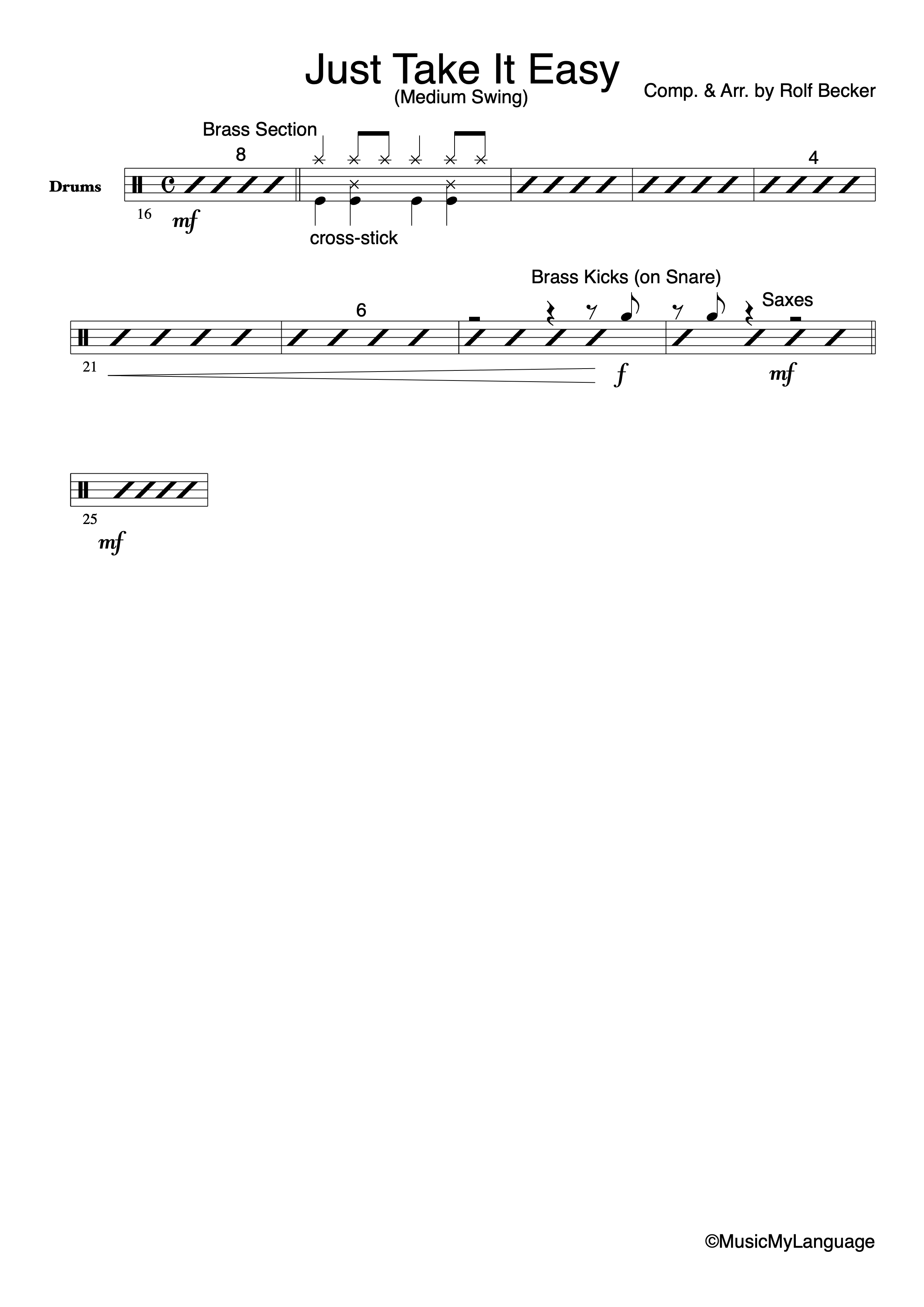
Drum Part with Ensemble Figures & Cues
The drummer isn’t being told what to play every second.
The drummer is being told what matters.
Audio Example 4.1 — Drum Part in Context:
Listen while following the notation above. Notice how the written figures provide the necessary ensemble information
while the open measures leave the drummer free to maintain the groove and shape the performance.
⸻
DON’T WRITE EVERYTHING
This is where arrangers can easily go too far.
If every bar contains fully written snare, bass drum, cymbal and hi-hat notation, we may actually make the part less useful.
The drummer’s attention becomes occupied with reproducing our notation rather than listening and reacting to the band.
And that can remove exactly what we want from a good rhythm-section player:
musical creativity.
Of course, there are situations where detailed notation is necessary.
If I need a very specific rhythmic effect, I write it.
If a fill must lead precisely into an ensemble entrance, I make that clear.
If a rhythmic figure is fundamental to the arrangement, the drummer should see it.
But if the drummer simply needs to play time for eight bars, why write eight bars of detailed drum notation?
Give the player the style, the musical context and the important information.
Then let the drummer play.
This is the same principle we encountered with piano and guitar in Chapter 3:
What does the player need?
Not:
How much can I possibly write on the page?
⸻
LESS NOTATION DOESN’T MEAN LESS INFORMATION
This distinction is important.
An uncluttered drum part should not be a vague drum part.
In fact, the best drum parts often contain less notation but more useful information.
That includes:
Dynamics.
Ensemble figures.
Important kicks.
Breaks and setups.
Changes of style or feel.
And written information about what is happening elsewhere in the band.
A drummer who sees Shout Chorus understands something that four bars of anonymous slash notation cannot communicate.
A drummer who sees Trumpet Solo immediately understands the musical hierarchy.
A drummer who sees an important brass figure can prepare for it before it happens.
The page should help the drummer understand the arrangement.
Less notation. More information.
⸻
BUT THE DRUMMER HAS TO BE ABLE TO READ IT
There is another side to this.
If we provide a carefully prepared drum part containing rhythmic figures, kicks, dynamics, cues and structural information, the drummer must be able to interpret that information.
Reading is therefore an important professional skill for a drummer working with written big-band arrangements.
And then, of course, jazz history gives us one rather spectacular exception.
AND THEN THERE WAS BUDDY RICH…
Buddy Rich was one of the most extraordinary big-band drummers in jazz history.
Yet Rich famously did not rely on conventional music reading in the way we would normally expect from a big-band drummer.
His extraordinary ears and musical memory allowed him to absorb complex arrangements by listening and retain an astonishing amount of musical information.
Henry Adler attempted to teach Rich to read music, but Rich’s performing and touring schedule repeatedly interrupted the process.
Musicians who worked with him also described his remarkable ability to hear an arrangement and remember its structure.
In other words, Buddy Rich could do something most musicians simply cannot.
So unless your drummer happens to possess Buddy Rich’s extraordinary musical memory…
give them a drum part they can read.
⸻
THE DRUM PART IS PART OF THE ARRANGEMENT
This brings us back to something that has been developing throughout Inside The Arrangement.
The rhythm section is not a collection of independent musicians.
It is one musical system.
The bass player needs to understand harmonic direction.
The guitarist needs to understand the rhythmic and harmonic framework.
The pianist needs to know where there is room to contribute—and where there isn’t.
And the drummer needs to understand what the entire band is doing.
That is why I don’t consider the drum part an afterthought that gets created after the “real” arranging is finished.
The drum part is part of the arrangement.
The clearer that part communicates the architecture of the music, the easier it becomes for the drummer to interact with the ensemble.
And the more efficiently the entire band can rehearse.
⸻
THE BALANCE
So what does a good big-band drum sheet actually need?
Not every note.
And certainly not just endless slash marks.
It needs the right information at the right moment.
Write the figures that matter.
Show the drummer what is happening in the band.
Include the dynamics.
Make the important kicks, breaks and transitions clear.
And wherever detailed notation is unnecessary, leave enough space for the drummer’s experience, musicality and creativity.
Because ultimately, a good drum part doesn’t tell the drummer how to play every beat.
It tells the drummer what matters.
Less notation. More information.
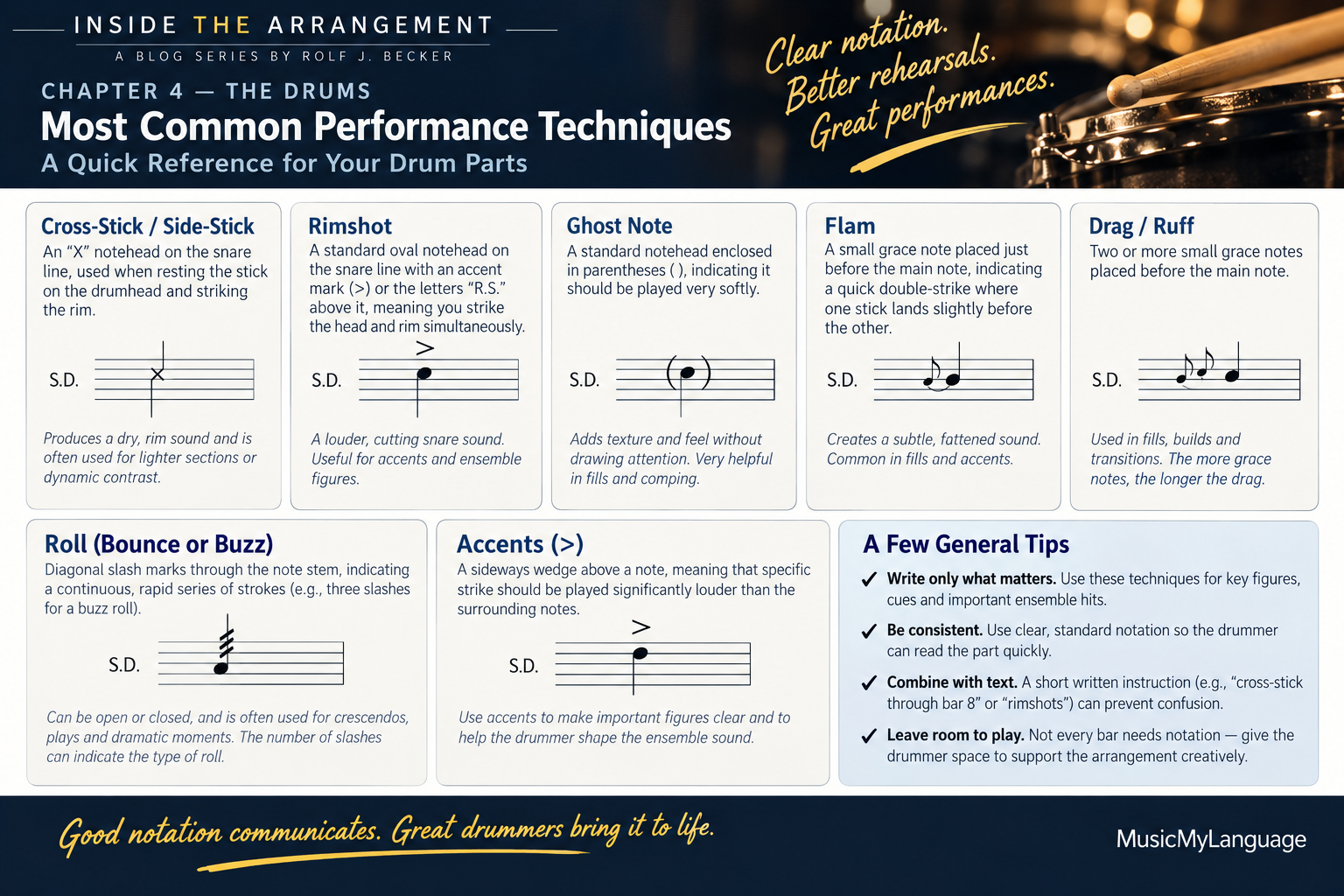
Most Common Performance Techniques
Coming Next
Chapter 5 — Brass & Woodwinds: What Can They Really Play?
We have built the foundation of the arrangement.
Bass, piano, guitar and drums have established the harmony, pulse, groove and rhythmic framework.
Now it’s time to turn our attention to the instruments that will give the arrangement much of its character, power and color:
The brass and woodwinds.
But before we start writing voicings and combining sections, there is a fundamental question every arranger needs to understand:
What can these instruments actually do?
What is the practical range of a trumpet, trombone or saxophone?
Which registers sound comfortable and natural—and which become demanding or potentially unreliable?
And just because a note exists in an instrument’s theoretical range, does that mean we should write it?
Then there is another essential consideration:
Not every register has the same sound.
A trumpet in its middle register has a very different character from a trumpet high above the staff.
A tenor saxophone can move from warm and full to increasingly powerful and penetrating as we change register.
And the same principle applies throughout the brass and woodwind sections.
Understanding range therefore isn’t only about knowing which notes are possible.
It’s about understanding what those notes will sound like.
And once we understand the individual instruments, another fascinating question appears:
What happens when we combine them?
Trumpets with trombones.
Saxophones with brass.
Flutes with muted trumpets.
Clarinet with saxophones.
And other options.
Different registers, doublings and instrumental combinations can transform exactly the same musical idea into completely different sounds and colors.
In Chapter 5, we’ll explore the practical possibilities and limitations of brass and woodwind instruments, their useful ranges, and how combining them begins to create the orchestral colors of a big-band arrangement.
Because before deciding what notes to write, an arranger needs to understand who is going to play them.
See you in the next chapter.
Small Big Band Arrangements for Sale: What to Look For
Discover what makes a Small Big Band arrangement work — from instrumentation and voicing to balance, playability and professional scoring.
Finding small big band arrangements that retain the energy, color, and impact of a larger ensemble is not simply a question of reducing the number of players.
A smaller instrumentation changes the way an arranger thinks about voicing, register, balance, dynamics, and the function of every individual instrument. With fewer musicians available, every line becomes more exposed and every orchestration decision becomes more important.
That is precisely what makes the Small Big Band format so interesting.
Rather than trying to imitate a full big band with missing chairs, a well-written Small Big Band arrangement should be conceived for the musicians who are actually going to perform it.
## Defining the MusicMyLanguage Small Big Band
For the MusicMyLanguage Small Big Band Series, I use a clearly defined instrumentation:
3 Saxophones • 3 Trumpets • 3 Trombones • Piano • Bass • Drums
This provides three distinct horn sections together with a complete rhythm section while requiring considerably fewer musicians than a traditional large big band.
The objective is not simply to make the ensemble smaller. The objective is to use those available instruments intelligently enough to retain the characteristics we associate with big band writing: power, contrast, harmonic color, rhythmic precision, and sectional interplay.
### Small Big Band Voicings
Writing for fewer horns requires a different approach to voicing.
In a larger big band, an arranger has more individual voices available and can distribute harmony across wider sections. With a reduced instrumentation, every note has to contribute more directly to the musical result.
Sometimes unison or octave writing creates the strongest statement. At other times, compact harmonic voicings produce the necessary density. Contrasting the saxophones, trumpets, and trombones can create the impression of a much larger palette without simply having everybody play all the time.
The important question is therefore not how many notes can be included in a voicing, but which notes and instrumental combinations best communicate the musical idea.
### Balancing Power with Practicality
A smaller ensemble does not necessarily have to sound small.
Register plays an important role. Writing constantly at the extremes of an instrument can create unnecessary technical demands without producing a better musical result. Effective scoring places musicians where their instruments speak naturally and uses extreme registers when the musical effect genuinely requires them.
Dynamics are equally important. A convincing forte is created through orchestration and balance, not simply by asking every player to play louder.
This principle is central to my Small Big Band arrangements: achieving power, color, and musical impact through efficient scoring rather than sheer numbers of musicians.
## Evaluating Professional Scoring and Playability
When looking at small big band arrangements for sale, the title of the tune is only one consideration.
I would also look carefully at the score itself.
Does the instrumentation suit your ensemble? Are the instrumental ranges sensible? Is the notation immediately understandable? Are articulations and dynamics consistent? Does the rhythm section receive enough information to understand the intended style without being unnecessarily restricted?
These details directly influence what happens when the music reaches the rehearsal room.
### Clarity in Notation and Phrasing
Good notation should communicate musical intention as efficiently as possible.
Articulations should be consistent between related horn lines. Dynamic markings should clarify the architecture of the arrangement. Rhythmic notation should be readable, and phrasing should help musicians understand where a line is going.
In a reduced ensemble this becomes particularly important because individual voices are more exposed.
If three trumpets are playing a harmonized figure, for example, inconsistent articulation immediately affects the section sound. The same applies to saxophone phrasing, trombone attacks, releases, accents, and dynamics.
The arranger's responsibility is to give musicians enough information to understand the musical intention without cluttering the page with unnecessary instructions.
### Stylistic Authenticity in Reduced Formats
Instrumentation may change, but musical style still has to remain convincing.
Swing, funk, Latin, ballad, bebop, pop, and contemporary jazz each require their own approach to articulation, rhythmic placement, harmony, orchestration, and rhythm-section writing.
Reducing the number of musicians does not remove those stylistic requirements.
For me, this is one of the most interesting aspects of arranging for Small Big Band: deciding how to preserve the character of the music with fewer instrumental resources.
The answer is rarely simply to remove parts from a larger score. The arrangement has to be reconsidered so that the reduced ensemble feels complete in its own right.
## The Rolf Becker Approach to Small Big Band Charts
My approach comes from decades of working as a composer, arranger, conductor, and performing musician.
That experience has repeatedly reinforced one principle:
A good arrangement should help the musicians make music. It should not stand in their way.
What appears sophisticated on a computer screen or in a full score is not automatically effective in rehearsal or performance. Ultimately, the arrangement has to work when real musicians put it on their stands.
### Craftsmanship in Every Section
For me, arranging is a continuous process of musical decision-making.
Should this passage be harmonized or played in unison?
Does the melody need the brilliance of trumpets, the warmth of trombones, the flexibility of saxophones, or a combination of sections?
Should the rhythm section support the horns or temporarily become the principal musical voice?
Would another background figure strengthen a solo, or simply compete with it?
These decisions shape the character of an arrangement far more than the number of instruments on stage.
With fewer musicians, those decisions become even more visible. There is less room for unnecessary doubling and less reason to write material merely to keep every player busy at every moment.
### Suitability for Live Performance
I write these arrangements with live performance in mind.
That means considering balance, instrumental ranges, rhythmic clarity, breathing, transitions, dynamics, and the relationship between the horn sections and rhythm section.
The aim is not to remove musical challenge. Good repertoire should challenge musicians.
But difficulty should serve the music rather than exist simply for its own sake.
The MusicMyLanguage Small Big Band catalog includes both original compositions and arranged repertoire, with each chart approached specifically from the perspective of this compact ensemble format.
## Small Big Band and Other Ensemble Options
Not every ensemble requires the same format.
For groups that want the sectional character of a big band with fewer musicians, the Small Big Band provides a practical alternative to the traditional full-size ensemble.
For still smaller groups, the [Septet Series](https://www.music-my-language.com/mml-septet-series) uses Trumpet, Alto Sax, Tenor Sax, Baritone Sax, Piano, Bass, and Drums.
The musical challenge is different again: four horns must create contrast, harmonic movement, and ensemble power while leaving sufficient space for the rhythm section.
Organizations with a particular instrumentation or repertoire requirement can also consider [custom ensemble commissions](https://www.music-my-language.com/ensemble-commissions), where the music can be written around the actual musicians available.
## Original Repertoire Versus Arranged Repertoire
Small Big Band writing can work particularly well when the music is conceived for the format from the beginning.
An original composition allows every musical idea to be developed around the available instrumentation. Melody, harmony, backgrounds, sectional writing, solos, and transitions can all grow naturally from the ensemble itself.
Arranged repertoire presents a different challenge.
Here the objective is to retain the musical identity of the source while translating it convincingly into a smaller instrumentation.
That does not necessarily mean reproducing every detail of a larger original arrangement. Sometimes the most effective solution is to identify what gives the music its character and rebuild those essential elements for the available forces.
The result should sound intentional rather than reduced.
## Small Big Band Arrangements in Music Education
A compact ensemble can also be valuable in an educational environment because every musician has an important musical role.
With fewer players in each section, balance, articulation, intonation, rhythmic precision, and listening become immediately noticeable.
This creates useful opportunities for directors to work on ensemble fundamentals while still rehearsing genuine performance repertoire.
### Sight Reading and Ensemble Development
Clear, professionally prepared notation is particularly valuable when developing sight-reading skills.
Musicians should be able to identify the structure of a chart quickly: introductions, themes, backgrounds, solo sections, transitions, dynamics, articulations, and endings.
The broader [Music Library](https://www.music-my-language.com/music-library) contains repertoire for different ensemble formats, allowing directors and musicians to explore material according to their particular requirements.
Sight reading improves through regular exposure to well-written musical material. The objective is not merely to read the correct notes, but to recognize style, phrasing, articulation, dynamics, and musical function as quickly as possible.
### Connecting Rehearsal to Performance
Ultimately, an arrangement has to move beyond the rehearsal room.
A successful chart should give musicians something worth developing over repeated rehearsals and provide an audience with a convincing musical experience when it reaches the stage.
That connection between rehearsal and performance is central to the way I approach arranging.
Technique, balance, articulation, dynamics, and stylistic accuracy are not separate academic exercises. They are tools musicians use to communicate the music.
## Exploring the MusicMyLanguage Small Big Band Catalog
The dedicated [Small Big Band Charts](https://www.music-my-language.com/small-big-band-charts) page brings together the available repertoire in the series.
When considering a chart, look at the instrumentation, musical style, character of the arrangement, and whether it fits the players and performance situation you actually have.
A smaller ensemble should never be treated simply as a compromise.
With thoughtful orchestration, clear notation, effective voicing, and an understanding of how the instruments work together, a Small Big Band can produce remarkable power, color, and musical variety.
That is the principle behind the MusicMyLanguage Small Big Band Series.
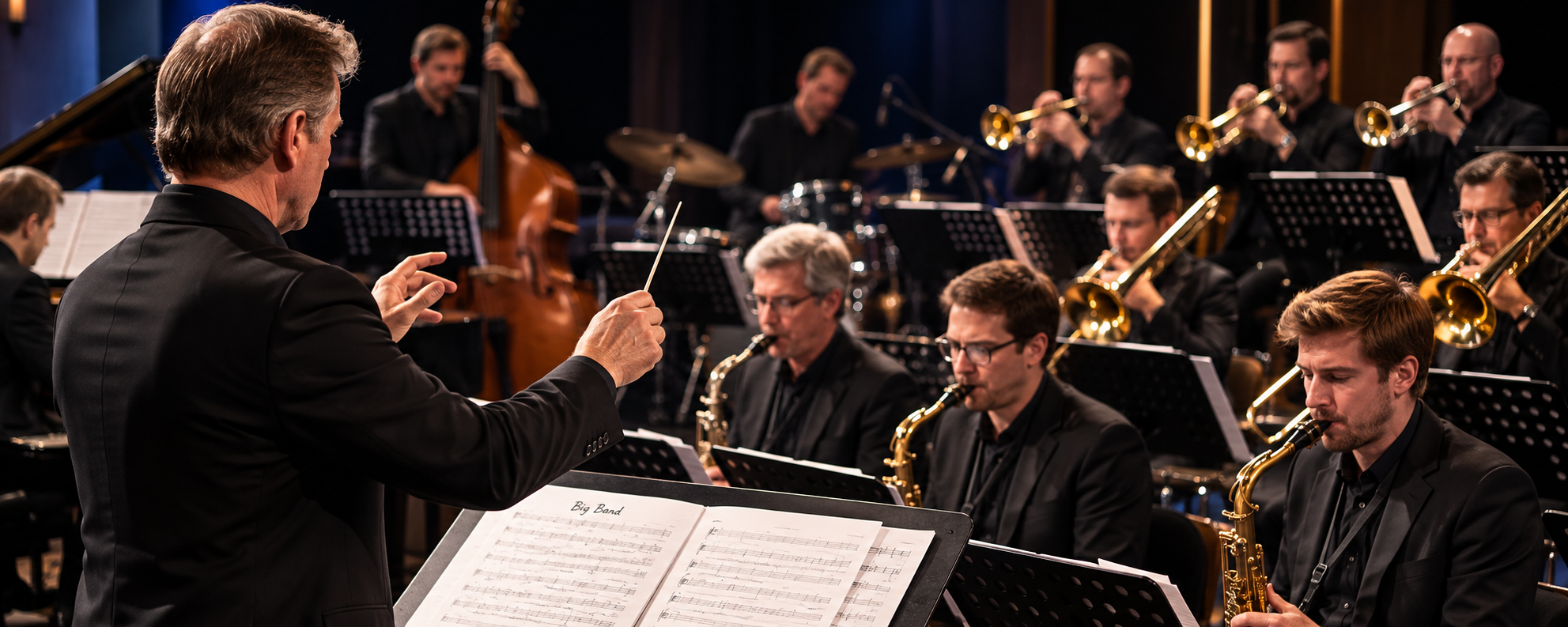
Buy Big Band Charts Online That Fit Your Ensemble
Choosing the right big band chart goes far beyond picking a great tune. Discover what to look for in instrumentation, playability, notation, style and arranging craftsmanship before buying your next chart.
Finding the right chart is about more than choosing a tune your ensemble might enjoy. When you buy big band charts online, you are investing rehearsal time, musical energy, and budget into material that needs to work for the musicians who will actually perform it.
A convincing audio demo or a well-known title can certainly attract attention, but neither tells you everything you need to know about an arrangement. Instrumentation, ranges, notation, balance, stylistic accuracy, solo opportunities, and the overall construction of the chart can make the difference between an enjoyable rehearsal process and one spent solving unnecessary problems.
I have spent decades composing, arranging, performing, and conducting ensembles in different countries and musical environments. One principle has remained consistent throughout that experience: a good arrangement should help the musicians make music. It should not stand in their way.
Here are some of the things I consider particularly important when choosing professional big band charts.
Assessing Instrumentation Before You Browse
Before buying an arrangement, start with one very practical question:
Who is actually going to play it?
Traditional big band instrumentation is relatively standardized, but not every ensemble works with the same lineup. Professional bands, school ensembles, university groups, community bands, project ensembles, and smaller jazz groups can all have different requirements.
Checking the instrumentation before purchasing therefore saves considerable rehearsal time later.
Standard vs. Reduced Instrumentation
A traditional big band commonly uses five saxophones, four trumpets, four trombones, plus rhythm section. That instrumentation produces the characteristic power and range of colors associated with the classic big band sound.
But a smaller ensemble does not necessarily have to sound small.
Good arranging can create considerable power, contrast, and harmonic color with fewer musicians. The important question is not simply how many instruments are available, but how effectively those instruments are used.
That philosophy is central to my own Small Big Band writing. Rather than treating reduced instrumentation as an incomplete traditional big band, I write specifically for the smaller format so that the available horns and rhythm section function as a complete ensemble.
If that format suits your group, you can explore the MusicMyLanguage Small Big Band Charts.
For an even more compact setting, the MusicMyLanguage Septet Series is based around four horns plus rhythm section.
Check the Actual Parts
Instrumentation is only the beginning. Look at the individual parts whenever previews are available.
Which instrument carries the melody? Where are the demanding passages? Are there exposed lines? What are the upper and lower ranges? Is a particular player expected to improvise?
These questions become especially important when programming music for a specific ensemble.
A technically excellent arrangement can still be the wrong arrangement for your band if one essential part sits consistently outside a player’s comfortable range or requires a stylistic ability that the player has not yet developed.
The best purchase is therefore not necessarily the most impressive chart. It is the chart that allows your ensemble to sound impressive.
Matching Difficulty Levels to Ensemble Skill
Difficulty labels can be useful, but they should be treated as a starting point rather than an absolute measurement.
Terms such as easy, intermediate, advanced, or professional can mean different things to different publishers and arrangers. The score itself tells you much more.
Look Beyond the Grade
When assessing a chart, examine the musical demands behind the difficulty label.
A passage may contain relatively few notes and still be challenging because of its range, articulation, rhythmic placement, dynamics, or stylistic requirements.
Conversely, a passage containing many notes may sit naturally on the instrument and be surprisingly comfortable to play.
Range is particularly important in brass writing. A trumpet part that remains unnecessarily high for long periods can become tiring regardless of how simple the rhythms appear.
The same principle applies throughout the ensemble. Good scoring considers not only whether a note can be played, but whether the entire part can be performed musically and consistently.
Rhythm, Articulation and Phrasing Matter
Jazz notation contains much more information than pitches and rhythms.
Articulations, accents, dynamics, note lengths, phrasing and stylistic conventions all influence the final result. Clear notation helps musicians understand what the arranger intends without requiring the conductor to explain every phrase during rehearsal.
This is particularly important in swing, funk, Latin music and other rhythmically defined styles.
For me, professional notation is not decoration added after the arrangement has been completed. It is part of the arrangement itself.
The score should communicate the music as clearly as possible.
Consider the Improvisation Requirements
If a chart contains open solo sections, check how those sections function.
Who can solo? Are the chord changes clearly presented? How long can the section continue? Does the ensemble have something musically useful to play behind the soloist?
An open solo section can be one of the most exciting moments in a jazz arrangement because it allows every performance to develop differently.
But the written arrangement still needs to provide a strong framework around that freedom.
Navigating Big Band Sheet Music Shops and Libraries
Buying sheet music online gives musicians and directors access to an enormous amount of repertoire. That is an advantage—but it also makes evaluation increasingly important.
A large catalog does not automatically mean that every chart will suit every ensemble.
Look at the Arrangement, Not Only the Song
One of the easiest mistakes when buying sheet music is choosing primarily by title.
You recognize the tune. Your musicians know it. Perhaps your audience knows it too.
But you are not really purchasing the song—you are purchasing an arranger’s interpretation of that song.
Two arrangements of the same composition can be completely different in instrumentation, difficulty, form, harmonic language, stylistic direction and rehearsal demands.
Whenever possible, examine the score preview and listen to the available audio example.
Ask yourself whether the arrangement itself—not merely the composition—is right for your ensemble.
The MusicMyLanguage Music Library brings together the different arranging formats and series available through MusicMyLanguage, making it easier to explore repertoire according to ensemble type and musical concept.
Read the Product Information Carefully
Before purchasing through any sheet-music platform, check exactly what is included.
Instrumentation, score and parts, arrangement format, available previews and the applicable purchasing or licensing conditions should be clear before you make a decision.
Where arrangements are sold through external publishing platforms, their respective purchase and licensing conditions apply.
This is particularly important for conductors and institutions building a repertoire library intended for repeated use.
Selecting Professional Big Band Charts by Style
A good jazz arrangement needs more than correct notes.
It needs a convincing understanding of style.
Swing, bebop, funk, Latin jazz, ballads and contemporary styles each require different approaches to rhythm, articulation, voicing, orchestration and phrasing.
Stylistic Authenticity Matters
A swing chart should feel like swing before the conductor has to explain it.
A funk chart needs an effective relationship between drums, bass, piano or guitar and the horn figures.
A Latin arrangement needs rhythmic clarity and an understanding of how its different layers interact.
This is where arranging becomes more than distributing notes among instruments.
The arranger is creating relationships between the sections of the ensemble.
Saxophones, trumpets, trombones and rhythm section each have their own character, but the arrangement needs to make them function as one musical organism.
Identifying Quality Arranging Craftsmanship
When looking at a score, pay attention to the details.
Are articulations consistent? Are dynamics meaningful? Are backgrounds written to support rather than obscure a soloist? Does the orchestration create contrast? Does the arrangement build somewhere, or simply repeat the same texture?
Also consider musical balance.
Not every instrument needs to play all the time. Sometimes the most effective arranging decision is to leave space.
Professional arranging is therefore not about putting as many notes as possible onto the page. It is about knowing which notes are necessary, who should play them, and when they should happen.
That principle becomes especially important with smaller ensembles, where every voice has a clearly audible function.
When to Commission Custom Big Band Arrangements
Published charts can cover a tremendous range of repertoire, but there are situations where a custom arrangement makes more sense.
Perhaps your ensemble has unusual instrumentation. You may have a particular soloist or vocalist you want to feature. You might need a specific duration, musical concept, opening number, finale, or arrangement built around the character of an event.
In those situations, commissioning an arrangement allows the music to be designed around the project rather than forcing the project to fit an existing chart.
MusicMyLanguage offers custom ensemble commissions for projects requiring an arrangement or original musical concept tailored to a particular ensemble.
A custom arrangement can also be useful when an existing musical idea needs to be transformed for a different ensemble format—provided, of course, that the necessary arranging and performance rights are available.
The important point is that instrumentation becomes part of the creative process from the beginning.
Building a Sustainable Repertoire Collection
A good music library should not simply contain a large number of titles.
It should contain music you genuinely want to perform.
Over time, those charts become part of an ensemble’s musical identity.
Balance Your Programming Needs
A useful repertoire collection contains contrast.
Fast and slow pieces. Swing and straight-eighth styles. Powerful ensemble charts and pieces featuring individual soloists. Familiar repertoire alongside less expected choices.
The exact balance depends on the purpose of the ensemble.
A professional concert band may have different priorities from a school ensemble, a community big band, a university jazz orchestra or a project band assembled for a particular event.
What they all share is the need for repertoire that works musically in performance.
Build a Library You Can Return To
Some arrangements are performed once and disappear into the archive. Others become charts musicians and conductors want to revisit.
Those are particularly valuable.
A well-written chart can reveal more with each performance because the musicians gradually move beyond simply playing the notes and begin concentrating on interaction, phrasing, dynamics, balance and interpretation.
That is when an arrangement becomes more than sheet music.
It becomes repertoire.
Maximizing Value from Your Music Library Purchase
When you buy big band charts online, consider four things before making the final decision:
Instrumentation. Playability. Style. Musical purpose.
Does the chart fit the musicians you actually have? Are the individual parts written intelligently? Does the arrangement communicate its style clearly? And does it serve the musical purpose for which you are buying it?
If those elements are right, rehearsals become more productive and musicians can concentrate on what ultimately matters: making music together.
A strong arrangement should give an ensemble something worth discovering—not merely something to play.
And that is ultimately what I look for in every chart I conduct, perform, or write.
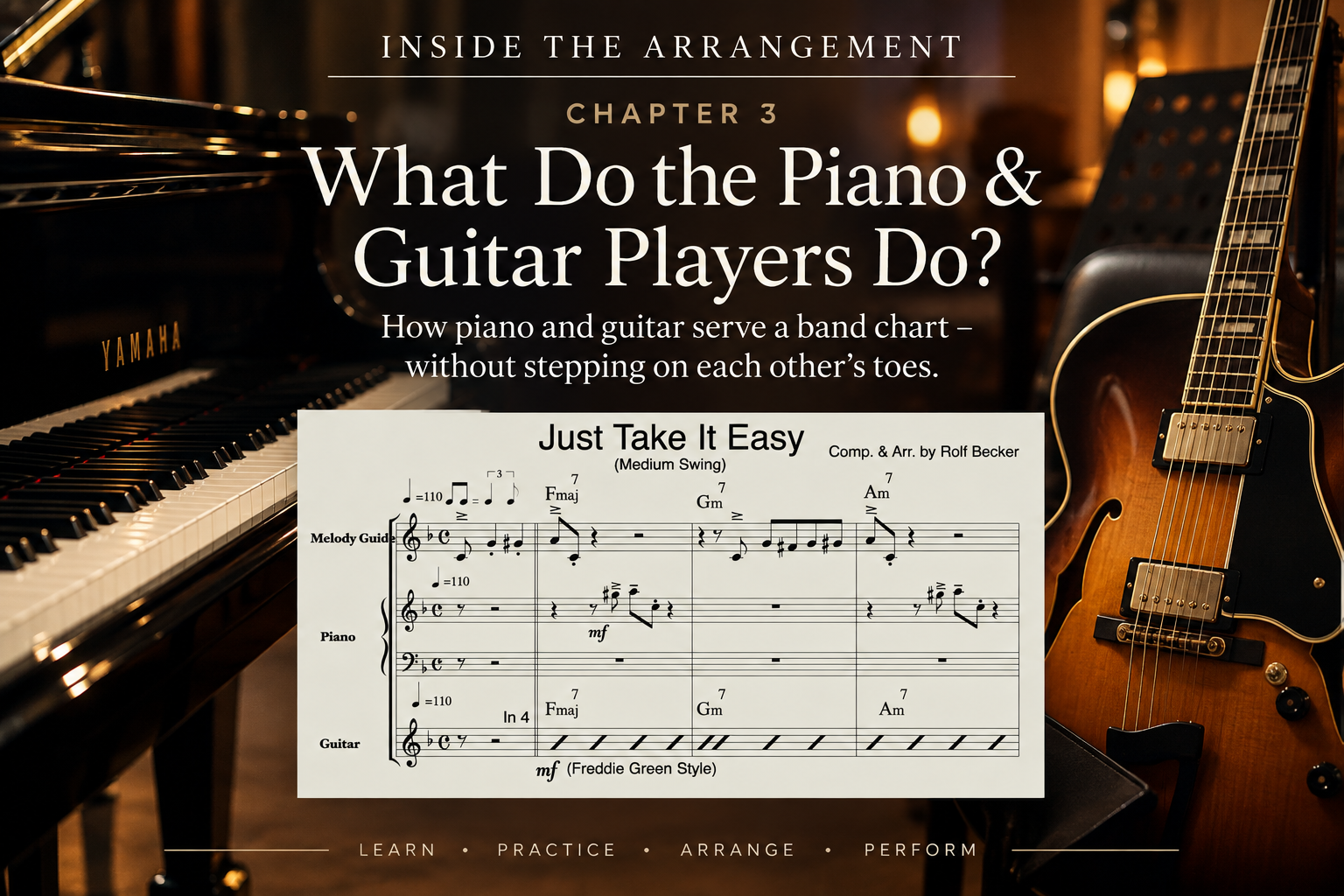
INSIDE THE ARRANGEMENT
How should piano and guitar work together in a Big Band arrangement without stepping on each other’s toes? In Chapter 3 of Inside The Arrangement, we explore their different roles, using Just Take It Easy as a practical example—from four-to-the-bar guitar comping to sparse piano fills, kicks and voicings that support the ensemble.
Chapter 3
What Do the Piano & Guitar Players Do?
How do piano and guitar serve a band chart and help create a satisfying, functional rhythm section—without stepping on each other’s toes?
The answer depends first on one very important factor:
The musical style of the arrangement.
For this chapter, let’s continue with Just Take It Easy and look at how I approached the piano and guitar parts step by step.
As I mentioned in Chapter 1, the inspiration for this composition came from Frank Foster’s Shiny Stockings, so wonderfully associated with the Count Basie Orchestra.
In that style, the roles of piano and guitar are beautifully clear.
The guitarist provides steady quarter-note chords, helping maintain the “In 4” flow together with the walking bass and drums.
The pianist does something very different.
Instead of constantly filling the harmony, the piano contributes occasional fills, accents and carefully placed chord kicks around the melody.
The result is not two chordal instruments competing for the same musical space.
It is two instruments performing different jobs inside the same rhythm section.
Audio Example 3.1 — Full Big Band: Piano & Guitar in Context
Listen to how piano and guitar perform different roles within the complete arrangement of Just Take It Easy. The guitar maintains the quarter-note swing flow, while the piano adds selective fills and chord kicks around the melody and ensemble figures.
Note: This audio example also accompanies the notation examples below.
⸻
A) THE PIANO
When writing the piano part, I normally think first about how much freedom the pianist should have.
There are three practical approaches.
Option 1 — Guide the Professional Player
For an experienced professional pianist—especially when performing a new or unfamiliar composition—I strongly recommend a two-stave piano part.
The upper stave can contain:
a melody guide
important woodwind or brass figures
fills and kicks that the pianist needs to know about
Example 3.1 —Melody Guide including Ensemble Cues & Piano Lead Sheet
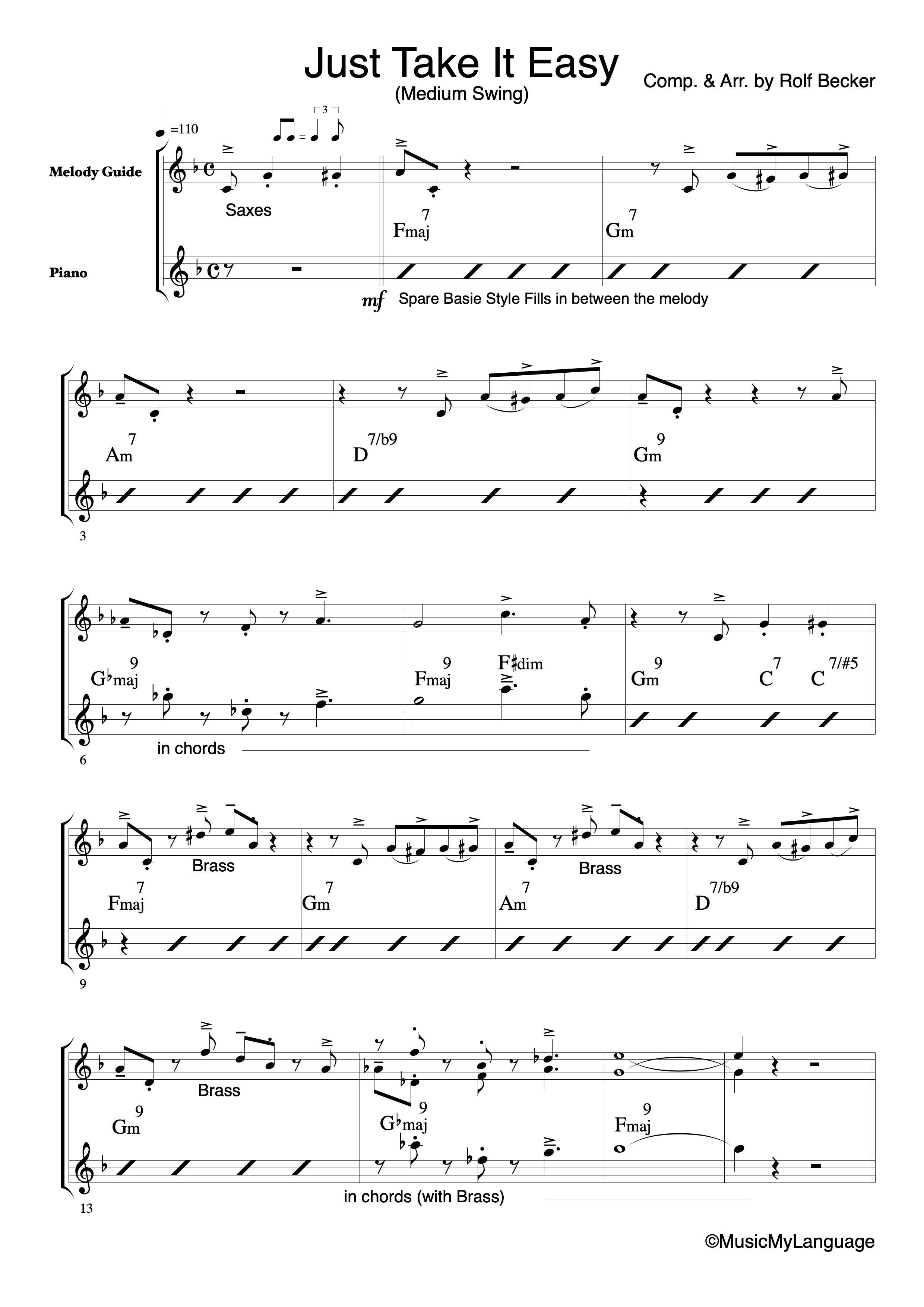
Example 3.1 — Piano Melody Guide and Ensemble Cues
The lower stave can then function more like a chord sheet.
This gives the pianist enough information to understand what is happening in the arrangement while still leaving room to create appropriate fills and chord kicks
For me, this is an important principle.
I don’t want to dictate every note if the player already knows how to create an effective jazz piano part.
I want to provide the information the player needs.
Then I leave room for musicianship.
Important: Anticipated notes should use the chord of the following beat. See, for example,
the anticipated note on beat 4+ in bar 7, leading into bar 8.
⸻
Option 2 — Write It Out
For student or developing ensembles, I would normally take a different approach.
The upper stave still provides the melodic and ensemble information.
But on the lower stave, I can write out the fills, voicings and rhythmic chord figures.
Example 3.2 — Melody Guide & Fully Written Piano Part

Example 3.2 — Melody Guide & Fully Written Piano Part
This removes unnecessary uncertainty and helps the pianist handle the chord progression correctly.
In this situation, the piano part serves two purposes:
It tells the player what to play, while also showing how a functional piano part can be constructed.
I still include the chord symbols above the Melody Guide, even when the piano part is fully written out.
There are two reasons for this:
First, for educational purposes, I want the pianist to understand which chords are actually being played rather than simply reading the written notes.
Second, if a young player is already familiar with most of the chord symbols, they can gradually begin to connect the written voicings with the underlying harmony.
This helps develop harmonic awareness and, eventually, gives the pianist more freedom to interpret the part rather than relying exclusively on the written notation.
⸻
Option 3 — Combine Freedom and Direction
The third possibility is often particularly useful with professional players.
Some passages can be left with chord symbols and freedom.
Other fills or chord figures may be important enough that I want them played exactly as written.
So the piano part becomes a combination of:
written material + chord symbols + ensemble information
Example 3.3 — Melody Guide & Combined Written and Open Piano Part

Example 3.3 — Melody Guide & Combined Written and Open Piano Part
This gives me control where the arrangement requires it, without unnecessarily restricting the pianist everywhere else.
⸻
B) THE GUITAR
The guitar has a different function in Just Take It Easy.
In this Basie-influenced swing style, the guitarist’s main job is to support the quarter-note flow.
Again, there are several ways to notate this.
Option 1 — The Chord Sheet
For an experienced guitarist, a single-stave chord part is normally sufficient.
But I don’t like giving the guitarist only chord symbols with no information about the arrangement.
The part should also indicate what is happening around the player:
saxes carrying the melody
trombones in the background
brass figures
shout chorus
significant breaks
important rhythmic hits
Example 3.4 — Guitar Chord Part with Arrangement Cues
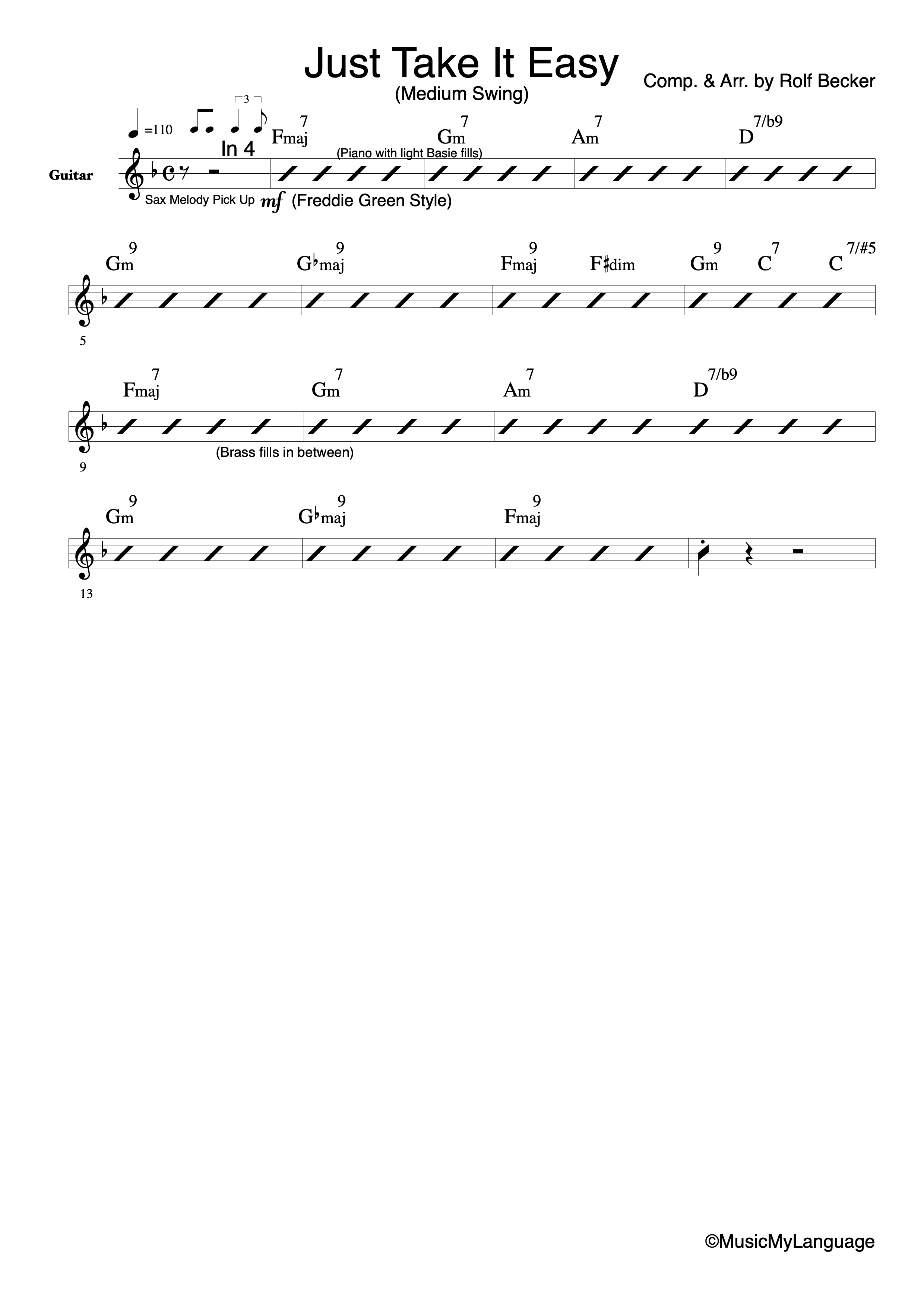
Example 3.4 — Guitar Chord Part with Arrangement Cues
This allows the guitarist to understand not only what chord to play, but also what role the guitar is playing at that moment.
That is much more useful.
⸻
Option 2 — Guitar Doubles the Melody
Sometimes I want the guitar to become part of the orchestration itself.
For example, the guitar may double the melody to create a particular color.
Example 3.5 — Guitar Doubling the Melody
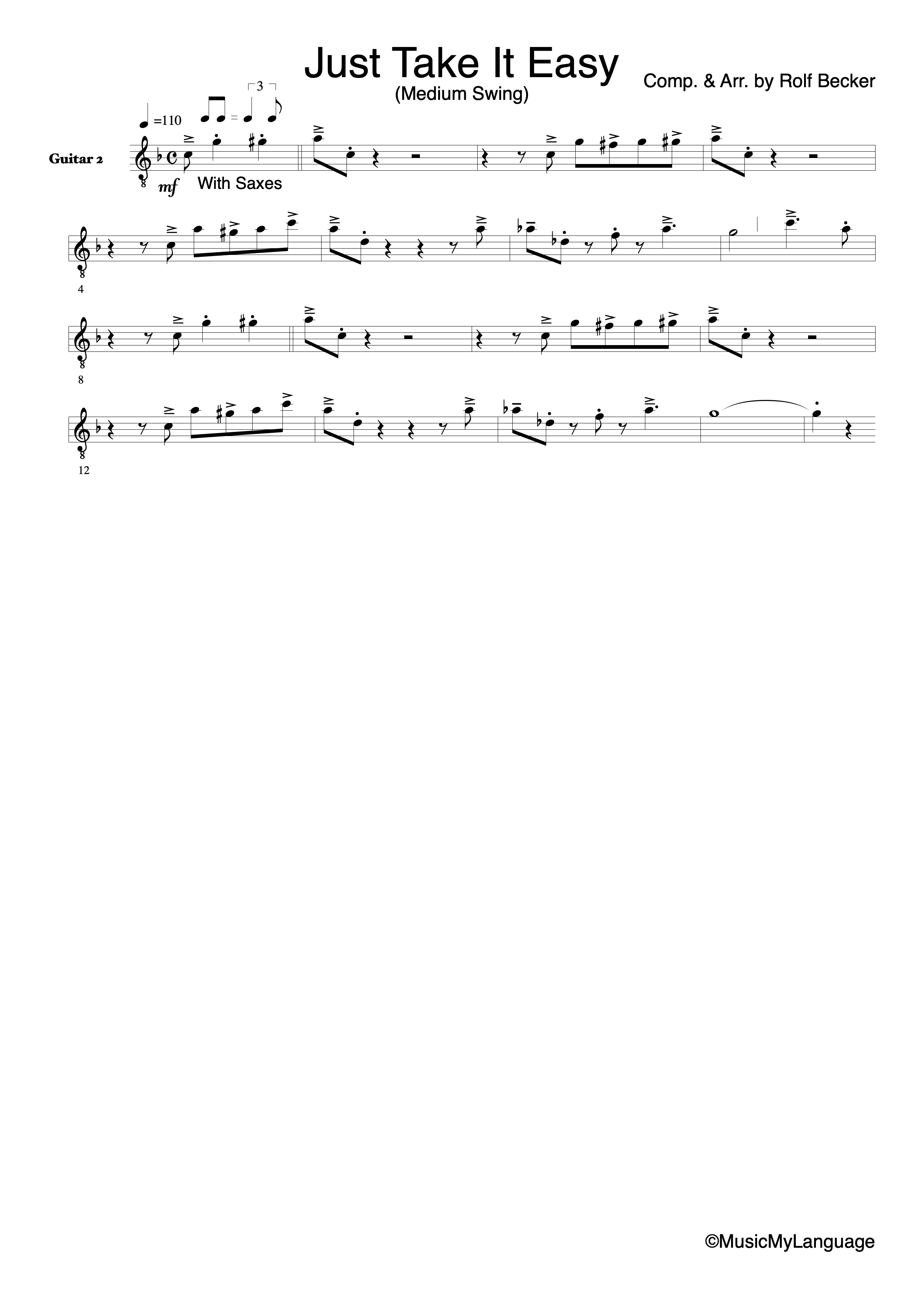
Example 3.5 — Guitar Doubling the Melody
IMPORTANT : The Guitar Sounds One Octave lower than written
Audio Example 3.2.1— Guitar Melody Doubling (With Saxes Only)
Listen to the example without the rest of the band - just Guitar doubling the Sax Section
Audio Example 3.2.2— Guitar Melody Doubling (With Full Orchestra)
Now you can probably hear the Guitar, playing the melody even with the full Big Band
In a published arrangement, I would consider providing both possibilities where appropriate.
Not every guitarist is equally comfortable with sight-reading fully notated melodic material, while others may welcome it.
Giving the player a practical alternative can make the arrangement considerably more usable.
⸻
Option 3 — Combine Melody and Chords
Example 3.6 — Melody Guide including Ensemble Cues & Guitar Lead Sheet

Example 3.6 — Melody Guide including Ensemble Cues & Guitar Lead Sheet
At first glance, this two-stave format looks very similar to Option 1 for the piano: the melody and important ensemble cues provide the guitarist with a clear picture of what is happening in the arrangement.
There is, however, one important difference.
Unlike the piano version, the guitar part does not contain written-out piano-specific chord voicings, fills, or rhythmic figures. Instead, the second stave is reserved exclusively for information relevant to the guitarist.
This keeps the part clean and practical while still allowing the guitarist to see the musical context of the arrangement and understand exactly how the guitar fits into the ensemble.
Again, the decision is based on what the music requires.
Not on the idea that one notation method is automatically better than another.
⸻
What If There Is No Guitarist?
This is a very practical question.
Many ensembles simply don’t have a guitarist.
In that case, the pianist normally needs to take a slightly more active harmonic role.
But that does not necessarily mean playing constantly.
In Just Take It Easy, the walking bass and drums already provide a strong “In 4” foundation.
The pianist can therefore add enough chordal support to maintain the harmonic texture without trying to imitate the guitar part note for note.
All three piano-part approaches discussed above can still work.
The important thing is to understand what has disappeared from the texture—and then decide whether the piano actually needs to replace it.
⸻
Do Piano and Guitar Always Need to Play Together?
No.
And this may be one of the most important lessons in this chapter.
Just because both instruments have chord symbols does not mean both instruments need to play at the same time.
Sometimes the guitar should carry the pulse while the piano leaves space.
Sometimes the piano should provide a fill while the guitar keeps its part simple.
Sometimes one instrument should stop completely.
Space is part of the arrangement.
If both instruments constantly play full chords, rhythmic figures and fills, even perfectly correct notes can create a rhythm section that sounds cluttered.
So the question is not:
Can both instruments play here?
The better question is:
Does the music need both instruments here?
⸻
A Word About Piano Voicing
Chord voicing is a large subject in itself.
Shell voicings, guide tones, rootless voicings, extensions, alterations, drop voicings and many other approaches can dramatically change the sound of a jazz piano part.
That topic would take us far beyond the purpose of this chapter.
There are excellent dedicated resources available for pianists who want to explore voicings in greater depth. For example,
Piano With Jonny presents a structured overview including shell voicings, guide tones, rootless voicings, block chords, drop-2 voicings and quartal voicings.
Additional useful resources include the Jazz Tutorial guides and J.B. Dyas’s Jazz Piano Voicings
For Inside The Arrangement, however, our focus is different.
We are asking:
How does the piano function inside the arrangement?
And that is an arranger’s question.
⸻
The Bigger Picture
Piano and guitar are both harmonic instruments.
But that does not mean they should perform identical jobs.
In Just Take It Easy, the guitar helps establish the quarter-note swing flow.
The piano adds color, punctuation and occasional fills.
The bass connects harmony and pulse.
The drums complete the rhythmic framework.
Each instrument contributes something different.
That is why the rhythm section works.
Good rhythm-section writing is not about giving every player something interesting to do every second.
It is about giving each player the right job at the right moment.
And sometimes the most effective thing a musician can play is:
nothing.
⸻
Coming Next
Chapter 4 — The Drums: Why Is Detailed Drum Notation So Important?
The bass establishes direction.
Piano and guitar shape the harmonic and rhythmic framework.
But there is one instrument that can change the entire character of the arrangement almost instantly:
The drums.
How much should an arranger actually write?
Which ensemble figures should appear in the drum part?
When should the drummer follow the written material—and when should the arranger leave room for interpretation?
And why can a carefully prepared drum part make rehearsals dramatically more efficient?
In Chapter 4, we’ll look at drum notation step by step.
See you in the next chapter.
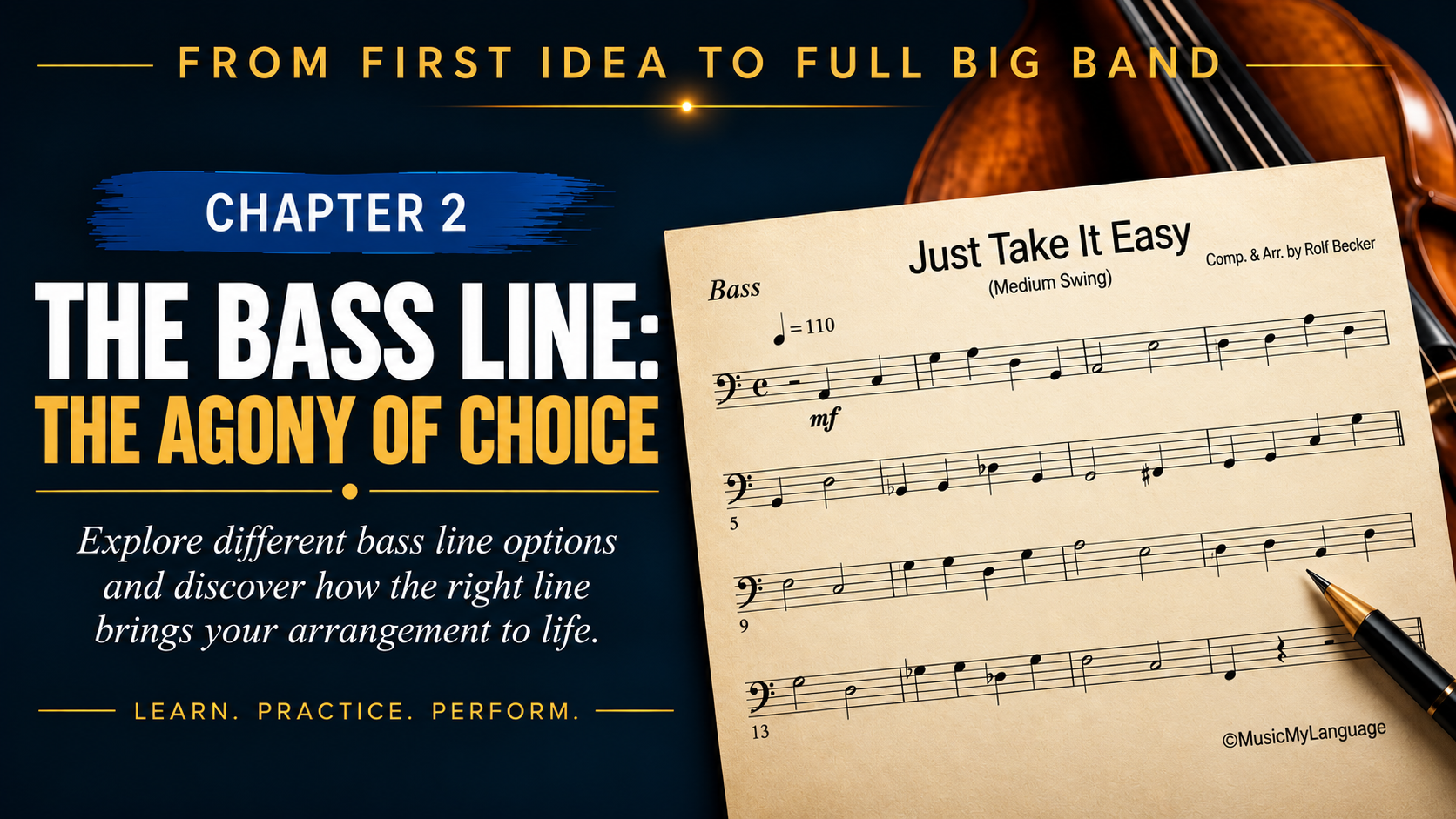
Inside The Arrangement
What makes a great bass line? Explore the essential choices between “In 2” and “In 4,” discover basic walking bass patterns, and learn how the bass works with the rhythm section to bring an arrangement to life. Includes practical sheet music and audio examples.
Chapter 2
The Bass Line: Choose the Right Bass Line and You’re Golden
You can write a great melody. You can find beautiful chords. You can even have a killer drum groove.
But choose the wrong bass line — and somehow the whole arrangement just doesn’t sit right.
The bass is one of the most important links between harmony and rhythm.
It supports the chord progression, locks in with the drums, gives the music direction and, perhaps most importantly, helps determine how the entire arrangement feels.
And there isn’t just one way to do it.
As a composer or arranger, you have several basic approaches to choose from.
In this chapter of Inside The Arrangement, I’ll introduce some of the most useful ones, accompanied by audio examples and sheet music,
so you can both see and hear the difference.
But before we get to the notes, there is one important principle:
A great bass line doesn’t work alone.
The bass player needs solid support from the other rhythm-section players. Drums, piano and guitar all contribute to the groove and harmony.
When they work together, the bass line doesn’t merely support the melody - it helps carry the entire arrangement.
So, let’s get started.
⸻
1. Playing “In 2”
When musicians say that the bass is playing “in 2,” it basically means that the bass emphasizes two notes within a 4/4 measure,
usually giving the music a spacious two-beat feeling.
It is simple - but simple does not mean boring.
There are several ways to create an effective in 2 bass line.
Root notes only
The simplest version is to play the root of the chord on beats 1 and 3.
This clearly establishes the harmony and gives the rest of the rhythm section plenty of space.
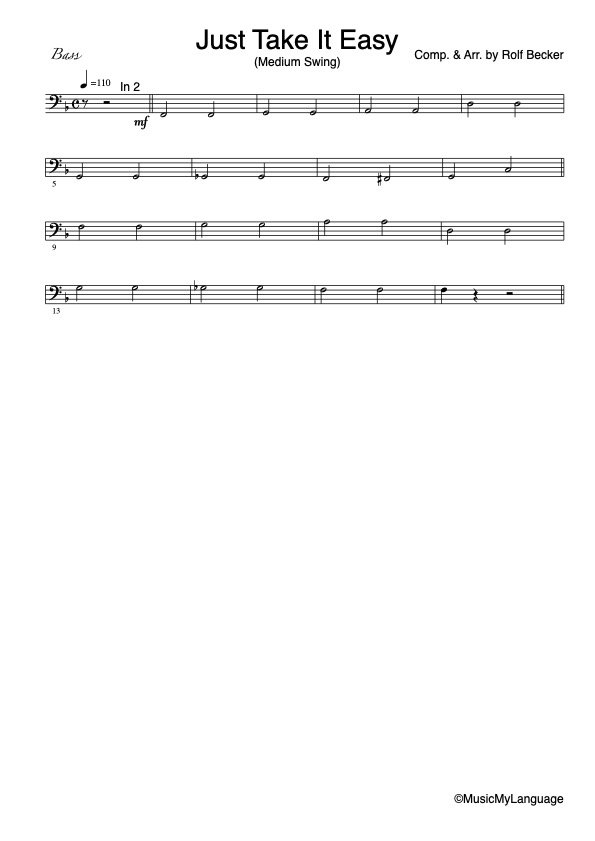
For better audible results please use headphones / proper in ears
Root notes — changing octaves
Now take the same basic idea but alternate between different octaves of the root.
The harmonic information hasn’t changed, but the line immediately has more movement.
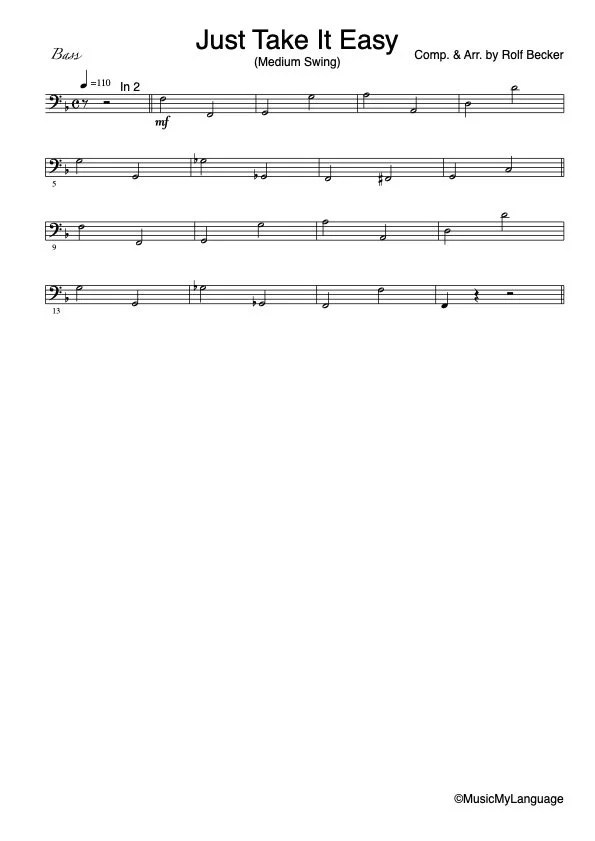
Root and fifth
Another classic approach is to alternate between the root and fifth of the chord.
It is still harmonically simple, but the fifth adds another dimension and creates a stronger sense of motion.
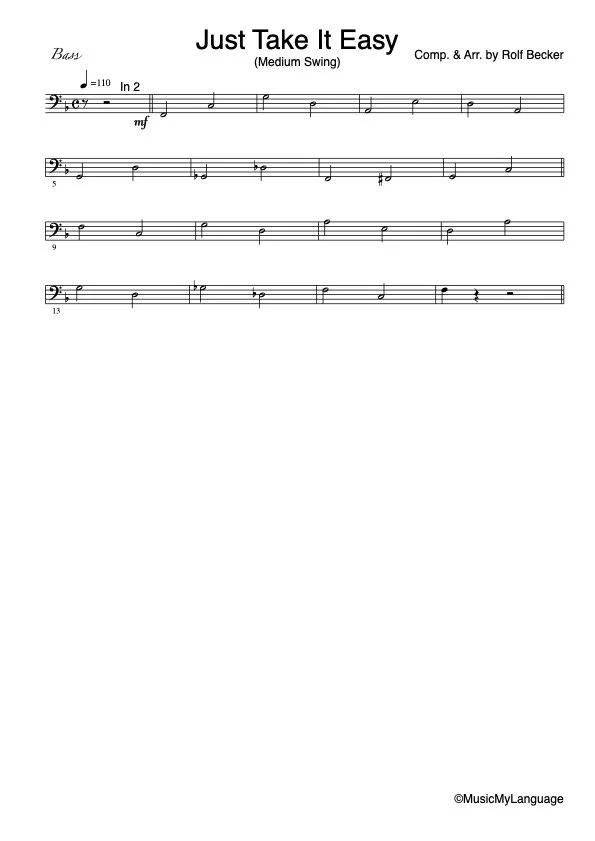
Root & Fifth
Root and fifth — with a little rhythmic movement
We can make the same idea more interesting by introducing a small rhythmic phrase around beats 1 and 2.
Now the bass is beginning to do more than simply state the harmony. It starts contributing its own rhythmic character to the arrangement.
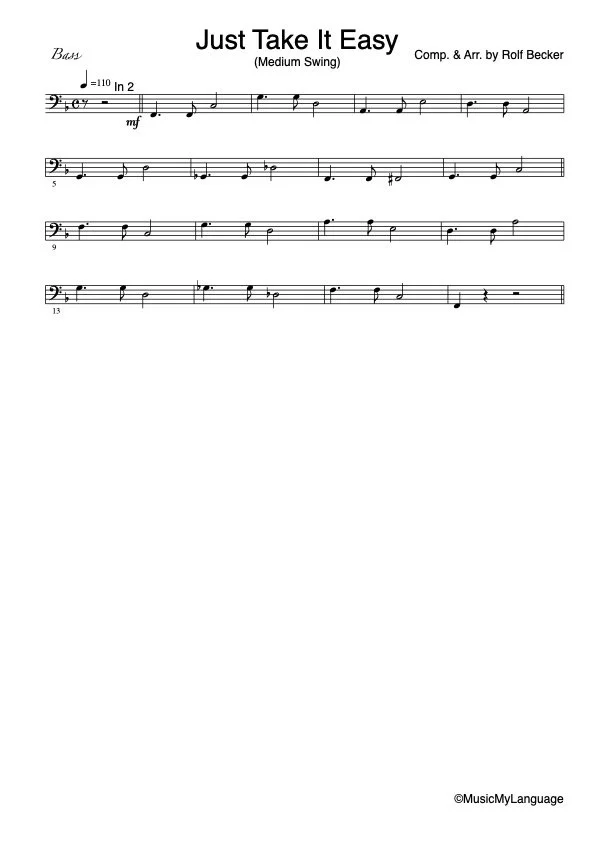
Mixing “In 2” and quarter-note movement
Here is another useful variation.
Instead of maintaining exactly the same pattern in every measure, try a two-bar phrase:
Bar 1: two half notes
Bar 2: four quarter notes
The bass is still creating an overall in 2 character, but the second measure introduces forward motion.
This is a very simple arranging device — and a very effective one.
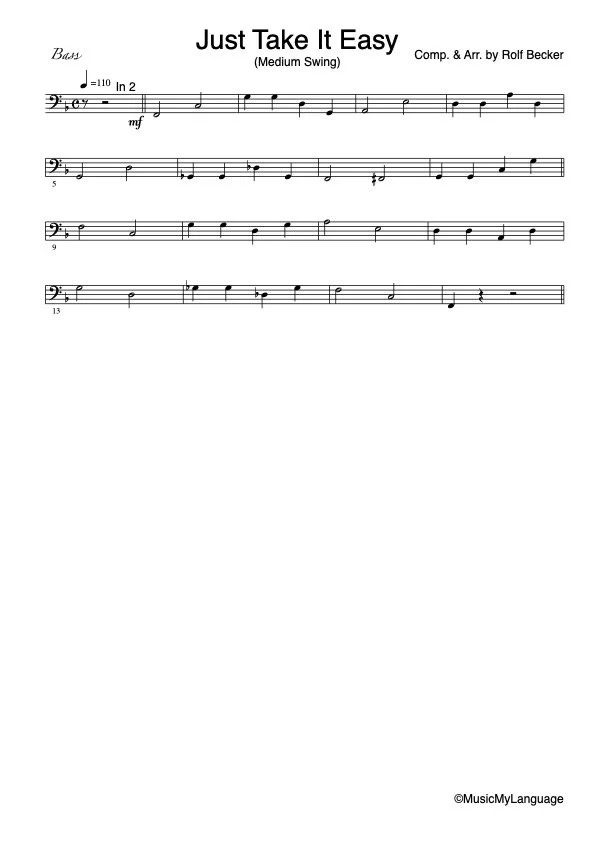
⸻
2. Playing “In 4” — The Walking Bass Line
Now things start moving.
When the bass plays four quarter notes in a 4/4 measure, we call this playing “in 4.”
In jazz, this is commonly associated with the walking bass line.
And this is where understanding harmony becomes particularly important.
A good walking bass line shouldn’t simply play the root four times:
1 – 1 – 1 – 1
That would establish the chord — but after a while it would become rather boring.
Instead, the bass player uses chord tones, scale tones and passing notes to create a melodic line that connects one chord to the next.
This is also why the bass player needs a rhythm section that clearly supports the correct chords and chord progression.
The better the harmonic foundation, the more naturally the bass can create movement through the harmony.
Here are a few basic patterns to get started.
1 – 1 – 5 – 5
Root – Root – Fifth – Fifth
A very straightforward pattern and a good starting point for understanding the sound of four quarter notes against the harmony.
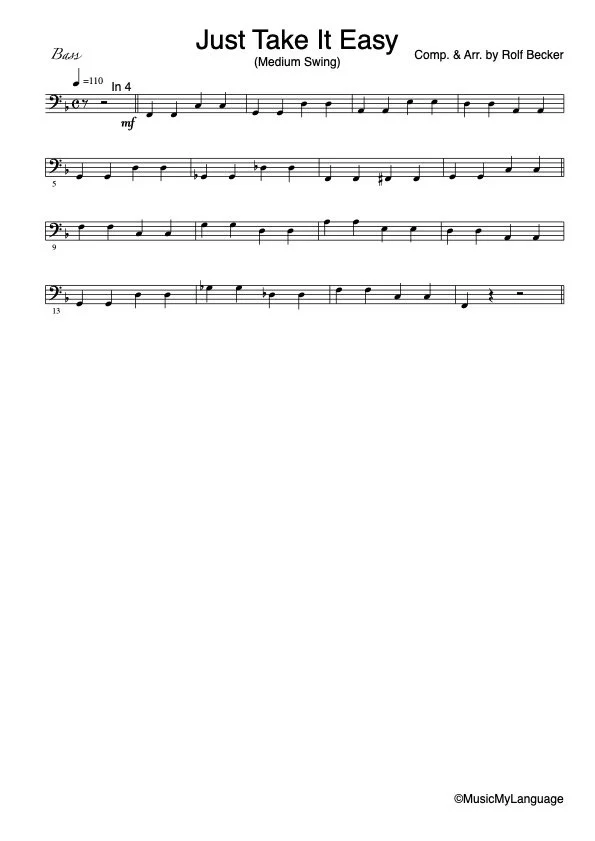
1 – 2 – 3 – 5
Root – Second – Third – Fifth
Now we are beginning to hear the line as something melodic rather than simply a sequence of chord root & fifth.
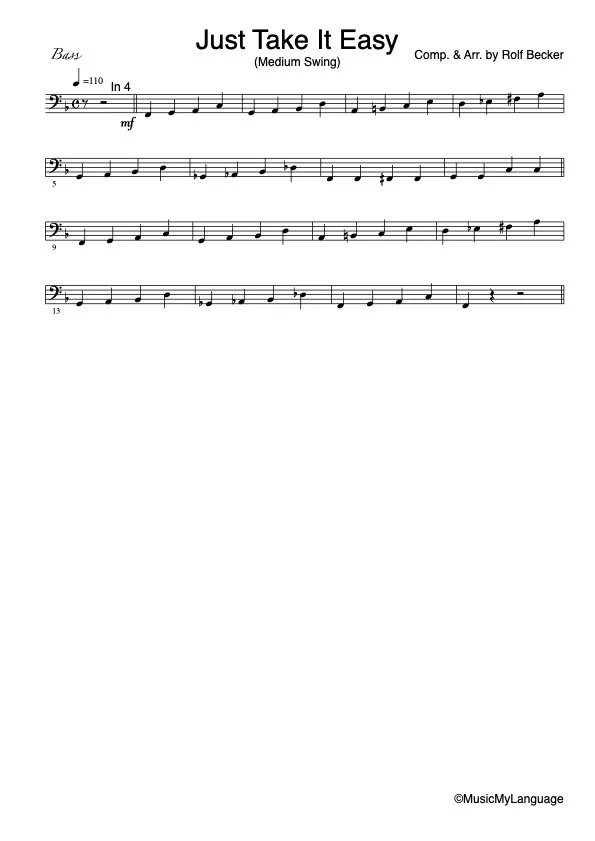
1 – 2 – 3 – 1
Root – Second – Third – Root
Another simple way of moving through the scale while keeping the root as a strong reference point.
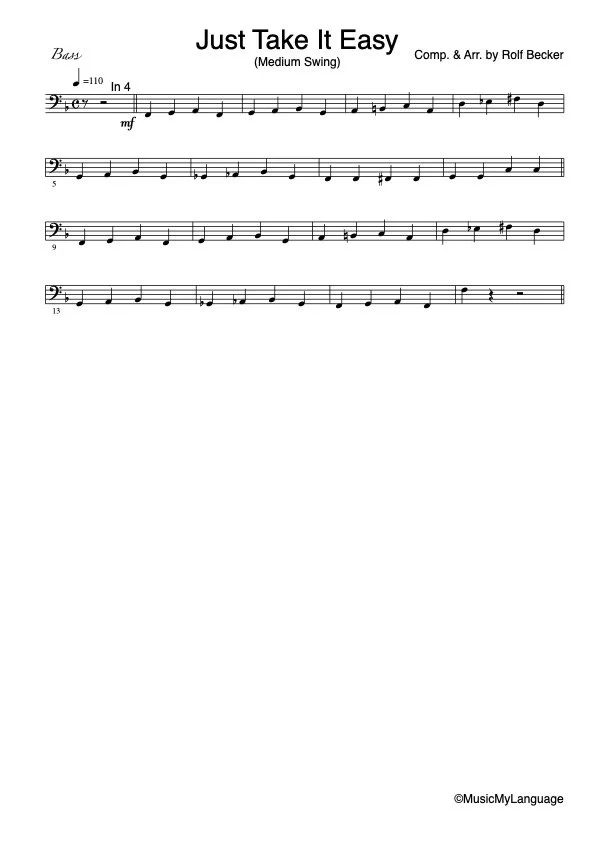
1 – 7 – 6 – 5
Root – Seventh – Sixth – Fifth
Here the line moves downward, creating a completely different sense of direction.
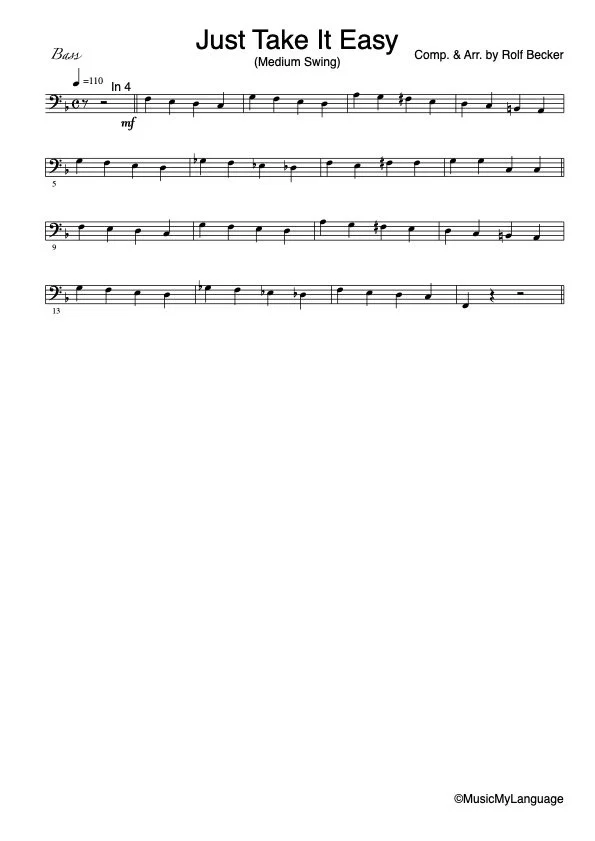
These aren’t rules.
Think of them as building blocks (or pattern).
Once you understand what they do, you can combine them, change their direction and adapt them to the chord progression.
⸻
What If the Chord Lasts Longer?
This is where things become even more interesting.
Suppose one chord lasts for two complete measures.
Playing exactly the same four-note pattern twice isn’t your only option.
You can create a longer melodic journey through the harmony.
For example:
1 – 7 – 6 – ♭6 | 5 – 4 – 3 – 2
Suddenly eight quarter notes form one continuous line.
And notice something important: the bass isn’t simply describing the chord anymore.
It is creating direction.
That is one of the secrets of a good walking bass line.
Every note should make you want to hear where the next one is going.
⸻
Should You Write the Bass Line Out?
This depends entirely on who is going to play your arrangement.
An experienced professional jazz bassist usually doesn’t need every quarter note written out.
Give an experienced player a lead sheet or bass part containing the chord progression and tell them:
“In 2.”
or
“Walk in 4.” (or just “In 4”)
…and they will know what to do.
In fact, allowing a good bass player some freedom can often produce a more natural result than trying to notate every single note yourself.
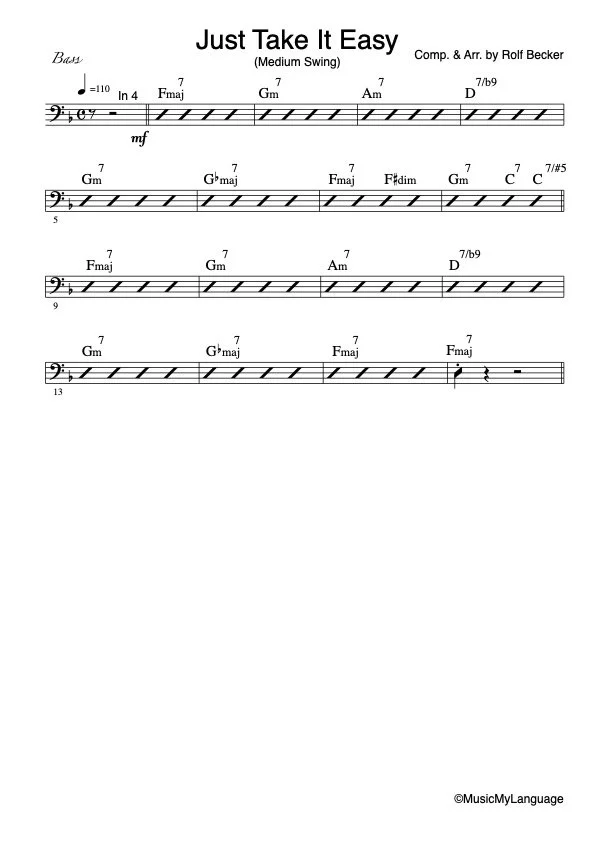
But there is an important exception.
Writing for Student Bands
If you’re arranging for a school ensemble, developing jazz band or educational publisher, I recommend a different approach.
Write out a suitable bass line and include the chord symbols above it.
I would also mark the intended feel — for example:
In 2
or
Walking in 4
Why both?
Because you’re doing two things at the same time.
You’re giving a developing bass player something they can perform successfully right now,
while also showing them how a bass line relates to the underlying chord progression.
Eventually, they may stop needing the written notes.
And that’s exactly what you want.
⸻
The Bigger Picture
The bass line is only one part of the rhythm-section puzzle.
A great bass player needs to know where the harmony is going.
The drummer needs to support the feel.
And piano and guitar have to provide the right harmonic and rhythmic framework without getting in the bass player’s way.
When all of those elements fit together, something wonderful happens:
The rhythm section stops sounding like four musicians playing individual parts.
It starts sounding like one instrument.
And that brings us perfectly to the next chapter of Inside The Arrangement:
Chapter 3: What Do the Piano & Guitar Players Do?
We’ll look at chord voicings, rhythmic comping, how piano and guitar can support the bass and drums -
and, just as importantly, how to keep them from stepping on each other’s toes.
See you in the next chapter.
Rolf Becker
Composer · Arranger · Conductor
MusicMyLanguage — Learn. Practice. Perform.
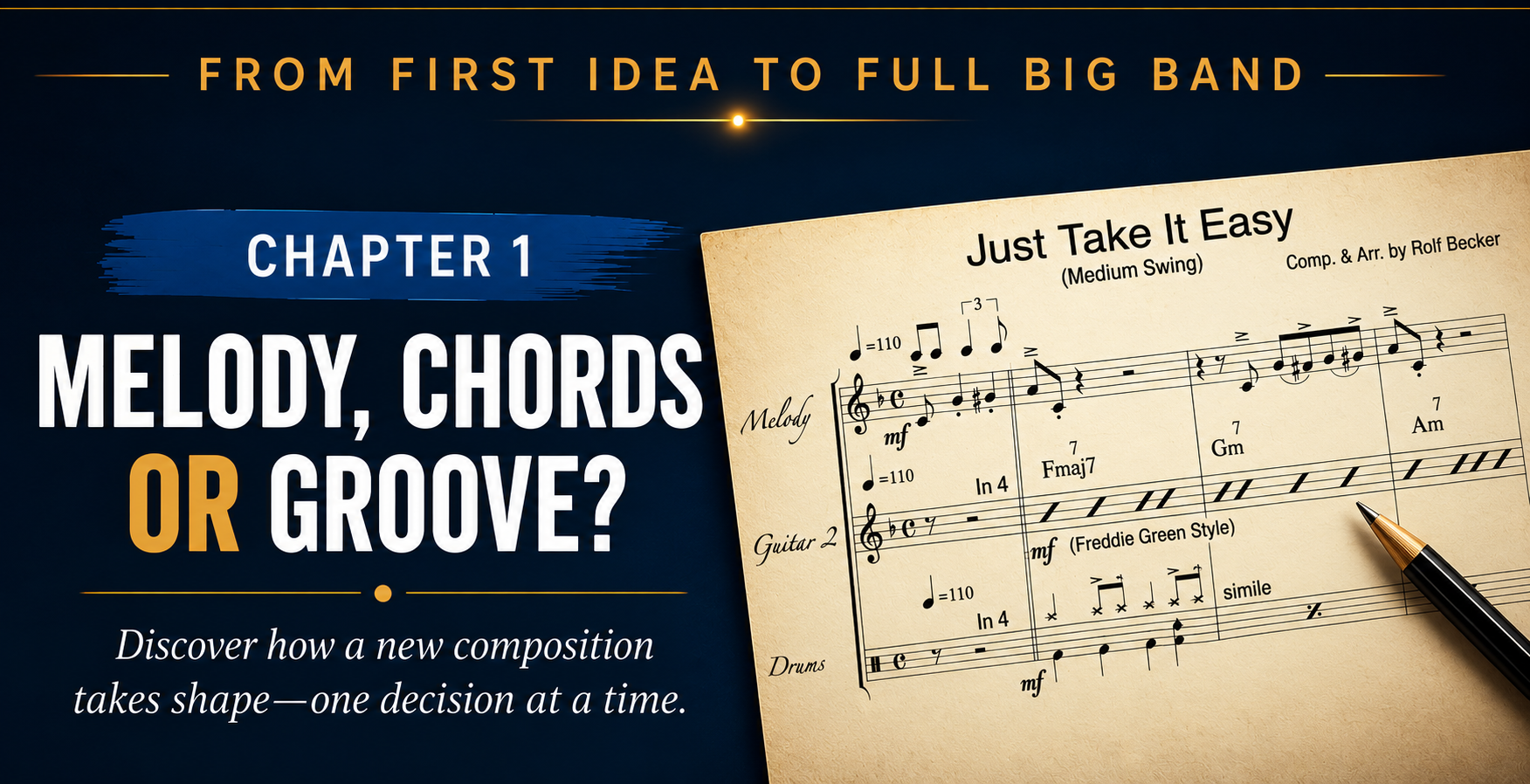
INSIDE THE ARRANGEMENT
What comes first when composing a new tune — melody, chords or groove? Follow “Just Take It Easy” from its first musical idea to a complete big-band arrangement in this new step-by-step series, with audio examples along the way.
From First Idea to Full Big Band
Chapter 1 — What Comes First: Melody, Chords or Groove?
How does a new composition actually begin?
With a melody?
A chord progression?
A bass line?
Or simply a groove that makes you want to play?
The answer is:
Any of them can come first.
There is no single formula for composing an instrumental tune.
Sometimes a melody suddenly appears in your head.
Sometimes you discover a chord progression that creates exactly the atmosphere you’re looking for.
And sometimes everything starts with a rhythm or groove.
For this new Inside the Arrangement series, however,
I don’t want to talk about composition and arranging only in theory.
I’m going to show you.
We’ll take one of my original compositions and follow it step by step
from its basic musical idea through harmony,
rhythm-section writing and orchestration,
until eventually it becomes a full big-band arrangement.
The tune is called:
“Just Take It Easy”
It’s a medium-swing composition inspired by the classic Count Basie big-band tradition.
Tempo: Medium Swing — ♩ = 110
The complete composition has an AABA form,
but we’ll begin with only the first 16 bars.
Why?
Because before we start adding instruments, voicings, backgrounds and orchestration,
I want you to hear what happens to the music when we change just one element at a time.
⸻
The First Ingredient: Melody
Let’s begin with the most exposed version possible.
Just the melody.
No chordal accompaniment.
No walking bass.
No drums.
No big band.
When a melody is heard on its own, there’s nowhere for it to hide.
Listen to its rhythmic character. Notice the short phrases and the spaces between them.
Listen to the repetition and development of the musical idea.
And ask yourself:
What harmony would you hear underneath this melody?
Don’t look for the “correct” answer yet.
Just listen.
🎧 AUDIO EXAMPLE 1
“Just Take It Easy” — Melody Only
⸻
Now Let’s Add Harmony
The melody gives us our horizontal musical line.
Harmony adds the vertical dimension.
For Just Take It Easy, I chose a harmonic progression that supports the relaxed swing character
while still providing enough movement and color to make the melody interesting.
But instead of immediately adding the entire rhythm section,
let’s hear what happens when we add only the harmonic framework.
For this example, the chords are supported by Freddie Green-style guitar accompaniment
- the classic four-to-the-bar approach associated with the Count Basie rhythm section.
Listen again to exactly the same melody.
This time, notice how differently individual melody notes can feel once you hear the harmony underneath them.
A note that sounded neutral on its own may suddenly create tension.
Another may sound completely settled.
And the movement from one chord to the next starts giving the melody direction.
🎧 AUDIO EXAMPLE 2
“Just Take It Easy” — Melody + Chords
⸻
Melody and Chords Aren’t Two Separate Things
This is an important point.
When composing, I don’t think of melody and harmony as two completely independent layers.
They communicate with each other.
A melody note can suggest a particular chord.
But the opposite is also true:
A chord can change the way we hear a melody note.
And there is another element that can dramatically change both of them.
The bass.
Changing the bass note underneath a chord can alter its color, direction and function
- even when the notes above it remain unchanged.
We’ll explore that much more closely in the next chapter.
For now, however, something is still missing.
We have melody.
We have harmony.
But we don’t yet have the complete feel of the tune.
⸻
Enter the Rhythm Section
Now let’s add the rhythm section.
This is where Just Take It Easy really begins to reveal its personality as a swing tune.
The harmonic pulse is joined by a walking bass line and drums establishing the swing feel.
Listen to the same 16 bars again.
Nothing fundamental has happened to the melody.
But the musical experience has changed considerably.
Suddenly there is forward motion.
There is pulse.
There is interaction.
There is groove.
🎧 AUDIO EXAMPLE 3
“Just Take It Easy” — Melody + Rhythm Section
⸻
Listen Again — But Differently
Now go back and compare the three examples.
Melody
→ Melody + Chords
→ Melody + Rhythm Section
The melody hasn’t changed.
So what has?
Almost everything around it.
This is one of the most important lessons in arranging.
An arrangement isn’t simply about adding more instruments.
It’s about deciding what each additional musical element contributes.
Sometimes adding something makes the music stronger.
Sometimes removing something does.
And sometimes one carefully chosen bass note can have more impact than adding an entire section of instruments.
⸻
What Comes First?
So let’s return to our original question.
Melody, chords or groove?
There is no universal answer.
You can start with a melodic fragment.
You can sit at the piano and discover a chord progression.
You can create a bass line.
You can hear a drum groove.
You might even begin with nothing more than a rhythmic figure.
The important thing is to recognize when you have found an idea worth developing.
Then ask:
What does this idea need next?
Not:
What can I add?
But:
What does the music need?
That small difference in thinking becomes increasingly important as an arrangement grows.
Because eventually we’ll have many more possibilities at our disposal:
Saxophones.
Trumpets.
Trombones.
Piano.
Guitar.
Bass.
Drums.
Different registers.
Different voicings.
Different combinations.
Different colors.
But before we get anywhere near the full big band, we need to make sure that the foundation is right.
And that takes us to the bottom of the arrangement.
⸻
Coming Next: The Bass Line
Choose the Right Bass Line and You’re Golden
In the next chapter of Inside the Arrangement,
we’re going to take these same 16 bars of Just Take It Easy and look underneath the melody and chords.
We’ll examine the walking bass line.
Why this note?
Why not simply play the root of every chord?
How can the bass connect one chord to the next?
Where can we use chord tones, passing notes and chromatic approaches?
And how much of a bass line should an arranger actually write?
We’ll see it in the score and hear it in the music.
Because a good bass line doesn’t merely tell us what chord we’re playing.
It helps tell us where the music is going.
And when you choose the right bass line…
you’re golden.
To be continued in Chapter 2 of Inside the Arrangement — From First Idea to Full Big Band.

Did You Know…
Music Is My Language
Did you know that there are approximately 7,170 living languages spoken around the world?
But there’s only 1 language that connects the world:
MUSIC
that there are approximately 7,170 living languages spoken around the world?
According to Ethnologue, the world's leading linguistic database, Asia alone is home to more than 2,300 languages, Africa to over 2,100, Oceania to around 1,300, the Americas to nearly 1,000, and Europe to about 280.
To reach readers across cultures and borders, great literary works must be translated. For example, The Lord of the Ringshas been translated into more than 80 languages. Yet even when we speak the same language, misunderstandings can still occur:
"I guess I misunderstood you there."
Music is different.
Whether Mozart's Eine kleine Nachtmusik is performed in Beijing, Berlin, New York, Cairo, or Sydney, it speaks with the same voice. It requires no translation. Its meaning transcends borders, cultures, and languages.
Music is perhaps humanity's most universal language.
But like any language, it must be learned, practiced, and mastered.
Your instrument is more than wood, brass, strings, or keys—it is your voice transmitter. Through it, you express thoughts, emotions, stories, and ideas that words often cannot capture.
The purpose of this website is to help you develop a practice routine tailored to your personal goals, enabling you to become confident, expressive, and fulfilled as a musician. Whether you are a beginner, an advancing student, or an experienced performer, you will find resources designed to help you make your instrument truly speak.
Explore
Professional backing tracks
Learn / Request
Specialized workshops & clinics covering a variety of musical topics
Guest conducting
Band charts, tailored for your ensemble
Perform
Unique Play-Alongs, only available at Music-My-Language
Ensemble arrangements
Band and Big Band charts
Everything you need to move beyond practice and into performance.
Because when your instrument becomes your voice, and your voice is understood everywhere, you can proudly say:
Music Is My Language