

INSIDE THE ARRANGEMENT — Chapter 7 — Notation, Transposition & Instrumental Ranges
A professional Big Band arrangement requires more than great musical ideas. In Chapter 7 of Inside The Arrangement, composer and arranger Rolf J. Becker explores instrument transposition, written versus concert pitch, practical brass and woodwind ranges, and the essential principles of clear, professional music notation.
Writing music that musicians can actually read and perform.
By Rolf J. Becker
A beautiful musical idea deserves a beautifully prepared score.
Throughout my career as a composer, arranger, conductor, and instrumentalist, I have learned that even the most imaginative arrangement can become unnecessarily difficult when its notation is unclear.
Incorrect transpositions, impractical instrumental ranges, inconsistent articulations, or poorly prepared parts can create confusion and waste valuable rehearsal time.
In Chapter 6, we explored how orchestration gives our music its colors.
Now we turn to an equally important question:
How do we communicate those musical ideas clearly to the musicians who will perform them?
1. Concert Pitch vs. Written Pitch
One of the first things every arranger must understand is the difference between concert pitch and written pitch.
Concert pitch is the actual sounding note.
Written pitch is the note displayed in the musician's part.
For example, when a B-flat trumpet player performs a written C, the instrument sounds a concert B-flat.
If we want that trumpet to sound concert C, we must write D.
The same principle applies to B-flat clarinet and the saxophone family, although the precise transpositions differ.
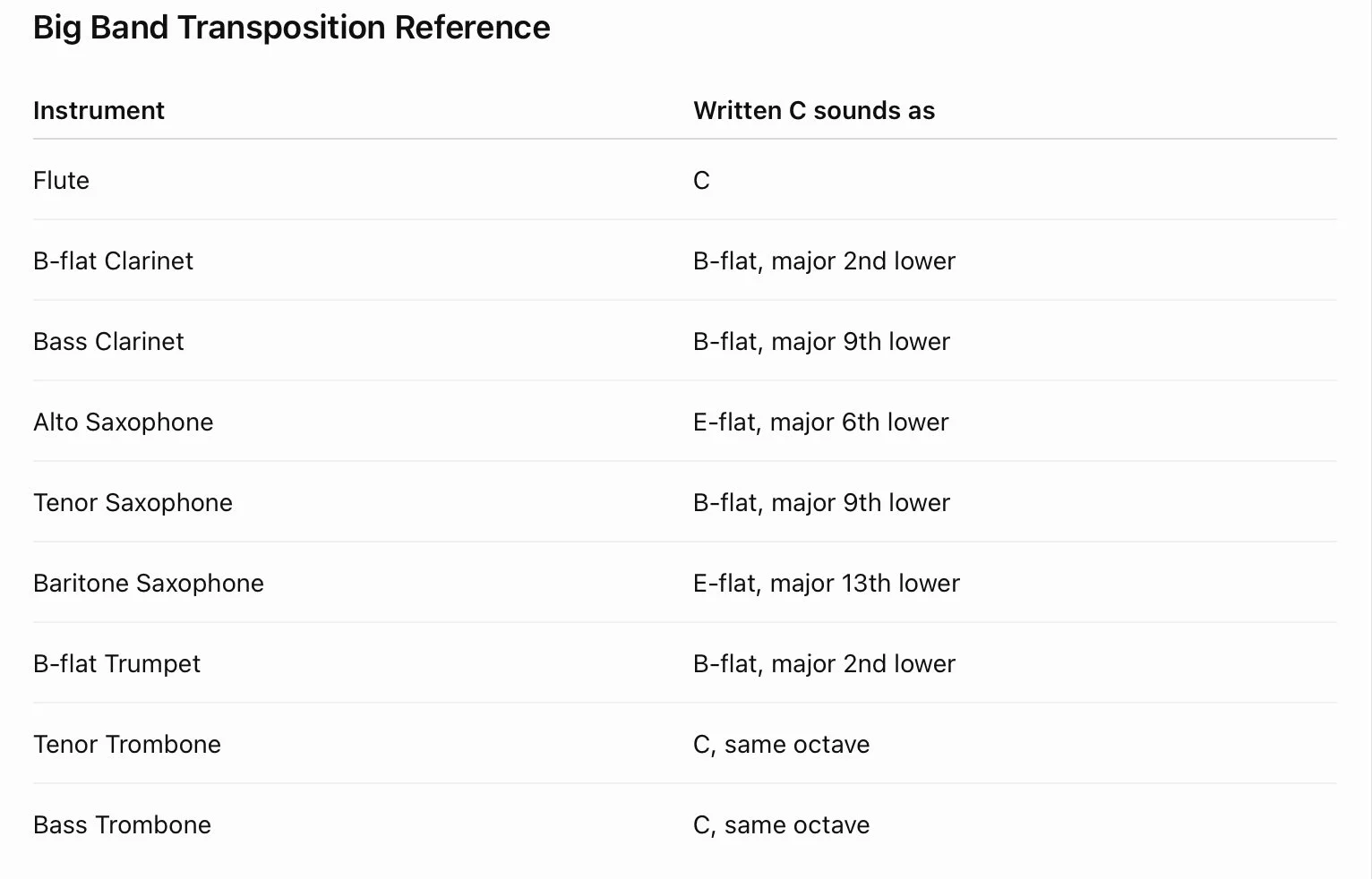
Big Band Transposition Reference (Inside The Arrangement — Chapter 7)
Important: In standard Big Band notation, tenor trombone and bass trombone are written in bass clef at concert pitch.
Although the tenor trombone is commonly described as a B-flat instrument, this refers to its fundamental tubing pitch—not a transposition of its standard bass-clef part.
2. Why Octaves Matter
Transposition involves more than changing the key signature.
The tenor saxophone sounds a major ninth below its written pitch.
The baritone saxophone sounds a major thirteenth below its written pitch.
Both instruments therefore include an octave displacement.
An arranger who overlooks this detail may produce an entirely different register from the one intended.
Modern notation software makes transposition considerably easier, but I strongly recommend understanding these relationships rather than relying exclusively on automatic functions.
Software is a tool. Musical knowledge remains essential.
3. Instrumental Ranges: Possible Doesn't Always Mean Practical
Every instrument has a physical range.
But that doesn't mean every player can perform every note within that range comfortably.
A professional lead trumpet player may perform high notes that would be entirely inappropriate for a developing student.
A professional saxophonist may use altissimo fingerings that an intermediate player has not yet mastered.
And a trombone passage can be difficult because of rapid slide movement, even when every note lies within the instrument's normal range.
For this reason, I distinguish between three levels when preparing arrangements:
Beginner: A conservative register that allows players to develop reliable tone, intonation, and confidence.
Intermediate: A broader range suitable for musicians with established technical skills.
Advanced / Professional: An extended range that may include demanding registers and specialized techniques.
These categories are practical guidelines, not fixed rules.
A Few Important Instrumental Details
Alto and Tenor Saxophones: Their standard written ranges are broadly similar, but their sounding registers differ. Altissimo should not be assumed available to every player.
Baritone Saxophone: Many modern instruments have a written low A, but others stop at low B-flat. Check the available instrument before requiring low A.
Flute: Its usual lowest note is middle C, although a B-footjoint allows written B3. The upper register requires increasing control.
Clarinet and Bass Clarinet: Their registers behave differently, and the bass clarinet's lowest available notes depend on the instrument's extension.
Trumpet: Upper-register endurance matters just as much as the highest note.
Tenor and Bass Trombone: Consider slide movement, valve configuration, articulation, and the demands of the low register.
The most important principle is simple:
Write for the musician, not merely for the theoretical range of the instrument.
4. A High Note Is Not the Whole Story
Consider two trumpet passages.
The first contains one demanding high note at the end of an otherwise comfortable phrase.
The second contains repeated high notes over several measures, played fortissimo.
Both passages may reach the same highest pitch.
Yet their technical demands are entirely different.
Endurance, articulation, dynamics, tempo, and recovery time must all be considered.
This applies to other wind instruments as well.
Good arranging requires an understanding of how musicians experience a passage from beginning to end.
5. Articulation and Dynamics: The Details That Matter
Correct notes and rhythms are only the beginning.
A short accented note produces a different musical result from a tenuto note.
A legato phrase requires a different approach from a passage of repeated marcato accents.
And a written forte does not produce the same perceived volume on every instrument.
These details are especially important in Big Band writing, where the precision of a section depends on consistent articulation and phrasing.
As a conductor, I regularly hear how much difference a unified note release can make.
Sometimes a passage doesn't need to be rewritten.
It simply needs clearer notation.
6. Preparing Professional Individual Parts
An arrangement is not finished when the full score looks correct.
Every individual part must be checked.
I recommend paying particular attention to:
Correct transpositions and sounding octaves
Clear rehearsal marks and measure numbers
Consistent articulation and dynamics
Readable staff size and spacing
Practical page turns
Multimeasure rests and useful cues
Sufficient time for instrument and mute changes
A well-prepared part allows musicians to concentrate on the music instead of correcting avoidable mistakes.
7. The Professional Arranger's Checklist
Before delivering an arrangement, ask yourself:
Are all transposing instruments correctly notated?
Are the written ranges appropriate for the intended musicians?
Have I considered endurance, articulation, and instrument-specific limitations?
Are the individual parts readable and professionally prepared?
Does the score communicate exactly what I want the musicians to perform?
These questions may seem straightforward.
But answering them carefully can make an enormous difference in rehearsal and performance.
Final Thoughts — Respecting the Musician
Professional notation is a sign of respect.
It respects the musician's time, preparation, and technical responsibilities.
It also respects the composition.
Throughout Inside The Arrangement, I have emphasized that arranging is about making musical decisions.
Notation is how we communicate those decisions.
A professional arrangement is not finished when the notes are written. It is finished when the musicians can understand and perform them as intended.
Discover my original Big Band arrangements, small ensemble charts, and educational music in the MusicMyLanguage Music Library.
Explore the complete Inside The Arrangement educational series, where we develop professional Big Band arrangements step by step.
Coming Next — Chapter 8: The Art of Voicing
From Closed Position to Clusters
How do we distribute chord tones among the instruments of a Big Band?
What distinguishes closed voicing from Drop 2 or Drop 4?
How do clusters create tension and color?
And how can voice leading transform a simple harmonic progression into a convincing ensemble sound?
In our next chapter, we'll explore these techniques using practical examples from my original composition Just Take It Easy.
Rolf J. Becker
Composer · Arranger · Conductor
MusicMyLanguage — Learn. Practice. Perform.
INSIDE THE ARRANGEMENT / Chapter 6 — Orchestration: Giving the Music Its Colors
How does orchestration transform a simple melody into a colorful Big Band arrangement? In Chapter 6 of Inside The Arrangement, composer and arranger Rolf J. Becker explores instrumental combinations, unison and octave doubling, sustained backgrounds, rhythmic accents, and complementary counterlines. Featuring nine practical audio examples from his original composition Just Take It Easy, this chapter demonstrates how thoughtful orchestration brings music to life.
From Individual Instruments to the Complete Sound
In Chapter 5, we explored the individual characteristics of brass and woodwind instruments: their ranges, registers, tonal qualities, and practical limitations.
Now comes one of the most fascinating aspects of arranging.
What happens when we combine those instruments?
A melody played by a single trumpet has a particular personality. Add an alto saxophone in unison, and the sound changes immediately. Combine a trumpet with a tenor saxophone in octaves, and another color emerges.
But orchestration is about much more than assigning a melody to different instruments.
It involves decisions about texture, balance, register, rhythmic activity, and the relationship between individual voices.
Should the melody stand alone? Should other instruments reinforce it? Should we add sustained harmonies, rhythmic accents, or an independent counterline?
Throughout this chapter, we'll continue using my composition Just Take It Easy to demonstrate how these decisions influence the musical result.
1. Orchestration Begins With Listening
Before writing notes for an ensemble, I try to imagine the sound I want to hear.
Is the passage supposed to feel intimate or powerful? Warm or brilliant? Transparent or dense?
The answers influence which instruments I choose and how I combine them.
A common mistake among developing arrangers is to assume that more instruments automatically produce a better result.
They don't.
Sometimes a single instrument playing a well-written melodic phrase can be more expressive than an entire section.
The essential question is not how many musicians are playing.
It's whether their combination serves the musical intention.
2. One Melody — Different Colors
Let's begin with a simple experiment.
We'll take the same melodic passage from Just Take It Easy and assign it to different instrumental combinations.
The melody remains recognizable, but its sound and character change.
Musical Example 6.1 — One Melody, Different Colors
Audio Example 6.1.1 — Trumpet Solo
The trumpet presents the melody without another horn doubling it.
Listen to the clarity of the melodic line, its articulation, and the instrument's distinctive tonal character.
This becomes our starting point for comparing the other versions.
Audio Example 6.1.2 — Alto Saxophone & Trumpet in Unison
Now we combine two instruments with different tonal characteristics.
The trumpet contributes its brass quality, while the alto saxophone introduces a contrasting reed sound.
When the instruments perform the same melodic line in unison, their combined timbres create a blended orchestral color.
Neither instrument needs to change the melody to influence its character.
Audio Example 6.1.3 — Trumpet & Tenor Saxophone in Octaves
In this example, we explore the combination of trumpet and tenor saxophone.
When these instruments are arranged in octaves, the difference in register introduces another dimension to the sound.
Octave doubling can reinforce a melodic line while preserving greater separation between the instruments' registers.
The result depends on register, dynamics, articulation, and the relative balance between the two players.
Listen Again
Compare all three versions.
Which combination gives the melody the strongest presence? Which creates the warmest impression? Which would you choose for a relaxed passage, and which for a more energetic one?
There is no universally correct answer.
The point of this exercise is to develop an awareness of instrumental color.
3. Supporting the Melody — Three Different Approaches
Once we have decided who plays the melody, the next question is:
What should the other instruments do?
One of the arranger's most important responsibilities is to create an effective relationship between the principal melody and the accompanying material.
Let's examine three possibilities using the same passage from Just Take It Easy.
For each approach, I've prepared two recordings.
The first presents the melody and its background without the rhythm section. The second demonstrates the same arrangement within the full-band texture.
Listen to the exposed version first, then compare it with the full band.
Musical Example 6.2.1 — Melody With Sustained Backgrounds
Sustained backgrounds are one of the most effective ways to provide harmonic support without adding excessive rhythmic activity.
While the melody moves, the accompanying instruments hold longer notes or chords.
These sustained harmonies can establish warmth, continuity, and harmonic depth.
They are particularly effective when the melody contains rhythmic movement or pauses that allow the background to remain audible.
Audio Example 6.2.1-1 — Melody With Sustained Backgrounds
Listen to how the sustained harmony supports the melody.
Pay attention to the relationship between the moving melodic line and the comparatively static background.
Audio Example 6.2.1-2 — Sustained Backgrounds With Full Band
Now the rhythm section adds its harmonic and rhythmic foundation.
Notice how the sustained background becomes part of the larger ensemble texture.
The arranger must ensure that the background remains supportive rather than becoming too prominent.
Sustained writing is not necessarily simple writing. Register, harmonic spacing, dynamics, and voice leading all influence its effectiveness.
Musical Example 6.2.2 — Melody With Short Rhythmic Kicks
Instead of sustaining chords beneath the melody, we can introduce short rhythmic accents.
These figures may reinforce the groove, emphasize selected beats, or respond to the melodic phrase.
In jazz arranging, short ensemble figures are often called kicks or hits.
They can create excitement without requiring continuous activity from the accompanying instruments.
Audio Example 6.2.2-1 — Melody With Short Rhythmic Kicks
Listen to the interaction between the melody and the short ensemble accents.
The background now has a more pronounced rhythmic identity.
Audio Example 6.2.2-2 — Rhythmic Kicks With Full Band
With the rhythm section added, the ensemble figures become part of the overall groove.
Notice how the kicks interact with the bass, piano, guitar, and drums.
One important consideration is whether these accents reinforce the rhythmic foundation or unnecessarily compete with it.
An effective rhythmic background should contribute to the music's momentum without obscuring the melody.
Musical Example 6.2.3 — Melody With a Complementary Counterline
Our third approach introduces an independent melodic idea beneath or around the principal melody.
This is commonly called a counterline or countermelody.
Unlike sustained backgrounds, which primarily provide harmonic support, or rhythmic kicks, which contribute accents, a counterline has its own melodic direction.
This creates a musical dialogue between two different lines.
Audio Example 6.2.3-1 — Melody With Complementary Counterline
Listen to how the secondary line moves in relation to the principal melody.
A successful counterline should be interesting enough to contribute something meaningful, but not so dominant that it distracts from the main theme.
Audio Example 6.2.3-2 — Counterline With Full Band
Now listen to the same material within the complete ensemble.
The counterline must find its place alongside the rhythm section and the principal melody.
Register, dynamics, articulation, and rhythmic placement become especially important when two melodic ideas are active simultaneously.
4. What Have We Learned From These Three Approaches?
We have used the same melody and explored three fundamentally different accompanying textures.
Sustained backgrounds create harmonic continuity and support.
Rhythmic kicks introduce punctuation, movement, and energy.
Complementary counterlines establish a second melodic dimension.
None of these approaches is automatically superior.
The correct choice depends on the style, the character of the composition, the surrounding orchestration, and the dramatic development of the arrangement.
An arranger might even use all three techniques within a single composition, provided the transitions are musically convincing.
The important principle is to avoid adding material simply because instruments are available.
Every additional voice should have a musical purpose.
5. Balance, Register, and the Importance of Space
An arrangement can contain excellent melodic ideas, convincing harmonies, and technically correct writing — yet still sound overcrowded.
Why?
Because orchestration is also about deciding what not to write.
If every section plays continuously, the listener may struggle to identify the principal musical idea.
A sustained background may interfere with an important piano fill. A counterline may compete with the melody. A powerful brass figure may overwhelm a delicate woodwind passage.
The solution is not always to rewrite the notes.
Sometimes we simply need to remove a layer, change the register, reduce the dynamics, or leave a few beats empty.
Throughout Just Take It Easy, the relaxed swing character remains an important reference point.
I want the ensemble to sound full when the music requires it, but I also want enough transparency for the melody and rhythm section to breathe.
Space is not the absence of orchestration. It is one of its most important tools.
6. Try It Yourself — An Orchestration Exercise
Choose a short melody of eight bars.
First, write it for a single instrument.
Then experiment with different instrumental combinations. Try unison doubling, octave doubling, and contrasting registers.
Next, create three accompanying textures: sustained harmony, rhythmic accents, and an independent counterline.
Listen to each version with and without the rhythm section.
Don't concentrate only on whether the notes are theoretically correct.
Ask yourself:
What changes in the overall sound?
Does the melody remain clearly audible?
Is the background contributing something meaningful?
Which register produces the most convincing result?
Does the orchestration suit the instruments?
Would removing a voice improve the arrangement?
This exercise can teach more about orchestration than simply filling an entire Big Band score with notes.
7. The Arranger's Decision
Orchestration is not about demonstrating how many techniques we know.
It's about choosing the right musical solution.
A unison melody can be powerful. A carefully placed rhythmic accent can transform a phrase. A sustained chord can create warmth and depth. A counterline can introduce a new melodic perspective.
And even an imaginative orchestration can be ineffective if it appears in the wrong register or at the wrong moment.
The techniques are tools.
The music determines which tools we should use.
Good orchestration isn't about making every instrument heard. It's about making every instrument matter.
Coming Next — Chapter 7: Notation, Transposition & Instrumental Ranges
We've explored how instrumental combinations, backgrounds, and orchestral textures influence the character of a Big Band arrangement.
But once we've decided what the instruments should play, we face another important responsibility:
How do we communicate those musical ideas correctly and effectively?
In Chapter 7, we'll examine the practical details of writing for brass and woodwind instruments.
We'll discuss transposing instruments, including E-flat and B-flat saxophones, trumpets, clarinets, and other common doublings.
We'll also distinguish between the theoretical range of an instrument and the practical range we should consider when writing for beginners, intermediate musicians, and experienced professionals.
We'll look at register, technical difficulty, notation conventions, and the importance of preparing clear, readable parts.
Because even the most imaginative orchestration must ultimately become something that musicians can understand and perform.
And once we've established these foundations, Chapter 8 will take us into the fascinating world of harmonic voicing — from closed-position writing to Drop 2, Drop 4, and clusters.
See you in Chapter 7!
Rolf J. Becker — MusicMyLanguage
Learn. Practice. Perform.