

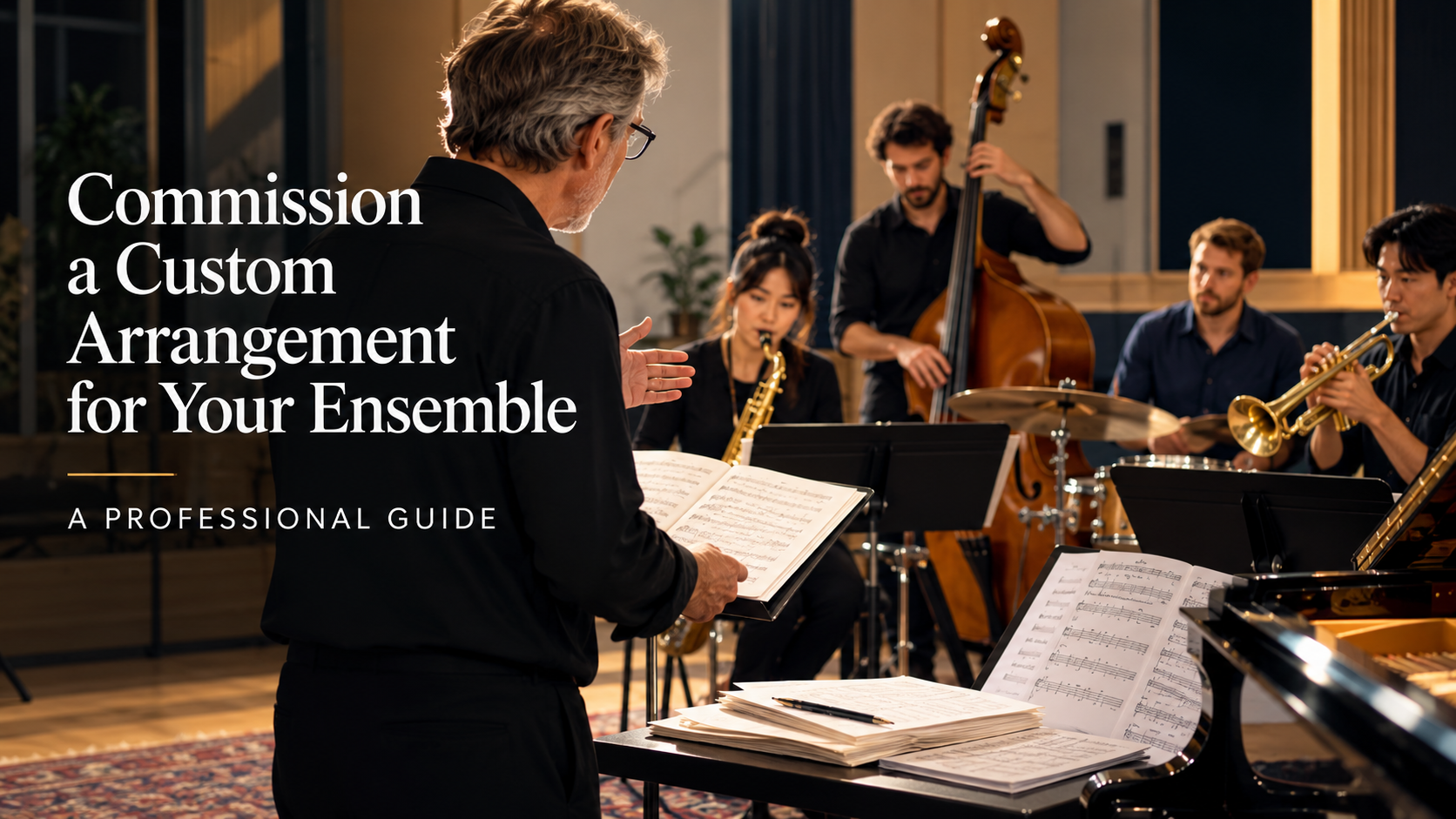
Commission a Custom Arrangement for Your Ensemble: A Professional Guide
Discover how a custom music arrangement can be tailored to your ensemble’s instrumentation, playing level, and artistic goals. Explore the commissioning process with composer and arranger Rolf Becker.
Every musical ensemble has its own character, shaped by its instrumentation, individual musicians, technical abilities, and artistic objectives.
Published arrangements provide an extensive repertoire for jazz ensembles, concert bands, orchestras, and smaller instrumental groups. However, standard instrumentation and predetermined difficulty levels do not always correspond to the needs of a particular ensemble.
A custom music arrangement offers an alternative: music developed around the musicians who will perform it.
Whether adapting an existing composition, arranging music for an unusual combination of instruments, or developing a distinctive concert program, a commissioned arrangement can address practical requirements while creating new artistic possibilities.
Why Commission a Custom Music Arrangement?
A professionally commissioned arrangement begins with the ensemble itself.
An orchestra may require an adaptation for reduced instrumentation. A jazz ensemble may have an unusual balance between brass and woodwinds. A school band may need repertoire that challenges its musicians without exceeding their technical abilities.
In other situations, an ensemble director may wish to feature a particular soloist, explore a different musical style, or create a new interpretation of familiar repertoire.
The purpose of a custom arrangement is not simply to accommodate limitations. It is to use the available musical resources effectively.
A successful arrangement considers instrumentation, instrumental ranges, harmonic balance, technical difficulty, rhythmic complexity, and stylistic authenticity.
These considerations influence how the music is orchestrated and how convincingly the ensemble can communicate its musical ideas.
Step 1: Discover — Understanding Your Ensemble
The first stage of planning a commissioned arrangement is understanding the musicians and the intended performance.
Before developing the score, several questions should be considered:
What is the exact instrumentation of the ensemble?
Are instrumental doublings or alternative instruments available?
What is the technical and musical experience of the performers?
Are there particular soloists to feature?
What musical style and character are desired?
Is the arrangement intended for a concert, recording, educational program, or special event?
Are there specific requirements concerning duration, difficulty, or performance date?
These details establish the musical framework for the project.
For educational ensembles, individual instrumental ranges, articulation requirements, and rhythmic complexity deserve particular attention.
For professional ensembles, the focus may be on a distinctive orchestral sound, sophisticated harmonic writing, featured improvisation, or a particular artistic interpretation.
Understanding these requirements from the beginning helps ensure that the resulting arrangement is musically convincing and practical to perform.
Step 2: Create — Developing the Musical Concept
Once the ensemble's requirements have been established, the next consideration is the musical concept.
An arrangement involves considerably more than assigning an existing melody to different instruments.
The arranger must determine how melodic material, harmonic structures, rhythmic figures, instrumental colors, and formal development will function within the available instrumentation.
For example, adapting a full big-band arrangement for a smaller jazz ensemble requires careful redistribution of musical responsibilities.
A passage originally written for five saxophones, four trumpets, and four trombones cannot necessarily be reproduced by simply omitting instrumental parts.
The arranger must reconsider the voicings, harmonic priorities, melodic lines, and balance between instrumental sections.
In some passages, a reduced number of voices may produce greater clarity. Elsewhere, octave doubling, carefully selected chord tones, or contrapuntal writing may provide the necessary harmonic and orchestral substance.
The objective is to preserve the musical character of the composition while creating a convincing arrangement for the new ensemble.
Musical Style and Artistic Identity
Stylistic understanding is equally important.
A swing arrangement requires attention to articulation, phrasing, rhythmic placement, and the interaction between the ensemble and rhythm section.
A Latin jazz arrangement may require a different approach to rhythmic organization, accompaniment patterns, and instrumental balance.
An orchestral adaptation introduces additional considerations involving instrumental color, register, dynamics, and the relationship between individual sections.
In each case, the arrangement should respect the musical style while allowing room for creative interpretation.
Step 3: Develop — Refining the Arrangement
The development stage brings together musical ideas and practical performance considerations.
As the score takes shape, the arranger evaluates the relationship between instrumental parts, the effectiveness of the orchestration, and the technical demands placed on individual musicians.
Several aspects deserve particular attention.
Instrumental ranges: Each part should reflect the capabilities of the intended performers while maintaining the musical character of the arrangement.
Voicing and balance: Harmonic structures must be distributed effectively to achieve clarity, blend, and the desired orchestral color.
Articulation and phrasing: Accurate musical indications help communicate style and interpretation.
Rhythmic precision: Complex figures must be notated clearly and appropriately for the ensemble's technical level.
Solo passages: Featured instrumentalists should have sufficient musical space, with backgrounds and accompaniment designed to support rather than obscure their contributions.
Rhythm-section writing: Piano, Bass, and Drums require appropriate musical information while retaining the flexibility demanded by the style.
Depending on the scope of the commission and the agreed working process, consultation or feedback may be incorporated during development.
The purpose of refinement is to ensure that the arrangement works as a coherent musical composition and as a practical performance resource.
Step 4: Deliver — Preparing the Score and Instrumental Parts
Professional music preparation is an essential part of the commissioning process.
Even an imaginative arrangement can become unnecessarily difficult to rehearse if the notation is unclear or the instrumental parts are poorly organized.
A properly prepared score should communicate the musical structure accurately, while individual parts should be readable and practical for performers.
Important considerations include:
Correct transposition for the respective instruments
Clear notation of rhythms, articulations, and dynamics
Appropriate rehearsal letters or measure references
Consistent tempo and stylistic indications
Practical page turns and readable page layouts
Accurate correspondence between the score and individual parts
The exact deliverables should be established before the project begins.
Depending on the commission, these may include a conductor score, individual instrumental parts, PDF files, reference audio, or other agreed materials.
Clear documentation and communication help ensure that the completed arrangement can move efficiently from preparation into rehearsal and performance.
Copyright, Permissions, and Commissioning Agreements
Copyright and usage rights are important considerations when commissioning music.
The applicable arrangements depend on the nature of the project, the source material, relevant copyright law, and the terms agreed upon by the parties.
An original composition and an arrangement of an existing copyrighted work may involve different rights and permissions.
For arrangements based on copyrighted material, authorization from the relevant rights holders may be required.
A commissioning agreement should clarify the scope of the work, agreed deliverables, payment terms, schedule, revision arrangements, and intended uses of the finished music.
Questions involving performance, recording, reproduction, distribution, exclusivity, and copyright ownership should be addressed explicitly where relevant.
Commissioning an arrangement does not automatically transfer copyright or grant unrestricted permission to reproduce, distribute, or record the music.
Establishing these matters before work begins helps protect both the commissioning client and the creative professional.
Custom Arrangements for Different Ensembles
Commissioned arrangements can serve a wide range of musical settings.
Jazz Ensembles and Big Bands
A custom jazz arrangement may be developed for a traditional big band, a reduced big band, or an ensemble with nonstandard instrumentation.
The arranger can adapt harmonic voicings, instrumental backgrounds, ensemble passages, and solo features to the available musicians.
This approach is particularly valuable when an ensemble wishes to preserve the character of a particular jazz style while developing its own musical identity.
Small Jazz Ensembles
Smaller groups offer distinctive opportunities for transparency, instrumental interaction, and flexible orchestration.
For example, the MusicMyLanguage Septet Series explores arrangements for Trumpet, Alto Saxophone, Tenor Saxophone, Baritone Saxophone, Piano, Bass, and Drums.
Although the series consists of published arrangements rather than individual commissions, it illustrates how carefully considered instrumentation can create substantial musical variety within a smaller ensemble.
Educational Ensembles
For school bands, youth orchestras, and student jazz ensembles, custom arrangements can help align musical repertoire with educational objectives.
Instrumental ranges, rhythmic demands, articulation, ensemble balance, and opportunities for individual development can all be considered during the arranging process.
The goal is to create music that remains artistically rewarding while being appropriate for the performers.
Professional Performances and Special Projects
Professional ensembles may commission arrangements for concerts, recordings, theatrical productions, special events, or collaborations involving unusual combinations of instruments.
Such projects may require a particular stylistic interpretation, orchestral character, or musical concept that is not available in existing published repertoire.
When Is a Custom Arrangement the Right Choice?
Commissioning music is not necessary for every ensemble or performance.
Published arrangements often provide excellent musical material and may be the most practical option when the instrumentation, difficulty, and artistic requirements already correspond to the ensemble's needs.
A custom arrangement becomes particularly valuable when existing repertoire does not adequately address the intended instrumentation or musical concept.
Before commissioning, it is useful to consider whether the project requires a new orchestration, a different key, an adapted level of difficulty, a featured soloist, or a substantially different musical interpretation.
A clear understanding of the artistic objective helps determine whether an existing publication or a commissioned arrangement is the more appropriate solution.
Planning Your Music Arrangement Commission
Good preparation is essential when approaching a professional arranger.
Begin by identifying the composition or musical concept, the available instrumentation, the intended performers, and the performance context.
Consider the desired duration, musical style, level of difficulty, and any special requirements.
If a performance date has already been established, allow sufficient time for arranging, score preparation, review, and rehearsal.
The time and cost involved will depend on the scale and complexity of the project.
A short arrangement for a small ensemble will generally require a different amount of preparation from a substantial orchestral adaptation or an extended concert work.
A detailed discussion of the requirements provides the most reliable basis for defining the scope of the commission.
Explore MusicMyLanguage Commissioning Services
MusicMyLanguage brings together professional experience in composition, arranging, orchestration, and conducting.
The objective of a commissioned arrangement is to create music that respects the character of the original material, uses the available instrumentation effectively, and supports the artistic intentions of the performers.
Whether you are planning a jazz concert, developing repertoire for an educational ensemble, or considering a special musical project, thoughtful preparation is the foundation of a successful collaboration.
Explore the MusicMyLanguage Ensemble Commissions page for further information about discussing your project.
Frequently Asked Questions
What is a custom music arrangement?
A custom music arrangement is a new musical treatment developed for particular performers, instrumentation, or artistic requirements. It may involve adapting an existing composition, changing its orchestration, or creating a distinctive interpretation for a specific ensemble.
How much does a commissioned arrangement cost?
The fee depends on factors such as ensemble size, duration, musical complexity, orchestration requirements, preparation of scores and parts, and the agreed schedule. A project-specific quotation is generally more meaningful than a fixed price that does not account for these differences.
Can an arrangement be written for unusual instrumentation?
Yes. One of the principal advantages of commissioning an arrangement is the opportunity to develop music for a particular combination of instruments. The arranger can consider the available instrumental ranges, tonal colors, technical capabilities, and desired musical balance.
Can a custom arrangement be adapted to the musicians' abilities?
Yes. Technical difficulty can be considered during the arranging process, including instrumental ranges, rhythmic complexity, articulation, tempo, and ensemble demands. The objective is to create an appropriate balance between musical interest and practical playability.
What materials should I prepare before requesting a commission?
Useful information includes the intended composition or musical concept, exact instrumentation, performer proficiency, desired style, approximate duration, performance context, and deadline. Recordings or examples of the desired musical character may also help communicate the project's artistic direction.
Can I commission an arrangement of a copyrighted composition?
Potentially, but the necessary permissions depend on the composition, its copyright status, the intended use, and applicable law. Permission from the relevant rights holders may be required before an arrangement can be created, distributed, or used in certain ways.
Giving Your Ensemble Its Own Musical Voice
The most successful arrangements combine musical imagination with an understanding of the performers for whom the music is written.
Instrumentation, orchestration, technical demands, harmonic language, and stylistic interpretation all contribute to the final result.
A commissioned arrangement offers the opportunity to bring these elements together around a particular artistic objective.
For ensemble directors, educators, and professional musicians, it can provide a practical and creative way to develop repertoire that reflects the musical identity of their ensemble.
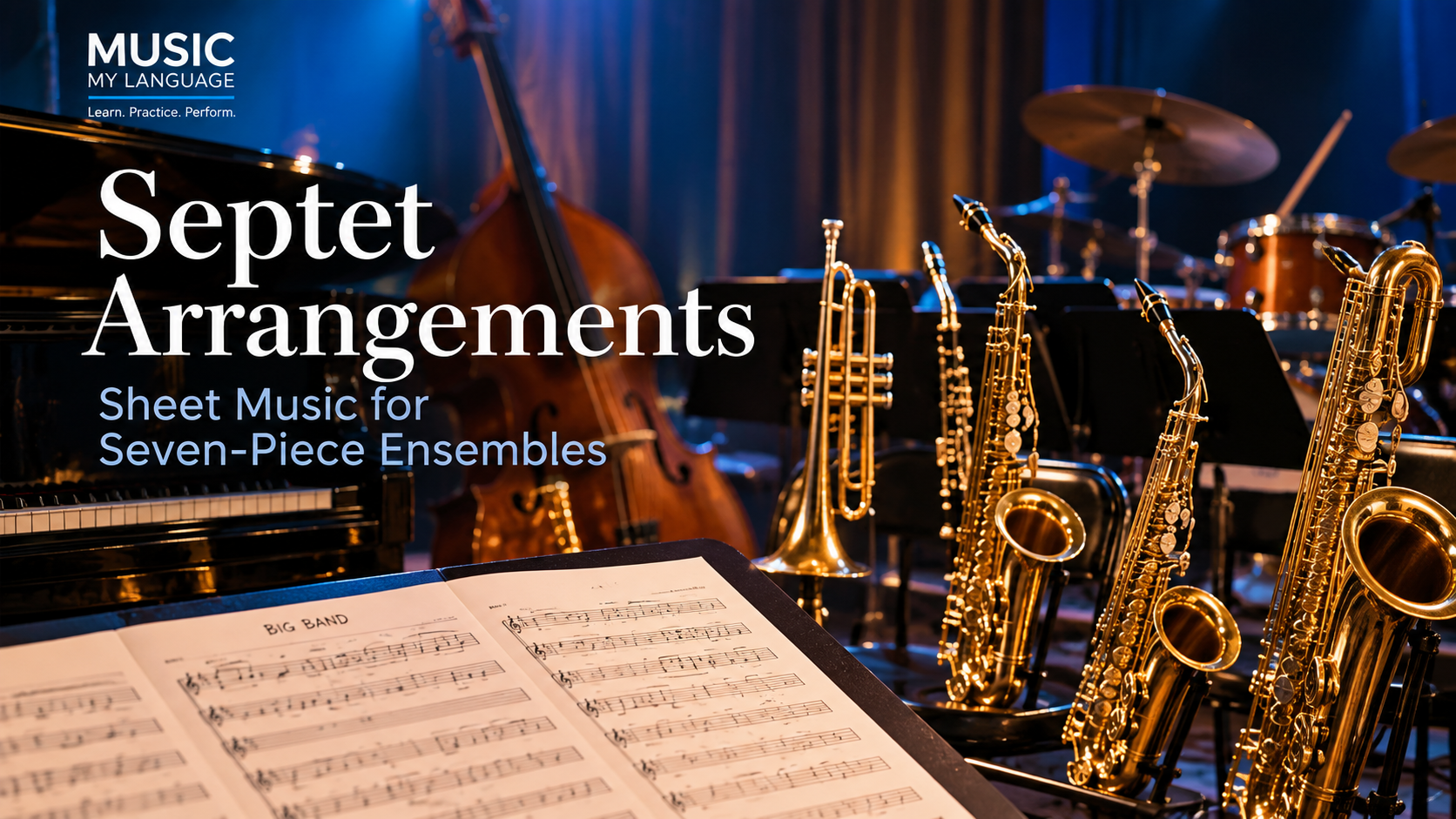
Septet Arrangements Sheet Music for Seven-Piece Ensembles
Discover how a seven-piece jazz ensemble can create a rich, powerful sound with just four horns and rhythm section. Explore professional septet arranging, instrumentation and the MusicMyLanguage Septet Series.
Finding professionally arranged music for a seven-piece jazz ensemble can be challenging. While repertoire for small jazz combos and traditional big bands is widely available, music written specifically for four horns and rhythm section offers a distinctive alternative.
The MusicMyLanguage Septet Series explores the musical possibilities of this instrumentation through arrangements conceived for the ensemble itself—not simply reductions of existing big-band scores.
Why the Seven-Piece Jazz Ensemble Works
The MusicMyLanguage Septet Series uses the following instrumentation:
Trumpet
Alto Saxophone
Tenor Saxophone
Baritone Saxophone
Piano
Bass
Drums
Four horns provide considerable melodic, harmonic, and timbral flexibility, while the rhythm section maintains the responsiveness associated with smaller jazz groups.
The ensemble can move naturally between unison passages, octave doubling, harmonized melodies, contrapuntal lines, rhythmic backgrounds, and featured improvisation.
The objective is not to imitate a larger ensemble, but to create a complete and convincing musical identity with seven musicians.
Four Horns, Distinctive Orchestral Possibilities
Writing for Trumpet, Alto Saxophone, Tenor Saxophone, and Baritone Saxophone requires careful consideration of register, balance, and instrumental character.
The Trumpet can contribute brilliance and definition, while the Alto and Tenor Saxophones offer contrasting melodic and harmonic colors. The Baritone Saxophone provides depth but can also function as an independent melodic voice or participate in upper-register ensemble writing.
These roles are not fixed. Effective orchestration allows each instrument to assume different responsibilities as the arrangement develops.
Unison passages can create rhythmic clarity and intensity. Octave writing broadens a melodic statement, while four-part harmonization introduces richer harmonic textures. Independent lines and contrapuntal passages provide movement without requiring additional instruments.
The greatest variety often comes from changing the orchestration rather than increasing the number of notes.
Creating Contrast and Ensemble Impact
A successful septet arrangement depends on contrast.
A single horn accompanied by Piano, Bass, and Drums can establish an intimate texture. Introducing a second melodic line or a restrained background changes the musical perspective. When all four horns return together, the resulting ensemble passage can have considerable impact.
Articulation, dynamics, phrasing, and balance are particularly important. With only four horns, each individual part remains clearly audible.
The rhythm section is equally essential. Piano, Bass, and Drums should contribute to the musical character, rhythmic direction, and formal development of the arrangement.
Together, these elements create a cohesive ensemble rather than a collection of independent instrumental parts.
Inside the MusicMyLanguage Septet Series
The MusicMyLanguage Septet Series was developed to provide substantial jazz ensemble writing for this particular instrumentation.
In A Mellow Tone — Duke Ellington
The first arrangement in the series opens with a unison introduction derived from the final eight bars of the composition.
The horn writing subsequently expands through harmonized passages, written backgrounds, and increasingly active ensemble figures. Later sections introduce more demanding textures, including closely voiced harmonies and sixteenth-note passages.
The arrangement demonstrates how a familiar jazz composition can be reimagined for four horns and rhythm section while preserving its musical character.
Quintessence — Quincy Jones
The second arrangement features the Alto Saxophone as its principal solo voice.
Trumpet, Tenor Saxophone, and Baritone Saxophone provide changing backgrounds, including chordal textures, double-time figures, and staggered bell-like effects.
Near the conclusion, the ensemble gives way to an Alto Saxophone cadenza before the final statement.
This arrangement demonstrates a different approach to the same instrumentation, emphasizing the featured soloist and the expressive possibilities of carefully constructed backgrounds.
The two arrangements illustrate a central principle of the series: consistent instrumentation does not require identical orchestration. Each composition calls for its own musical treatment.
Educational Benefits of the Septet Format
The septet is also a valuable ensemble format for music education.
Because each horn has a distinct role, performers must pay close attention to intonation, articulation, rhythmic precision, balance, and blend.
Players develop an understanding of how their individual parts contribute to the complete musical texture.
They learn to recognize whether they are carrying the melody, supporting a harmonic structure, playing an independent counterline, or responding to another instrumental voice.
These skills are equally valuable in small jazz ensembles, big bands, and professional performance settings.
For advanced students and experienced musicians, the septet offers sufficient complexity for sophisticated ensemble writing while preserving the direct musical communication of a small group.
What to Consider When Choosing Septet Sheet Music
Before selecting an arrangement, ensemble directors and musicians should examine several practical and musical factors.
Instrumentation: Confirm that the arrangement matches the available ensemble. A seven-piece arrangement is not necessarily written for the same combination of instruments.
Playing difficulty: Consider instrumental ranges, rhythmic complexity, articulation, tempo, and the technical demands of ensemble passages.
Solo features: Identify which instruments are featured and whether improvisation is required or optional.
Rhythm-section writing: Examine the balance between notated material, chord symbols, rhythmic figures, and stylistically appropriate performance freedom.
Score and parts: Check which materials are included in the published edition, especially when a conductor score is required.
Audio previews: When available, listen to the recording or sample to evaluate the arrangement's musical character and suitability for your ensemble.
Choosing an arrangement involves more than finding the correct number of instrumental parts. The music should also match the ensemble's technical ability, artistic objectives, and performance setting.
Explore the MusicMyLanguage Septet Series
The MusicMyLanguage Septet Series brings together arrangements developed specifically for Trumpet, Alto Saxophone, Tenor Saxophone, Baritone Saxophone, Piano, Bass, and Drums.
Visit the MusicMyLanguage Septet Series to explore the arrangements, instrumentation, available audio previews, and purchasing information.
Individual arrangement pages provide the most appropriate starting point for evaluating each publication and following the relevant retailer links.
A Distinctive Musical Identity
The seven-piece jazz ensemble deserves recognition as an independent musical format.
Four horns provide opportunities for substantial harmonic and contrapuntal writing, while the rhythm section preserves flexibility, transparency, and interaction.
The MusicMyLanguage Septet Series is built around these strengths, offering arrangements that explore the full expressive potential of the instrumentation.
For professional musicians, educators, and ensemble directors seeking septet arrangements and sheet music, the series provides a focused approach to jazz ensemble performance.
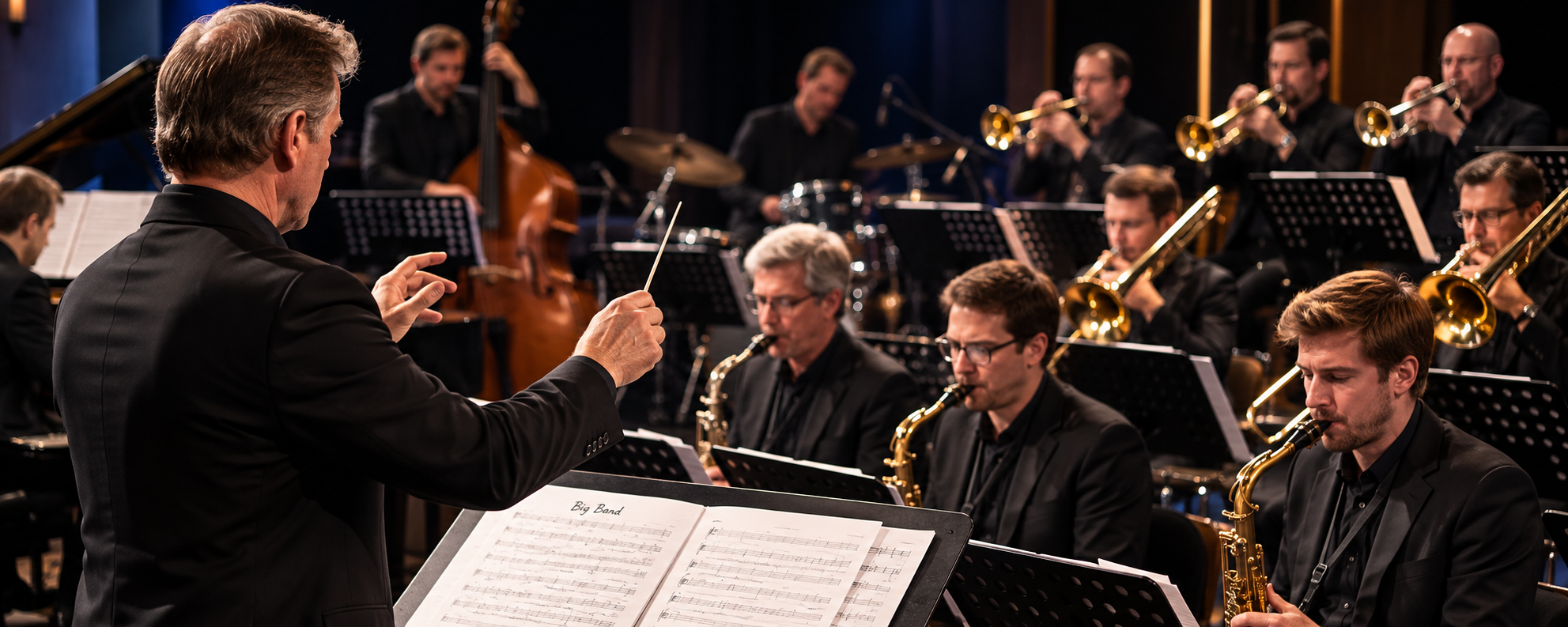
Buy Big Band Charts Online That Fit Your Ensemble
Choosing the right big band chart goes far beyond picking a great tune. Discover what to look for in instrumentation, playability, notation, style and arranging craftsmanship before buying your next chart.
Finding the right chart is about more than choosing a tune your ensemble might enjoy. When you buy big band charts online, you are investing rehearsal time, musical energy, and budget into material that needs to work for the musicians who will actually perform it.
A convincing audio demo or a well-known title can certainly attract attention, but neither tells you everything you need to know about an arrangement. Instrumentation, ranges, notation, balance, stylistic accuracy, solo opportunities, and the overall construction of the chart can make the difference between an enjoyable rehearsal process and one spent solving unnecessary problems.
I have spent decades composing, arranging, performing, and conducting ensembles in different countries and musical environments. One principle has remained consistent throughout that experience: a good arrangement should help the musicians make music. It should not stand in their way.
Here are some of the things I consider particularly important when choosing professional big band charts.
Assessing Instrumentation Before You Browse
Before buying an arrangement, start with one very practical question:
Who is actually going to play it?
Traditional big band instrumentation is relatively standardized, but not every ensemble works with the same lineup. Professional bands, school ensembles, university groups, community bands, project ensembles, and smaller jazz groups can all have different requirements.
Checking the instrumentation before purchasing therefore saves considerable rehearsal time later.
Standard vs. Reduced Instrumentation
A traditional big band commonly uses five saxophones, four trumpets, four trombones, plus rhythm section. That instrumentation produces the characteristic power and range of colors associated with the classic big band sound.
But a smaller ensemble does not necessarily have to sound small.
Good arranging can create considerable power, contrast, and harmonic color with fewer musicians. The important question is not simply how many instruments are available, but how effectively those instruments are used.
That philosophy is central to my own Small Big Band writing. Rather than treating reduced instrumentation as an incomplete traditional big band, I write specifically for the smaller format so that the available horns and rhythm section function as a complete ensemble.
If that format suits your group, you can explore the MusicMyLanguage Small Big Band Charts.
For an even more compact setting, the MusicMyLanguage Septet Series is based around four horns plus rhythm section.
Check the Actual Parts
Instrumentation is only the beginning. Look at the individual parts whenever previews are available.
Which instrument carries the melody? Where are the demanding passages? Are there exposed lines? What are the upper and lower ranges? Is a particular player expected to improvise?
These questions become especially important when programming music for a specific ensemble.
A technically excellent arrangement can still be the wrong arrangement for your band if one essential part sits consistently outside a player’s comfortable range or requires a stylistic ability that the player has not yet developed.
The best purchase is therefore not necessarily the most impressive chart. It is the chart that allows your ensemble to sound impressive.
Matching Difficulty Levels to Ensemble Skill
Difficulty labels can be useful, but they should be treated as a starting point rather than an absolute measurement.
Terms such as easy, intermediate, advanced, or professional can mean different things to different publishers and arrangers. The score itself tells you much more.
Look Beyond the Grade
When assessing a chart, examine the musical demands behind the difficulty label.
A passage may contain relatively few notes and still be challenging because of its range, articulation, rhythmic placement, dynamics, or stylistic requirements.
Conversely, a passage containing many notes may sit naturally on the instrument and be surprisingly comfortable to play.
Range is particularly important in brass writing. A trumpet part that remains unnecessarily high for long periods can become tiring regardless of how simple the rhythms appear.
The same principle applies throughout the ensemble. Good scoring considers not only whether a note can be played, but whether the entire part can be performed musically and consistently.
Rhythm, Articulation and Phrasing Matter
Jazz notation contains much more information than pitches and rhythms.
Articulations, accents, dynamics, note lengths, phrasing and stylistic conventions all influence the final result. Clear notation helps musicians understand what the arranger intends without requiring the conductor to explain every phrase during rehearsal.
This is particularly important in swing, funk, Latin music and other rhythmically defined styles.
For me, professional notation is not decoration added after the arrangement has been completed. It is part of the arrangement itself.
The score should communicate the music as clearly as possible.
Consider the Improvisation Requirements
If a chart contains open solo sections, check how those sections function.
Who can solo? Are the chord changes clearly presented? How long can the section continue? Does the ensemble have something musically useful to play behind the soloist?
An open solo section can be one of the most exciting moments in a jazz arrangement because it allows every performance to develop differently.
But the written arrangement still needs to provide a strong framework around that freedom.
Navigating Big Band Sheet Music Shops and Libraries
Buying sheet music online gives musicians and directors access to an enormous amount of repertoire. That is an advantage—but it also makes evaluation increasingly important.
A large catalog does not automatically mean that every chart will suit every ensemble.
Look at the Arrangement, Not Only the Song
One of the easiest mistakes when buying sheet music is choosing primarily by title.
You recognize the tune. Your musicians know it. Perhaps your audience knows it too.
But you are not really purchasing the song—you are purchasing an arranger’s interpretation of that song.
Two arrangements of the same composition can be completely different in instrumentation, difficulty, form, harmonic language, stylistic direction and rehearsal demands.
Whenever possible, examine the score preview and listen to the available audio example.
Ask yourself whether the arrangement itself—not merely the composition—is right for your ensemble.
The MusicMyLanguage Music Library brings together the different arranging formats and series available through MusicMyLanguage, making it easier to explore repertoire according to ensemble type and musical concept.
Read the Product Information Carefully
Before purchasing through any sheet-music platform, check exactly what is included.
Instrumentation, score and parts, arrangement format, available previews and the applicable purchasing or licensing conditions should be clear before you make a decision.
Where arrangements are sold through external publishing platforms, their respective purchase and licensing conditions apply.
This is particularly important for conductors and institutions building a repertoire library intended for repeated use.
Selecting Professional Big Band Charts by Style
A good jazz arrangement needs more than correct notes.
It needs a convincing understanding of style.
Swing, bebop, funk, Latin jazz, ballads and contemporary styles each require different approaches to rhythm, articulation, voicing, orchestration and phrasing.
Stylistic Authenticity Matters
A swing chart should feel like swing before the conductor has to explain it.
A funk chart needs an effective relationship between drums, bass, piano or guitar and the horn figures.
A Latin arrangement needs rhythmic clarity and an understanding of how its different layers interact.
This is where arranging becomes more than distributing notes among instruments.
The arranger is creating relationships between the sections of the ensemble.
Saxophones, trumpets, trombones and rhythm section each have their own character, but the arrangement needs to make them function as one musical organism.
Identifying Quality Arranging Craftsmanship
When looking at a score, pay attention to the details.
Are articulations consistent? Are dynamics meaningful? Are backgrounds written to support rather than obscure a soloist? Does the orchestration create contrast? Does the arrangement build somewhere, or simply repeat the same texture?
Also consider musical balance.
Not every instrument needs to play all the time. Sometimes the most effective arranging decision is to leave space.
Professional arranging is therefore not about putting as many notes as possible onto the page. It is about knowing which notes are necessary, who should play them, and when they should happen.
That principle becomes especially important with smaller ensembles, where every voice has a clearly audible function.
When to Commission Custom Big Band Arrangements
Published charts can cover a tremendous range of repertoire, but there are situations where a custom arrangement makes more sense.
Perhaps your ensemble has unusual instrumentation. You may have a particular soloist or vocalist you want to feature. You might need a specific duration, musical concept, opening number, finale, or arrangement built around the character of an event.
In those situations, commissioning an arrangement allows the music to be designed around the project rather than forcing the project to fit an existing chart.
MusicMyLanguage offers custom ensemble commissions for projects requiring an arrangement or original musical concept tailored to a particular ensemble.
A custom arrangement can also be useful when an existing musical idea needs to be transformed for a different ensemble format—provided, of course, that the necessary arranging and performance rights are available.
The important point is that instrumentation becomes part of the creative process from the beginning.
Building a Sustainable Repertoire Collection
A good music library should not simply contain a large number of titles.
It should contain music you genuinely want to perform.
Over time, those charts become part of an ensemble’s musical identity.
Balance Your Programming Needs
A useful repertoire collection contains contrast.
Fast and slow pieces. Swing and straight-eighth styles. Powerful ensemble charts and pieces featuring individual soloists. Familiar repertoire alongside less expected choices.
The exact balance depends on the purpose of the ensemble.
A professional concert band may have different priorities from a school ensemble, a community big band, a university jazz orchestra or a project band assembled for a particular event.
What they all share is the need for repertoire that works musically in performance.
Build a Library You Can Return To
Some arrangements are performed once and disappear into the archive. Others become charts musicians and conductors want to revisit.
Those are particularly valuable.
A well-written chart can reveal more with each performance because the musicians gradually move beyond simply playing the notes and begin concentrating on interaction, phrasing, dynamics, balance and interpretation.
That is when an arrangement becomes more than sheet music.
It becomes repertoire.
Maximizing Value from Your Music Library Purchase
When you buy big band charts online, consider four things before making the final decision:
Instrumentation. Playability. Style. Musical purpose.
Does the chart fit the musicians you actually have? Are the individual parts written intelligently? Does the arrangement communicate its style clearly? And does it serve the musical purpose for which you are buying it?
If those elements are right, rehearsals become more productive and musicians can concentrate on what ultimately matters: making music together.
A strong arrangement should give an ensemble something worth discovering—not merely something to play.
And that is ultimately what I look for in every chart I conduct, perform, or write.