

Chapter 7 — Fourteen German Unity Days
An unexpected invitation at Shanghai's JZ Club in 2006 began fourteen years of musical collaboration with the German Consulate General. From conducting three national anthems to performing jazz at diplomatic celebrations, this chapter recalls the music, memorable encounters, and friendship that made those years so special.
Music, Diplomacy, and an Unexpected Friendship
How an invitation at a Shanghai jazz club led to fourteen years of musical celebrations, an unusual responsibility involving three national anthems, and a friendship I still cherish.
An Unexpected Invitation at the JZ Club
It was a Saturday evening in late August 2006. I was performing with the JZ All Star Big Band at the JZ Club on Fuxing Road when a member of the cultural affairs staff from the German Consulate General approached me with an invitation.
Would I be interested in meeting the German Consul General, Dr. Röhr, to discuss providing music for the upcoming German Unity Day celebrations?
Naturally, I was interested.
What I didn't know at the time was that this seemingly ordinary invitation would lead to fourteen years of musical involvement with the German Consulate General in Shanghai—and to a friendship that would become one of my most cherished memories of those years.
Two Celebrations, Two Very Different Ensembles
When I met Dr. Röhr, he explained that German Unity Day was celebrated in Shanghai with two separate events.
The first was the official reception at the Consul General's residence on Yongfu Road, not far from the JZ Club. This was a formal diplomatic occasion, attended by representatives of the Shanghai municipal government and other invited guests of honor.
The second was a much larger celebration for the German community in Shanghai, attracting an estimated 2,000 guests or more.
Both occasions followed a similar ceremonial structure. First came the Chinese, European, and German anthems, followed by speeches from the Consul General and a representative of the Chinese delegation. Afterwards, guests enjoyed refreshments and a buffet while live music provided the atmosphere for the celebrations.
Given the limited space at the residence, I suggested putting together a septet for the official reception. For the large public celebration, I recommended my big band.
Dr. Röhr immediately approved both proposals.
There was, however, one small detail I had neglected to mention.
I didn't have a single arrangement ready for the septet.
With barely a month before the celebrations, I now had to write enough music for two complete 45-minute sets.
It was an ambitious undertaking, to say the least. But arranging music under pressure was hardly unfamiliar territory for me, and I was determined to make this new ensemble work.
Three Anthems—and a Question of Trust
There was another musical challenge, one that required considerably more diplomatic sensitivity.
Traditionally, the Chinese, European, and German anthems had been played from recordings. This ensured that their familiar musical character remained untouched—an understandable precaution at an official diplomatic event.
I proposed something different.
Why not perform all three anthems live?
I assured Dr. Röhr that I could rearrange the music for my ensembles without compromising the original character or dignity of the compositions.
He trusted my judgment.
That trust was particularly meaningful because, as Consul General, he was effectively accepting responsibility for allowing a departure from the customary procedure.
I took the task seriously. These were not pieces of music to be treated as opportunities for clever reharmonization or jazz improvisation. Their ceremonial character had to remain intact, while the arrangements needed to work convincingly with the musicians and instrumentation available.
At the official receptions, I personally conducted all three anthems.
And the result?
The audience responded with applause.
Not just that first year, but year after year.
For me, this was especially gratifying. It demonstrated that a live musical performance, handled with care and respect, could add something meaningful to an occasion where recorded music had previously been the norm.
A Consul General with a Clarinet
During my conversations with Dr. Röhr, I discovered something rather delightful.
He was not merely interested in jazz.
He played the clarinet himself.
That opened the door to an entirely different kind of musical collaboration.
I put together a Dixieland sextet in which I played clarinet, and Dr. Röhr joined us with his own instrument.
It was a wonderful experience.
For those moments, the usual distinction between a diplomat and a professional musician seemed to disappear. We were simply people enjoying the pleasure of making music together.
Looking back, I believe our shared enthusiasm for jazz helped establish a relationship that extended well beyond the usual professional arrangement between an event organizer and a musician.
Over time, we developed a genuine friendship.
And although I would continue working for the German Consulate General under two of Dr. Röhr's successors, the years of our collaboration have remained particularly special to me.
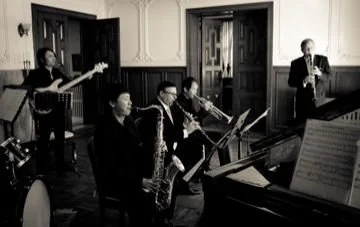
German Consul General Dr. Röhr joining me and fellow musicians for a Dixieland performance. Our shared enthusiasm for jazz became the foundation of a lasting friendship.
From the Residence to a Crowd of Thousands
The two celebrations required very different musical approaches.
At the residence, the septet provided an intimate setting, with carefully arranged music suitable for an official reception.
The public celebration was another matter entirely.
With an audience of approximately 2,000 guests or more, the big band provided the musical energy and presence appropriate for such a large gathering.
It was a rather unusual situation: a German national celebration in Shanghai, featuring an international group of musicians performing American-style big band music.
Some years later, Dr. Röhr told me a story that still makes me smile.
His American counterpart had apparently remarked:
"I have to go to a German event to see an American big band."
I thought that was a marvelous observation.
It also said something about Shanghai's international musical life. Music crossed national boundaries quite naturally. A German celebration could feature American jazz, performed by musicians from different countries, for an audience gathered in China.
And somehow, it all made perfect sense.
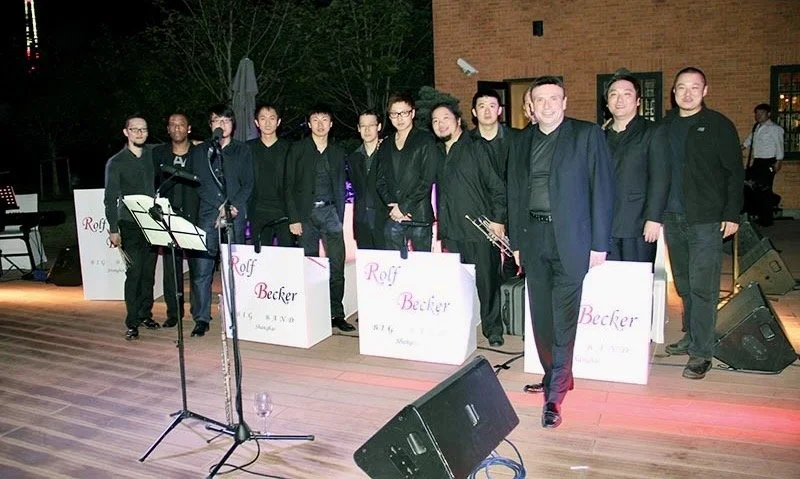
My smaller big band at the German Unity Day celebrations in Shanghai, October 2012. Depending on the occasion and available space, the ensemble varied in size.
Nanjing, 2007 — Music Beyond Shanghai
Dr. Röhr served as Consul General in Shanghai on two separate occasions.
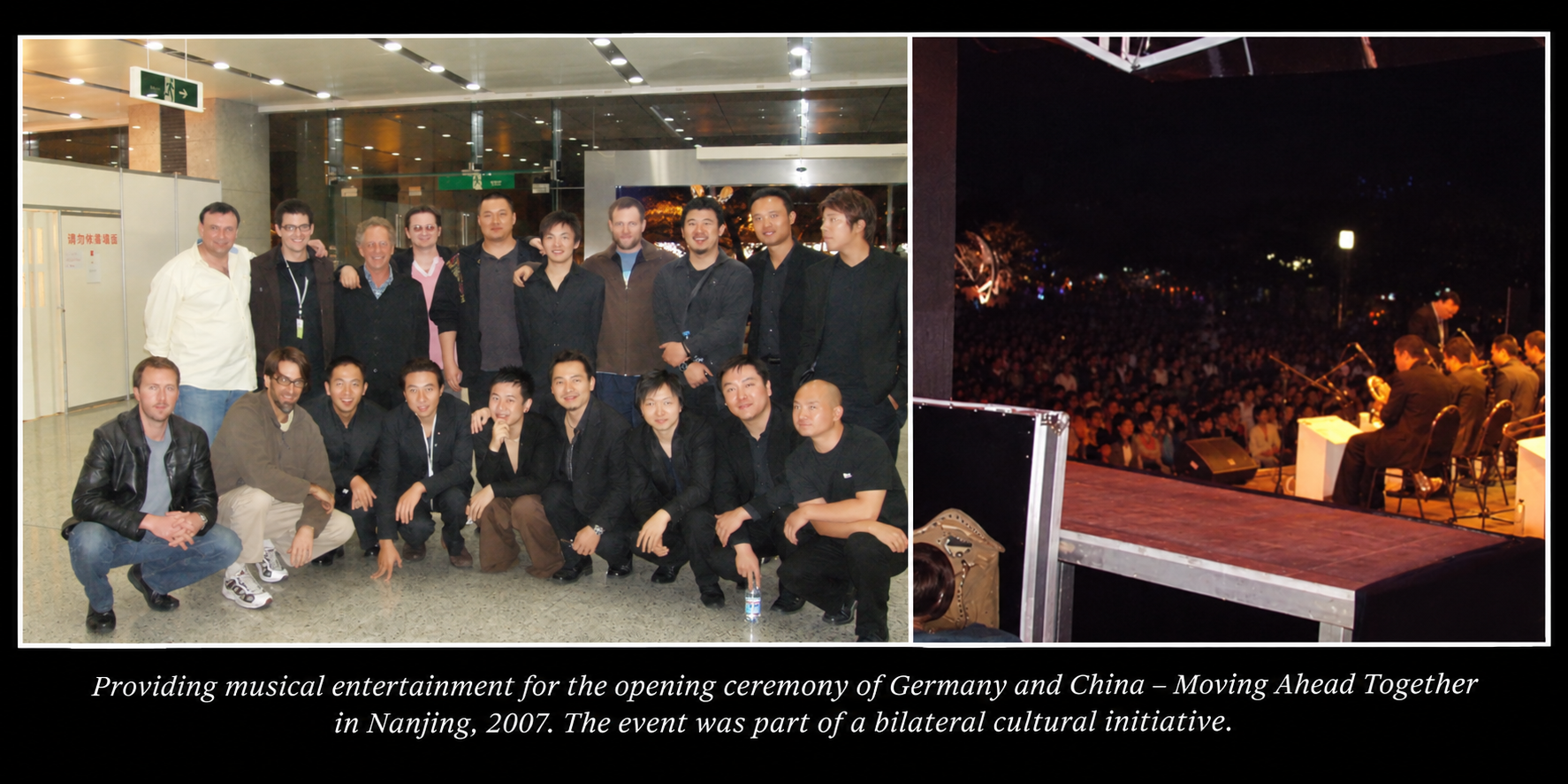
Between his two terms, he was called to Berlin to oversee and implement an ambitious cultural initiative agreed upon by Germany and China: Germany and China – Moving Ahead Together (in German: “Deutschland und China – Gemeinsam In Bewegung”)
In 2007, he invited me to provide the musical accompaniment for the project's opening ceremony in Nanjing.
The event took place in a public square, bringing our music into a very different environment from the diplomatic receptions in Shanghai.
For this occasion, I also invited Coco Zhao, the outstanding Shanghai jazz vocalist who had already appeared as a guest artist in my Jazzy Mozart concert in April 2006.
I asked him to perform two German songs: Für Dich soll's rote Rosen regnen, famously associated with German actress and singer Hildegard Knef, and Tipitipso, performed by Caterina Valente.
The second song held a particularly personal meaning for me. I had worked with Caterina Valente earlier in my career, including a concert tour in 1987. Now, twenty years later, I found myself presenting one of the songs associated with her through the voice of a Chinese jazz singer at a German-Chinese cultural celebration.
It was one of those unexpected connections that made my musical life in Shanghai so fascinating.
What had begun with a conversation at the JZ Club was now extending into a broader program of cultural exchange between Germany and China.
For me, this invitation was another indication of the trust that had developed between Dr. Röhr and me—and another memorable experience in a career that continually reminded me how music could bring people together across cultural and national boundaries.
The Septet That Became a Tradition
Over the years, the septet became a familiar part of the official German Unity Day celebrations at the Consul General's residence.
Although individual musicians occasionally changed, I was fortunate to work with some outstanding players.
One lineup, in particular, remains my favorite:
Hu Danfeng — Trumpet
Nix Xue — Alto Saxophone
Alec Haavik — Tenor Saxophone
Charles Chang — Baritone Saxophone
Oleg Roschin — Piano
Brian Hurley — Bass
Charles Foldesh — Drums
Several of these musicians were familiar colleagues from Shanghai's jazz scene, including Alec Haavik, whose name has already appeared in earlier chapters of this series.
I usually concentrated on arranging and conducting rather than performing as a regular member of the septet. Occasionally, however, I picked up my flute for arrangements that required an additional woodwind voice, particularly when the saxophonists were unable to double.
The repertoire reflected my musical preferences: carefully crafted arrangements, a strong ensemble sound, and enough room for the individual personalities of the musicians to shine.
One surviving live recording captures the septet performing my arrangement of Duke Ellington's Do Nothing till You Hear From Me at the Consul General's residence on Yongfu Road.
Listening to such recordings brings back more than just the music. They remind me of the musicians, the atmosphere, and the many hours of preparation that went into performances which, for the audience, might have seemed effortless.
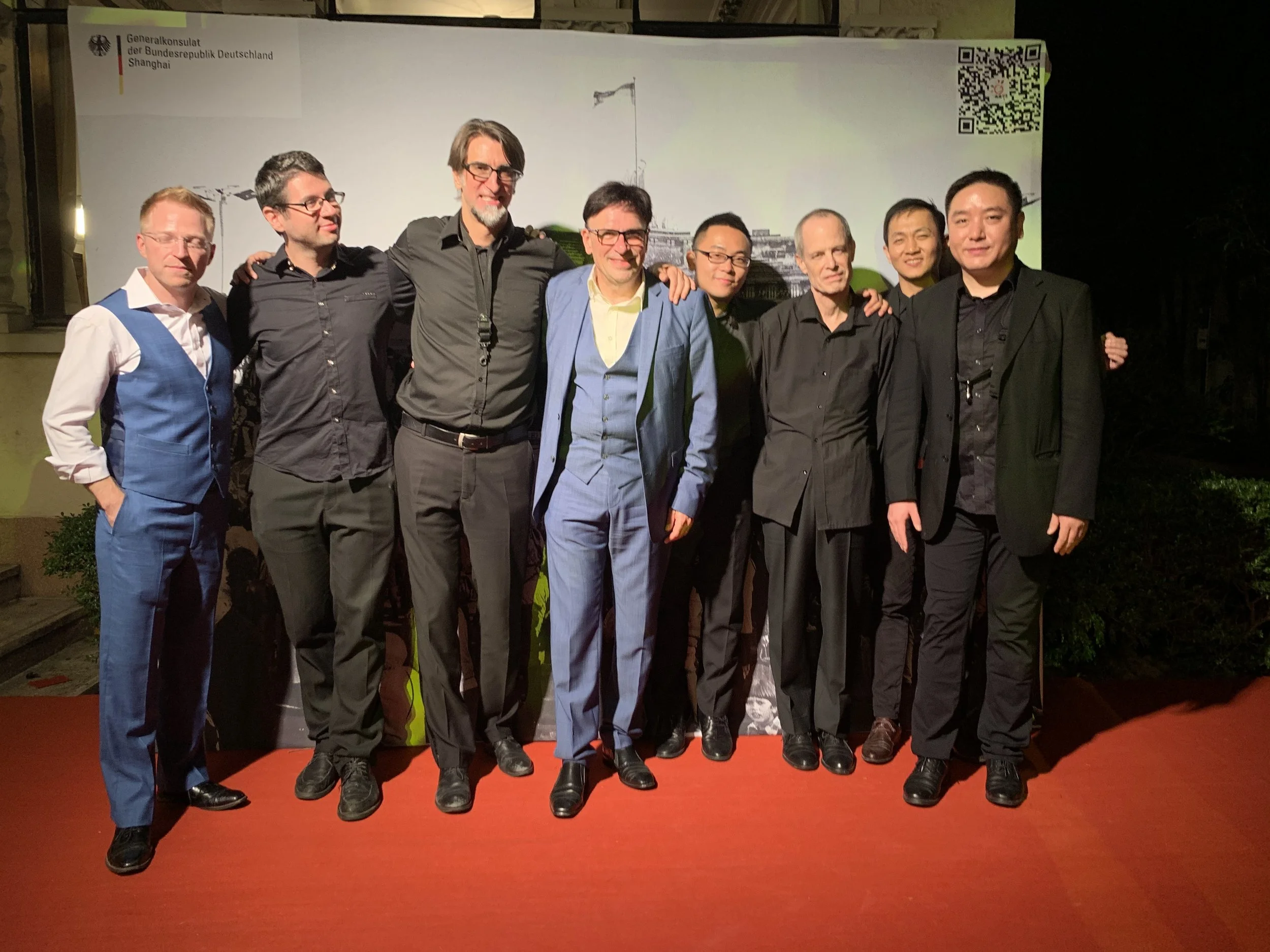
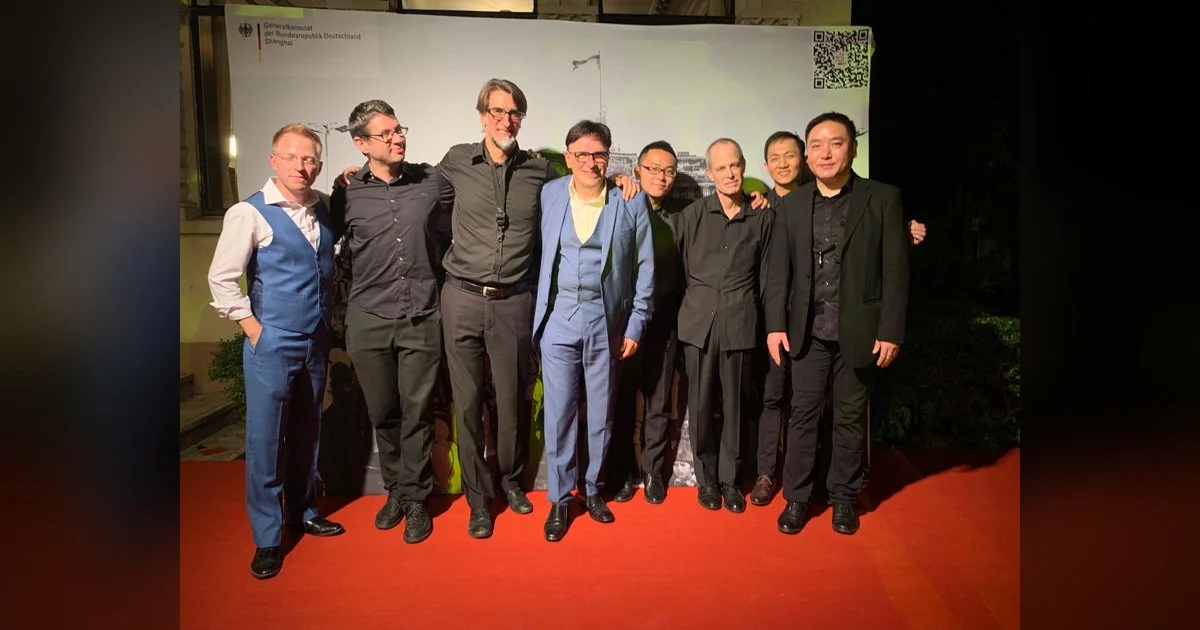
My preferred German Unity Day Septet lineup, circa 2014: Hu Danfeng, Nix Xue, Alec Haavik, Charles Chang, Oleg Roschin, Brian Hurley, and Charles Foldesh. Although personnel occasionally varied, this was the combination of musicians I particularly valued.
Live performance by the Rolf Becker Septet at the German Consul General's residence in Shanghai. An excerpt from Rolf Becker's arrangement of Duke Ellington's "Do Nothing Till You Hear From Me," recorded during the German Unity Day celebrations.
Fourteen Years of German Unity Day
For approximately the first six years, the celebrations continued in their original two-part format.
Eventually, the large public celebration was discontinued.
The official reception at the residence, however, continued, and so did my musical involvement.
From 2006 until 2019, I provided music for fourteen consecutive German Unity Day celebrations in Shanghai.
During those years, I experienced changes in personnel, different musical requirements, and the transitions between Consuls General. But the underlying purpose remained the same: to provide music that was appropriate for the occasion while retaining the warmth and individuality of a live performance.
Fourteen years is a long time in the life of a musician, particularly in a city as constantly changing as Shanghai.
And yet, when I think back on those celebrations, it is not the number of performances that first comes to mind.
It is the people.
More Than a Professional Engagement
Dr. Röhr has since retired and now lives in Berlin.
Our professional collaboration began with a simple invitation in 2006, but what I remember most fondly is the trust he placed in me, his enthusiasm for jazz, and the friendship that developed over the years.
I continued working with two subsequent German Consuls General, and I remain grateful for those opportunities.
But the time spent working with Dr. Röhr holds a particularly special place in my memory.
There is something rather wonderful about the fact that a German diplomat and a German musician, both living and working in Shanghai, found common ground through American jazz.
We shared a love of music, enjoyed performing together, and built a relationship that went beyond our respective professional roles.
Looking back, I realize that some of the most meaningful moments of my career did not necessarily happen on the biggest stages or in front of the largest audiences.
Sometimes, they began with an unexpected conversation in a small jazz club.
And sometimes, they lasted fourteen years.
Next in Shanghai Big Band History: The story continues...