

From the JZ All Star Big Band to a New Orchestral Vision, 2009–2014
When Artistic Independence Met Club Ownership
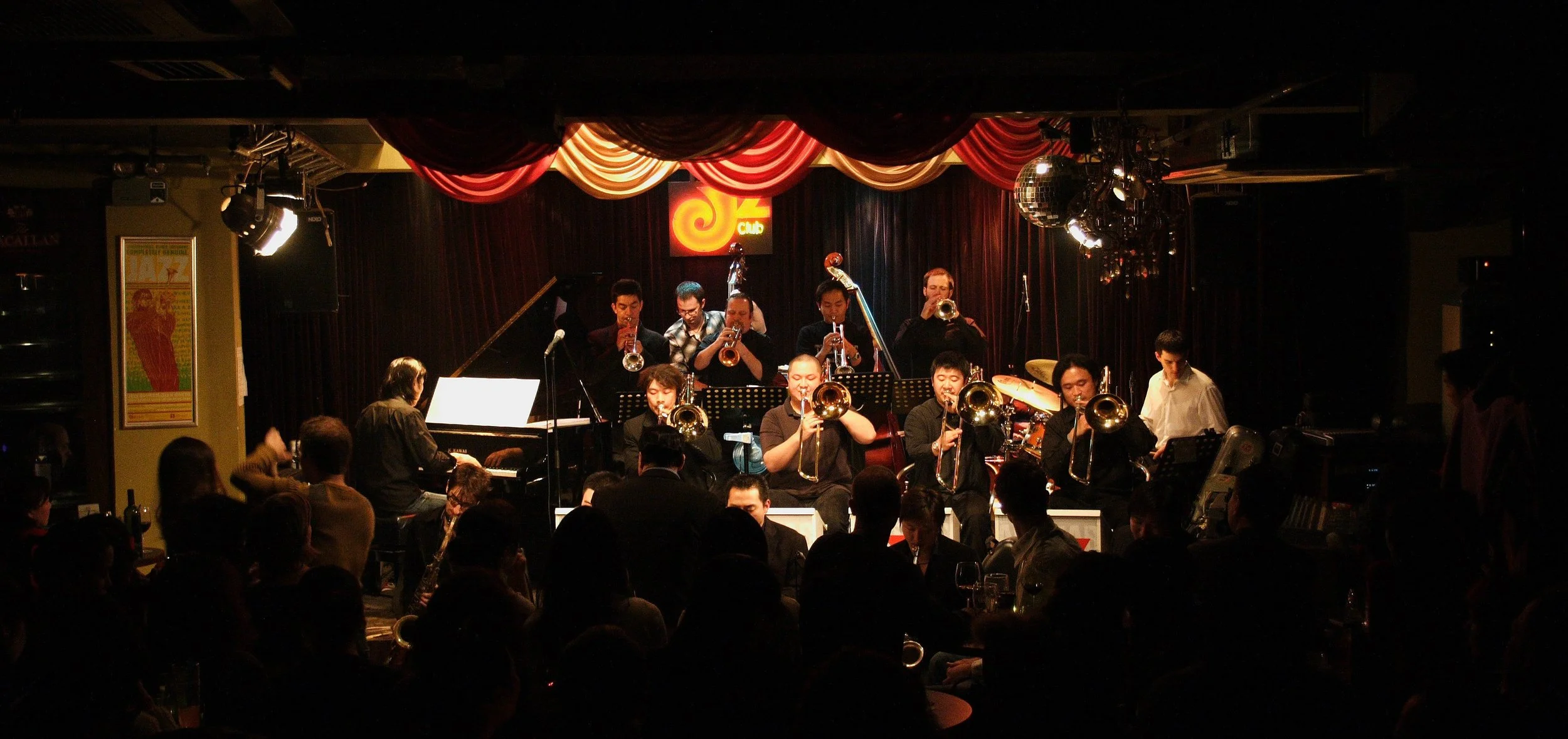
The original JZ All Star Big Band during my years as its conductor and musical director (2006–2009). What began as an ambitious musical project had developed into a professional jazz orchestra with its own repertoire and artistic identity.
By early 2009, the JZ All Star Big Band had become much more than a regular attraction at the JZ Club. What had started in August 2006 as an ambitious musical project had developed into a professional ensemble with its own repertoire, identity, and opportunities beyond the club's small stage.
Over the years, I had written the band's arrangements, organized rehearsals, and worked to develop a distinctive orchestral sound. I had also managed to secure outside engagements, which made it possible to pay the musicians considerably more generously than our regular club performances allowed.
However, this growing independence eventually became a point of conflict with Ren, the owner of the JZ Club.
From my perspective, there was a fundamental difference between providing a venue for an orchestra and owning the orchestra itself. The musical arrangements were my work and remained my property. None of them had been commissioned or purchased by the club.
Ren apparently saw things differently.
Although he never gave me a clear explanation for his decision, I had the impression that he wanted greater control over the ensemble, particularly as our activities expanded beyond the JZ Club.
Ultimately, he decided to replace me as conductor.
As the club owner, Ren held the stronger position. Without access to our regular performance venue, there was little I could do to continue the ensemble in its established form.
My final performance with the band was, as far as I remember, in early February 2009. There was no farewell concert, no formal conclusion to nearly three years of musical collaboration.
An Unexpected Turning Point
Shortly afterward, while visiting my parents in Germany, I suffered a stroke.
Suddenly, my professional concerns became secondary to something far more important: my health and my family.
It became clear that I needed to remain in Germany for medical treatment and recovery. My wife and our young daughter, who had been born in Shanghai on December 11, 2007, joined me, and we established a temporary home in Berlin.
Fortunately, my wife secured a position as a high-school science teacher at a leading international school in the city. This provided our family with much-needed stability during a difficult period.
Although my recovery required time and patience, I did not stop working as a musician.
I continued composing and arranging, and I even traveled back to Shanghai for selected professional engagements. In fact, by late October 2009, only about seven months after my stroke, I was already back on the podium, conducting the Shanghai Light Music Orchestra.
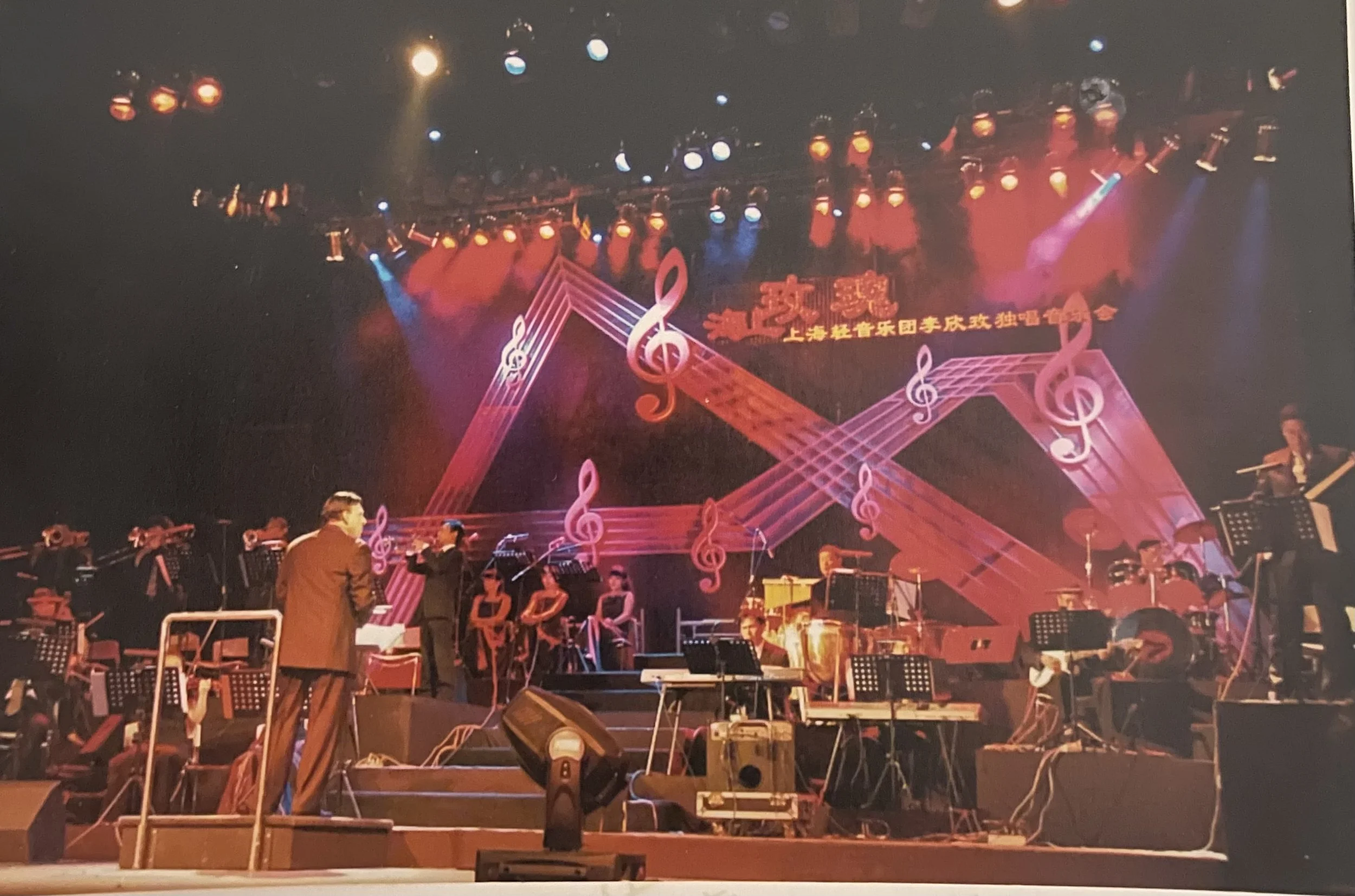
Back on the podium — Shanghai, October 2009.
Conducting the Shanghai Light Music Orchestra just seven months after suffering a stroke in Germany. For this collaboration, I created new pop and jazz arrangements of traditional Chinese melodies.
This engagement developed into a collaboration involving four productions, including recordings commissioned for Shanghai Media Group (SMG). Unfortunately, I no longer have copies of those recordings, but the surviving photographs remain a valuable reminder of this period.
My connection with Shanghai and its musical community had never entirely disappeared.
While Berlin remained our temporary home, I continued traveling between Germany and China for selected performances and productions.
After more than two years in Germany, my family and I finally returned to Shanghai in July 2011.
A new musical chapter was about to begin.
What Became of the JZ All Star Big Band?
Meanwhile, the JZ All Star Big Band had continued under its original name with a new musical director.
However, several important musicians subsequently departed, including tenor saxophonist Alec Haavik and trumpeter Theodore Croker.
Within approximately a year, that version of the ensemble had come to an end.
The JZ organization subsequently engaged Swedish composer and arranger Mats Holmquist.
Mats was an experienced musician who certainly understood the demands of writing for and directing a jazz orchestra. From my perspective, the difficulties he encountered had less to do with his musical abilities than with the organizational support required to sustain such an ensemble.
Towards the end of his engagement, before he and his family left Shanghai in late 2011, I was approached about taking over the band again.
After considerable thought, I decided against returning to the old arrangement.
By then, however, I was already exploring another musical direction.
A New Orchestral Vision — The Small Big Band
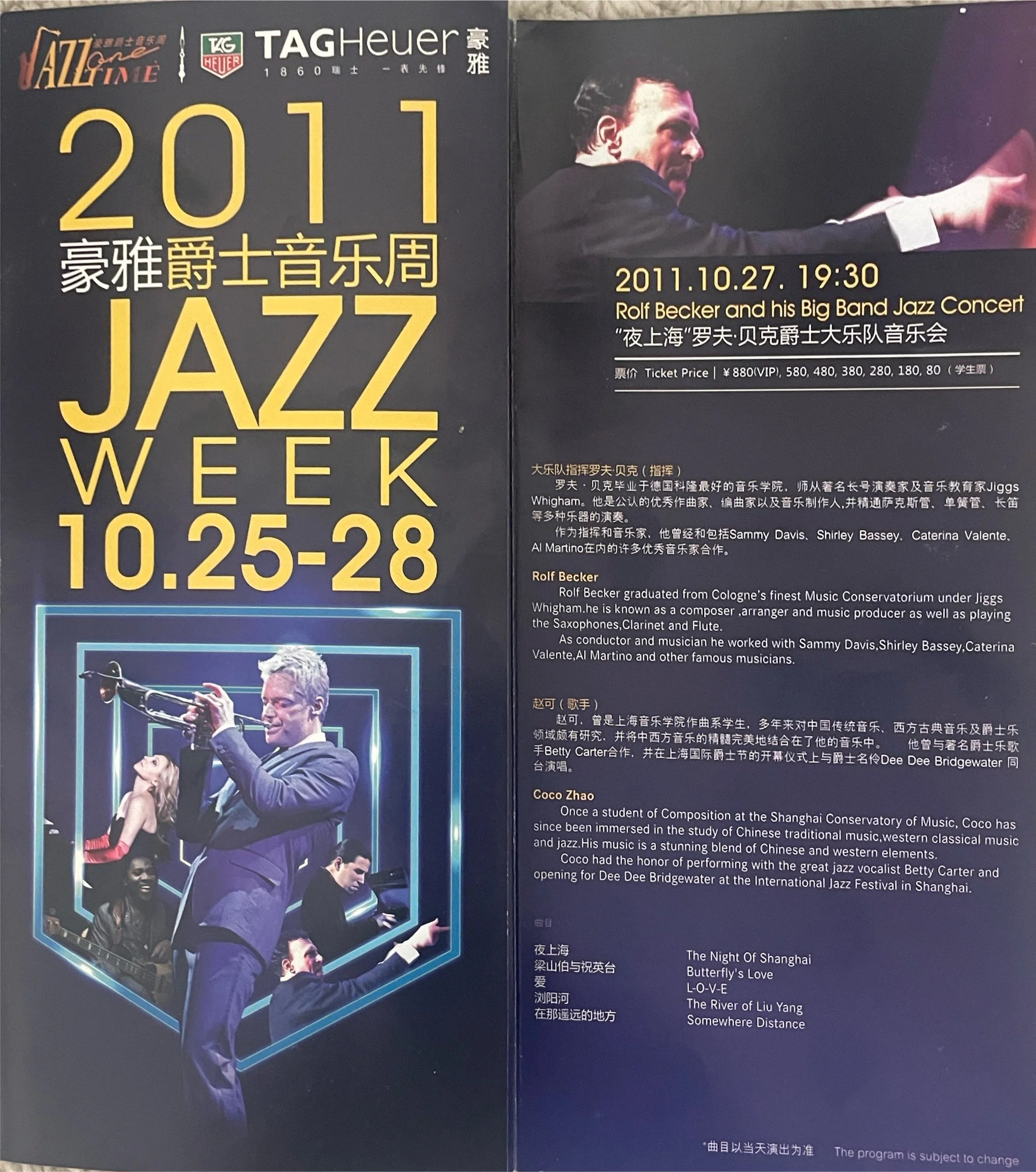
The official program of the 2011 TAG Heuer Jazz Festival in Shanghai. My concert on October 27 marked the introduction of my new Small Big Band concept, independently of JZ.
On October 27, 2011, just three months after our permanent return to Shanghai, I presented a concert at the TAG Heuer Jazz Festival.
This concert was an independent engagement, entirely unrelated to JZ. It gave me the opportunity to introduce my new orchestral concept on its own merits, before the Small Big Band began performing at JZ in early 2012.
The official festival program announced the performance as Rolf Becker and his Big Band Jazz Concert.
For me, this concert marked the beginning of a new orchestral concept: the Small Big Band.
Rather than assembling a conventional big band with five saxophones, four trumpets, four trombones, and rhythm section, I wanted to experiment with a smaller but equally expressive ensemble.
My instrumentation consisted of:
Three saxophones: alto, tenor, and baritone
Three trumpets
Three trombones
Piano, guitar, bass, and drums
Thirteen instrumentalists instead of the conventional seventeen.
The challenge was to preserve the power, harmonic richness, and flexibility of a traditional big band while taking advantage of the distinctive sound of this smaller instrumentation.
For an arranger, this opened up fascinating possibilities.
I could not simply remove instrumental parts from conventional big band arrangements. The music had to be conceived specifically for the ensemble, with careful attention to voicings, instrumental balance, and the individual musical personalities of the players.
For the 2011 TAG Heuer Jazz Week concert, I invited Coco Zhao to join us for a couple of traditional Chinese songs. For one of them, I created an arrangement that began in 5/4 time before moving into a fast samba—a particularly enjoyable meeting of Chinese melody and jazz rhythm. Unfortunately, I have no recordings of this concert, so the printed program remains a treasured reminder of that performance.
Back at JZ — But with a Different Band
In early 2012, the Small Big Band began performing at JZ.
It was an interesting return to familiar territory.
Ren remained the club's owner, and despite our earlier disagreements, we found ourselves working together again.
Our professional relationship would continue to have its ups and downs over the following years. Nevertheless, I appreciated the opportunity to present my music with a new ensemble whose instrumentation, arrangements, and artistic direction I had developed myself.
Most importantly, I wanted to work with some of the finest musicians in Shanghai.
Among them were the gifted pianist Oleg Roschin, the outstanding drummer Charles Foldesh, and the remarkable lead trombonist Tom Smith, whose impressive career included collaborations with jazz legend Clark Terry and the renowned vocal group The Manhattan Transfer.
Another particular highlight was the occasional participation of the exceptional saxophonist Andres Boiarsky. Having served as musical director of the Lionel Hampton Big Band and performed with Slide Hampton’s Dizzy Gillespie Alumni All-Stars, alongside numerous legendary figures in jazz history, Andres brought a wealth of experience and musical brilliance to our ensemble.
It was both a privilege and a personal pleasure to welcome him whenever his schedule allowed. His extraordinary solos added yet another dimension to the band's sound, making those performances especially memorable.
I was also delighted to welcome musicians who had already participated in my earliest big band activities in Shanghai, including alto saxophonist Willson Chen and baritone saxophonist Charles Chang.
Their musical abilities, loyalty, and friendship meant a great deal to me.
Having them in the new ensemble created a wonderful sense of continuity with the early Club Shanghai Big Band.
Teresa Lee — Writing for a Voice
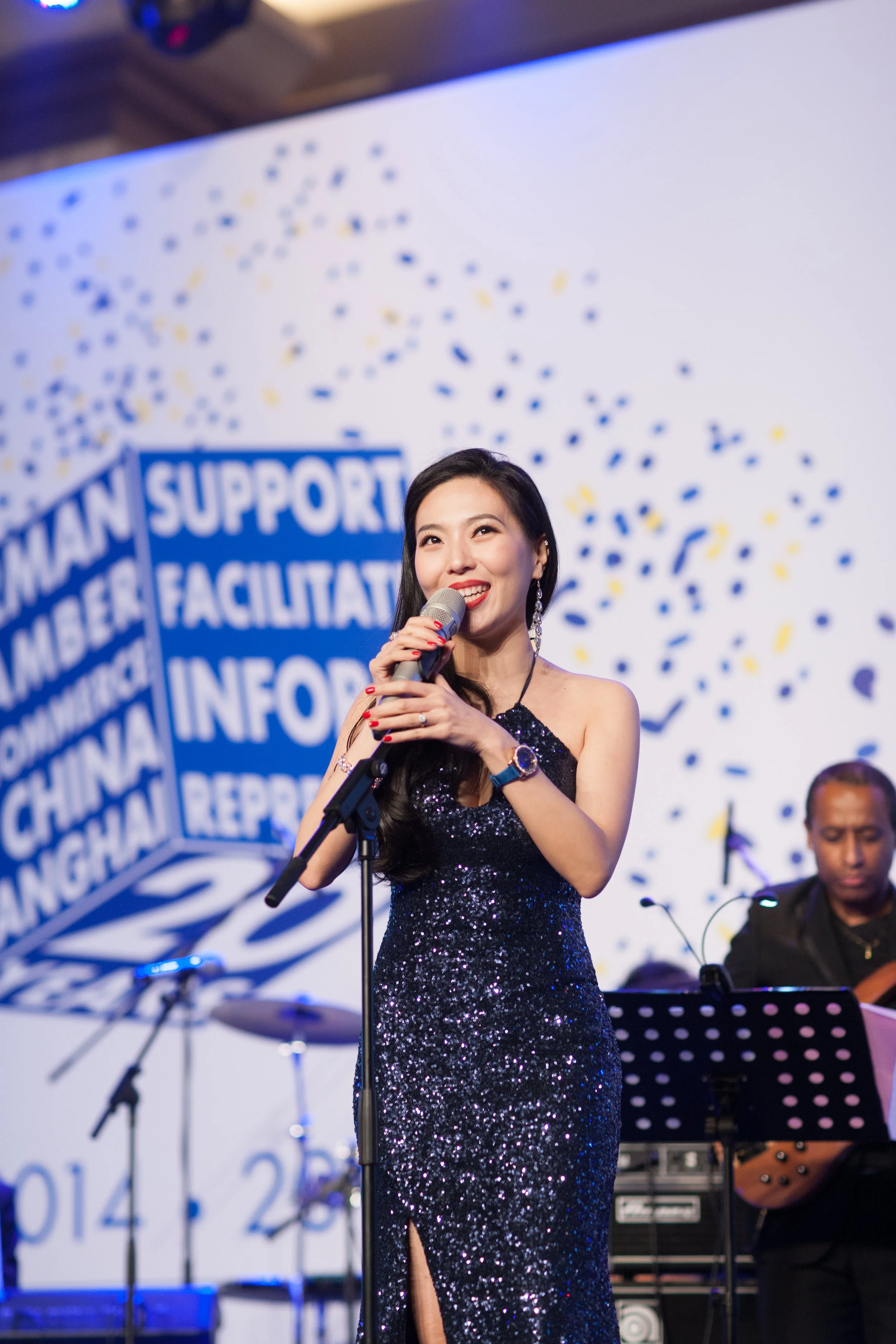
Teresa Lee performing with my Small Big Band at the German Chamber of Commerce's 20th anniversary celebration in Shanghai, 2014. I particularly enjoyed creating arrangements tailored to her voice and musical personality.
Our vocalist was the lovely Teresa Lee, who was married to pianist Oleg Roschin.
Teresa brought another dimension to the orchestra.
I particularly enjoyed writing arrangements tailored to her voice, taking care to match her vocal range, musical personality, and expressive qualities.
For me, arranging for a singer has always been about more than providing orchestral accompaniment.
The arrangement should support the interpretation, complement the singer's natural strengths, and create a musical conversation between the vocalist and the orchestra.
Working with Teresa gave me another opportunity to explore this approach.
Twenty Years of the German Chamber — 2014
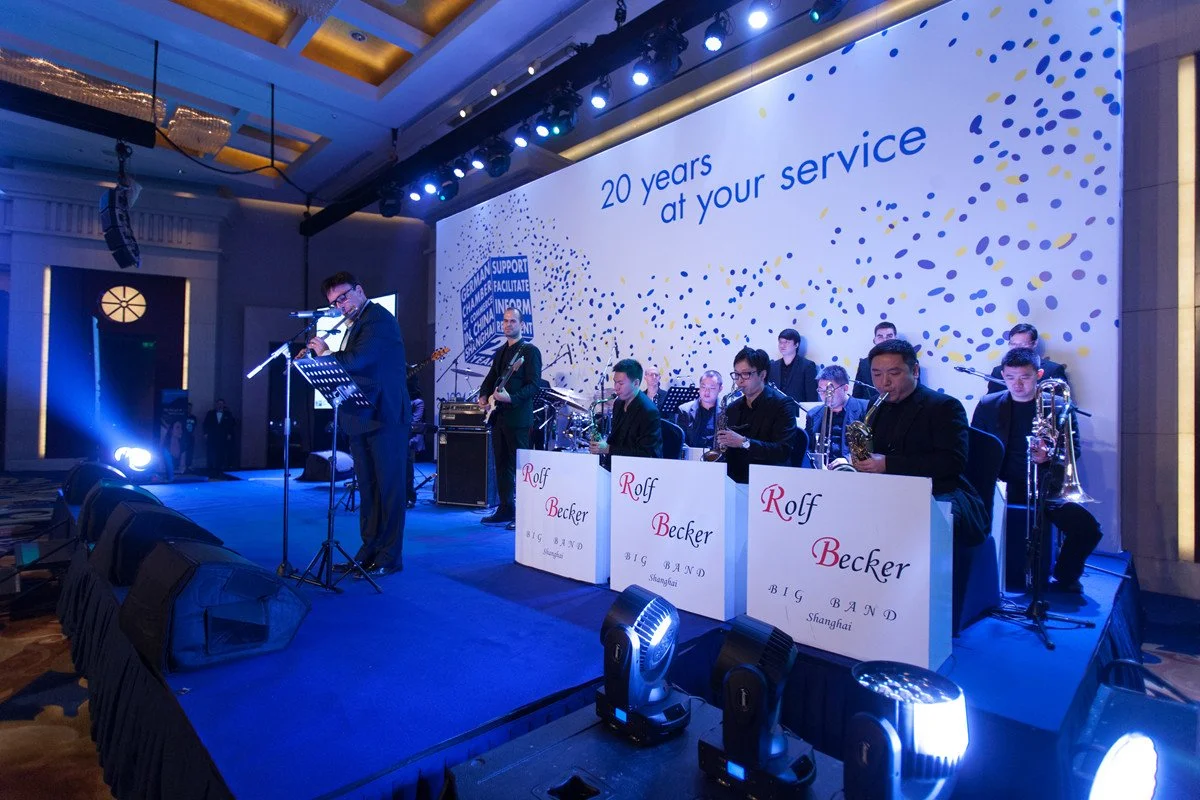
Performing on flute with my Small Big Band at the German Chamber of Commerce's 20th anniversary celebration in Shanghai, 2014. The ensemble performed under the name Rolf Becker Big Band Shanghai.
One memorable engagement took place in 2014, when the Small Big Band performed at the celebration of the 20th anniversary of the German Chamber of Commerce in Shanghai.
It was particularly rewarding to present the ensemble in a setting that brought together two important aspects of my musical life in China: my work with jazz orchestras and my long-standing involvement in major international business and cultural events.
Several photographs from that evening have survived, showing the band performing under the name Rolf Becker Big Band Shanghai, with Teresa as our featured vocalist.
They also document the remarkable musicians with whom I had the pleasure of sharing the stage.
Why I Continued Performing
There is something important I would like to explain.
Throughout my years in Shanghai, I never depended financially on my performances with the various orchestras.
My principal professional income came—and continues to come—from composing and arranging music for publishers, as well as working on television and film productions.
Performing with a big band was therefore never primarily about earning my living.
Of course, I always believed that the musicians deserved to be paid fairly for their work, and I made every effort to secure engagements that allowed me to compensate them appropriately.
But my personal motivation was different.
I simply loved making music with outstanding players and singers.
There is something deeply satisfying about hearing an arrangement that began as an idea in my imagination come alive through the musicians on stage.
And there is nothing quite like the feeling of receiving applause from an appreciative audience, knowing that both my work as a composer and arranger and the collective performance of the orchestra have reached the listeners.
Those moments were what made the effort worthwhile.
One Chapter Ends — Another Continues
Looking back, my departure from the original JZ All Star Big Band was certainly disappointing.
But it also encouraged me to explore new musical possibilities.
The Small Big Band allowed me to develop a different orchestral sound, reconnect with musicians I admired, and continue doing what I enjoyed most: writing music and bringing it to life on stage.
My relationship with JZ, however, was far from over.
What had begun in 2006 would develop into a long, sometimes complicated, on-and-off professional relationship with the club and particularly with its owner, Ren.
But that is another story.
Stay tuned if you would like to discover how long that relationship lasted—and what happened along the way.