

Chapter 5 — The End of an Era, the Beginning of Another
Leaving the JZ All Star Big Band marked the end of an era—and the beginning of another. In Chapter 5 of my Shanghai Big Band History, I reflect on recovery in Berlin, my return to Shanghai, and the creation of my Small Big Band: a new musical direction shaped by remarkable musicians and memorable performances between 2009 and 2014.
From the JZ All Star Big Band to a New Orchestral Vision, 2009–2014
When Artistic Independence Met Club Ownership
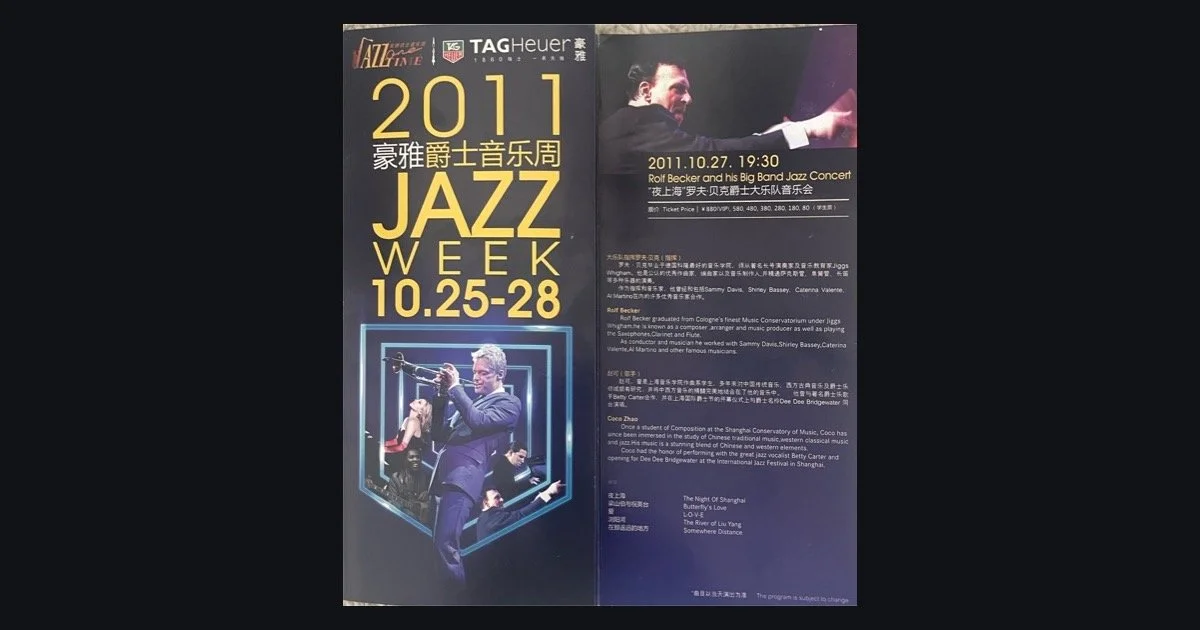
The original JZ All Star Big Band during my years as its conductor and musical director (2006–2009). What began as an ambitious musical project had developed into a professional jazz orchestra with its own repertoire and artistic identity.
By early 2009, the JZ All Star Big Band had become much more than a regular attraction at the JZ Club. What had started in August 2006 as an ambitious musical project had developed into a professional ensemble with its own repertoire, identity, and opportunities beyond the club's small stage.
Over the years, I had written the band's arrangements, organized rehearsals, and worked to develop a distinctive orchestral sound. I had also managed to secure outside engagements, which made it possible to pay the musicians considerably more generously than our regular club performances allowed.
However, this growing independence eventually became a point of conflict with Ren, the owner of the JZ Club.
From my perspective, there was a fundamental difference between providing a venue for an orchestra and owning the orchestra itself. The musical arrangements were my work and remained my property. None of them had been commissioned or purchased by the club.
Ren apparently saw things differently.
Although he never gave me a clear explanation for his decision, I had the impression that he wanted greater control over the ensemble, particularly as our activities expanded beyond the JZ Club.
Ultimately, he decided to replace me as conductor.
As the club owner, Ren held the stronger position. Without access to our regular performance venue, there was little I could do to continue the ensemble in its established form.
My final performance with the band was, as far as I remember, in early February 2009. There was no farewell concert, no formal conclusion to nearly three years of musical collaboration.
An Unexpected Turning Point
Shortly afterward, while visiting my parents in Germany, I suffered a stroke.
Suddenly, my professional concerns became secondary to something far more important: my health and my family.
It became clear that I needed to remain in Germany for medical treatment and recovery. My wife and our young daughter, who had been born in Shanghai on December 11, 2007, joined me, and we established a temporary home in Berlin.
Fortunately, my wife secured a position as a high-school science teacher at a leading international school in the city. This provided our family with much-needed stability during a difficult period.
Although my recovery required time and patience, I did not stop working as a musician.
I continued composing and arranging, and I even traveled back to Shanghai for selected professional engagements. In fact, by late October 2009, only about seven months after my stroke, I was already back on the podium, conducting the Shanghai Light Music Orchestra.
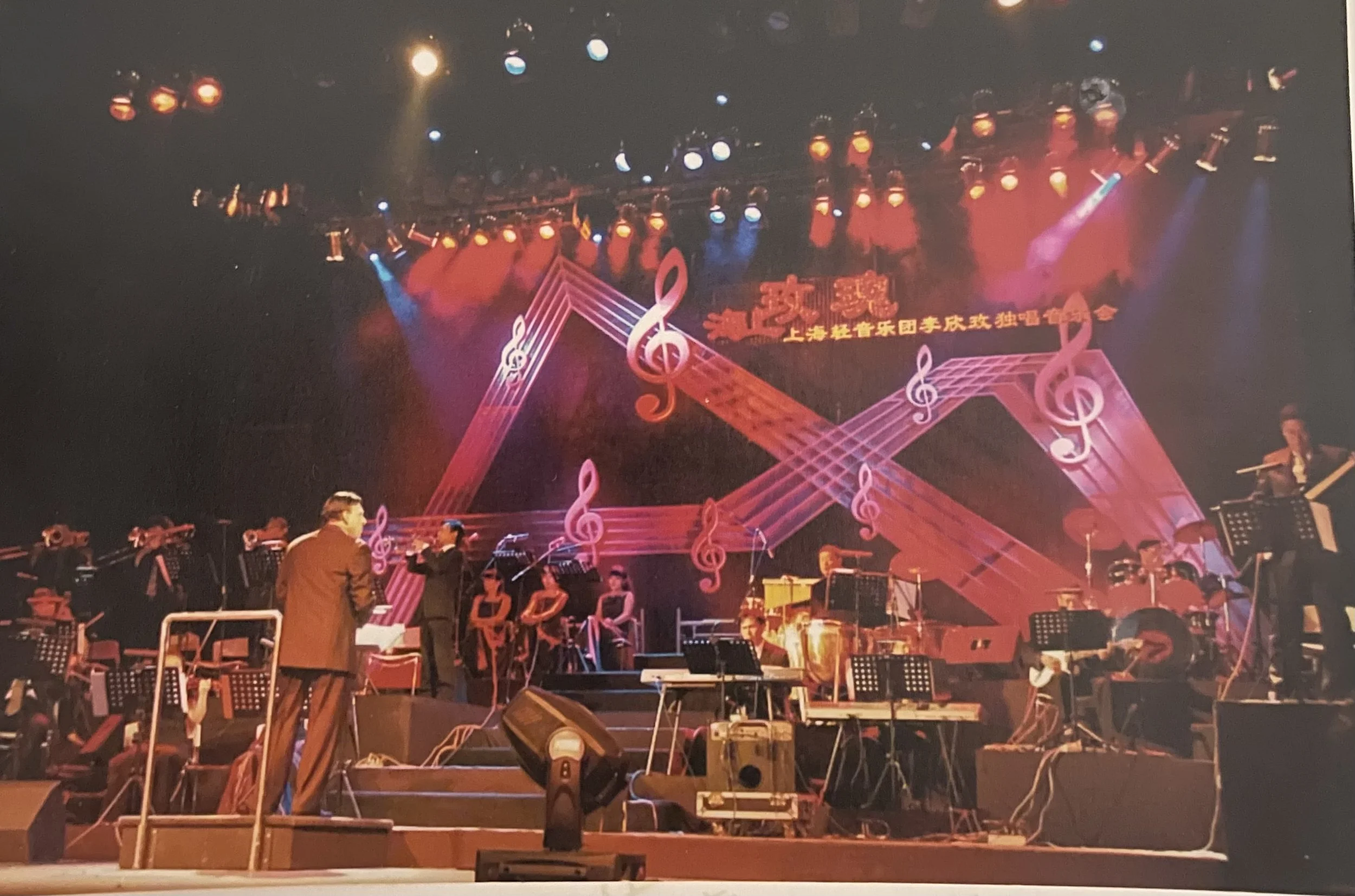
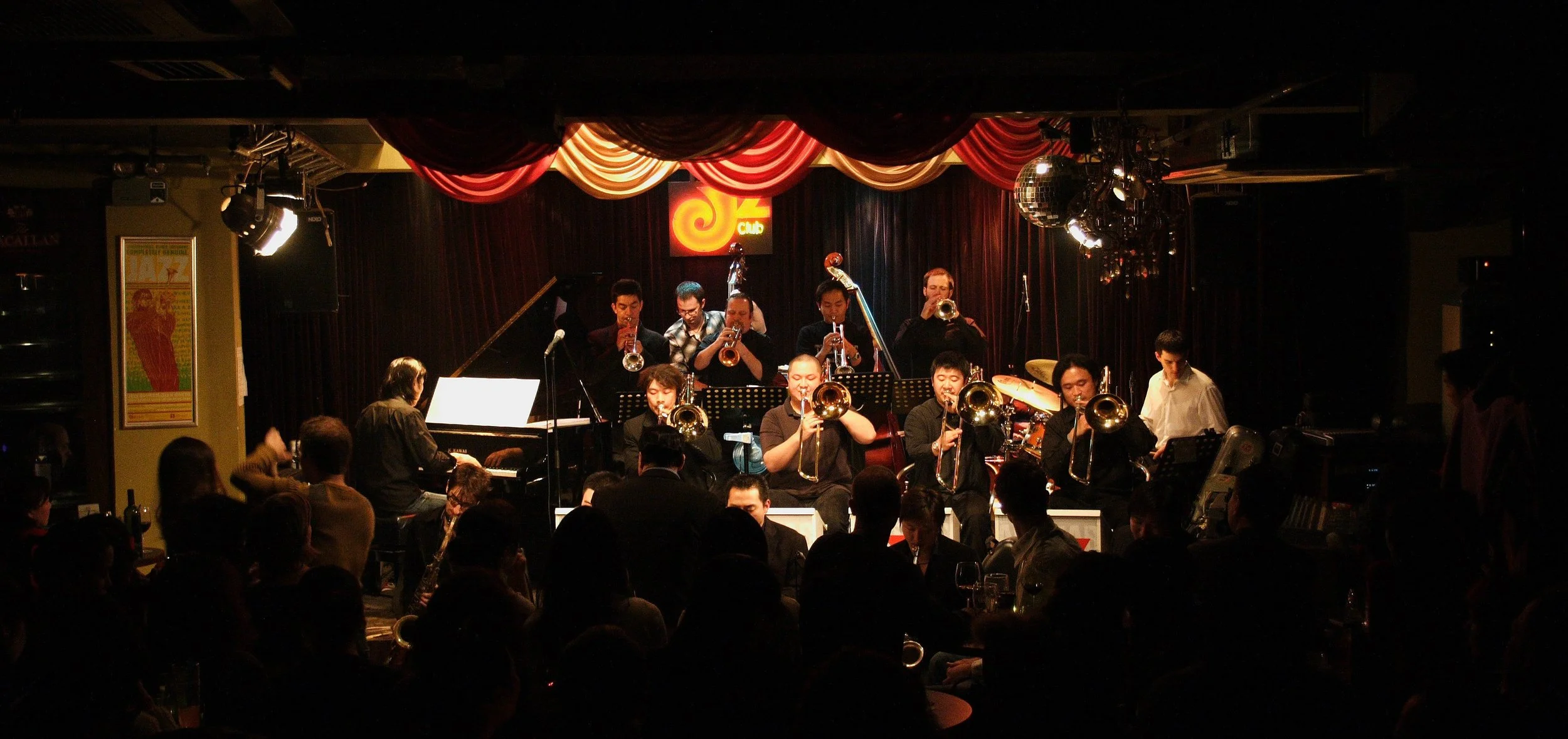
Back on the podium — Shanghai, October 2009.
Conducting the Shanghai Light Music Orchestra just seven months after suffering a stroke in Germany. For this collaboration, I created new pop and jazz arrangements of traditional Chinese melodies.
This engagement developed into a collaboration involving four productions, including recordings commissioned for Shanghai Media Group (SMG). Unfortunately, I no longer have copies of those recordings, but the surviving photographs remain a valuable reminder of this period.
My connection with Shanghai and its musical community had never entirely disappeared.
While Berlin remained our temporary home, I continued traveling between Germany and China for selected performances and productions.
After more than two years in Germany, my family and I finally returned to Shanghai in July 2011.
A new musical chapter was about to begin.
What Became of the JZ All Star Big Band?
Meanwhile, the JZ All Star Big Band had continued under its original name with a new musical director.
However, several important musicians subsequently departed, including tenor saxophonist Alec Haavik and trumpeter Theodore Croker.
Within approximately a year, that version of the ensemble had come to an end.
The JZ organization subsequently engaged Swedish composer and arranger Mats Holmquist.
Mats was an experienced musician who certainly understood the demands of writing for and directing a jazz orchestra. From my perspective, the difficulties he encountered had less to do with his musical abilities than with the organizational support required to sustain such an ensemble.
Towards the end of his engagement, before he and his family left Shanghai in late 2011, I was approached about taking over the band again.
After considerable thought, I decided against returning to the old arrangement.
By then, however, I was already exploring another musical direction.
A New Orchestral Vision — The Small Big Band
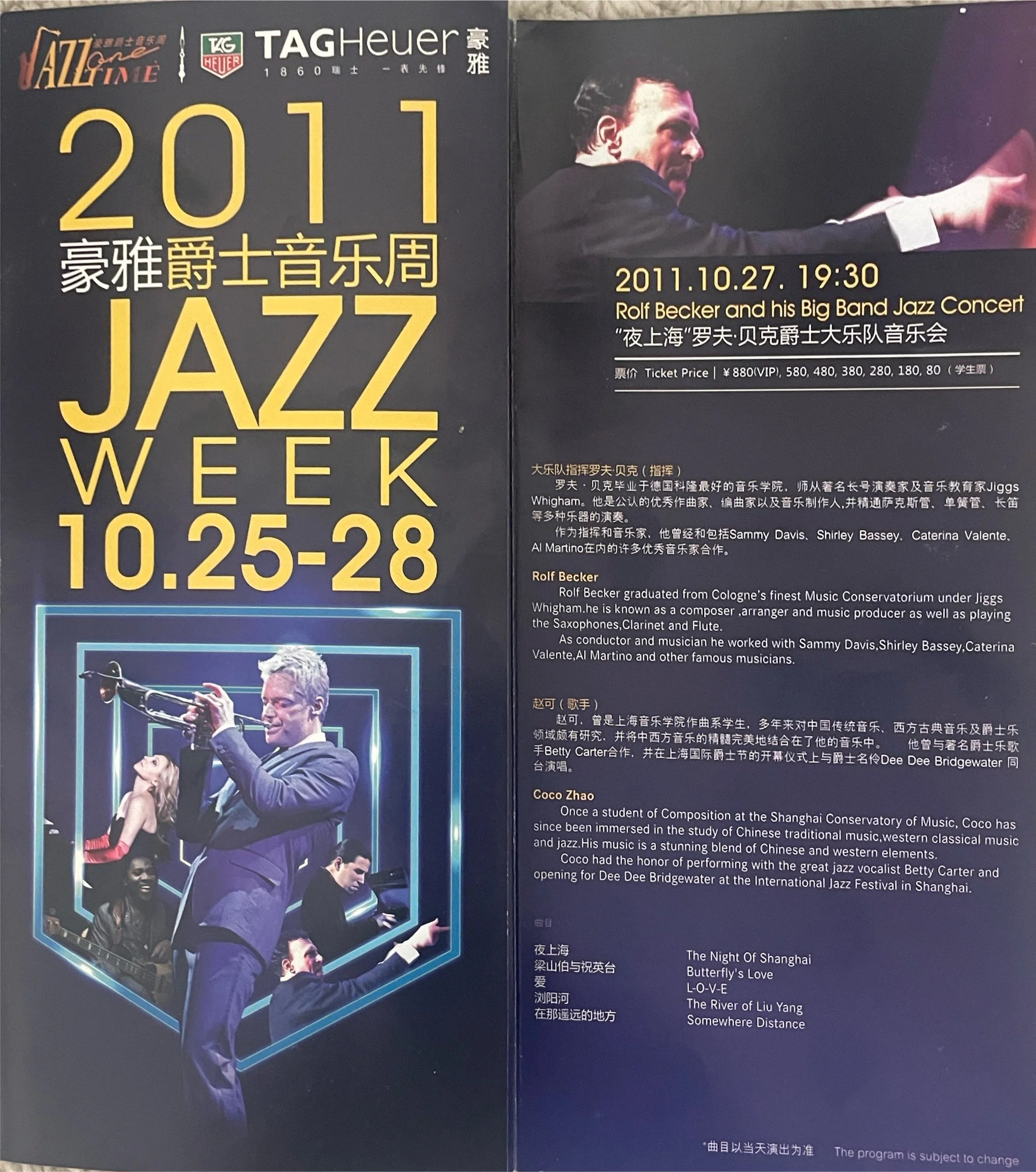
The official program of the 2011 TAG Heuer Jazz Festival in Shanghai. My concert on October 27 marked the introduction of my new Small Big Band concept, independently of JZ.
On October 27, 2011, just three months after our permanent return to Shanghai, I presented a concert at the TAG Heuer Jazz Festival.
This concert was an independent engagement, entirely unrelated to JZ. It gave me the opportunity to introduce my new orchestral concept on its own merits, before the Small Big Band began performing at JZ in early 2012.
The official festival program announced the performance as Rolf Becker and his Big Band Jazz Concert.
For me, this concert marked the beginning of a new orchestral concept: the Small Big Band.
Rather than assembling a conventional big band with five saxophones, four trumpets, four trombones, and rhythm section, I wanted to experiment with a smaller but equally expressive ensemble.
My instrumentation consisted of:
Three saxophones: alto, tenor, and baritone
Three trumpets
Three trombones
Piano, guitar, bass, and drums
Thirteen instrumentalists instead of the conventional seventeen.
The challenge was to preserve the power, harmonic richness, and flexibility of a traditional big band while taking advantage of the distinctive sound of this smaller instrumentation.
For an arranger, this opened up fascinating possibilities.
I could not simply remove instrumental parts from conventional big band arrangements. The music had to be conceived specifically for the ensemble, with careful attention to voicings, instrumental balance, and the individual musical personalities of the players.
For the 2011 TAG Heuer Jazz Week concert, I invited Coco Zhao to join us for a couple of traditional Chinese songs. For one of them, I created an arrangement that began in 5/4 time before moving into a fast samba—a particularly enjoyable meeting of Chinese melody and jazz rhythm. Unfortunately, I have no recordings of this concert, so the printed program remains a treasured reminder of that performance.
Back at JZ — But with a Different Band
In early 2012, the Small Big Band began performing at JZ.
It was an interesting return to familiar territory.
Ren remained the club's owner, and despite our earlier disagreements, we found ourselves working together again.
Our professional relationship would continue to have its ups and downs over the following years. Nevertheless, I appreciated the opportunity to present my music with a new ensemble whose instrumentation, arrangements, and artistic direction I had developed myself.
Most importantly, I wanted to work with some of the finest musicians in Shanghai.
Among them were the gifted pianist Oleg Roschin, the outstanding drummer Charles Foldesh, and the remarkable lead trombonist Tom Smith, whose impressive career included collaborations with jazz legend Clark Terry and the renowned vocal group The Manhattan Transfer.
Another particular highlight was the occasional participation of the exceptional saxophonist Andres Boiarsky. Having served as musical director of the Lionel Hampton Big Band and performed with Slide Hampton’s Dizzy Gillespie Alumni All-Stars, alongside numerous legendary figures in jazz history, Andres brought a wealth of experience and musical brilliance to our ensemble.
It was both a privilege and a personal pleasure to welcome him whenever his schedule allowed. His extraordinary solos added yet another dimension to the band's sound, making those performances especially memorable.
I was also delighted to welcome musicians who had already participated in my earliest big band activities in Shanghai, including alto saxophonist Willson Chen and baritone saxophonist Charles Chang.
Their musical abilities, loyalty, and friendship meant a great deal to me.
Having them in the new ensemble created a wonderful sense of continuity with the early Club Shanghai Big Band.
Teresa Lee — Writing for a Voice
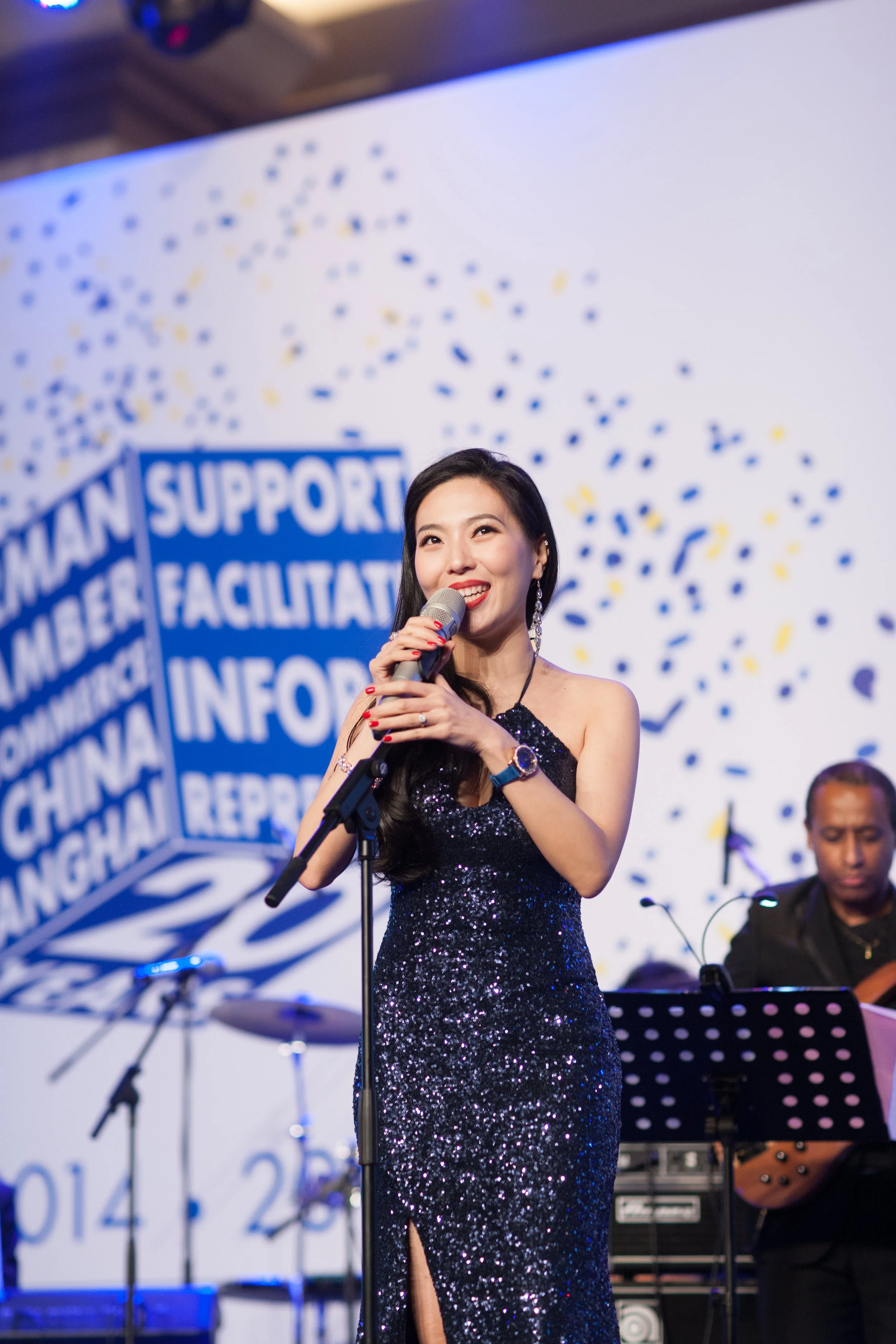
Teresa Lee performing with my Small Big Band at the German Chamber of Commerce's 20th anniversary celebration in Shanghai, 2014. I particularly enjoyed creating arrangements tailored to her voice and musical personality.
Our vocalist was the lovely Teresa Lee, who was married to pianist Oleg Roschin.
Teresa brought another dimension to the orchestra.
I particularly enjoyed writing arrangements tailored to her voice, taking care to match her vocal range, musical personality, and expressive qualities.
For me, arranging for a singer has always been about more than providing orchestral accompaniment.
The arrangement should support the interpretation, complement the singer's natural strengths, and create a musical conversation between the vocalist and the orchestra.
Working with Teresa gave me another opportunity to explore this approach.
Twenty Years of the German Chamber — 2014
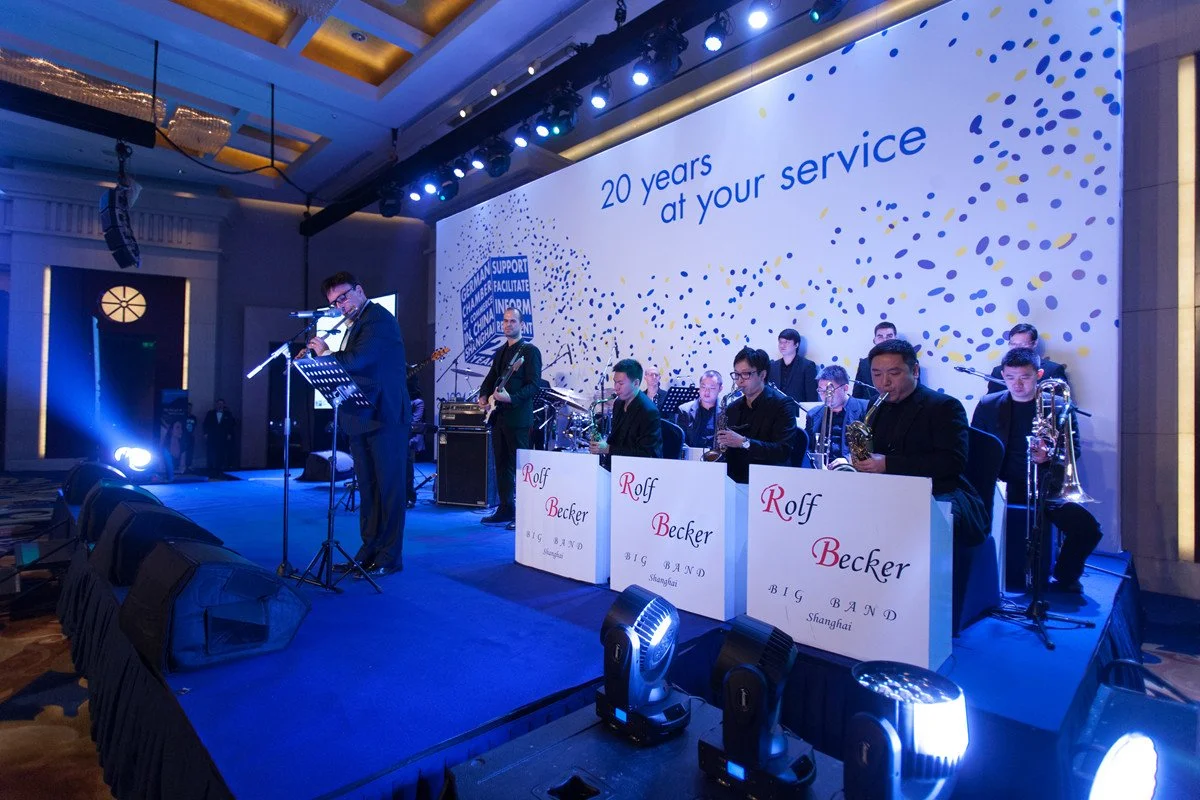
Performing on flute with my Small Big Band at the German Chamber of Commerce's 20th anniversary celebration in Shanghai, 2014. The ensemble performed under the name Rolf Becker Big Band Shanghai.
One memorable engagement took place in 2014, when the Small Big Band performed at the celebration of the 20th anniversary of the German Chamber of Commerce in Shanghai.
It was particularly rewarding to present the ensemble in a setting that brought together two important aspects of my musical life in China: my work with jazz orchestras and my long-standing involvement in major international business and cultural events.
Several photographs from that evening have survived, showing the band performing under the name Rolf Becker Big Band Shanghai, with Teresa as our featured vocalist.
They also document the remarkable musicians with whom I had the pleasure of sharing the stage.
Why I Continued Performing
There is something important I would like to explain.
Throughout my years in Shanghai, I never depended financially on my performances with the various orchestras.
My principal professional income came—and continues to come—from composing and arranging music for publishers, as well as working on television and film productions.
Performing with a big band was therefore never primarily about earning my living.
Of course, I always believed that the musicians deserved to be paid fairly for their work, and I made every effort to secure engagements that allowed me to compensate them appropriately.
But my personal motivation was different.
I simply loved making music with outstanding players and singers.
There is something deeply satisfying about hearing an arrangement that began as an idea in my imagination come alive through the musicians on stage.
And there is nothing quite like the feeling of receiving applause from an appreciative audience, knowing that both my work as a composer and arranger and the collective performance of the orchestra have reached the listeners.
Those moments were what made the effort worthwhile.
One Chapter Ends — Another Continues
Looking back, my departure from the original JZ All Star Big Band was certainly disappointing.
But it also encouraged me to explore new musical possibilities.
The Small Big Band allowed me to develop a different orchestral sound, reconnect with musicians I admired, and continue doing what I enjoyed most: writing music and bringing it to life on stage.
My relationship with JZ, however, was far from over.
What had begun in 2006 would develop into a long, sometimes complicated, on-and-off professional relationship with the club and particularly with its owner, Ren.
But that is another story.
Stay tuned if you would like to discover how long that relationship lasted—and what happened along the way.
Chapter 4 —The Birth of the JZ All Star Big Band
Following the success of Jazzy Mozart in April 2006, the Shanghai Jazz Orchestra came to an unexpected end. But a meeting with guitarist Lawrence Ku opened the door to a new beginning. In this personal account, Rolf Becker recalls how the JZ All Star Big Band was founded, how it received its name, and how Saturday nights at JZ Club became a celebrated part of Shanghai's jazz scene.
How the Shanghai Jazz Orchestra came to an end — and a new chapter began in August 2006
The End of a Promising Orchestra
Following the success of our Jazzy Mozart concert at Shanghai Concert Hall on April 9, 2006, I had every reason to believe that the Shanghai Jazz Orchestra was moving toward a promising future.
We had accomplished something special. Bringing together jazz musicians, classical players, and different musical traditions had required considerable preparation, arrangements, rehearsals, and, above all, the commitment of everyone involved.
The concert had been a success, and I was already thinking about how we could build upon that experience.
Unfortunately, things developed differently.
Shortly after the concert, the manager of the Shanghai Jazz Orchestra visited my wife and me at our home, accompanied by his wife and brother.
He was enthusiastic about the concert.
“The Big Band performance was a huge success,” he told me, “and you, as its conductor, are famous now.”
That was certainly flattering, but I was more interested in what would happen next.
He wanted me to start preparing a new concert program for another radio and television production. It sounded like an exciting opportunity — until we discussed the financial arrangements.
Once again, there was no reasonable payment available for the musicians or myself.
I had already invested an enormous amount of time and energy in preparing the orchestra, writing arrangements, rehearsing, and developing its musical identity. I was willing to continue that work, but not under conditions that failed to recognize the musicians' professional contributions.
When I contacted the players, their reaction was clear. They were no longer willing to continue under the proposed financial conditions.
Neither was I.
And so, despite its considerable potential, the Shanghai Jazz Orchestra came to an end.
I was deeply disappointed.
We had made real musical progress, and I believed that with regular rehearsals and further performances, the orchestra could have developed into an outstanding ensemble.
But without a sustainable foundation, even the most promising musical project eventually reaches its limits.
At that moment, I had no particular desire to start all over again.
An Unexpected Proposal
Fortunately, someone else had a different idea.
Lawrence Ku, the guitarist I had previously invited as a guest soloist for our Shanghai Jazz Orchestra concerts, contacted me and asked whether we could meet.
Lawrence had been closely involved in Shanghai's jazz scene, and he knew many of the musicians working in the city.
During our meeting, he suggested forming another Big Band.
This time, however, the orchestra would bring together both Chinese and international musicians living and working in Shanghai.
I wasn't immediately convinced.
After everything that had happened with the Shanghai Jazz Orchestra, I was reluctant to invest another enormous amount of work in a project that might eventually face the same problems.
I explained my concerns to Lawrence.
First, a good Big Band cannot develop simply by gathering seventeen musicians for an occasional performance. It needs regular rehearsals, a consistent repertoire, and a clear musical direction.
Second, the players must have opportunities to perform. Rehearsals alone are not enough. An orchestra develops through the experience of playing together in front of an audience.
And finally, there was the question of payment.
I wanted the musicians — and myself — to receive reasonable compensation for their professional work.
Lawrence listened carefully.
Then he told me something that changed the entire conversation.
He had already spoken with the founder and owner of a jazz club called JZ. The club was interested in offering the new Big Band a regular Saturday-night engagement.
That was a very different proposition.
For the first time, we were discussing an orchestra with a potential home, a regular performance schedule, and the opportunity to develop through continuous work.
I began to reconsider.
Who Gave the JZ Big Band Its Name?
Toward the end of our conversation, Lawrence asked me a question that would become an important part of the band's history.
“It's great that you're willing to start this Big Band. How do you want to call it? The Rolf Becker Big Band?”
I thought about it for a moment.
Of course, having an orchestra named after its conductor is not unusual in jazz. But I felt that this new ensemble should represent something broader.
We wanted to bring together some of the finest musicians working in Shanghai, regardless of nationality. And if JZ Club was going to become our regular home, why not acknowledge that relationship in the band's name?
I replied:
“Since JZ Club will be the home of this Big Band, why don't we call it the JZ All Star Big Band? After all, we'll have some of the most talented players in town.”
And that was how the name came about.
It wasn't the result of a marketing campaign or a decision made after the orchestra became successful.
It was simply an idea that emerged during my conversation with Lawrence Ku.
The name JZ All Star Big Band was used from our very first performance in August 2006.
A New Home on Fuxing Road
Following our conversation, Lawrence arranged a meeting with Ren — better known among Shanghai's jazz musicians as Lao Ren — the founder of JZ Club.
We discussed the practical arrangements and agreed that the Big Band would perform regularly on Saturday nights.
Our starting time was rather unusual: 11:30 p.m.
There was, however, a very practical reason.
Many of the jazz musicians already had earlier engagements on Saturday evenings. Some were playing in hotels, restaurants, or other venues around Shanghai.
The classical musicians who joined us often had orchestral concerts that finished around 10 p.m.
Starting at 11:30 gave everyone enough time to finish their earlier commitments and make their way to JZ Club.
It wasn't necessarily the most comfortable schedule, but it worked.
And most importantly, we now had something the Shanghai Jazz Orchestra had never been able to establish: a regular performance opportunity.
Building the Band, One Rehearsal at a Time
We began rehearsing every Tuesday at 1 p.m.
From the beginning, I wanted the orchestra to develop its own musical identity.
I brought along some original Big Band charts, including arrangements from the Count Basie Orchestra's repertoire. These provided valuable reference points for ensemble playing, articulation, phrasing, dynamics, and the rhythmic precision that makes a Big Band swing.
But much of our repertoire consisted of arrangements I wrote specifically for the musicians in our new ensemble.
That was an important part of my approach.
Rather than expecting the orchestra to master technically demanding arrangements immediately, I wanted to build its capabilities gradually.
I considered the strengths of individual players, the balance between sections, and the challenges we needed to address.
As the musicians became more familiar with one another, I could introduce increasingly sophisticated arrangements.
Week by week, the orchestra began to develop.
The saxophone section became more unified. The brass players learned to phrase and articulate together. The rhythm section grew more comfortable supporting a large ensemble.
And perhaps most importantly, the musicians began to understand one another musically.
A Big Band is not simply a collection of individual players.
It is an ensemble in which everyone must listen, react, and contribute to a common musical interpretation.
That takes time.
But we were making progress.
Saturday Night Was Big Band Night
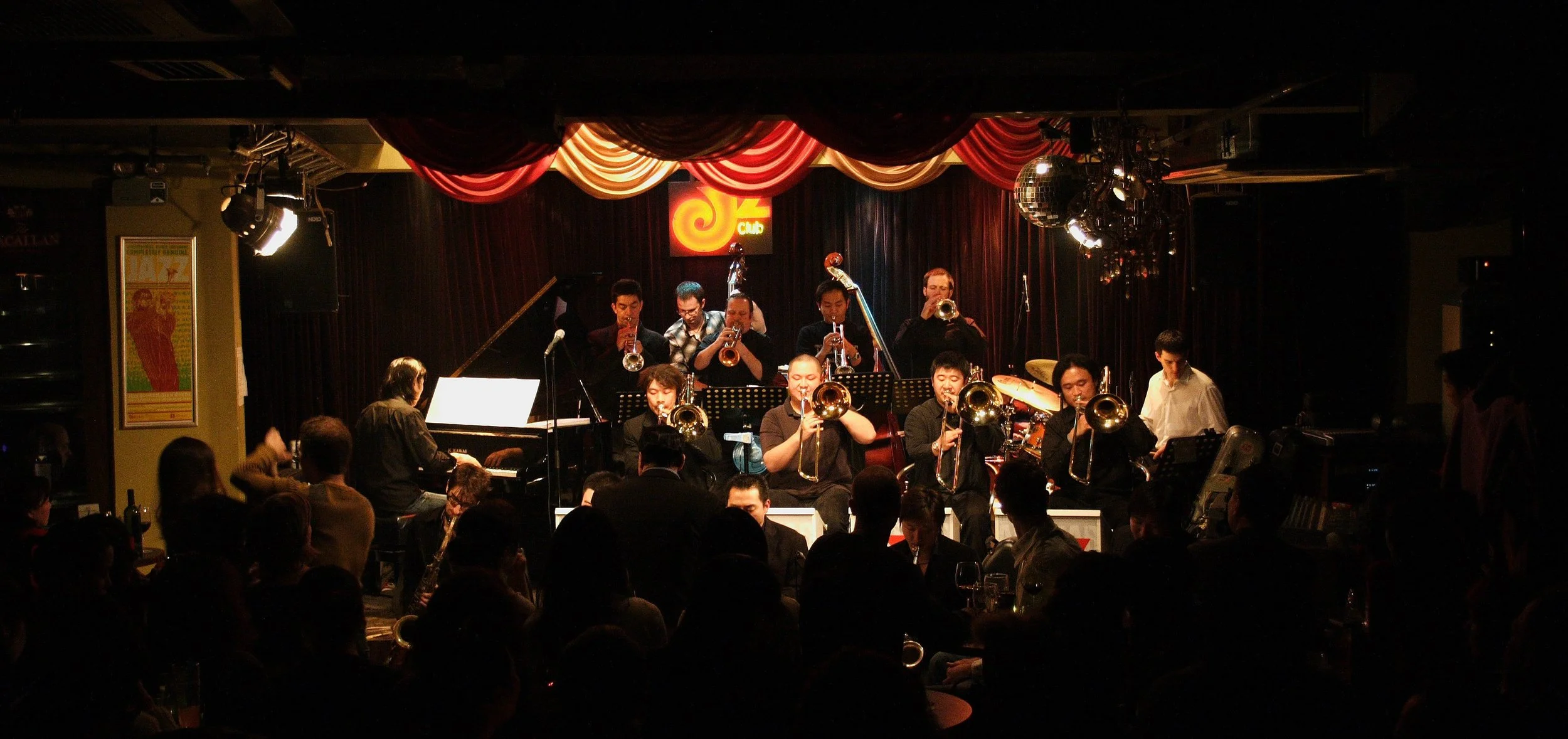
Rolf Becker conducting the JZ All Star Big Band at JZ Club on Fuxing Road, Shanghai, during the orchestra's early years.
What happened next exceeded my expectations.
The audience response was extraordinary.
After only a short time, JZ Club on Fuxing Road became packed whenever the Big Band performed.
People lined up outside, waiting to get in.
Word spread quickly throughout Shanghai's growing jazz community.
Saturday night was Big Band night at JZ.
The club itself was hardly designed to accommodate a full-sized Big Band.
The stage was simply too small.
We had to place the saxophone section on the floor directly in front of the stage, while the other musicians occupied whatever space was available.
As conductor, I stood practically among the audience.
The first standing tables were immediately behind me.
There wasn't much room to move, and the atmosphere could become rather warm and crowded.
But that intimacy was also part of the experience.
The audience wasn't watching the orchestra from a distant concert hall seat. They were standing just a few steps away from the musicians, surrounded by the sound of trumpets, trombones, saxophones, and the rhythm section.
The energy was remarkable.
For me, it was particularly rewarding to see the musicians enjoying themselves and the audience responding so enthusiastically.
After the disappointment of losing the Shanghai Jazz Orchestra, I finally felt that we were building something sustainable.
Two Voices, Two Personalities
As the orchestra developed, I also wanted to expand our repertoire by featuring vocalists.
I brought in two wonderful performers and began writing arrangements specifically for them.
The first was Arlene Estrella, a gifted singer whose musical personality brought a special quality to our performances.
Arlene was a wonderful colleague, and I remember her with great affection. Sadly, she has since passed away.
Arlene Estrella performing with the JZ All Star Big Band at JZ Club on Fuxing Road, Shanghai. This archival photograph captures the crowded stage, trombone section, and intimate atmosphere of the band's early performances.
The second was Danny Woody, an accomplished drummer and singer who was also the music director at the Portman Ritz-Carlton Hotel on Nanjing Road.
Danny's schedule was particularly demanding.
After finishing his earlier performance, he would make his way to JZ Club to join us for the late-night Big Band show.
Danny Woody, drummer, vocalist, and music director at the Portman Ritz-Carlton Hotel in Shanghai, was one of the featured singers with the JZ All Star Big Band during its early years.
That was typical of the dedication many of our musicians brought to the project.
Both singers contributed their individual musical personalities, and I enjoyed writing vocal arrangements that suited their voices and styles.
Their performances added another dimension to our Saturday-night concerts.
From a New Beginning to an Established Orchestra
Over the following months, the JZ All Star Big Band continued to improve.
The regular rehearsals were paying off. Our repertoire expanded, the ensemble became more confident, and the musical interaction between the players grew stronger.
What had begun as a proposal during a conversation with Lawrence Ku was becoming an established part of Shanghai's jazz scene.
Approximately a year and a half after our first performances, an introduction video was produced to present the orchestra.
The featured piece was “Magic Flea,” associated with the Count Basie Orchestra.
Lawrence Ku took on two roles in the video.
Besides being our guitarist, he also appeared as the master of ceremonies, introducing the band.
Looking back at that recording today, I am reminded of how much we had achieved in a relatively short time.
The orchestra had developed from a newly assembled group of musicians into an ensemble with its own character, repertoire, and loyal audience.
And for me personally, it represented something equally important.
The end of the Shanghai Jazz Orchestra had been disappointing, particularly after the success of Jazzy Mozart.
But that disappointment had led to an unexpected opportunity.
Instead of abandoning the idea of developing a professional Big Band in Shanghai, I had been given the chance to begin again — this time with regular rehearsals, a permanent home, and musicians who shared my enthusiasm.
The JZ All Star Big Band had found its place in the city.
And our story was only beginning.
Archival Video — JZ All Star Big Band: “Magic Flea”
An early promotional recording of the JZ All Star Big Band, featuring Lawrence Ku as both master of ceremonies and guitarist. The video documents the orchestra's musical development during its early years in Shanghai.
This historical recording has been preserved from the original video source. Its picture quality reflects the limitations of the surviving archival footage.
From the Archives — Splanky (Live at JZ Club)
A rare live recording of the early JZ All Star Big Band performing “Splanky”, the Count Basie classic composed by Neal Hefti.
Recorded in the intimate atmosphere of Shanghai's JZ Club, this performance captures the energy of the musicians, their improvisations, and the enthusiastic audience.
At the conclusion of the performance, I can be heard introducing the featured soloists — another personal reminder of those formative years of big band jazz in Shanghai.
An authentic musical document from an important chapter in Shanghai's modern jazz history.