Shanghai Big Band History — Part Two | By Rolf Becker
A New Opportunity
When my engagement as musical director of the Club Shanghai Big Band ended in February 2005, I certainly did not expect that the story of this orchestra would continue in quite the way it did.
The musicians, however, had other ideas.
Later that year, drummer Billy Pan and several of his colleagues became involved in establishing a new ensemble: the Shanghai Jazz Orchestra. Some of the musicians had previously performed with me at Club Shanghai, while others were newly recruited.
This was not simply the old Club Shanghai Big Band operating under a different name. The Shanghai Jazz Orchestra was a new organization with its own management and ambitions.
In autumn 2005, Billy Pan approached me and asked whether I would return as the orchestra's conductor. He also mentioned that two Chinese New Year concerts were already being planned for January 2006.
I accepted the invitation.
It was an opportunity to continue the work we had started at Club Shanghai, but this time within an organization dedicated to developing a concert Big Band.
Continuing Where We Had Left Off
When I returned to rehearsals, I quickly realized that we would have to continue more or less where we had left off.
Although a few new musicians had joined the ensemble, the overall musical level had not improved significantly during my absence.
This was not particularly surprising. Most of the players came from musical backgrounds in which jazz had played only a minor role, if any.
The experience gained during our Club Shanghai rehearsals and performances had provided a foundation, but developing a convincing Big Band required much more than reading the correct notes.
Swing phrasing, articulation, rhythmic precision, ensemble balance and stylistic understanding were all essential elements of the musical language we were trying to establish.
Nevertheless, we now had a specific goal: preparing the orchestra for its first public concerts in January.
That gave our rehearsals a clear direction.
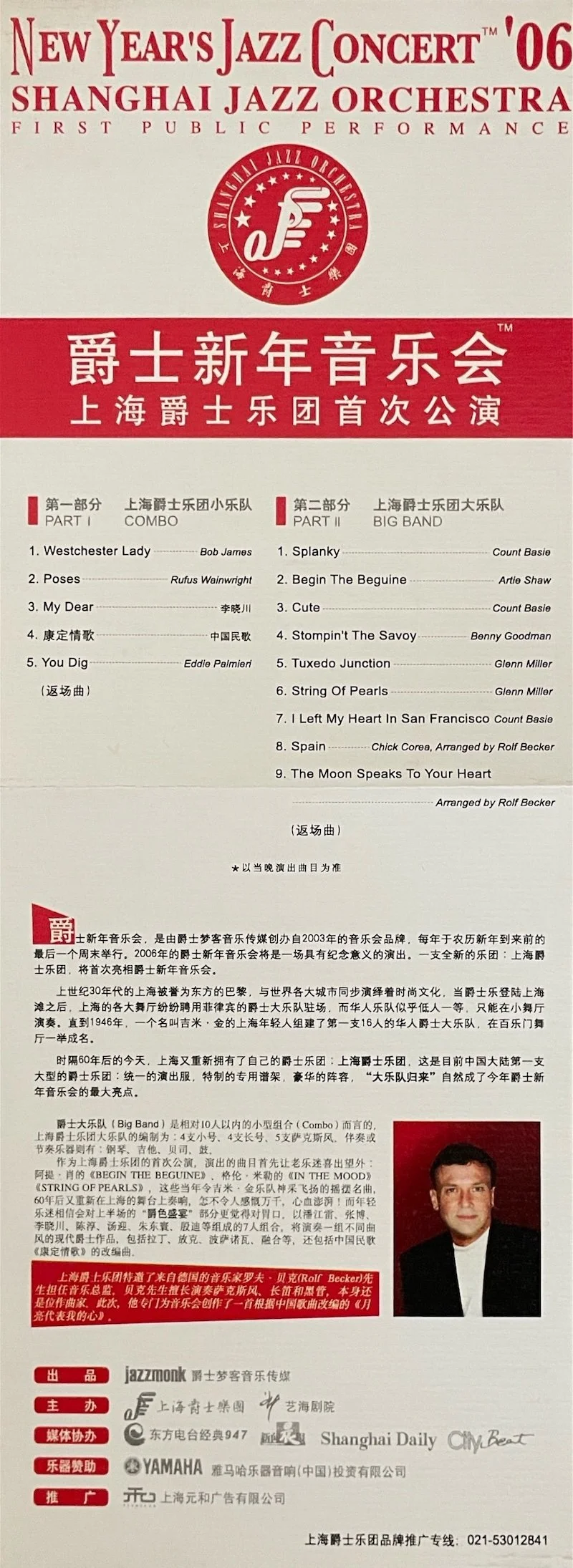
Original program for the Shanghai Jazz Orchestra's New Year's Jazz Concert in January 2006, announcing the ensemble's first public performance and documenting the repertoire, including my arrangements of Spain and The Moon Speaks to Your Heart.
Orchestra photograph: The Shanghai Jazz Orchestra performing at Yi Hai Theater, Shanghai, January 2006. Rolf Becker conducting.
Choosing the Right Repertoire
As I began planning the program, two considerations guided my decisions.
The first was the orchestra itself.
I had to select or prepare music that would challenge the musicians without exceeding their capabilities. An overly ambitious repertoire might have been musically interesting on paper, but it would not necessarily have produced a convincing performance.
The second consideration was our audience.
At that time, many Chinese concertgoers had relatively little experience with jazz, particularly with the traditions of the American Big Band.
I wanted to present a program that would introduce this musical world in an accessible and entertaining way.
For that reason, I decided to concentrate much of the repertoire on the Golden Era of Big Band music.
Glenn Miller's In the Mood was an obvious choice. Its memorable melodies, characteristic swing rhythm and unmistakable orchestral sound made it an excellent introduction to the traditional Big Band.
Another selection was Begin the Beguine, closely associated with Artie Shaw and his orchestra.
This particular piece presented an interesting practical challenge.
The arrangement required a clarinet solo, but none of our saxophonists provided clarinet doubling. Consequently, I performed the clarinet solo myself.
It was one of those situations in which being both a conductor and an instrumentalist proved particularly useful.
Introducing a Different Side of Jazz
Although I wanted the concerts to be accessible, I also felt it was important to introduce something beyond the familiar swing repertoire.
For that purpose, I selected Chick Corea's Spain.
This was the one jazz chart in the program that ventured significantly beyond the traditional Big Band repertoire.
To feature the composition properly, I invited the talented guitarist Lawrence Ku to join us as guest soloist.
Lawrence was not a regular member of the Shanghai Jazz Orchestra, but his musicianship made him an excellent addition to the concerts.
Our collaboration would continue a few months later when he returned as a guest musician for Jazzy Mozart at Shanghai Concert Hall.
The inclusion of Spain reflected an important part of my approach to programming: I wanted to respect the orchestra's current abilities and the audience's musical experience without limiting our artistic ambitions to familiar material.
Bringing the Swing Era to the Stage
The concerts were not intended to be purely musical presentations.
I also wanted to recreate some of the atmosphere associated with the great Big Band era, when swing music was closely connected with dancing and entertainment.
A couple of swing dancers therefore joined us on stage, adding a visual and theatrical element to the performances.
Their appearance helped bring the music to life in a different way.
For an audience that might not have been familiar with the history of swing, the combination of a live Big Band and dancers provided an immediate connection to the music's original cultural setting.
It was a relatively simple addition to the program, but an effective one.
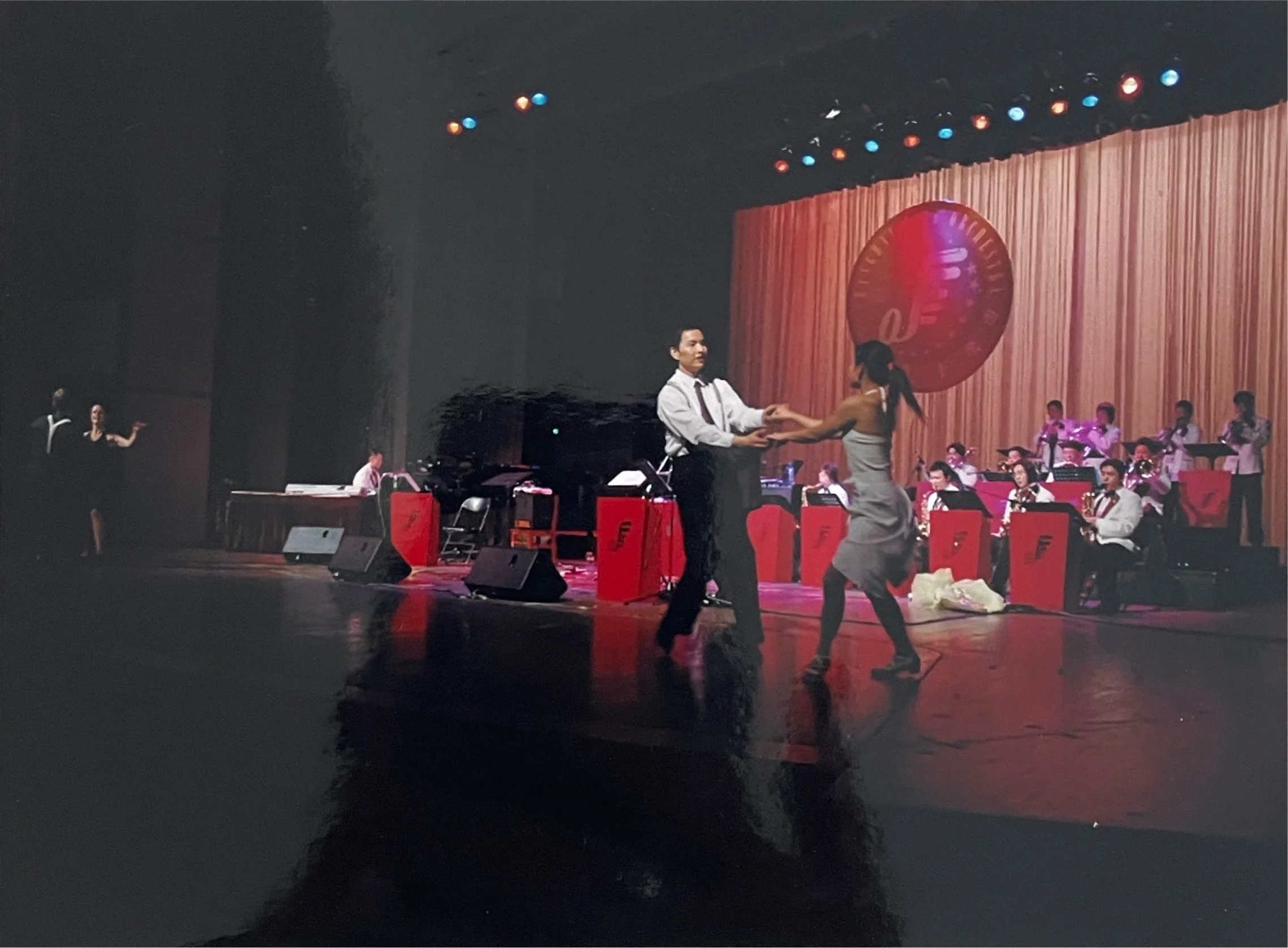
Swing dancers performing on stage with the Shanghai Jazz Orchestra during the New Year's Jazz Concert in January 2006.
January 20–21, 2006:
The First Public Performances
The Shanghai Jazz Orchestra's first public concerts took place on January 20 and 21, 2006, at Yi Hai Theater in Shanghai.
The performances were presented as the New Year's Jazz Concert '06, with the orchestra advertised as making its first public appearance.
The original promotional poster listed me as Musical Director and featured Lawrence Ku as guest guitarist.
Both concerts were sold out.
For me, this was particularly encouraging.
Only a few months earlier, we had been working to develop an orchestra whose musicians were still becoming familiar with the language of jazz. Now we were performing before full houses.
The audiences responded enthusiastically.
They enjoyed the music, appreciated the show elements and called for encores.
Of course, the orchestra still had considerable room for improvement. But the success of those two evenings demonstrated that our efforts had been worthwhile.
More importantly, they showed that there was an audience in Shanghai interested in experiencing this kind of music.
The Shanghai Jazz Orchestra had taken an important step forward.
Concert poster: Original promotional poster for the Shanghai Jazz Orchestra's first public concerts, January 20–21, 2006.
Growing Public Attention
The concerts also attracted attention beyond the concert hall.
One particularly valuable document from this period is a newspaper article by Yu Bingxia titled Revival of Jazz Slow but Steady, published in China Daily.
The article discussed the development of jazz in Shanghai and introduced the newly established Shanghai Jazz Orchestra.
It also documented the orchestra's January performances and my involvement as its musical supervisor.
Looking back, I consider this newspaper coverage an important part of the orchestra's early history.
It provides a contemporary record of a time when establishing a professional Chinese Big Band was still an unusual undertaking.
The musicians had created a new organization, we had successfully presented our first public concerts, and the orchestra was beginning to attract wider attention.
Newspaper article: “Revival of jazz slow but steady,” by Yu Bingxia, China Daily, January 2006. Contemporary reporting on the emergence of the Shanghai Jazz Orchestra.
From the Swing Era Toward Mozart
The success of the January concerts gave us confidence.
It also appears to have helped create the circumstances for a much more ambitious project.
Shortly afterward, the Shanghai Jazz Orchestra's manager approached me with an interesting question:
Could I rewrite Mozart's music into swing?
My answer was yes.
But the more I considered the idea, the more I realized that simply transforming Mozart's compositions into conventional swing arrangements would be too limiting.
I began thinking about a broader musical concept.
Rather than presenting Mozart exclusively through the language of traditional swing, I wanted to explore the possibilities of bebop, contemporary jazz, salsa and other Latin styles.
I would select the Mozart compositions myself and develop arrangements that connected the original classical material with these different musical traditions.
The project would also require a considerably expanded ensemble, combining the Shanghai Jazz Orchestra with guest musicians, Latin percussion and strings.
What began as a relatively straightforward question would eventually become Jazzy Mozart, performed at Shanghai Concert Hall on April 9, 2006.
But that story deserves a chapter of its own.
Explore the Shanghai Big Band History
Previous chapter: Club Shanghai Big Band (2004) — Where It All Began
Discover how Shanghai's first Club Shanghai Big Band came together and laid the foundation for the developments described in this chapter.
Next chapter: Jazzy Mozart (2006) — A New Musical Adventure
Discover how jazz, classical music, Latin rhythms, and a full orchestra came together for an ambitious concert at Shanghai Concert Hall on April 9, 2006.