
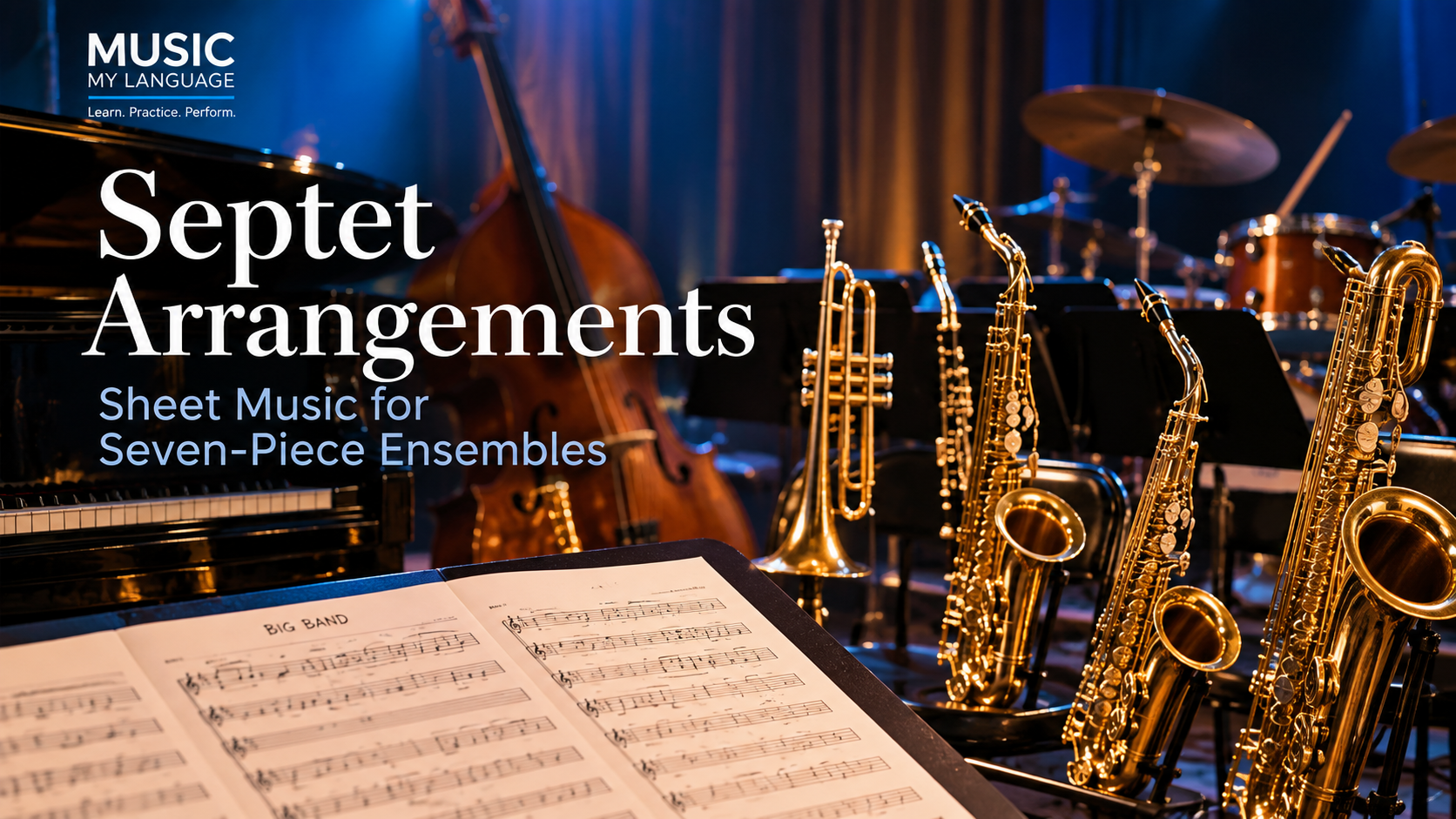
Septet Arrangements Sheet Music for Seven-Piece Ensembles
Discover how a seven-piece jazz ensemble can create a rich, powerful sound with just four horns and rhythm section. Explore professional septet arranging, instrumentation and the MusicMyLanguage Septet Series.
Finding professionally arranged music for a seven-piece jazz ensemble can be challenging. While repertoire for small jazz combos and traditional big bands is widely available, music written specifically for four horns and rhythm section offers a distinctive alternative.
The MusicMyLanguage Septet Series explores the musical possibilities of this instrumentation through arrangements conceived for the ensemble itself—not simply reductions of existing big-band scores.
Why the Seven-Piece Jazz Ensemble Works
The MusicMyLanguage Septet Series uses the following instrumentation:
Trumpet
Alto Saxophone
Tenor Saxophone
Baritone Saxophone
Piano
Bass
Drums
Four horns provide considerable melodic, harmonic, and timbral flexibility, while the rhythm section maintains the responsiveness associated with smaller jazz groups.
The ensemble can move naturally between unison passages, octave doubling, harmonized melodies, contrapuntal lines, rhythmic backgrounds, and featured improvisation.
The objective is not to imitate a larger ensemble, but to create a complete and convincing musical identity with seven musicians.
Four Horns, Distinctive Orchestral Possibilities
Writing for Trumpet, Alto Saxophone, Tenor Saxophone, and Baritone Saxophone requires careful consideration of register, balance, and instrumental character.
The Trumpet can contribute brilliance and definition, while the Alto and Tenor Saxophones offer contrasting melodic and harmonic colors. The Baritone Saxophone provides depth but can also function as an independent melodic voice or participate in upper-register ensemble writing.
These roles are not fixed. Effective orchestration allows each instrument to assume different responsibilities as the arrangement develops.
Unison passages can create rhythmic clarity and intensity. Octave writing broadens a melodic statement, while four-part harmonization introduces richer harmonic textures. Independent lines and contrapuntal passages provide movement without requiring additional instruments.
The greatest variety often comes from changing the orchestration rather than increasing the number of notes.
Creating Contrast and Ensemble Impact
A successful septet arrangement depends on contrast.
A single horn accompanied by Piano, Bass, and Drums can establish an intimate texture. Introducing a second melodic line or a restrained background changes the musical perspective. When all four horns return together, the resulting ensemble passage can have considerable impact.
Articulation, dynamics, phrasing, and balance are particularly important. With only four horns, each individual part remains clearly audible.
The rhythm section is equally essential. Piano, Bass, and Drums should contribute to the musical character, rhythmic direction, and formal development of the arrangement.
Together, these elements create a cohesive ensemble rather than a collection of independent instrumental parts.
Inside the MusicMyLanguage Septet Series
The MusicMyLanguage Septet Series was developed to provide substantial jazz ensemble writing for this particular instrumentation.
In A Mellow Tone — Duke Ellington
The first arrangement in the series opens with a unison introduction derived from the final eight bars of the composition.
The horn writing subsequently expands through harmonized passages, written backgrounds, and increasingly active ensemble figures. Later sections introduce more demanding textures, including closely voiced harmonies and sixteenth-note passages.
The arrangement demonstrates how a familiar jazz composition can be reimagined for four horns and rhythm section while preserving its musical character.
Quintessence — Quincy Jones
The second arrangement features the Alto Saxophone as its principal solo voice.
Trumpet, Tenor Saxophone, and Baritone Saxophone provide changing backgrounds, including chordal textures, double-time figures, and staggered bell-like effects.
Near the conclusion, the ensemble gives way to an Alto Saxophone cadenza before the final statement.
This arrangement demonstrates a different approach to the same instrumentation, emphasizing the featured soloist and the expressive possibilities of carefully constructed backgrounds.
The two arrangements illustrate a central principle of the series: consistent instrumentation does not require identical orchestration. Each composition calls for its own musical treatment.
Educational Benefits of the Septet Format
The septet is also a valuable ensemble format for music education.
Because each horn has a distinct role, performers must pay close attention to intonation, articulation, rhythmic precision, balance, and blend.
Players develop an understanding of how their individual parts contribute to the complete musical texture.
They learn to recognize whether they are carrying the melody, supporting a harmonic structure, playing an independent counterline, or responding to another instrumental voice.
These skills are equally valuable in small jazz ensembles, big bands, and professional performance settings.
For advanced students and experienced musicians, the septet offers sufficient complexity for sophisticated ensemble writing while preserving the direct musical communication of a small group.
What to Consider When Choosing Septet Sheet Music
Before selecting an arrangement, ensemble directors and musicians should examine several practical and musical factors.
Instrumentation: Confirm that the arrangement matches the available ensemble. A seven-piece arrangement is not necessarily written for the same combination of instruments.
Playing difficulty: Consider instrumental ranges, rhythmic complexity, articulation, tempo, and the technical demands of ensemble passages.
Solo features: Identify which instruments are featured and whether improvisation is required or optional.
Rhythm-section writing: Examine the balance between notated material, chord symbols, rhythmic figures, and stylistically appropriate performance freedom.
Score and parts: Check which materials are included in the published edition, especially when a conductor score is required.
Audio previews: When available, listen to the recording or sample to evaluate the arrangement's musical character and suitability for your ensemble.
Choosing an arrangement involves more than finding the correct number of instrumental parts. The music should also match the ensemble's technical ability, artistic objectives, and performance setting.
Explore the MusicMyLanguage Septet Series
The MusicMyLanguage Septet Series brings together arrangements developed specifically for Trumpet, Alto Saxophone, Tenor Saxophone, Baritone Saxophone, Piano, Bass, and Drums.
Visit the MusicMyLanguage Septet Series to explore the arrangements, instrumentation, available audio previews, and purchasing information.
Individual arrangement pages provide the most appropriate starting point for evaluating each publication and following the relevant retailer links.
A Distinctive Musical Identity
The seven-piece jazz ensemble deserves recognition as an independent musical format.
Four horns provide opportunities for substantial harmonic and contrapuntal writing, while the rhythm section preserves flexibility, transparency, and interaction.
The MusicMyLanguage Septet Series is built around these strengths, offering arrangements that explore the full expressive potential of the instrumentation.
For professional musicians, educators, and ensemble directors seeking septet arrangements and sheet music, the series provides a focused approach to jazz ensemble performance.