

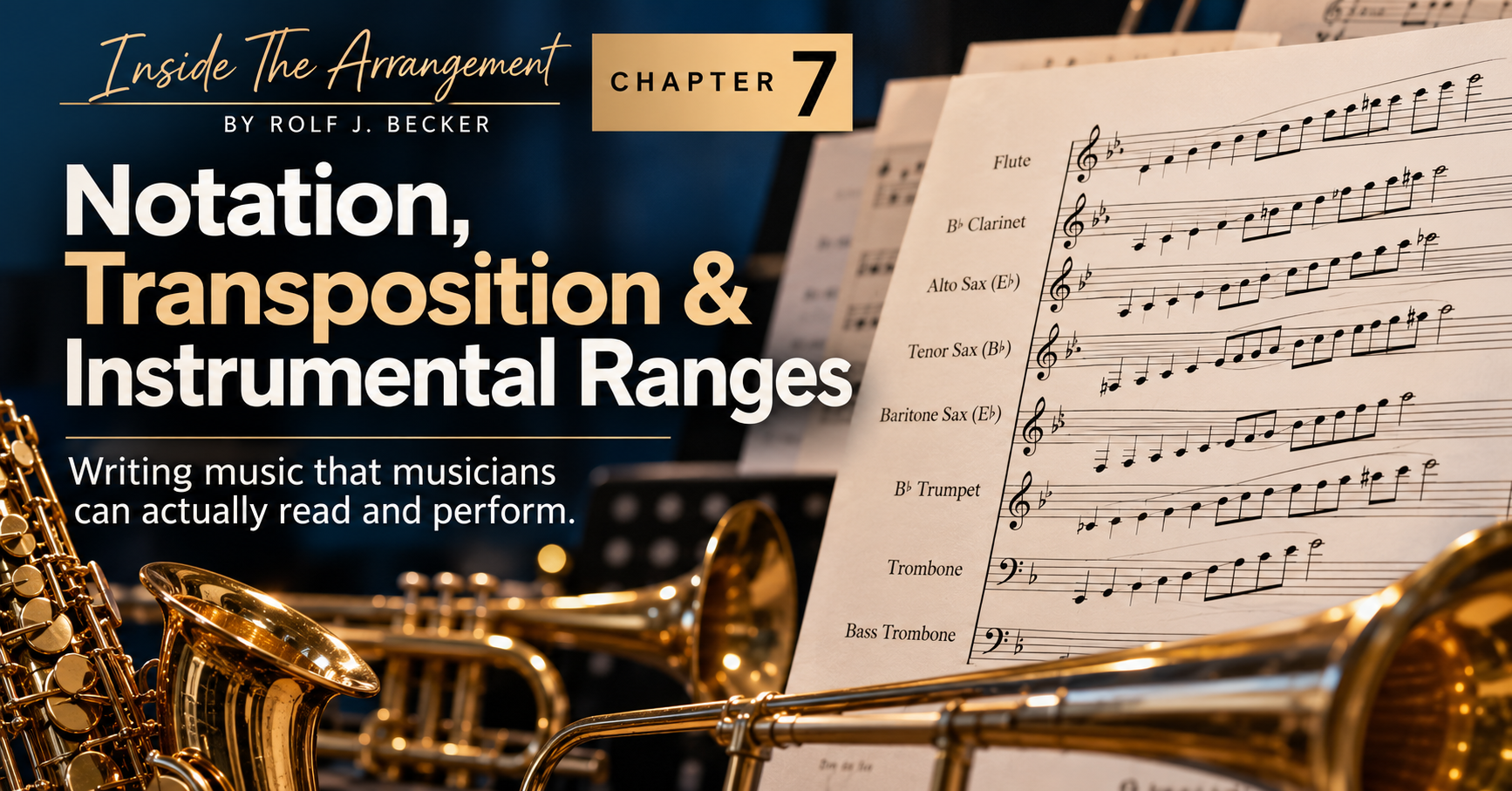
INSIDE THE ARRANGEMENT — Chapter 7 — Notation, Transposition & Instrumental Ranges
A professional Big Band arrangement requires more than great musical ideas. In Chapter 7 of Inside The Arrangement, composer and arranger Rolf J. Becker explores instrument transposition, written versus concert pitch, practical brass and woodwind ranges, and the essential principles of clear, professional music notation.
Writing music that musicians can actually read and perform.
By Rolf J. Becker
A beautiful musical idea deserves a beautifully prepared score.
Throughout my career as a composer, arranger, conductor, and instrumentalist, I have learned that even the most imaginative arrangement can become unnecessarily difficult when its notation is unclear.
Incorrect transpositions, impractical instrumental ranges, inconsistent articulations, or poorly prepared parts can create confusion and waste valuable rehearsal time.
In Chapter 6, we explored how orchestration gives our music its colors.
Now we turn to an equally important question:
How do we communicate those musical ideas clearly to the musicians who will perform them?
1. Concert Pitch vs. Written Pitch
One of the first things every arranger must understand is the difference between concert pitch and written pitch.
Concert pitch is the actual sounding note.
Written pitch is the note displayed in the musician's part.
For example, when a B-flat trumpet player performs a written C, the instrument sounds a concert B-flat.
If we want that trumpet to sound concert C, we must write D.
The same principle applies to B-flat clarinet and the saxophone family, although the precise transpositions differ.
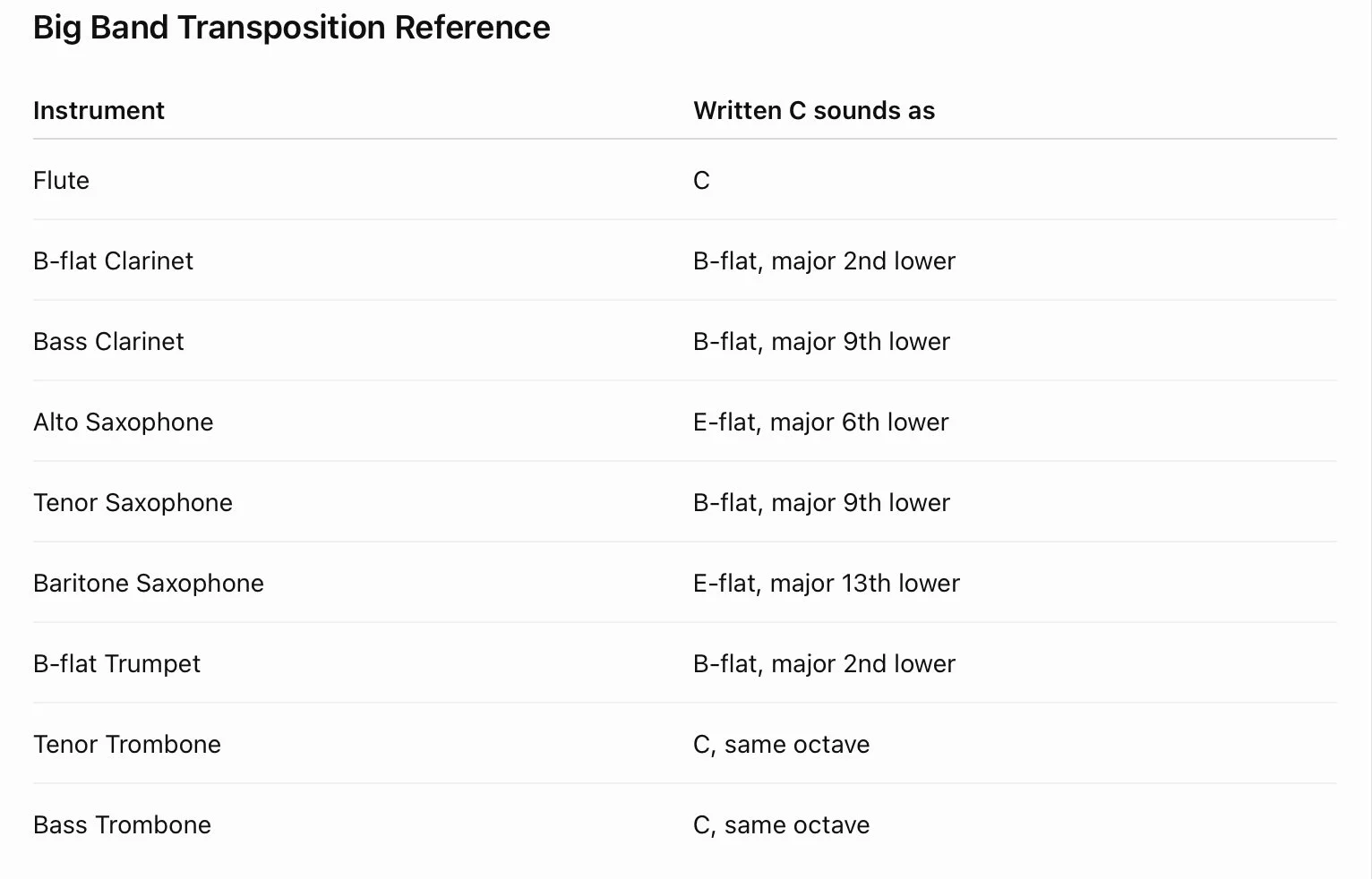
Big Band Transposition Reference (Inside The Arrangement — Chapter 7)
Important: In standard Big Band notation, tenor trombone and bass trombone are written in bass clef at concert pitch.
Although the tenor trombone is commonly described as a B-flat instrument, this refers to its fundamental tubing pitch—not a transposition of its standard bass-clef part.
2. Why Octaves Matter
Transposition involves more than changing the key signature.
The tenor saxophone sounds a major ninth below its written pitch.
The baritone saxophone sounds a major thirteenth below its written pitch.
Both instruments therefore include an octave displacement.
An arranger who overlooks this detail may produce an entirely different register from the one intended.
Modern notation software makes transposition considerably easier, but I strongly recommend understanding these relationships rather than relying exclusively on automatic functions.
Software is a tool. Musical knowledge remains essential.
3. Instrumental Ranges: Possible Doesn't Always Mean Practical
Every instrument has a physical range.
But that doesn't mean every player can perform every note within that range comfortably.
A professional lead trumpet player may perform high notes that would be entirely inappropriate for a developing student.
A professional saxophonist may use altissimo fingerings that an intermediate player has not yet mastered.
And a trombone passage can be difficult because of rapid slide movement, even when every note lies within the instrument's normal range.
For this reason, I distinguish between three levels when preparing arrangements:
Beginner: A conservative register that allows players to develop reliable tone, intonation, and confidence.
Intermediate: A broader range suitable for musicians with established technical skills.
Advanced / Professional: An extended range that may include demanding registers and specialized techniques.
These categories are practical guidelines, not fixed rules.
A Few Important Instrumental Details
Alto and Tenor Saxophones: Their standard written ranges are broadly similar, but their sounding registers differ. Altissimo should not be assumed available to every player.
Baritone Saxophone: Many modern instruments have a written low A, but others stop at low B-flat. Check the available instrument before requiring low A.
Flute: Its usual lowest note is middle C, although a B-footjoint allows written B3. The upper register requires increasing control.
Clarinet and Bass Clarinet: Their registers behave differently, and the bass clarinet's lowest available notes depend on the instrument's extension.
Trumpet: Upper-register endurance matters just as much as the highest note.
Tenor and Bass Trombone: Consider slide movement, valve configuration, articulation, and the demands of the low register.
The most important principle is simple:
Write for the musician, not merely for the theoretical range of the instrument.
4. A High Note Is Not the Whole Story
Consider two trumpet passages.
The first contains one demanding high note at the end of an otherwise comfortable phrase.
The second contains repeated high notes over several measures, played fortissimo.
Both passages may reach the same highest pitch.
Yet their technical demands are entirely different.
Endurance, articulation, dynamics, tempo, and recovery time must all be considered.
This applies to other wind instruments as well.
Good arranging requires an understanding of how musicians experience a passage from beginning to end.
5. Articulation and Dynamics: The Details That Matter
Correct notes and rhythms are only the beginning.
A short accented note produces a different musical result from a tenuto note.
A legato phrase requires a different approach from a passage of repeated marcato accents.
And a written forte does not produce the same perceived volume on every instrument.
These details are especially important in Big Band writing, where the precision of a section depends on consistent articulation and phrasing.
As a conductor, I regularly hear how much difference a unified note release can make.
Sometimes a passage doesn't need to be rewritten.
It simply needs clearer notation.
6. Preparing Professional Individual Parts
An arrangement is not finished when the full score looks correct.
Every individual part must be checked.
I recommend paying particular attention to:
Correct transpositions and sounding octaves
Clear rehearsal marks and measure numbers
Consistent articulation and dynamics
Readable staff size and spacing
Practical page turns
Multimeasure rests and useful cues
Sufficient time for instrument and mute changes
A well-prepared part allows musicians to concentrate on the music instead of correcting avoidable mistakes.
7. The Professional Arranger's Checklist
Before delivering an arrangement, ask yourself:
Are all transposing instruments correctly notated?
Are the written ranges appropriate for the intended musicians?
Have I considered endurance, articulation, and instrument-specific limitations?
Are the individual parts readable and professionally prepared?
Does the score communicate exactly what I want the musicians to perform?
These questions may seem straightforward.
But answering them carefully can make an enormous difference in rehearsal and performance.
Final Thoughts — Respecting the Musician
Professional notation is a sign of respect.
It respects the musician's time, preparation, and technical responsibilities.
It also respects the composition.
Throughout Inside The Arrangement, I have emphasized that arranging is about making musical decisions.
Notation is how we communicate those decisions.
A professional arrangement is not finished when the notes are written. It is finished when the musicians can understand and perform them as intended.
Discover my original Big Band arrangements, small ensemble charts, and educational music in the MusicMyLanguage Music Library.
Explore the complete Inside The Arrangement educational series, where we develop professional Big Band arrangements step by step.
Coming Next — Chapter 8: The Art of Voicing
From Closed Position to Clusters
How do we distribute chord tones among the instruments of a Big Band?
What distinguishes closed voicing from Drop 2 or Drop 4?
How do clusters create tension and color?
And how can voice leading transform a simple harmonic progression into a convincing ensemble sound?
In our next chapter, we'll explore these techniques using practical examples from my original composition Just Take It Easy.
Rolf J. Becker