Chapter 3 — Jazzy Mozart — When Classical Music Met Jazz in Shanghai
In April 2006, Rolf Becker brought Mozart, big band jazz, Latin rhythms, and strings together at Shanghai Concert Hall. Discover the story behind Jazzy Mozart, its remarkable musicians, unexpected orchestral challenges, and the live performances that made this concert a memorable chapter in Shanghai's jazz history.
April 9, 2006 | Shanghai Concert Hall
An ambitious musical experiment, an unexpected personnel crisis, and a concert that brought Mozart, big band jazz, Latin rhythms, and strings together on one stage.
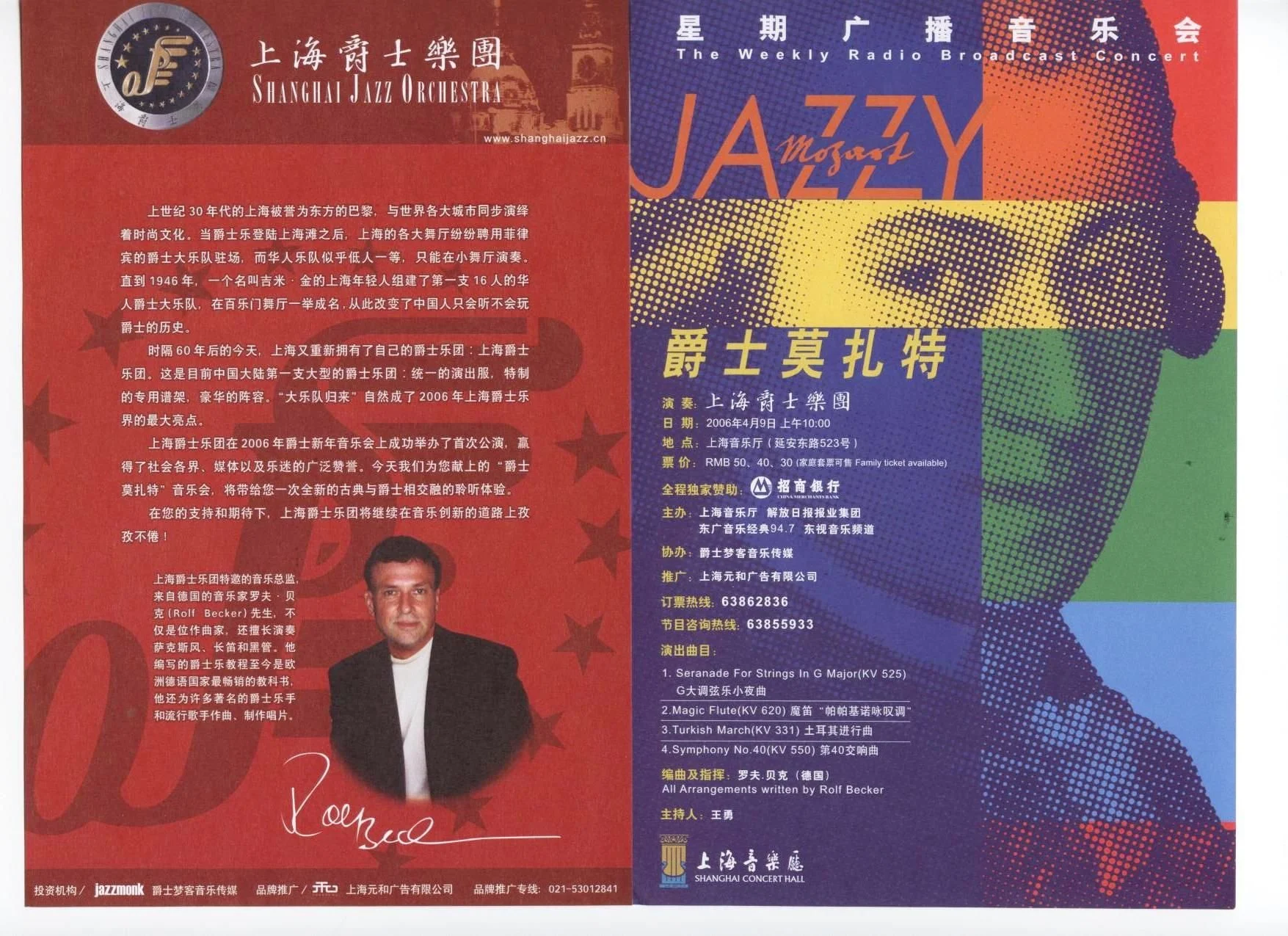
Original promotional flyer for Jazzy Mozart, presented by the Shanghai Jazz Orchestra at Shanghai Concert Hall on April 9, 2006. The program featured arrangements by Rolf Becker celebrating Mozart's 250th anniversary.
A Concert Inspired by Mozart's 250th Birthday
In 2006, the musical world celebrated the 250th anniversary of Wolfgang Amadeus Mozart's birth.
For me, it presented an opportunity to explore something I had always found fascinating: the relationship between classical composition and jazz.
By that time, I had been working with the Shanghai Jazz Orchestra, developing arrangements and exploring ways to present big band music to audiences in China.
The idea behind Jazzy Mozart was to create a concert that would bring different musical traditions together without sacrificing their individual character.
Rather than simply placing a swing rhythm beneath Mozart's melodies, I wanted to explore how his musical ideas could be transformed through jazz harmony, improvisation, Latin rhythms, and contemporary orchestration.
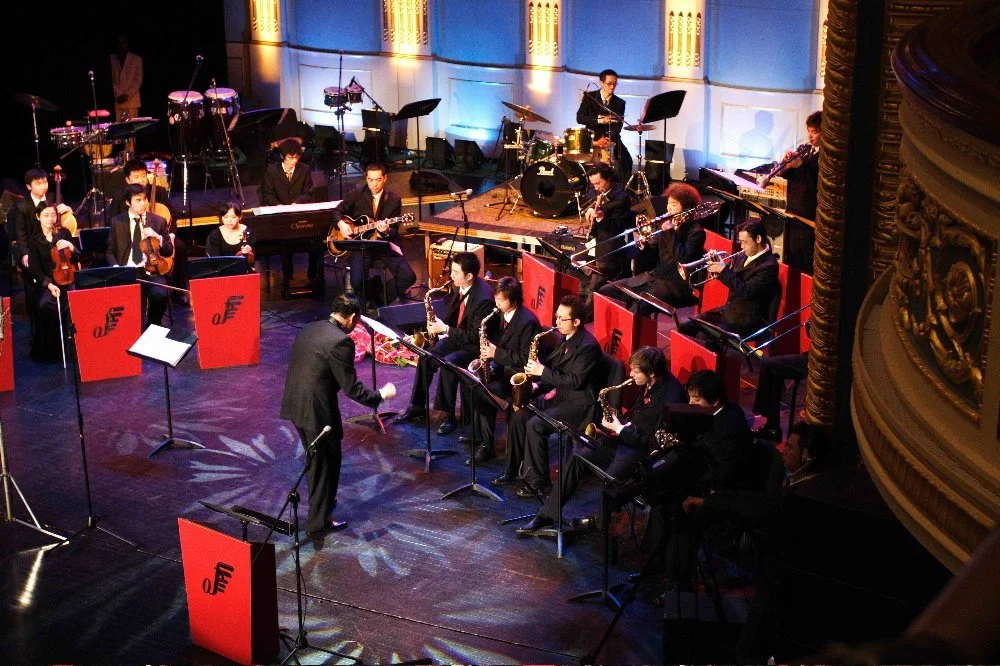
The concert took place on April 9, 2006, at Shanghai Concert Hall, bringing together the Shanghai Jazz Orchestra, a string ensemble, and Latin percussionists.
It was broadcast by Shanghai Media Group (SMG), preserving a remarkable record of this period in Shanghai's developing jazz scene.
Mozart Through a Jazz Arranger's Eyes
Mozart's music offers an extraordinary foundation for creative arranging.
His melodic clarity, harmonic movement, and rhythmic vitality make it possible to explore different musical languages while retaining the identity of the original composition.
For this concert, I developed four arrangements based on the movements of Eine kleine Nachtmusik.
Each arrangement approached Mozart from a different stylistic perspective.
Together, they formed a musical journey from classical Vienna into the world of big band jazz and Latin American rhythms.
1. Let's Start With Mozart
The opening movement established the central idea of the project: Mozart's familiar musical language presented through a different orchestral and rhythmic perspective.
The challenge was to preserve the recognizability of the original while introducing the harmonic colors, articulation, and ensemble textures of jazz.
Let's Start With Mozart — from Jazzy Mozart, Shanghai Concert Hall, April 9, 2006.
2. Romance in Salzburg
The second movement offered an opportunity to explore a more lyrical side of the project.
Here, melodic expression and orchestral color were particularly important.
The combination of jazz instruments and strings allowed me to approach Mozart's musical material with a different sense of phrasing, harmonic atmosphere, and instrumental balance.
Romance in Salzburg — from Jazzy Mozart, Shanghai Concert Hall, April 9, 2006.
3. Menuetto Cubana
With Menuetto Cubana, the musical journey moved toward Latin American rhythms.
This was one of the central attractions of the project: exploring how Mozart's music could interact with rhythmic traditions far removed from eighteenth-century Vienna.
The Latin percussion group added another dimension to the orchestra, bringing different rhythmic colors and performance energy to the stage.
Cuban percussionist and singer Felix Ramón Niebla López was among the musicians contributing to this distinctive musical combination.
Menuetto Cubana — Mozart meets Cuban and Latin rhythmic influences.
4. Stringsy Samba
The fourth movement continued the exploration of Latin American musical influences, this time through the rhythmic character of samba.
The interaction between the strings, big band, and percussion created an opportunity to bring together the different ensemble elements that had shaped the concert.
For me, this combination was at the heart of Jazzy Mozart: using arranging as a creative bridge between musical traditions.
Stringsy Samba — the fourth movement of the Jazzy Mozart suite.
Two Weeks Before the Concert — An Unexpected Crisis
With Jazzy Mozart approaching, the arrangements were written, and preparations for the performance at Shanghai Concert Hall were underway.
Then, approximately two weeks before the concert, an unexpected conflict threatened to disrupt the entire production.
Our lead trombonist had a dispute with the lead alto saxophonist and decided to leave the Shanghai Jazz Orchestra.
Unfortunately, the situation did not end there.
The other trombonists were his students, and when their teacher left, they followed him.
Suddenly, I had lost the entire trombone section.
For a big band arranger, this was a serious problem. My arrangements had been written for a conventional four-part trombone section consisting of three tenor trombones and one bass trombone.
The trombones were an integral part of the orchestration, providing harmonic depth, rhythmic accents, contrapuntal lines, and the characteristic middle and lower brass colors of the ensemble.
With only two weeks remaining before the concert, replacing four experienced trombonists was practically impossible.
I eventually managed to find two replacement players, but the orchestra was still missing an essential voice.
Canceling the concert was not an option.
I needed another solution.
Toby Mak and the Flugelhorn —
Turning a Crisis into a Musical Opportunity
Rather than attempting to reproduce the original trombone section with insufficient personnel, I began considering a different orchestral approach.
My solution was to replace the lead trombone voice with a flugelhorn.
This was not simply a matter of handing the trombone part to a trumpet player. The flugelhorn is a B-flat transposing instrument with a different playing range, articulation, and tonal character.
I had to rewrite the lead trombone material, transpose and adapt passages for the flugelhorn, and adjust the remaining brass voicings to achieve a convincing orchestral balance.
In a way, the idea reminded me of Glenn Miller's distinctive orchestral sound.
Miller had developed a recognizable ensemble color by placing the clarinet above the saxophone section, creating a different tonal blend from conventional big-band writing.
My own solution was born out of necessity rather than a search for a new signature sound, but the underlying principle was similar: changing the instrumentation could produce a different and musically effective orchestral texture.
Fortunately, Toby Mak stepped in to play the flugelhorn.
Toby proved to be exactly the musician we needed.
He performed the specially adapted parts with remarkable precision and musical sensitivity. His warm flugelhorn sound blended beautifully with the remaining trombones, and he contributed wonderful solos that added another expressive dimension to the performance.
What had initially seemed like a serious setback gradually became an interesting musical feature of the concert.
The combination of flugelhorn and the reduced trombone section created a different brass color from the one I had originally imagined.
And most importantly, it worked.
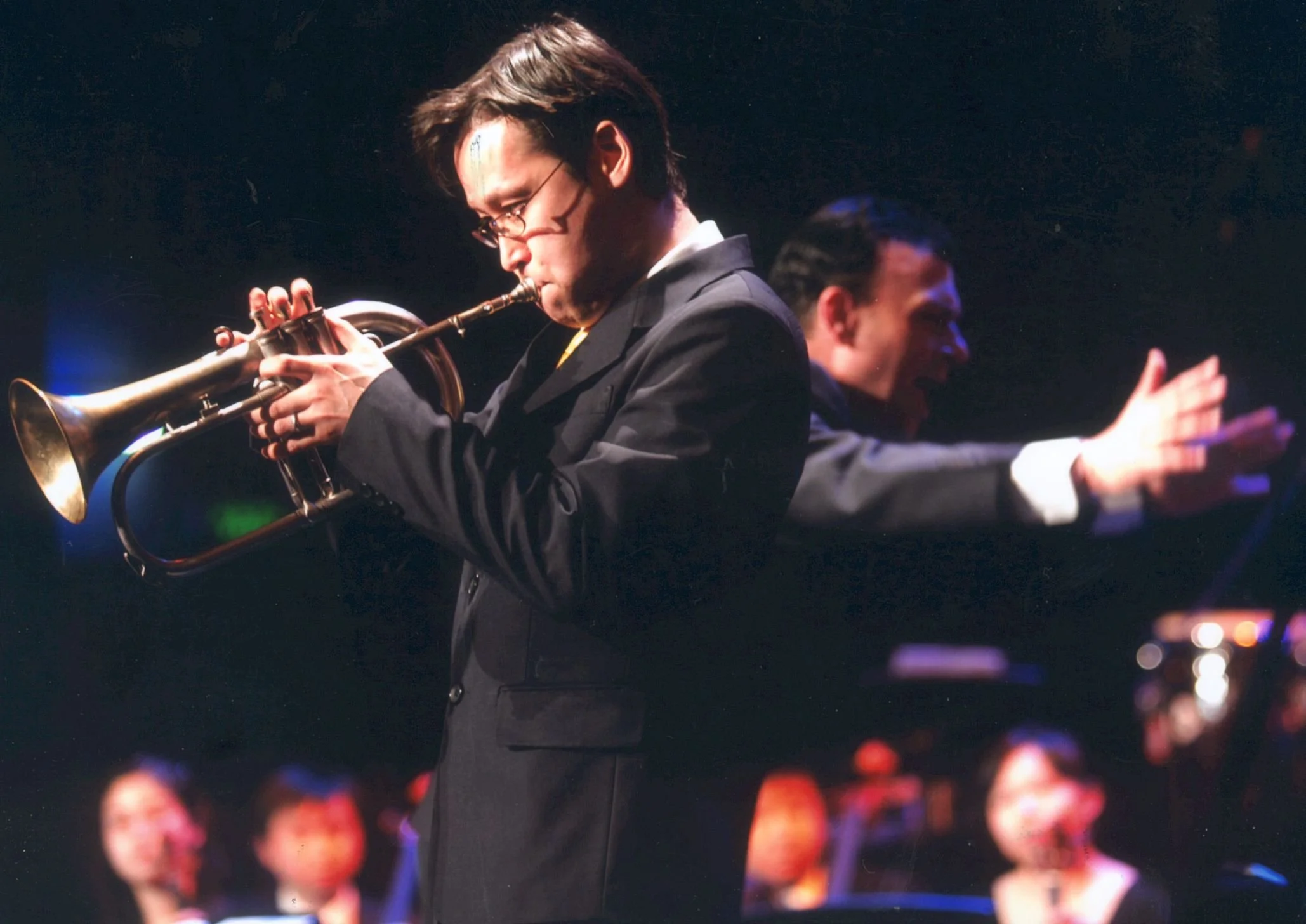
Toby Mak performing on flugelhorn during Jazzy Mozart, with Rolf Becker conducting in the background. Shanghai Concert Hall, April 9, 2006.
Looking back, I remain particularly grateful to Toby for his professionalism, flexibility, and outstanding musicianship.
This experience also reinforced something I have always believed about arranging: writing music is only one part of the profession.
A successful arranger must understand the musicians, their instruments, and the practical realities of live performance.
Sometimes, an unexpected problem forces us to reconsider an orchestration entirely.
And occasionally, the solution produces something we might never have discovered under normal circumstances.
Wolfie Meets Charlie
Beyond the four movements of Eine kleine Nachtmusik, the concert also included Wolfie Meets Charlie.
The title itself suggests the encounter between two musical worlds: Wolfgang Amadeus Mozart and the jazz tradition associated with Charlie Parker.
For me, it represented another aspect of the concert's artistic concept — allowing classical inspiration and the language of bebop to meet in a contemporary big band setting.
Wolfie Meets Charlie — a meeting of classical inspiration and bebop.
Coco Zhao — From Mozart to Chinese Jazz
One of the featured vocalists of Jazzy Mozart was Coco Zhao, whose performance added another dimension to the concert's musical diversity.
For his interpretation of Mozart's Air Papageno, I created an arrangement that began with a Bossa Nova feel before transitioning into Swing. The arrangement also incorporated scat-singing passages, allowing Coco to interact with the Big Band in a distinctly jazz-oriented setting.
As a special addition to the program, Coco performed The Moon Speaks to My Heart, a song widely known and loved throughout Asia. Although unrelated to Mozart, it provided a connection between the concert's international musical concept and Chinese popular music.
Coco Zhao subsequently established himself as a prominent jazz vocalist, particularly through his distinctive approach to incorporating Chinese musical traditions into jazz.
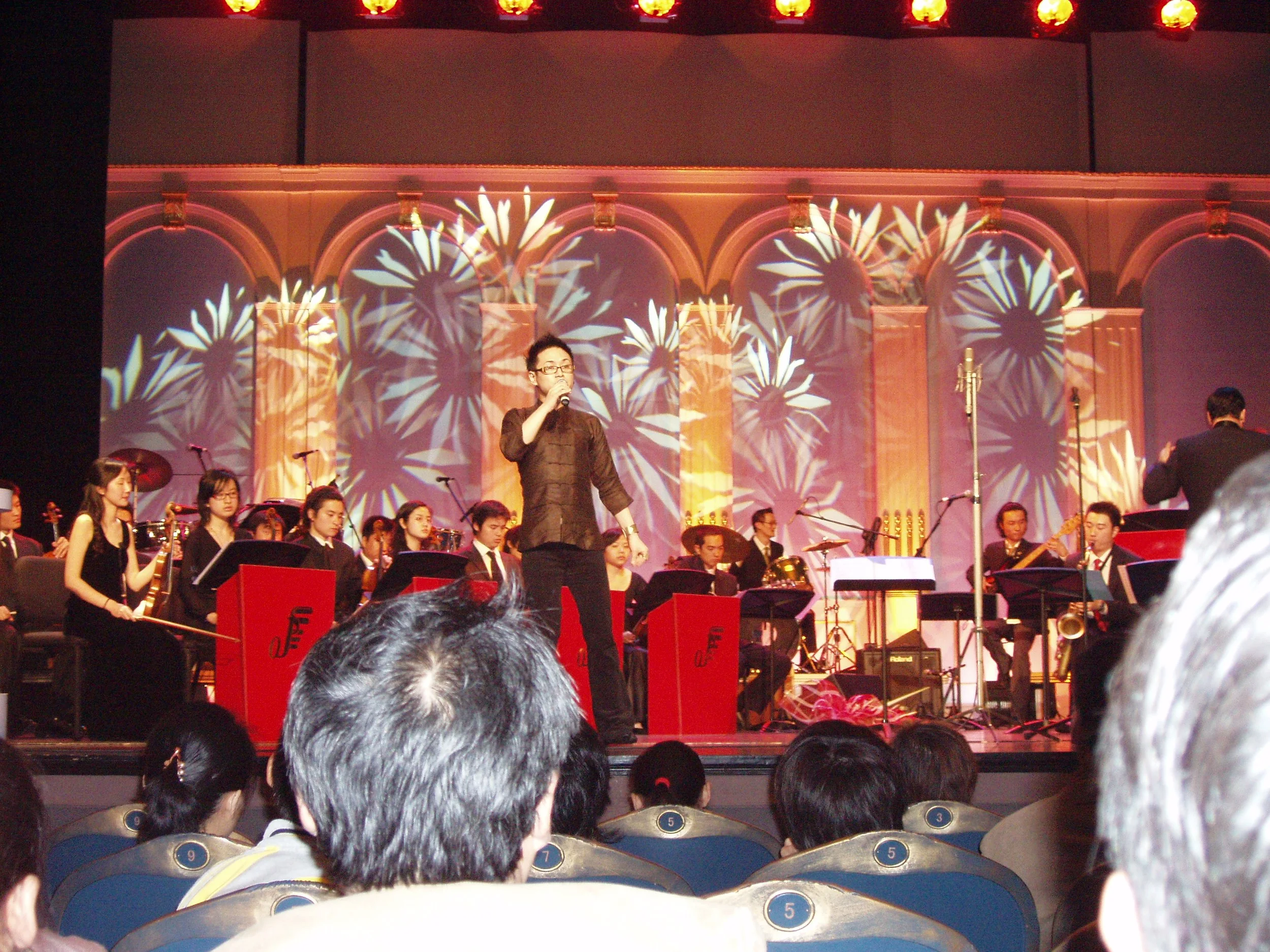
Chinese jazz vocalist Coco Zhao performing with the Shanghai Jazz Orchestra during Jazzy Mozart at Shanghai Concert Hall, April 9, 2006.
Coco Zhao performs Papageno's Aria from Mozart's The Magic Flute, arranged and conducted by Rolf Becker. The arrangement moves from Bossa Nova into Swing, featuring scat singing with the Shanghai Jazz Orchestra. Recorded live at Shanghai Concert Hall on April 9, 2006, as part of Jazzy Mozart.
The Musicians Behind the Music
A project of this scale depends on the musicians who bring the written arrangements to life.
The Shanghai Jazz Orchestra was joined by strings and Latin percussion, creating an ensemble that could move between different musical styles.
Among the musicians was lead trumpeter Lance Goerner, who also performed on the Electronic Valve Instrument (EVI), adding an unusual instrumental color to the production.
The participation of musicians from different backgrounds reflected something I valued greatly about working in Shanghai: the opportunity to bring together performers with different musical experiences and traditions.
The concert was not simply about combining instruments. It was about creating a shared musical language.
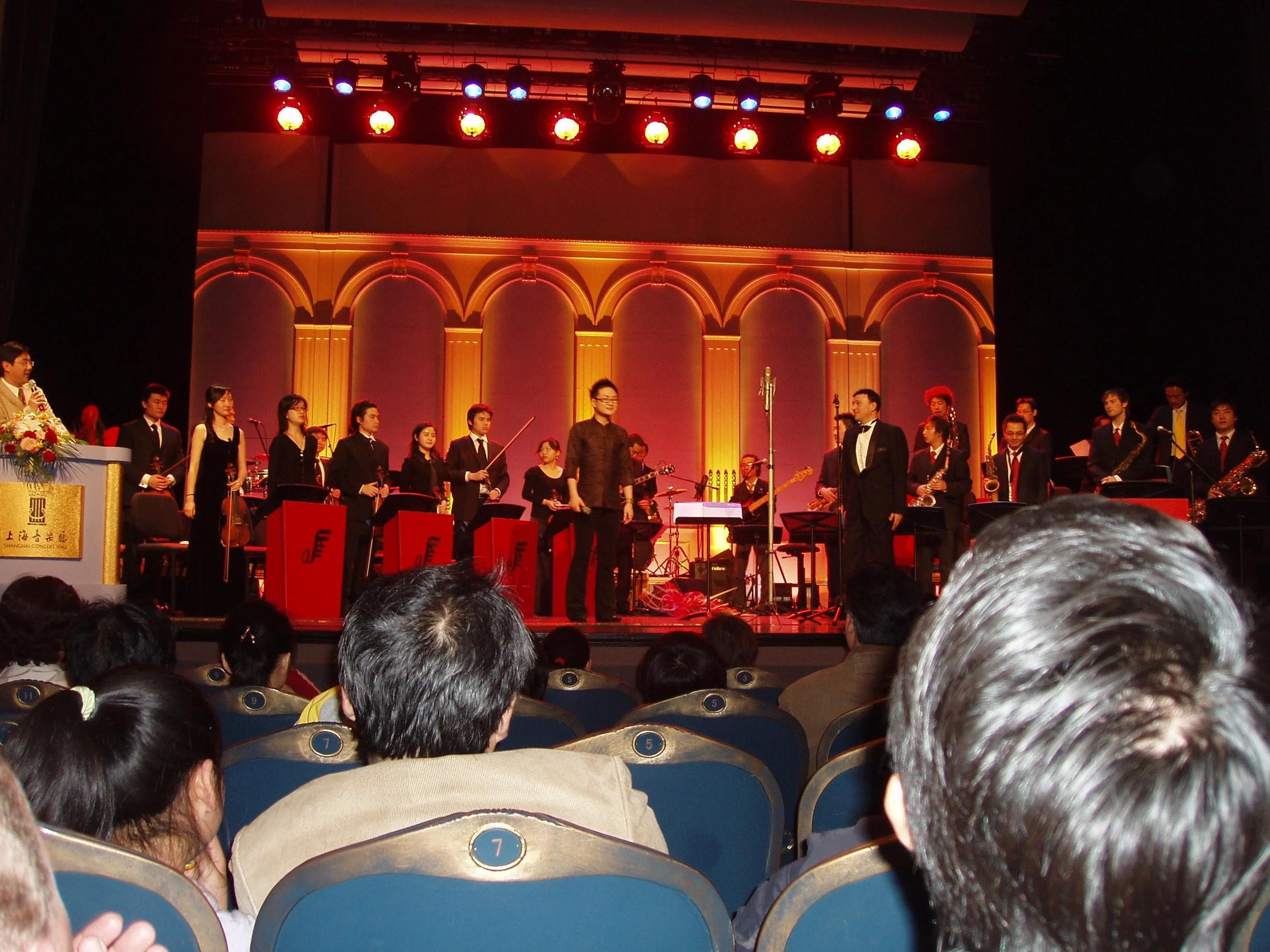
A memorable finale: The Shanghai Jazz Orchestra and guest vocalist Coco Zhao gathered on stage at Shanghai Concert Hall following the final notes of Jazzy Mozart, April 9, 2006.
Preserving the Original Concert Recordings
The surviving footage of Jazzy Mozart comes from the original 2006 television broadcast.
Although the recordings are not technically perfect by today's standards, they remain important historical documents.
They capture the musicians, arrangements, and atmosphere of a concert that formed a significant part of my early musical years in Shanghai.
Archival recording note:
"The surviving 2006 broadcast recording contains occasional audio overload and a slight discrepancy between picture and sound. These limitations belong to the archival source and do not reflect the musical performance."
From the Concert Stage to the Music Library
One of my continuing objectives with MusicMyLanguage is to make professional arrangements available to musicians, conductors, and educational ensembles.
The Jazzy Mozart project represents the same philosophy that guides much of my arranging work: respecting the original musical material while exploring new possibilities through orchestration, harmony, rhythm, and ensemble color.
Selected arrangements from my catalog can be explored through my music library, with score previews, instrumentation information, and purchasing options available through the following platforms.
A Full House at Shanghai Concert Hall
A view of the sold-out audience at Shanghai Concert Hall during Jazzy Mozart on April 9, 2006 — a memorable evening that brought classical music, big band jazz, and Latin rhythms together on one stage.
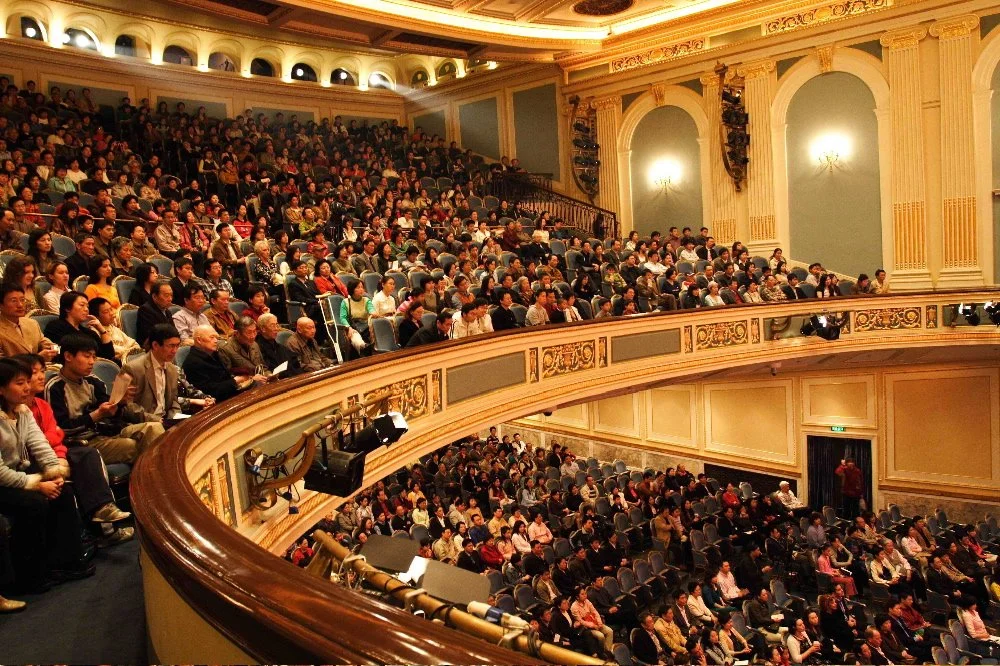
A sold-out audience at Shanghai Concert Hall during the Jazzy Mozart concert on April 9, 2006.
Looking Back — and Moving Forward
Looking back, Jazzy Mozart remains a particularly memorable project from my early years in Shanghai.
It brought together classical music, jazz, Latin percussion, and orchestral writing in a way that reflected both my musical background and the international character of the city's developing music scene.
The concert also marked an important turning point.
Despite the artistic success of the project, the future of the Shanghai Jazz Orchestra soon became uncertain.
What followed would lead to a new musical collaboration, a different orchestra, and the beginning of another important chapter in my Shanghai years.
That next chapter would become the story of the JZ All Star Big Band.
Continue reading: The Birth of the JZ All Star Big Band →
Previous chapter: Shanghai Jazz Orchestra (2005–2006)
Discover how the Shanghai Jazz Orchestra emerged as an important part of Shanghai's developing big band scene, leading to the Jazzy Mozart concert.
MusicMyLanguage | Composition • Arranging • Conducting • Music Education
Chapter 2 — The Shanghai Jazz Orchestra: A New Beginning (2005–2006)
From Club Shanghai to the Shanghai Jazz Orchestra: Rolf Becker recalls the orchestra's beginnings, its sold-out New Year's concerts in January 2006, and the musical journey that led to Jazzy Mozart.
Shanghai Big Band History — Part Two | By Rolf Becker
A New Opportunity
When my engagement as musical director of the Club Shanghai Big Band ended in February 2005, I certainly did not expect that the story of this orchestra would continue in quite the way it did.
The musicians, however, had other ideas.
Later that year, drummer Billy Pan and several of his colleagues became involved in establishing a new ensemble: the Shanghai Jazz Orchestra. Some of the musicians had previously performed with me at Club Shanghai, while others were newly recruited.
This was not simply the old Club Shanghai Big Band operating under a different name. The Shanghai Jazz Orchestra was a new organization with its own management and ambitions.
In autumn 2005, Billy Pan approached me and asked whether I would return as the orchestra's conductor. He also mentioned that two Chinese New Year concerts were already being planned for January 2006.
I accepted the invitation.
It was an opportunity to continue the work we had started at Club Shanghai, but this time within an organization dedicated to developing a concert Big Band.
Continuing Where We Had Left Off
When I returned to rehearsals, I quickly realized that we would have to continue more or less where we had left off.
Although a few new musicians had joined the ensemble, the overall musical level had not improved significantly during my absence.
This was not particularly surprising. Most of the players came from musical backgrounds in which jazz had played only a minor role, if any.
The experience gained during our Club Shanghai rehearsals and performances had provided a foundation, but developing a convincing Big Band required much more than reading the correct notes.
Swing phrasing, articulation, rhythmic precision, ensemble balance and stylistic understanding were all essential elements of the musical language we were trying to establish.
Nevertheless, we now had a specific goal: preparing the orchestra for its first public concerts in January.
That gave our rehearsals a clear direction.
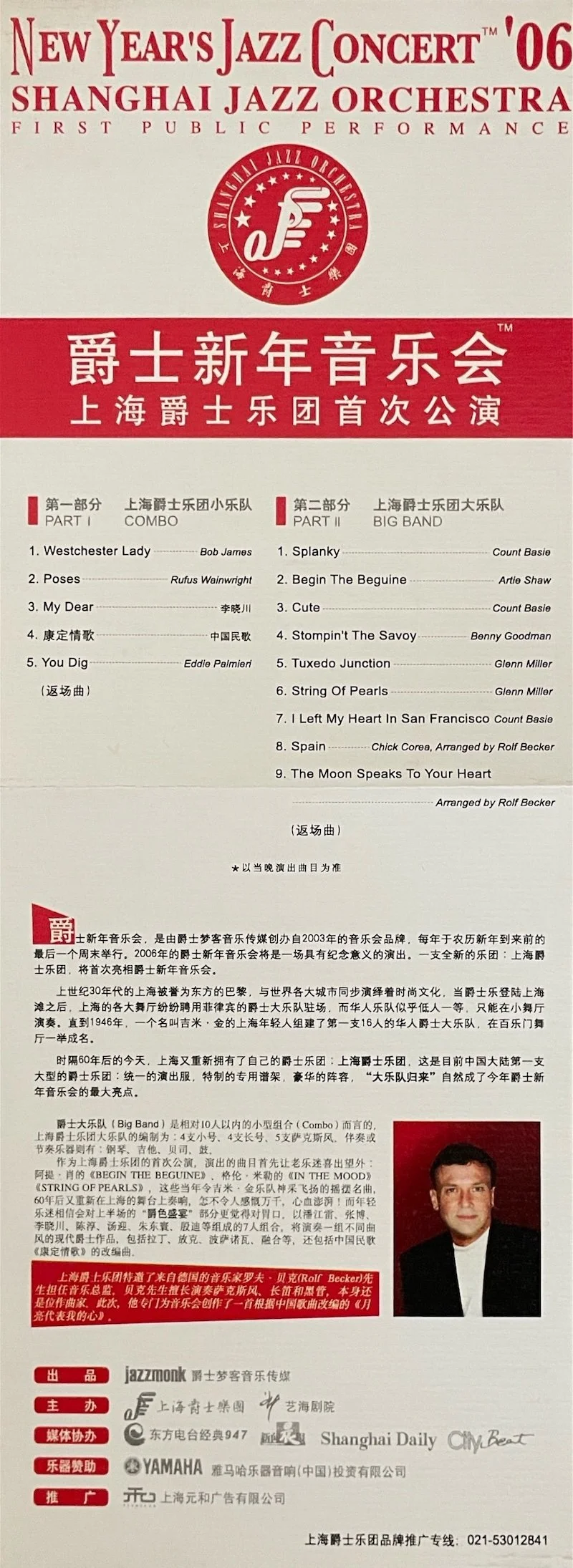
Original program for the Shanghai Jazz Orchestra's New Year's Jazz Concert in January 2006, announcing the ensemble's first public performance and documenting the repertoire, including my arrangements of Spain and The Moon Speaks to Your Heart.
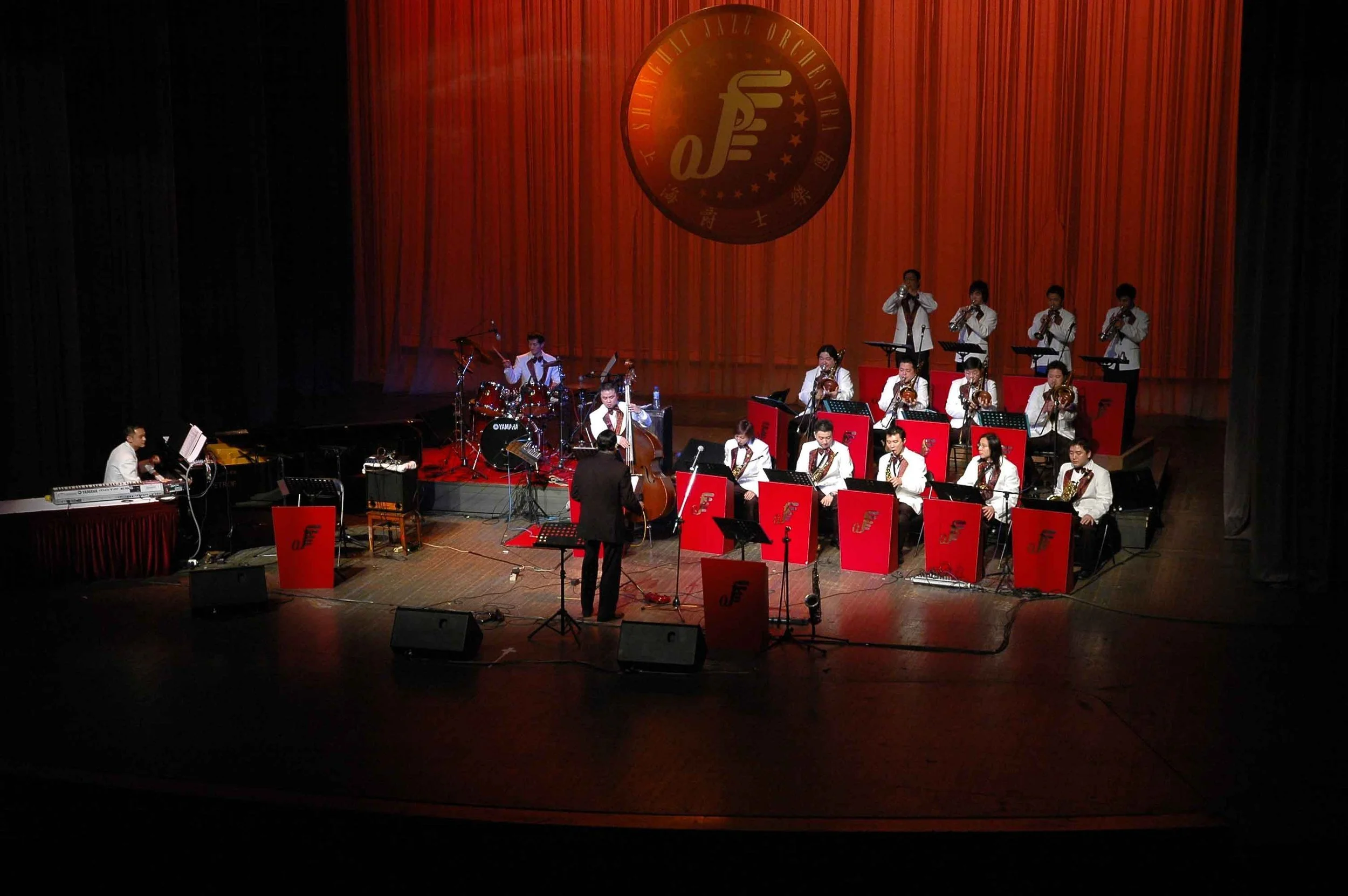
Orchestra photograph: The Shanghai Jazz Orchestra performing at Yi Hai Theater, Shanghai, January 2006. Rolf Becker conducting.
Choosing the Right Repertoire
As I began planning the program, two considerations guided my decisions.
The first was the orchestra itself.
I had to select or prepare music that would challenge the musicians without exceeding their capabilities. An overly ambitious repertoire might have been musically interesting on paper, but it would not necessarily have produced a convincing performance.
The second consideration was our audience.
At that time, many Chinese concertgoers had relatively little experience with jazz, particularly with the traditions of the American Big Band.
I wanted to present a program that would introduce this musical world in an accessible and entertaining way.
For that reason, I decided to concentrate much of the repertoire on the Golden Era of Big Band music.
Glenn Miller's In the Mood was an obvious choice. Its memorable melodies, characteristic swing rhythm and unmistakable orchestral sound made it an excellent introduction to the traditional Big Band.
Another selection was Begin the Beguine, closely associated with Artie Shaw and his orchestra.
This particular piece presented an interesting practical challenge.
The arrangement required a clarinet solo, but none of our saxophonists provided clarinet doubling. Consequently, I performed the clarinet solo myself.
It was one of those situations in which being both a conductor and an instrumentalist proved particularly useful.
Introducing a Different Side of Jazz
Although I wanted the concerts to be accessible, I also felt it was important to introduce something beyond the familiar swing repertoire.
For that purpose, I selected Chick Corea's Spain.
This was the one jazz chart in the program that ventured significantly beyond the traditional Big Band repertoire.
To feature the composition properly, I invited the talented guitarist Lawrence Ku to join us as guest soloist.
Lawrence was not a regular member of the Shanghai Jazz Orchestra, but his musicianship made him an excellent addition to the concerts.
Our collaboration would continue a few months later when he returned as a guest musician for Jazzy Mozart at Shanghai Concert Hall.
The inclusion of Spain reflected an important part of my approach to programming: I wanted to respect the orchestra's current abilities and the audience's musical experience without limiting our artistic ambitions to familiar material.
Bringing the Swing Era to the Stage
The concerts were not intended to be purely musical presentations.
I also wanted to recreate some of the atmosphere associated with the great Big Band era, when swing music was closely connected with dancing and entertainment.
A couple of swing dancers therefore joined us on stage, adding a visual and theatrical element to the performances.
Their appearance helped bring the music to life in a different way.
For an audience that might not have been familiar with the history of swing, the combination of a live Big Band and dancers provided an immediate connection to the music's original cultural setting.
It was a relatively simple addition to the program, but an effective one.
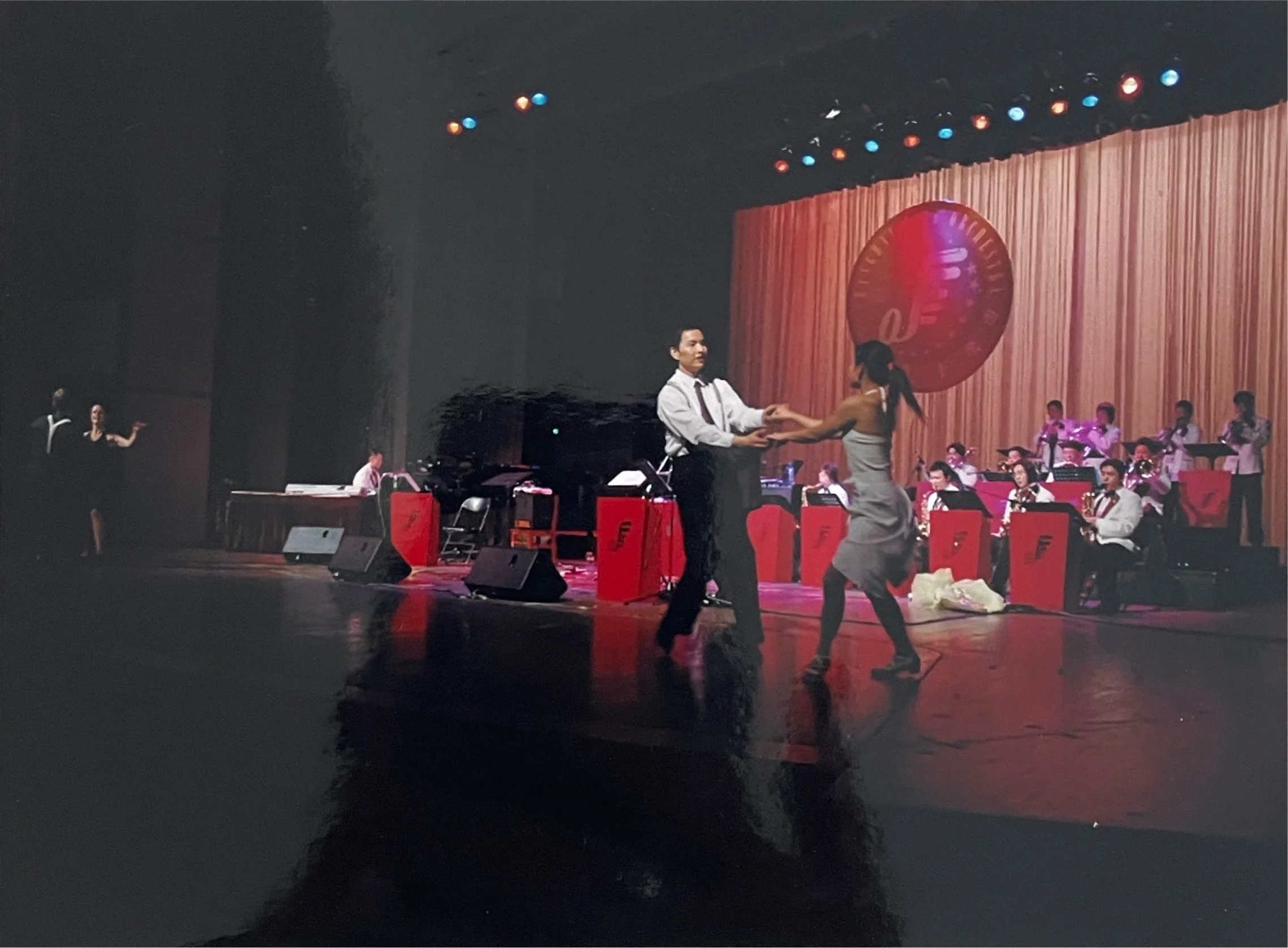
Swing dancers performing on stage with the Shanghai Jazz Orchestra during the New Year's Jazz Concert in January 2006.
January 20–21, 2006:
The First Public Performances
The Shanghai Jazz Orchestra's first public concerts took place on January 20 and 21, 2006, at Yi Hai Theater in Shanghai.
The performances were presented as the New Year's Jazz Concert '06, with the orchestra advertised as making its first public appearance.
The original promotional poster listed me as Musical Director and featured Lawrence Ku as guest guitarist.
Both concerts were sold out.
For me, this was particularly encouraging.
Only a few months earlier, we had been working to develop an orchestra whose musicians were still becoming familiar with the language of jazz. Now we were performing before full houses.
The audiences responded enthusiastically.
They enjoyed the music, appreciated the show elements and called for encores.
Of course, the orchestra still had considerable room for improvement. But the success of those two evenings demonstrated that our efforts had been worthwhile.
More importantly, they showed that there was an audience in Shanghai interested in experiencing this kind of music.
The Shanghai Jazz Orchestra had taken an important step forward.
Concert poster: Original promotional poster for the Shanghai Jazz Orchestra's first public concerts, January 20–21, 2006.
Growing Public Attention
The concerts also attracted attention beyond the concert hall.
One particularly valuable document from this period is a newspaper article by Yu Bingxia titled Revival of Jazz Slow but Steady, published in China Daily.
The article discussed the development of jazz in Shanghai and introduced the newly established Shanghai Jazz Orchestra.
It also documented the orchestra's January performances and my involvement as its musical supervisor.
Looking back, I consider this newspaper coverage an important part of the orchestra's early history.
It provides a contemporary record of a time when establishing a professional Chinese Big Band was still an unusual undertaking.
The musicians had created a new organization, we had successfully presented our first public concerts, and the orchestra was beginning to attract wider attention.
Newspaper article: “Revival of jazz slow but steady,” by Yu Bingxia, China Daily, January 2006. Contemporary reporting on the emergence of the Shanghai Jazz Orchestra.
From the Swing Era Toward Mozart
The success of the January concerts gave us confidence.
It also appears to have helped create the circumstances for a much more ambitious project.
Shortly afterward, the Shanghai Jazz Orchestra's manager approached me with an interesting question:
Could I rewrite Mozart's music into swing?
My answer was yes.
But the more I considered the idea, the more I realized that simply transforming Mozart's compositions into conventional swing arrangements would be too limiting.
I began thinking about a broader musical concept.
Rather than presenting Mozart exclusively through the language of traditional swing, I wanted to explore the possibilities of bebop, contemporary jazz, salsa and other Latin styles.
I would select the Mozart compositions myself and develop arrangements that connected the original classical material with these different musical traditions.
The project would also require a considerably expanded ensemble, combining the Shanghai Jazz Orchestra with guest musicians, Latin percussion and strings.
What began as a relatively straightforward question would eventually become Jazzy Mozart, performed at Shanghai Concert Hall on April 9, 2006.
But that story deserves a chapter of its own.
Explore the Shanghai Big Band History
Previous chapter: Club Shanghai Big Band (2004) — Where It All Began
Discover how Shanghai's first Club Shanghai Big Band came together and laid the foundation for the developments described in this chapter.
Next chapter: Jazzy Mozart (2006) — A New Musical Adventure
Discover how jazz, classical music, Latin rhythms, and a full orchestra came together for an ambitious concert at Shanghai Concert Hall on April 9, 2006.