

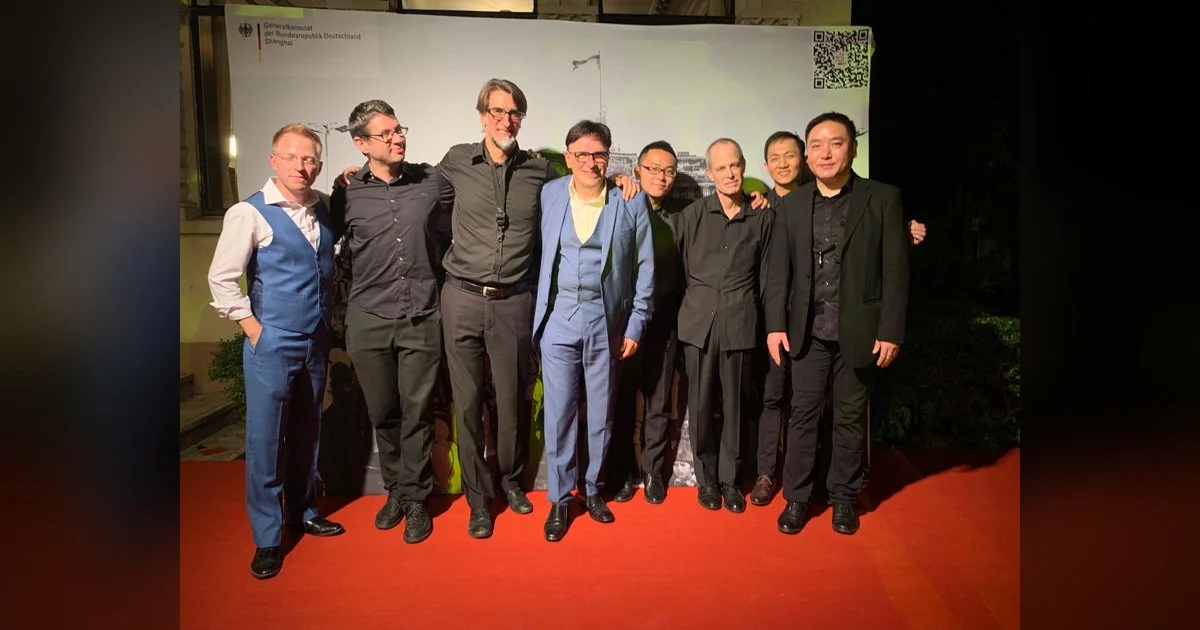
Chapter 7 — Fourteen German Unity Days
An unexpected invitation at Shanghai's JZ Club in 2006 began fourteen years of musical collaboration with the German Consulate General. From conducting three national anthems to performing jazz at diplomatic celebrations, this chapter recalls the music, memorable encounters, and friendship that made those years so special.
Music, Diplomacy, and an Unexpected Friendship
How an invitation at a Shanghai jazz club led to fourteen years of musical celebrations, an unusual responsibility involving three national anthems, and a friendship I still cherish.
An Unexpected Invitation at the JZ Club
It was a Saturday evening in late August 2006. I was performing with the JZ All Star Big Band at the JZ Club on Fuxing Road when a member of the cultural affairs staff from the German Consulate General approached me with an invitation.
Would I be interested in meeting the German Consul General, Dr. Röhr, to discuss providing music for the upcoming German Unity Day celebrations?
Naturally, I was interested.
What I didn't know at the time was that this seemingly ordinary invitation would lead to fourteen years of musical involvement with the German Consulate General in Shanghai—and to a friendship that would become one of my most cherished memories of those years.
Two Celebrations, Two Very Different Ensembles
When I met Dr. Röhr, he explained that German Unity Day was celebrated in Shanghai with two separate events.
The first was the official reception at the Consul General's residence on Yongfu Road, not far from the JZ Club. This was a formal diplomatic occasion, attended by representatives of the Shanghai municipal government and other invited guests of honor.
The second was a much larger celebration for the German community in Shanghai, attracting an estimated 2,000 guests or more.
Both occasions followed a similar ceremonial structure. First came the Chinese, European, and German anthems, followed by speeches from the Consul General and a representative of the Chinese delegation. Afterwards, guests enjoyed refreshments and a buffet while live music provided the atmosphere for the celebrations.
Given the limited space at the residence, I suggested putting together a septet for the official reception. For the large public celebration, I recommended my big band.
Dr. Röhr immediately approved both proposals.
There was, however, one small detail I had neglected to mention.
I didn't have a single arrangement ready for the septet.
With barely a month before the celebrations, I now had to write enough music for two complete 45-minute sets.
It was an ambitious undertaking, to say the least. But arranging music under pressure was hardly unfamiliar territory for me, and I was determined to make this new ensemble work.
Three Anthems—and a Question of Trust
There was another musical challenge, one that required considerably more diplomatic sensitivity.
Traditionally, the Chinese, European, and German anthems had been played from recordings. This ensured that their familiar musical character remained untouched—an understandable precaution at an official diplomatic event.
I proposed something different.
Why not perform all three anthems live?
I assured Dr. Röhr that I could rearrange the music for my ensembles without compromising the original character or dignity of the compositions.
He trusted my judgment.
That trust was particularly meaningful because, as Consul General, he was effectively accepting responsibility for allowing a departure from the customary procedure.
I took the task seriously. These were not pieces of music to be treated as opportunities for clever reharmonization or jazz improvisation. Their ceremonial character had to remain intact, while the arrangements needed to work convincingly with the musicians and instrumentation available.
At the official receptions, I personally conducted all three anthems.
And the result?
The audience responded with applause.
Not just that first year, but year after year.
For me, this was especially gratifying. It demonstrated that a live musical performance, handled with care and respect, could add something meaningful to an occasion where recorded music had previously been the norm.
A Consul General with a Clarinet
During my conversations with Dr. Röhr, I discovered something rather delightful.
He was not merely interested in jazz.
He played the clarinet himself.
That opened the door to an entirely different kind of musical collaboration.
I put together a Dixieland sextet in which I played clarinet, and Dr. Röhr joined us with his own instrument.
It was a wonderful experience.
For those moments, the usual distinction between a diplomat and a professional musician seemed to disappear. We were simply people enjoying the pleasure of making music together.
Looking back, I believe our shared enthusiasm for jazz helped establish a relationship that extended well beyond the usual professional arrangement between an event organizer and a musician.
Over time, we developed a genuine friendship.
And although I would continue working for the German Consulate General under two of Dr. Röhr's successors, the years of our collaboration have remained particularly special to me.
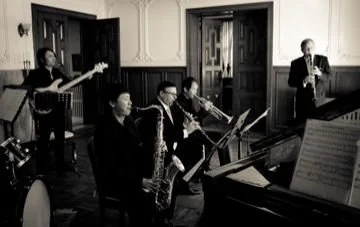
German Consul General Dr. Röhr joining me and fellow musicians for a Dixieland performance. Our shared enthusiasm for jazz became the foundation of a lasting friendship.
From the Residence to a Crowd of Thousands
The two celebrations required very different musical approaches.
At the residence, the septet provided an intimate setting, with carefully arranged music suitable for an official reception.
The public celebration was another matter entirely.
With an audience of approximately 2,000 guests or more, the big band provided the musical energy and presence appropriate for such a large gathering.
It was a rather unusual situation: a German national celebration in Shanghai, featuring an international group of musicians performing American-style big band music.
Some years later, Dr. Röhr told me a story that still makes me smile.
His American counterpart had apparently remarked:
"I have to go to a German event to see an American big band."
I thought that was a marvelous observation.
It also said something about Shanghai's international musical life. Music crossed national boundaries quite naturally. A German celebration could feature American jazz, performed by musicians from different countries, for an audience gathered in China.
And somehow, it all made perfect sense.
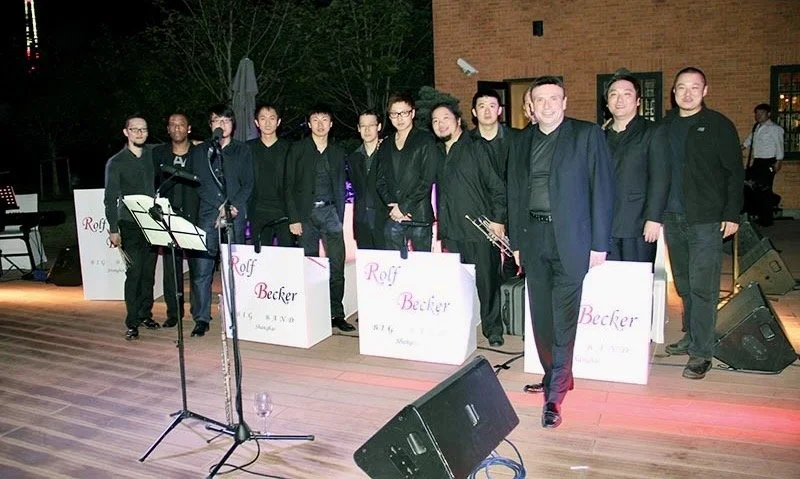
My smaller big band at the German Unity Day celebrations in Shanghai, October 2012. Depending on the occasion and available space, the ensemble varied in size.
Nanjing, 2007 — Music Beyond Shanghai
Dr. Röhr served as Consul General in Shanghai on two separate occasions.
Between his two terms, he was called to Berlin to oversee and implement an ambitious cultural initiative agreed upon by Germany and China: Germany and China – Moving Ahead Together (in German: “Deutschland und China – Gemeinsam In Bewegung”)
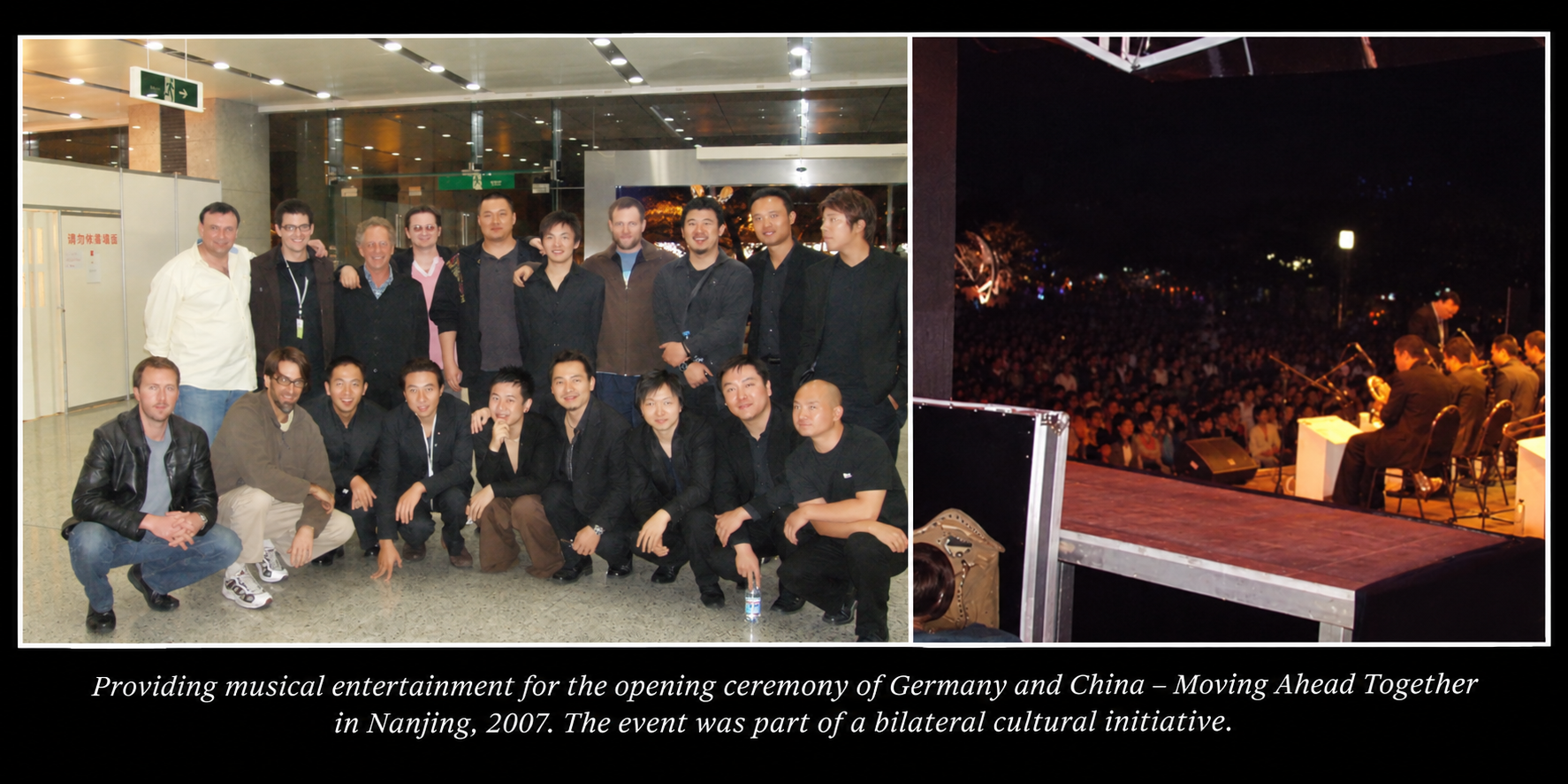
In 2007, he invited me to provide the musical accompaniment for the project's opening ceremony in Nanjing.
The event took place in a public square, bringing our music into a very different environment from the diplomatic receptions in Shanghai.
For this occasion, I also invited Coco Zhao, the outstanding Shanghai jazz vocalist who had already appeared as a guest artist in my Jazzy Mozart concert in April 2006.
I asked him to perform two German songs: Für Dich soll's rote Rosen regnen, famously associated with German actress and singer Hildegard Knef, and Tipitipso, performed by Caterina Valente.
The second song held a particularly personal meaning for me. I had worked with Caterina Valente earlier in my career, including a concert tour in 1987. Now, twenty years later, I found myself presenting one of the songs associated with her through the voice of a Chinese jazz singer at a German-Chinese cultural celebration.
It was one of those unexpected connections that made my musical life in Shanghai so fascinating.
What had begun with a conversation at the JZ Club was now extending into a broader program of cultural exchange between Germany and China.
For me, this invitation was another indication of the trust that had developed between Dr. Röhr and me—and another memorable experience in a career that continually reminded me how music could bring people together across cultural and national boundaries.
The Septet That Became a Tradition
Over the years, the septet became a familiar part of the official German Unity Day celebrations at the Consul General's residence.
Although individual musicians occasionally changed, I was fortunate to work with some outstanding players.
One lineup, in particular, remains my favorite:
Hu Danfeng — Trumpet
Nix Xue — Alto Saxophone
Alec Haavik — Tenor Saxophone
Charles Chang — Baritone Saxophone
Oleg Roschin — Piano
Brian Hurley — Bass
Charles Foldesh — Drums
Several of these musicians were familiar colleagues from Shanghai's jazz scene, including Alec Haavik, whose name has already appeared in earlier chapters of this series.
I usually concentrated on arranging and conducting rather than performing as a regular member of the septet. Occasionally, however, I picked up my flute for arrangements that required an additional woodwind voice, particularly when the saxophonists were unable to double.
The repertoire reflected my musical preferences: carefully crafted arrangements, a strong ensemble sound, and enough room for the individual personalities of the musicians to shine.
One surviving live recording captures the septet performing my arrangement of Duke Ellington's Do Nothing till You Hear From Me at the Consul General's residence on Yongfu Road.
Listening to such recordings brings back more than just the music. They remind me of the musicians, the atmosphere, and the many hours of preparation that went into performances which, for the audience, might have seemed effortless.
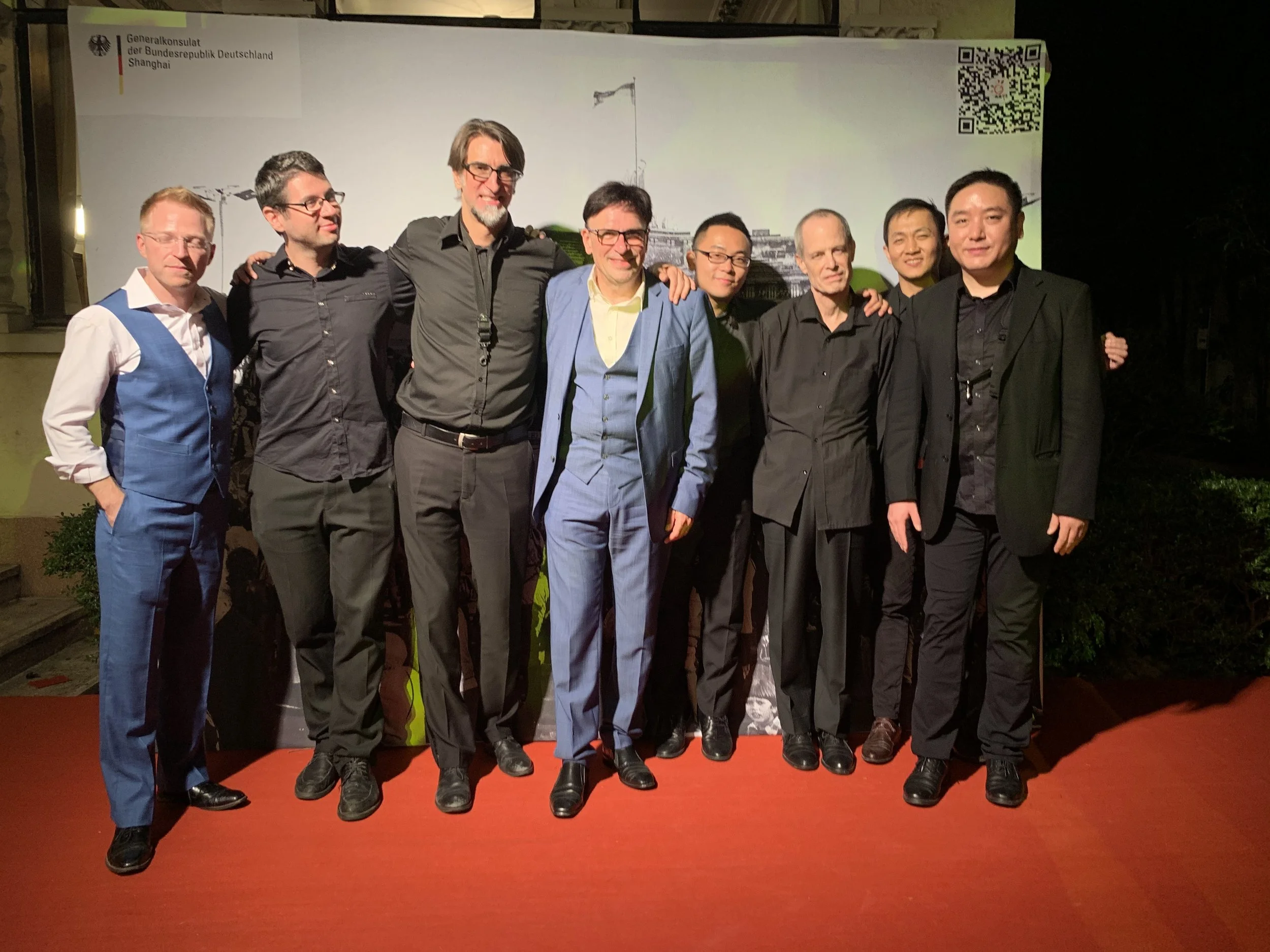
My preferred German Unity Day Septet lineup, circa 2014: Hu Danfeng, Nix Xue, Alec Haavik, Charles Chang, Oleg Roschin, Brian Hurley, and Charles Foldesh. Although personnel occasionally varied, this was the combination of musicians I particularly valued.
Live performance by the Rolf Becker Septet at the German Consul General's residence in Shanghai. An excerpt from Rolf Becker's arrangement of Duke Ellington's "Do Nothing Till You Hear From Me," recorded during the German Unity Day celebrations.
Fourteen Years of German Unity Day
For approximately the first six years, the celebrations continued in their original two-part format.
Eventually, the large public celebration was discontinued.
The official reception at the residence, however, continued, and so did my musical involvement.
From 2006 until 2019, I provided music for fourteen consecutive German Unity Day celebrations in Shanghai.
During those years, I experienced changes in personnel, different musical requirements, and the transitions between Consuls General. But the underlying purpose remained the same: to provide music that was appropriate for the occasion while retaining the warmth and individuality of a live performance.
Fourteen years is a long time in the life of a musician, particularly in a city as constantly changing as Shanghai.
And yet, when I think back on those celebrations, it is not the number of performances that first comes to mind.
It is the people.
More Than a Professional Engagement
Dr. Röhr has since retired and now lives in Berlin.
Our professional collaboration began with a simple invitation in 2006, but what I remember most fondly is the trust he placed in me, his enthusiasm for jazz, and the friendship that developed over the years.
I continued working with two subsequent German Consuls General, and I remain grateful for those opportunities.
But the time spent working with Dr. Röhr holds a particularly special place in my memory.
There is something rather wonderful about the fact that a German diplomat and a German musician, both living and working in Shanghai, found common ground through American jazz.
We shared a love of music, enjoyed performing together, and built a relationship that went beyond our respective professional roles.
Looking back, I realize that some of the most meaningful moments of my career did not necessarily happen on the biggest stages or in front of the largest audiences.
Sometimes, they began with an unexpected conversation in a small jazz club.
And sometimes, they lasted fourteen years.
Next in Shanghai Big Band History: The story continues...
Chapter 6 — Beyond Jazz: The Chamber Balls and Shanghai's International Stage
Beyond Shanghai's jazz clubs, Rolf Becker built a remarkable musical career conducting international Chamber Balls, gala productions, and corporate events. From the 2006 European Chamber Ball to the 2016 Frank Sinatra tribute, discover the stories, musicians, and memorable performances behind these productions.
Shanghai Big Band History — A Personal Musical Journey in China
A Different Kind of Stage
When I look back on my musical years in Shanghai, the big bands and jazz clubs naturally occupy a special place in my memories. But there was another side to my professional life in China, one that developed almost simultaneously with my jazz activities and eventually became an important part of my musical journey.
It took me into magnificent hotel ballrooms, international business celebrations, corporate events, and elaborate gala productions.
For many years, I provided orchestras and musical entertainment for the American, European, German, and Swiss Chambers of Commerce in Shanghai, as well as for events organized by the German Consulate and international companies.
These engagements demanded something quite different from leading a jazz orchestra.
At JZ Club, the audience came primarily to listen to jazz. At a Chamber Ball, the music had to serve an entire evening: elegant dinner entertainment, ballroom dancing, familiar popular songs, and sometimes a specially designed musical show.
It was a fascinating challenge for a composer and arranger.
And it gave me the opportunity to demonstrate that a professional orchestra could be much more than a jazz band.
2006 — The Beginning of Another Musical Journey
One of the earliest important engagements was the European Chamber Ball in May 2006.
That year was already an extraordinarily busy period for me. In April, I had presented my Jazzy Mozart production at Shanghai Concert Hall, and a few months later, the JZ All Star Big Band would begin its regular performances at JZ Club.
But the European Chamber Ball belonged to an entirely different musical world.
Instead of presenting a jazz concert, I was responsible for providing music that would complement a sophisticated international social event.
The repertoire had to be versatile. Guests expected familiar melodies, danceable rhythms, and a musical atmosphere that could change naturally as the evening progressed.
Swing and jazz certainly had their place, but so did pop music, Latin rhythms, and traditional ballroom dances.
A successful evening might move from an elegant waltz to a cha-cha, from a romantic ballad to a lively disco number.
For me, this variety was never a disadvantage.
Quite the opposite.
I enjoyed the challenge of arranging music in different styles while maintaining the quality and character of a professional live orchestra.
The European Chamber Ball also brought valuable publicity. A newspaper article from 2006 documented the performance and showed the orchestra on stage.
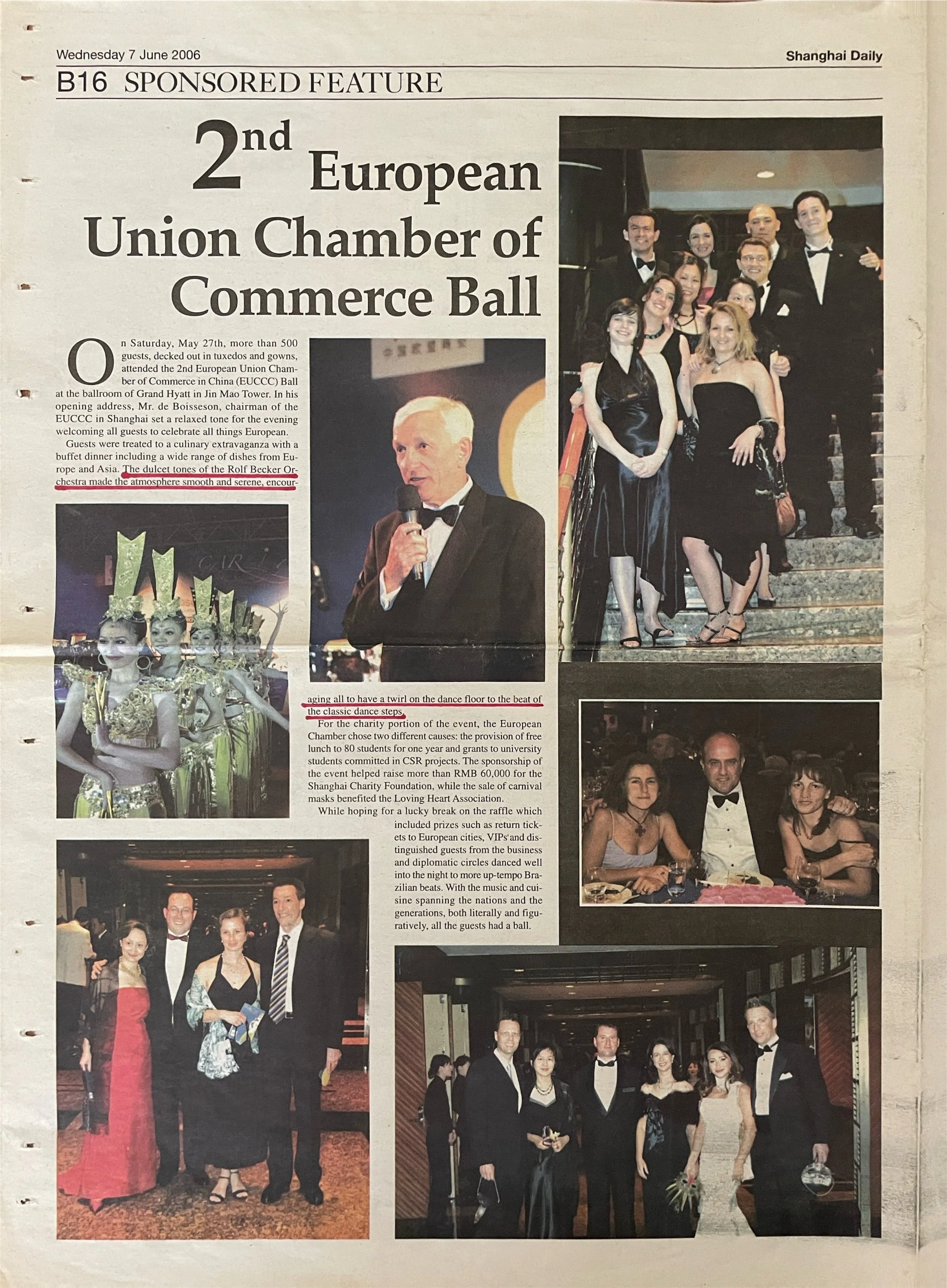
Archival newspaper coverage of the 2006 European Chamber Ball in Shanghai, featuring photographs of guests attending the gala evening. The event was accompanied by live orchestral music conducted by Rolf Becker.
Looking at that article today, I see more than a record of a successful evening. It reminds me how quickly my musical activities in Shanghai were expanding beyond the concert hall and the jazz club.
From the Ballroom to Porsche
Another memorable project followed in September 2006.
Porsche commissioned me to produce music for the Shanghai launch of its new 911 Turbo, held at the prestigious Three on the Bund.
This engagement included the production of a CD.
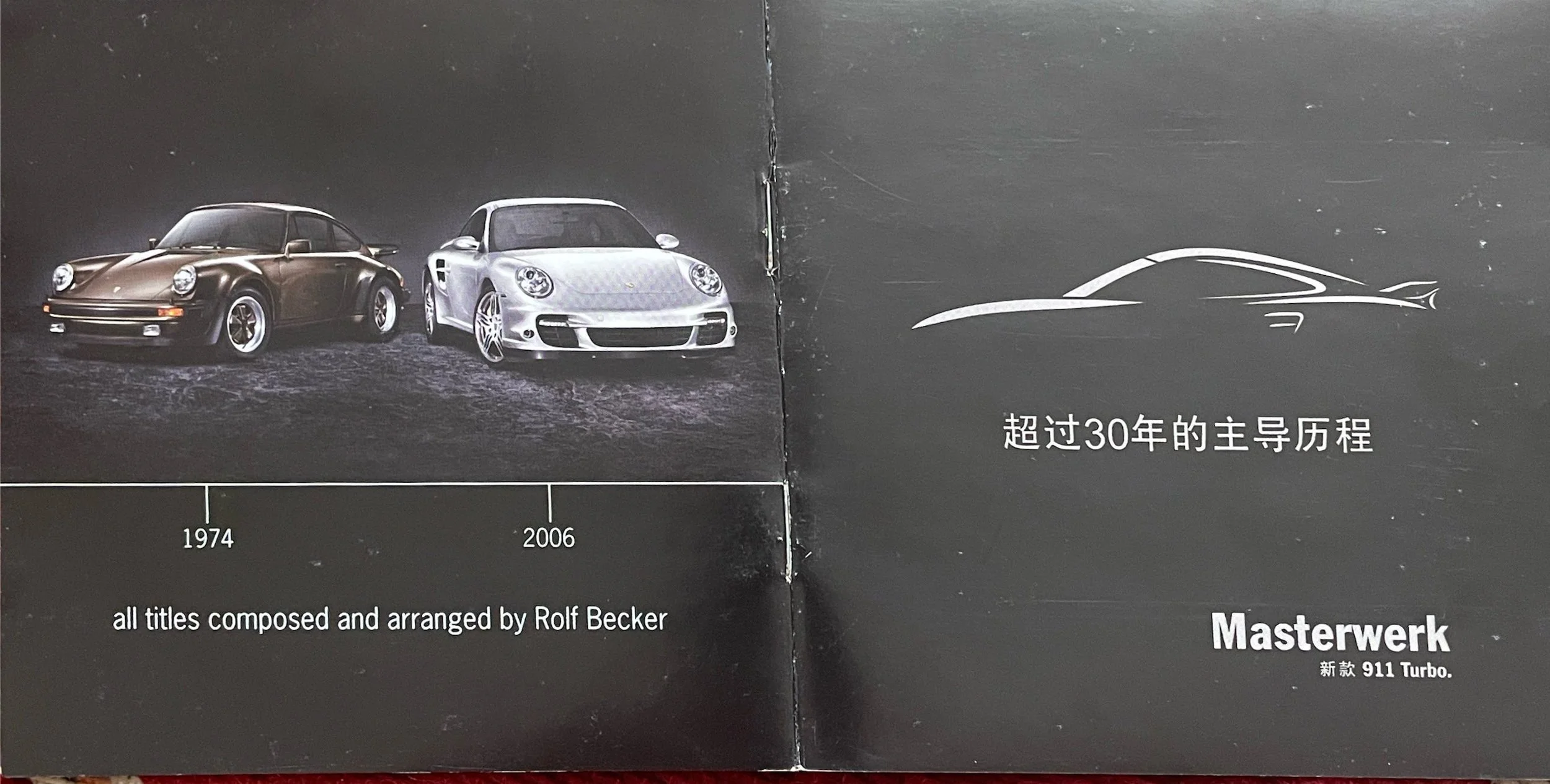
Original artwork from the 2006 Porsche 911 Turbo launch in Shanghai. I was commissioned to compose and arrange the music for this special CD production.
It was another opportunity to combine my work as a composer and arranger with the practical requirements of a high-profile international event.
A corporate presentation has its own musical demands. The music must reflect the character of the occasion, support the atmosphere, and contribute to the overall experience.
The Porsche project was an encouraging example of how my musical work in Shanghai was becoming increasingly diverse.
By then, I was moving regularly between very different musical environments: jazz clubs, concert stages, ballrooms, and corporate productions.
Yet they all had one important element in common.
The music had to be carefully prepared, professionally arranged, and convincingly performed.
The Chamber Balls — More Than Dance Music
Over the following years, my work with the international Chambers of Commerce continued to grow.
The German, European, and Swiss Chamber Balls generally required a broad repertoire of dance and party music.
For these events, I sometimes used names such as Rolf Becker & The Party Gang or Rolf Becker Big Band.
These names were deliberately different from the JZ All Star Big Band.
Although some musicians might participate in both ensembles, the musical concepts were not identical.
The JZ All Star Big Band was a jazz orchestra with a distinctive repertoire and artistic identity.
My event orchestras, on the other hand, had to be stylistically flexible.
A typical evening might include music from the 1970s, contemporary popular hits, Latin dance numbers, swing standards, and traditional ballroom repertoire.
And because I was an arranger, I could adapt the music to the particular instrumentation available.
That flexibility was especially important.
Rather than relying entirely on commercially available arrangements, I could create musical versions tailored to the musicians, the singers, and the requirements of a particular event.
In November 2007, I was invited to provide music for the tenth German Chamber Ball.
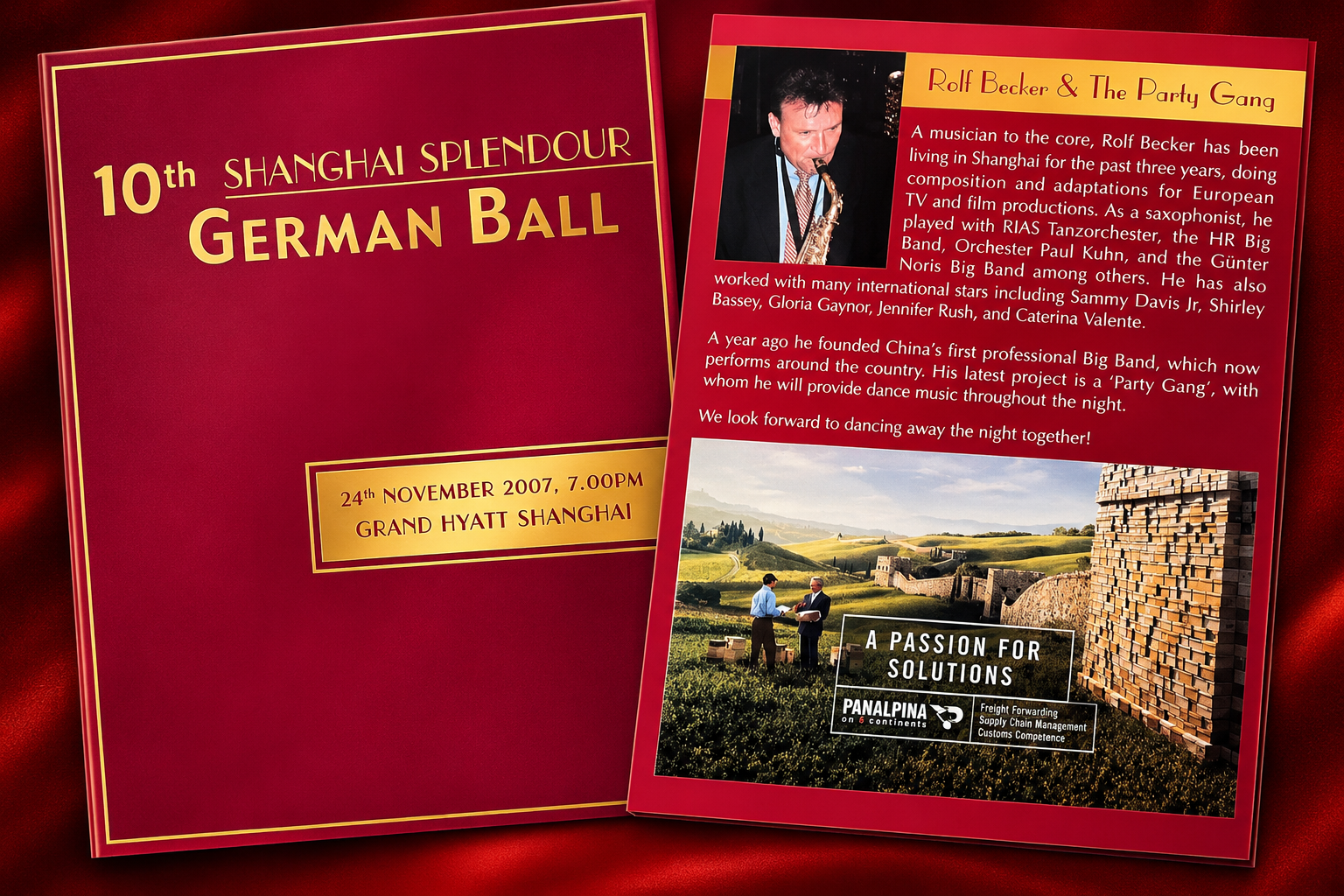
The 10th Shanghai Splendour German Ball, November 24, 2007, at the Grand Hyatt Shanghai. The original program introduced my orchestra, Rolf Becker & The Party Gang, providing dance music throughout the evening.
It was another significant engagement in what would become a long association with Shanghai's German business community.
These evenings were not simply concerts with an audience seated in front of the stage.
They were social occasions, and the orchestra was part of the entire experience.
A good dance orchestra has to understand its audience, recognize the atmosphere in the room, and respond musically.
Sometimes the most successful arrangement is not the most complicated one.
It is the one that makes people want to dance.
The American Chamber — When a Gala Became a Show
My collaborations with the American Chamber of Commerce in Shanghai developed in a somewhat different direction.
While the European and German Chamber Balls generally emphasized dancing and party entertainment, the American Chamber often preferred a more theatrical approach.
Its gala evenings were frequently built around a particular theme.
And this was where my work as a composer, arranger, and musical director became especially interesting.
I had the pleasure of collaborating with Brenda Foster, who headed the American Chamber in Shanghai for several years.
Brenda was a marvelous person to work with.
She understood the importance of creating a memorable evening, and I greatly enjoyed our collaborations.
Instead of simply providing a dance orchestra, I could develop musical programs that supported the chosen theme.
Over the years, these concepts included New York, Show Boat, Mardi Gras, A Sentimental Journey, and USO Club.
Each theme suggested a different musical world.
For an arranger, that opened the door to countless possibilities.
The music could evoke a particular period, location, or atmosphere. Familiar melodies could be presented in new orchestral settings, and singers or instrumental soloists could become part of the larger production.
It was a wonderful combination of entertainment and musical creativity.
2008 — A Sentimental Journey
One particularly memorable American Chamber Gala took place in 2008 under the theme A Sentimental Journey.
The title immediately suggests the great era of swing music and the American big bands.
It was a musical world I knew well and one that offered plenty of opportunities for imaginative arrangements.
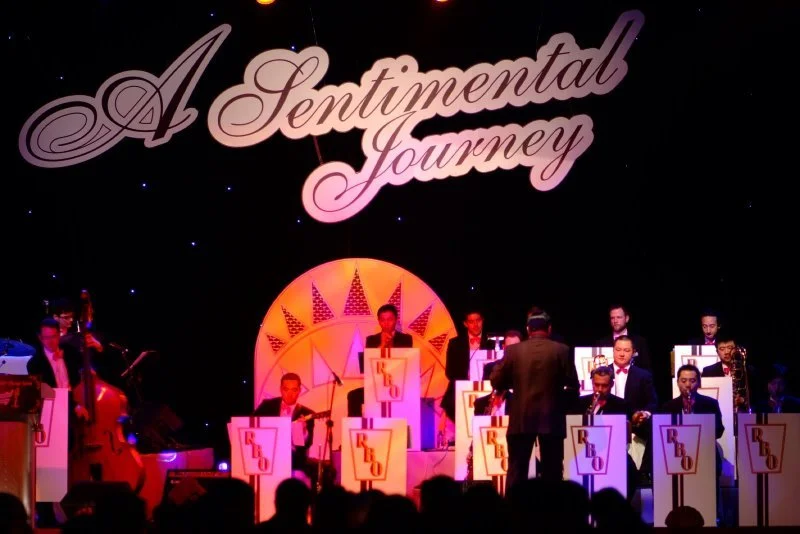
A surviving photograph from that evening shows the orchestra performing on stage.
I am standing in front of the musicians, conducting, although the camera captured me from behind.
The orchestra shield displays the letters RBO, an abbreviation for Rolf Becker Orchestra.
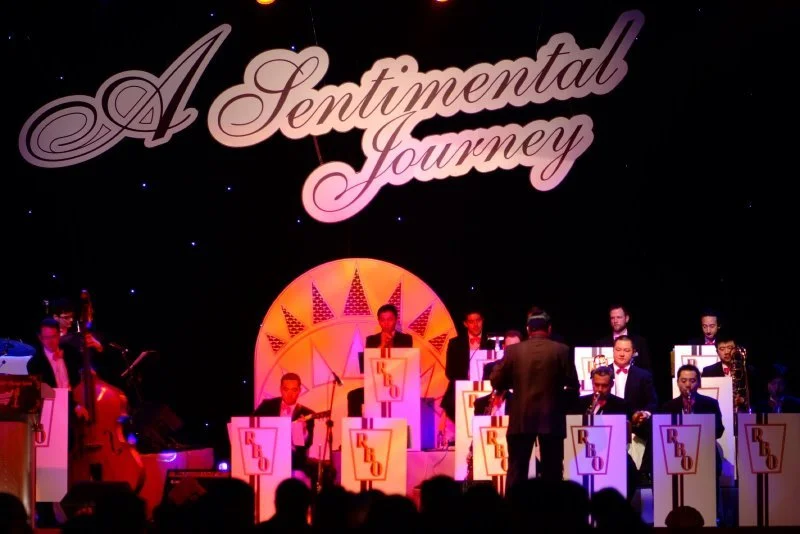
Conducting my Rolf Becker Orchestra at the 2008 American Chamber Gala in Shanghai, “A Sentimental Journey.” The RBO orchestra shields proudly displayed our musical identity.
It is a small but meaningful detail.
The photograph documents not only the performance itself but also the independent musical identity under which I presented my orchestra at these events.
Looking at it today, I remember how much I enjoyed bringing the sound of a live orchestra into these elaborate productions.
There is something special about a full ensemble performing in a ballroom filled with guests, where the music becomes part of a larger celebration.
And there was another important aspect.
These engagements created opportunities for professional musicians in Shanghai to perform in settings where their abilities could be appreciated by audiences who might not normally attend a jazz concert.
March 2009 — An Evening I Could Not Attend
Not every memory from those years is a happy one.
In March 2009, I was scheduled to provide the orchestra for another American Chamber Gala.
The arrangements had already been prepared, and the musicians had been selected.
But shortly before the event, while visiting my parents in Germany, I suffered a stroke.
Suddenly, everything changed.
I was unable to return to Shanghai for the performance.
My wife was confronted with an extremely difficult situation. Apart from the concerns about my health, there was also a professional commitment that needed to be fulfilled.
Somehow, she managed to organize a replacement orchestra.
She contacted Gregory Smith, a respected blues and jazz guitarist and a veteran of Shanghai's music scene, closely associated with the legendary Cotton Club, which sadly no longer exists.
Gregory agreed to take charge of the band.
My wife also managed to get the arrangements I had already written for the event, together with the intended musicians' list, into his hands.
Thanks to their efforts, the music could go ahead without me.
But what happened at the beginning of the gala touched me deeply.
Brenda Foster asked the guests to observe a minute of silence in my honor and to wish me a speedy recovery.
I was thousands of kilometers away, dealing with a completely unexpected medical crisis.
Knowing that people in Shanghai were thinking of me at that moment meant more than I can easily express.
It remains one of the most moving memories of my years working with the American Chamber.
Returning to the International Stage
My recovery required time, and for a while Berlin became our family's temporary home.
Nevertheless, my musical connections with Shanghai remained strong.
As I described in the previous chapter, I eventually resumed selected engagements in China while continuing to live in Germany.
Among the events from that period was the July 2010 topping-out ceremony associated with the German Pavilion at the Shanghai World Expo.
These engagements helped maintain my professional connections during a period when my personal circumstances had changed considerably.
When my family and I returned permanently to Shanghai in 2011, I was able to continue the musical activities that had become such an important part of my life there.
My work for the international business community remained one of those activities.
2013 — USO Club: Return to the Era of Big Band Music
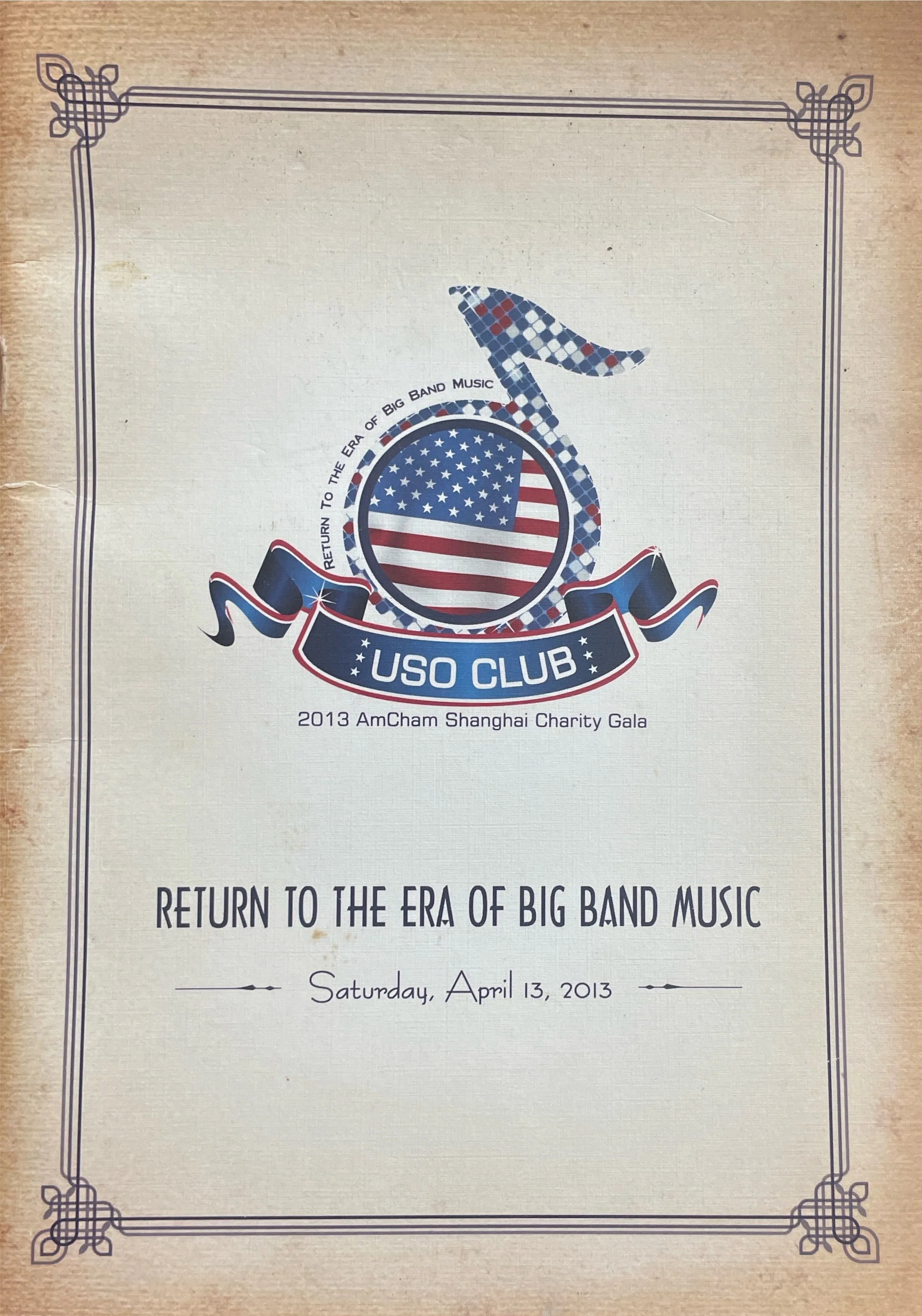
The original program for the American Chamber's “USO Club — Return to the Era of Big Band Music” gala, April 13, 2013. A memorable production featuring my orchestra and Canadian trumpeter Mike Herriott.
One of the most memorable productions came in 2013.
Brenda Foster had told me that this would be her final year as president of the American Chamber in Shanghai.
For this special occasion, she wanted a gala that would evoke the atmosphere of the great American big band era.
The theme was:
USO Club — Return to the Era of Big Band Music
For me, this was an especially attractive assignment.
The USO theme recalled the entertainment culture surrounding American service personnel during the Second World War, when big bands and popular singers played an important role in lifting spirits and bringing people together.
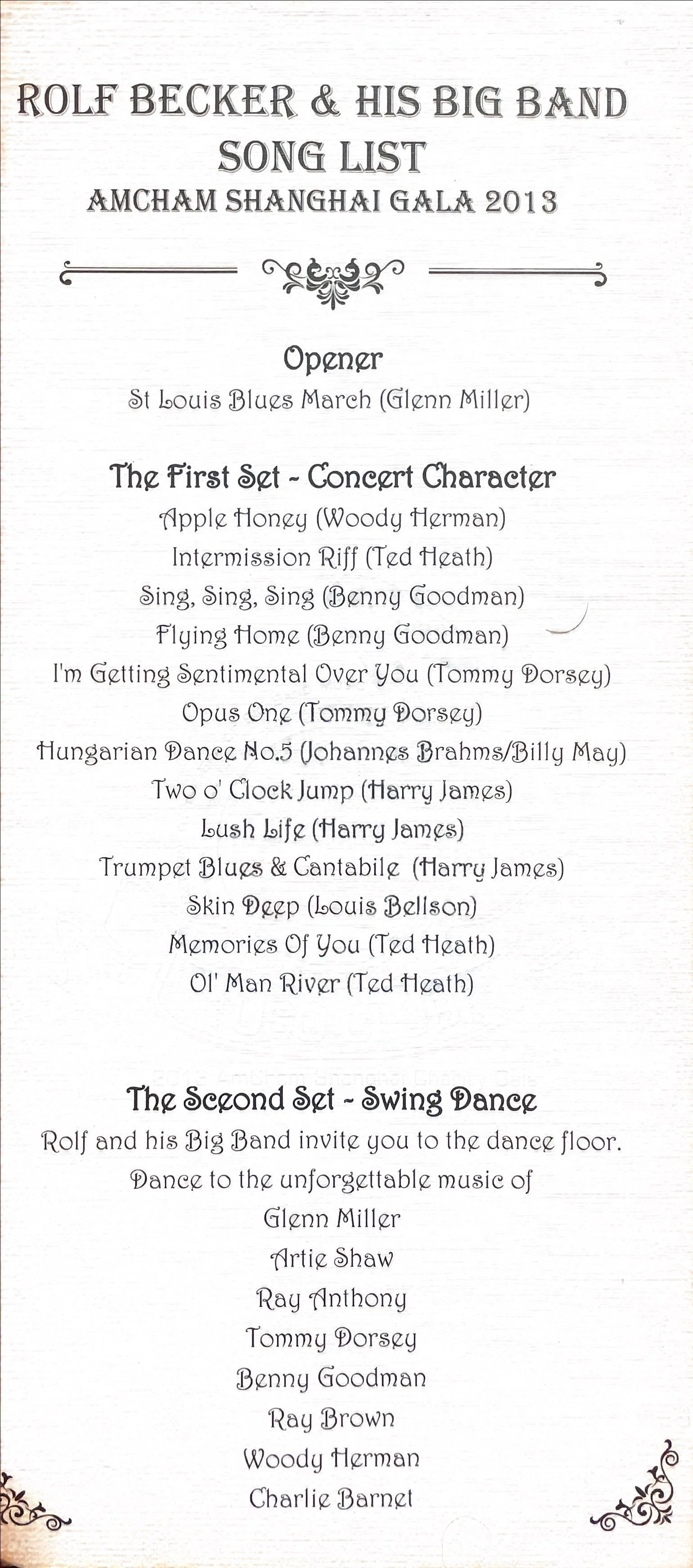
The original repertoire for my 2013 American Chamber Gala, celebrating the golden age of big band music. Our opening concert featured swing classics associated with Glenn Miller, Benny Goodman, Tommy Dorsey, Harry James, Woody Herman and Ted Heath, followed by an evening of unforgettable swing dance music. Besides arranging and conducting the orchestra, I also performed all the clarinet solos myself.
Musically, it offered an opportunity to celebrate the energy, elegance, and excitement of that era.
But I also wanted the orchestra to deliver the kind of powerful brass sound that makes a big band truly thrilling.
For this production, I invited the outstanding Canadian trumpeter Mike Herriott.
Mike was an exceptional musician with the experience and technical ability required for demanding lead trumpet parts.
His professional credits included associations with artists and orchestras connected to Maynard Ferguson, Rob McConnell, Doc Severinsen, Arturo Sandoval, and Michael Bublé.
For an arranger, having a musician of that caliber available is a wonderful opportunity.
It allows you to write with greater confidence, knowing that even the most demanding passages can be performed convincingly.
Mike's contribution helped give the orchestra the brilliant trumpet sound I had imagined for the production.
But Mike wasn't the only one stepping into the spotlight that evening. Besides arranging and conducting the orchestra, I also picked up my clarinet to perform all the clarinet solos myself. It was a wonderful opportunity to return to my roots as an instrumentalist and enjoy the music from within the band. With Mike's brilliant trumpet playing and my clarinet solos, we could bring some of the distinctive sounds of the great swing orchestras back to life. For me, it was one of those special evenings when everything I loved about being a musician came together — arranging, conducting, and performing.
The 2013 gala was particularly meaningful because it also marked the conclusion of Brenda's years leading the American Chamber.
After so many enjoyable collaborations, it felt like a fitting musical celebration of our work together.
A Night with Frank Sinatra — The Final American Chamber Production
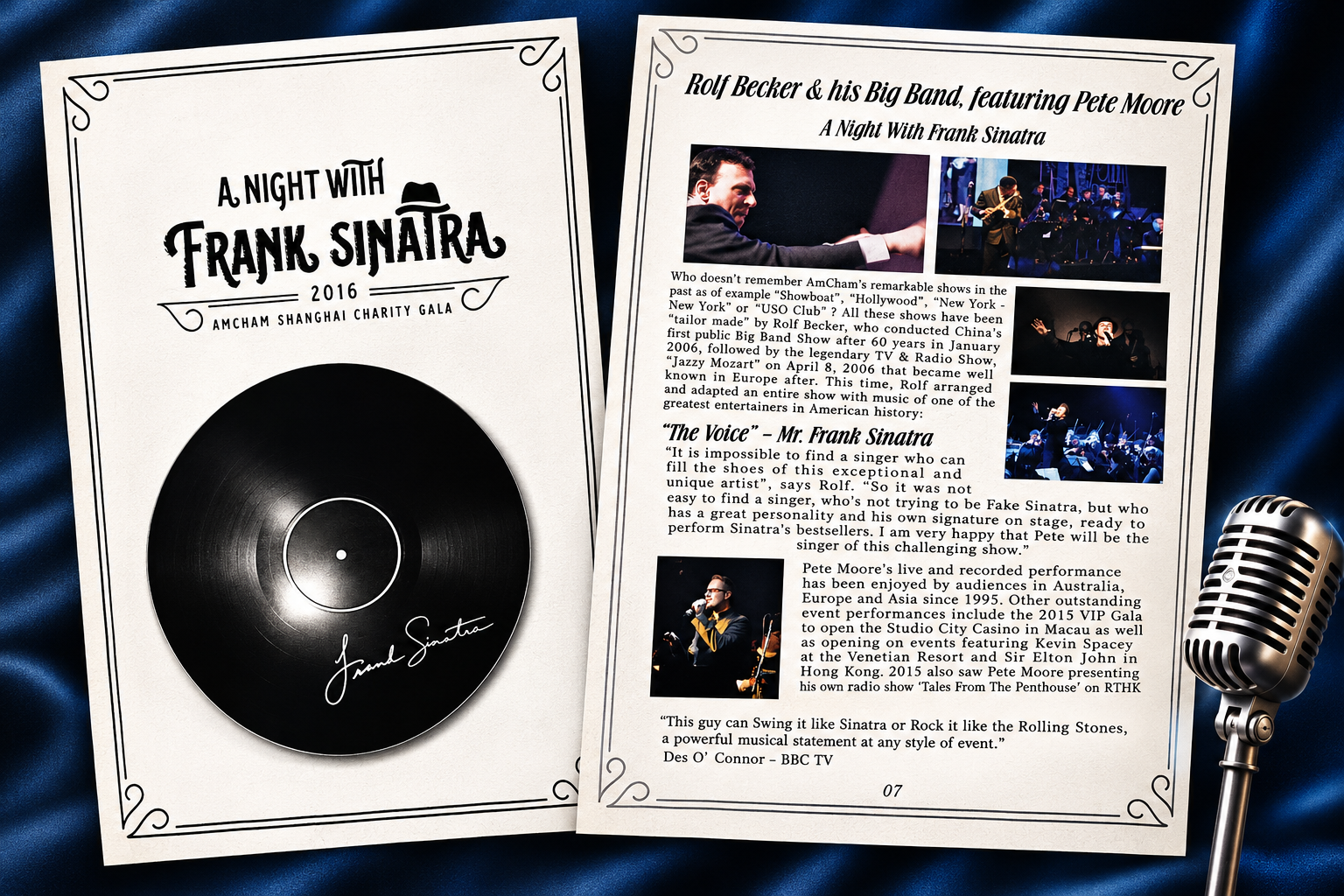
The 2016 AmCham Shanghai Charity Gala, “A Night with Frank Sinatra,” featuring Australian vocalist Pete Moore with my big band. The original program documents our tribute to Sinatra's musical legacy, with specially prepared orchestral arrangements and Pete's distinctive vocal interpretations.
My involvement with the American Chamber's gala productions continued beyond Brenda's presidency.
One of the final projects was A Night with Frank Sinatra, in 2016.
Sinatra's music occupies a special place in the history of popular singing and big band arranging.
His recordings with orchestras led by figures such as Nelson Riddle, Billy May, and Count Basie helped establish a standard of musical sophistication that remains influential today.
For me, Sinatra's repertoire represents a wonderful example of the relationship between a great singer and a great arrangement.
The orchestra does not merely accompany the vocalist.
It contributes to the interpretation, creates dramatic contrasts, and gives the music its distinctive character.
For this production, I invited Australian vocalist Pete Moore to perform Sinatra's legendary songs with my big band. Following in the footsteps of “The Voice” was certainly no small challenge. As I explained in the original gala program, I wasn't looking for someone simply trying to imitate Frank Sinatra. I wanted a singer with his own personality, musical character, and unmistakable stage presence. Pete brought exactly that experience to the production. Having performed internationally for many years, he was equally at home with swing, jazz, and popular music. Together, we set out to celebrate Sinatra's extraordinary musical legacy while allowing Pete to bring his own interpretation to these timeless songs.
That was precisely the kind of musical relationship I had always enjoyed exploring.
Looking back, the Sinatra production also marked the closing of a long chapter in my work for the American Chamber.
What had begun years earlier with themed gala evenings had developed into a series of productions that allowed me to bring together many aspects of my musical experience.
More Than Twenty Years of Musical Memories
My work for Shanghai's international community was never limited to a single organization.
Alongside the Chamber Balls and American Chamber productions, I continued providing music for German Consulate events over many years, with engagements extending into 2018.
Some occasions called for a large orchestra. Others were better suited to a smaller ensemble.
The repertoire could range from traditional ballroom music to jazz, popular songs, and specially arranged concert pieces.
This variety kept the work interesting.
It also reminded me that being a professional musician involves more than specializing in one musical style.
A good arranger needs to understand how music functions in different situations.
A concert audience listens differently from guests at a gala dinner.
A dance floor requires a different musical energy from a theater.
And a corporate celebration may need an entirely different atmosphere from a jazz club.
For me, the challenge was always to find the right musical language for each occasion without compromising the quality of the performance.
Looking Back — One City, Many Musical Worlds
When I think about those years, I realize how fortunate I was to experience so many different aspects of Shanghai's musical life.
I could spend one evening conducting a jazz orchestra, another preparing music for an international gala, and the following day working on arrangements or compositions in my studio.
These activities were not competing interests.
They were different expressions of the same passion.
I loved writing music, working with outstanding musicians, and hearing my arrangements come alive in performance.
The Chamber Balls and gala productions also introduced me to people outside the jazz community, created lasting professional relationships, and provided many wonderful memories.
Some of those memories survive in photographs, newspaper articles, programs, and brochures.
Others exist only in my mind.
Together, they tell another part of the story of my musical years in Shanghai.
And while these grand international evenings were taking place, another story was continuing in parallel.
My long and sometimes complicated relationship with JZ Club had not yet reached its conclusion.
That final chapter would bring me back to a familiar stage on Fuxing Road — the very place where the JZ All Star Big Band had begun ten years earlier.
But that story deserves a chapter of its own.
To be continued…
Chapter 5 — The End of an Era, the Beginning of Another
Leaving the JZ All Star Big Band marked the end of an era—and the beginning of another. In Chapter 5 of my Shanghai Big Band History, I reflect on recovery in Berlin, my return to Shanghai, and the creation of my Small Big Band: a new musical direction shaped by remarkable musicians and memorable performances between 2009 and 2014.
From the JZ All Star Big Band to a New Orchestral Vision, 2009–2014
When Artistic Independence Met Club Ownership
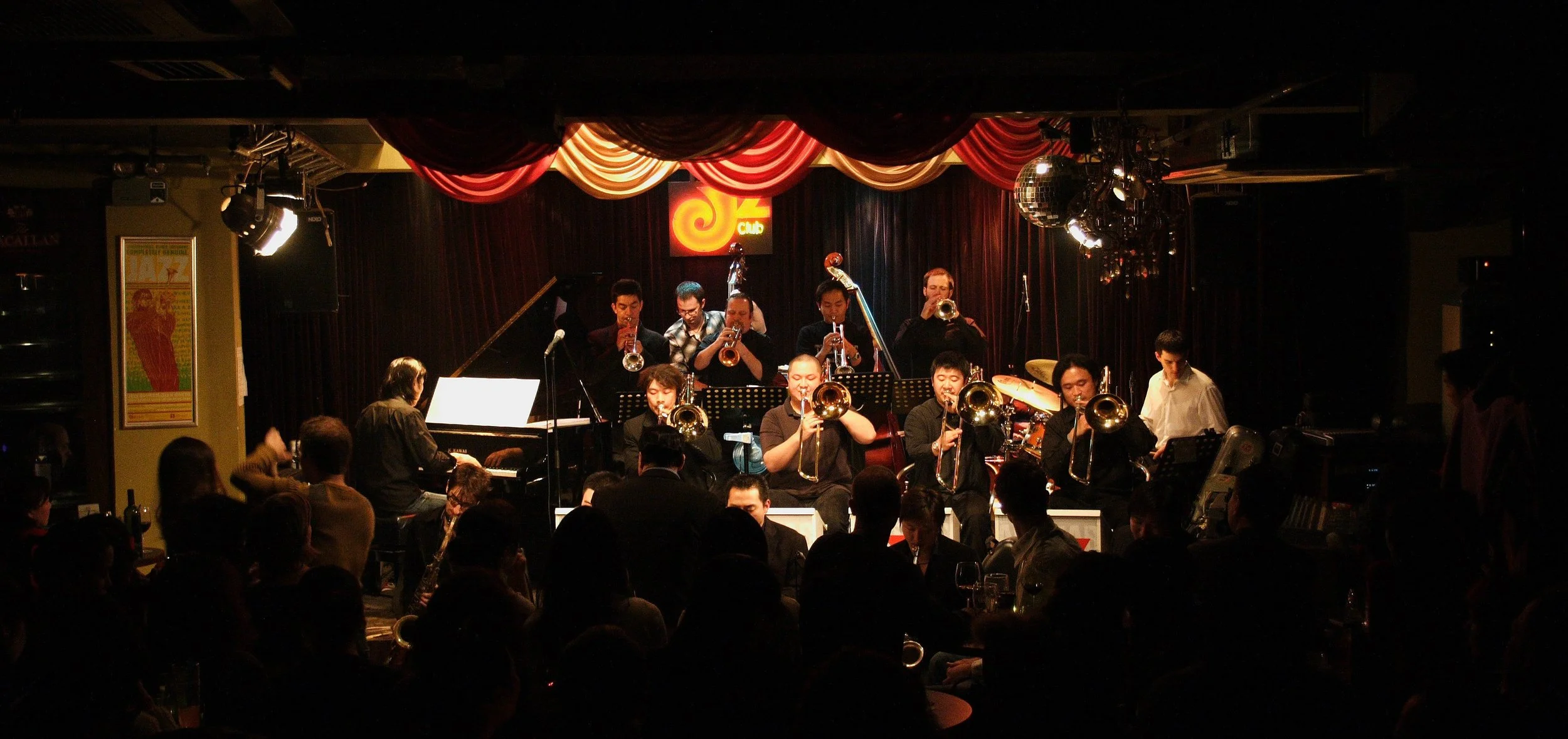
The original JZ All Star Big Band during my years as its conductor and musical director (2006–2009). What began as an ambitious musical project had developed into a professional jazz orchestra with its own repertoire and artistic identity.
By early 2009, the JZ All Star Big Band had become much more than a regular attraction at the JZ Club. What had started in August 2006 as an ambitious musical project had developed into a professional ensemble with its own repertoire, identity, and opportunities beyond the club's small stage.
Over the years, I had written the band's arrangements, organized rehearsals, and worked to develop a distinctive orchestral sound. I had also managed to secure outside engagements, which made it possible to pay the musicians considerably more generously than our regular club performances allowed.
However, this growing independence eventually became a point of conflict with Ren, the owner of the JZ Club.
From my perspective, there was a fundamental difference between providing a venue for an orchestra and owning the orchestra itself. The musical arrangements were my work and remained my property. None of them had been commissioned or purchased by the club.
Ren apparently saw things differently.
Although he never gave me a clear explanation for his decision, I had the impression that he wanted greater control over the ensemble, particularly as our activities expanded beyond the JZ Club.
Ultimately, he decided to replace me as conductor.
As the club owner, Ren held the stronger position. Without access to our regular performance venue, there was little I could do to continue the ensemble in its established form.
My final performance with the band was, as far as I remember, in early February 2009. There was no farewell concert, no formal conclusion to nearly three years of musical collaboration.
An Unexpected Turning Point
Shortly afterward, while visiting my parents in Germany, I suffered a stroke.
Suddenly, my professional concerns became secondary to something far more important: my health and my family.
It became clear that I needed to remain in Germany for medical treatment and recovery. My wife and our young daughter, who had been born in Shanghai on December 11, 2007, joined me, and we established a temporary home in Berlin.
Fortunately, my wife secured a position as a high-school science teacher at a leading international school in the city. This provided our family with much-needed stability during a difficult period.
Although my recovery required time and patience, I did not stop working as a musician.
I continued composing and arranging, and I even traveled back to Shanghai for selected professional engagements. In fact, by late October 2009, only about seven months after my stroke, I was already back on the podium, conducting the Shanghai Light Music Orchestra.
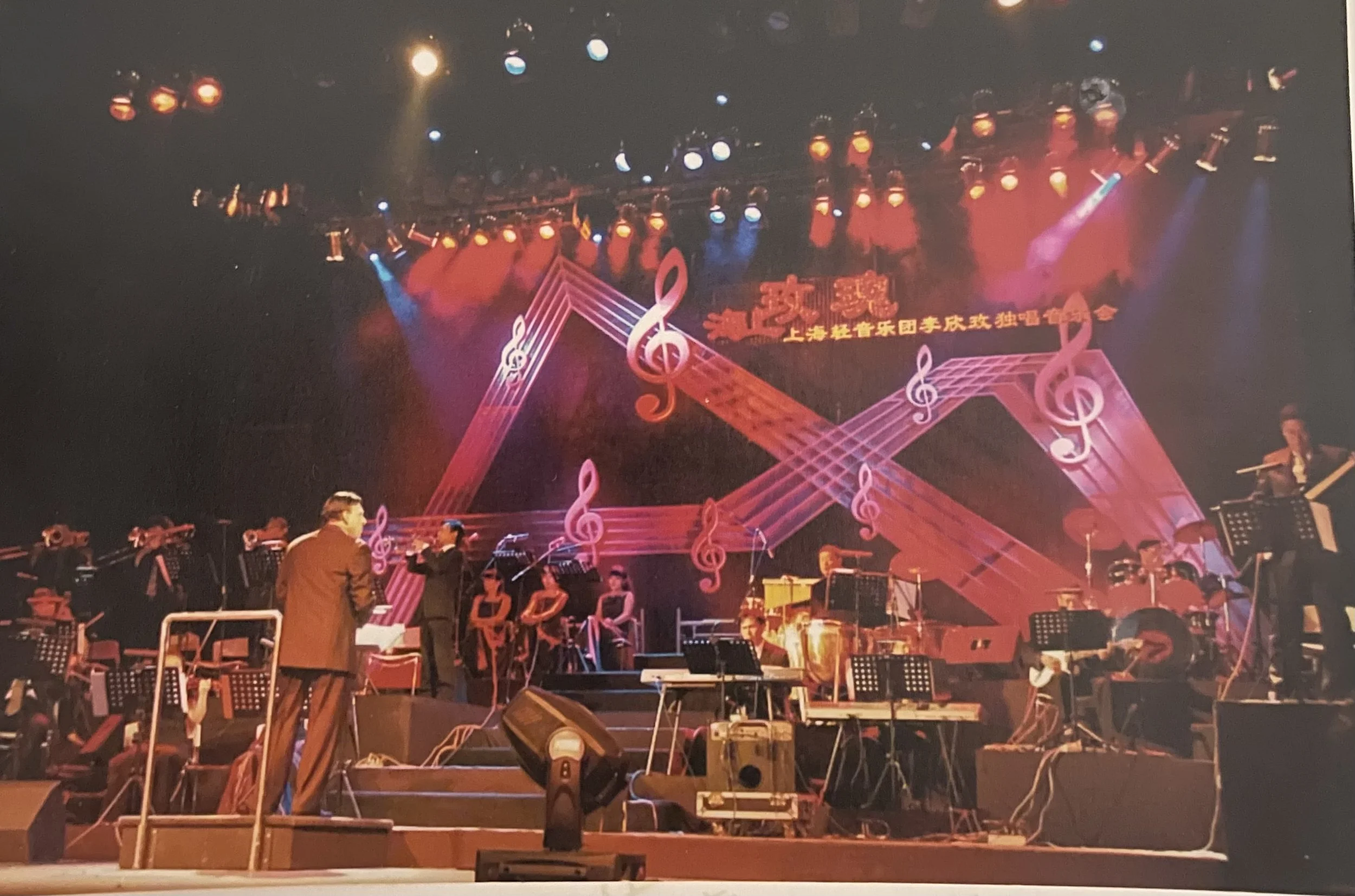
Back on the podium — Shanghai, October 2009.
Conducting the Shanghai Light Music Orchestra just seven months after suffering a stroke in Germany. For this collaboration, I created new pop and jazz arrangements of traditional Chinese melodies.
This engagement developed into a collaboration involving four productions, including recordings commissioned for Shanghai Media Group (SMG). Unfortunately, I no longer have copies of those recordings, but the surviving photographs remain a valuable reminder of this period.
My connection with Shanghai and its musical community had never entirely disappeared.
While Berlin remained our temporary home, I continued traveling between Germany and China for selected performances and productions.
After more than two years in Germany, my family and I finally returned to Shanghai in July 2011.
A new musical chapter was about to begin.
What Became of the JZ All Star Big Band?
Meanwhile, the JZ All Star Big Band had continued under its original name with a new musical director.
However, several important musicians subsequently departed, including tenor saxophonist Alec Haavik and trumpeter Theodore Croker.
Within approximately a year, that version of the ensemble had come to an end.
The JZ organization subsequently engaged Swedish composer and arranger Mats Holmquist.
Mats was an experienced musician who certainly understood the demands of writing for and directing a jazz orchestra. From my perspective, the difficulties he encountered had less to do with his musical abilities than with the organizational support required to sustain such an ensemble.
Towards the end of his engagement, before he and his family left Shanghai in late 2011, I was approached about taking over the band again.
After considerable thought, I decided against returning to the old arrangement.
By then, however, I was already exploring another musical direction.
A New Orchestral Vision — The Small Big Band
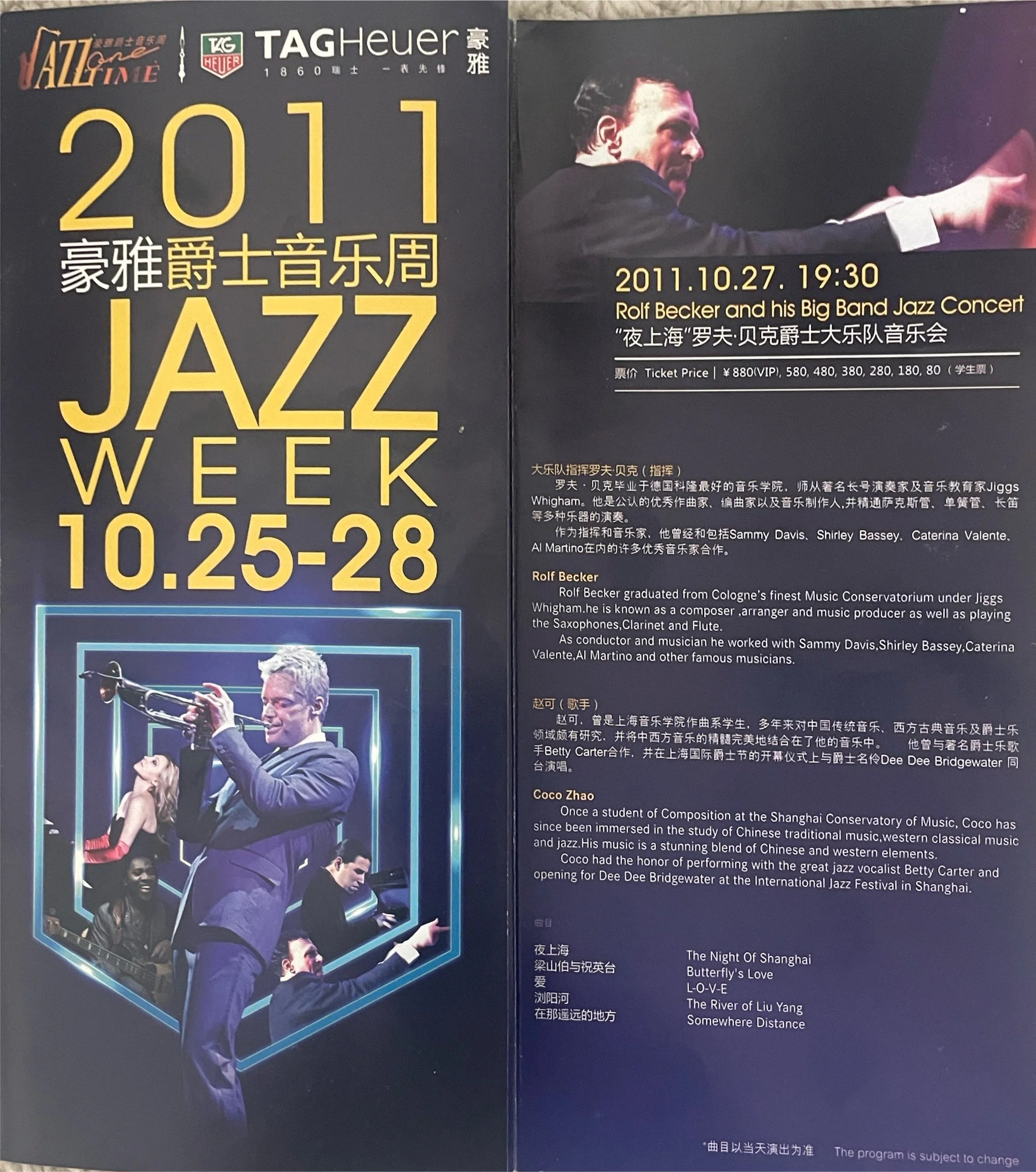
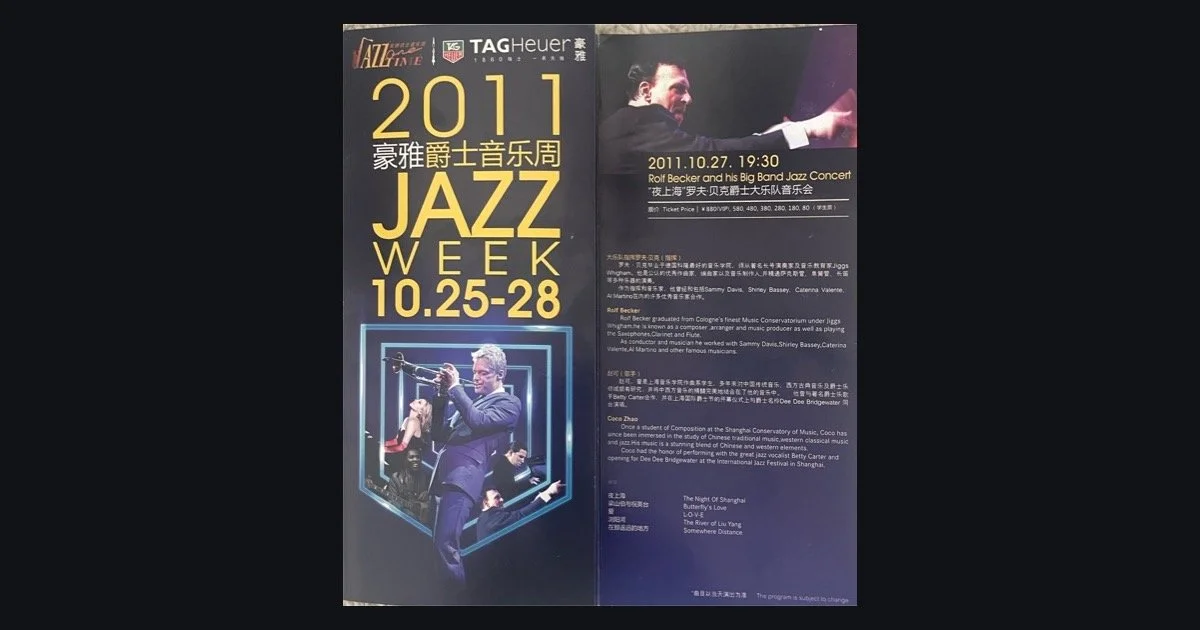
The official program of the 2011 TAG Heuer Jazz Festival in Shanghai. My concert on October 27 marked the introduction of my new Small Big Band concept, independently of JZ.
On October 27, 2011, just three months after our permanent return to Shanghai, I presented a concert at the TAG Heuer Jazz Festival.
This concert was an independent engagement, entirely unrelated to JZ. It gave me the opportunity to introduce my new orchestral concept on its own merits, before the Small Big Band began performing at JZ in early 2012.
The official festival program announced the performance as Rolf Becker and his Big Band Jazz Concert.
For me, this concert marked the beginning of a new orchestral concept: the Small Big Band.
Rather than assembling a conventional big band with five saxophones, four trumpets, four trombones, and rhythm section, I wanted to experiment with a smaller but equally expressive ensemble.
My instrumentation consisted of:
Three saxophones: alto, tenor, and baritone
Three trumpets
Three trombones
Piano, guitar, bass, and drums
Thirteen instrumentalists instead of the conventional seventeen.
The challenge was to preserve the power, harmonic richness, and flexibility of a traditional big band while taking advantage of the distinctive sound of this smaller instrumentation.
For an arranger, this opened up fascinating possibilities.
I could not simply remove instrumental parts from conventional big band arrangements. The music had to be conceived specifically for the ensemble, with careful attention to voicings, instrumental balance, and the individual musical personalities of the players.
For the 2011 TAG Heuer Jazz Week concert, I invited Coco Zhao to join us for a couple of traditional Chinese songs. For one of them, I created an arrangement that began in 5/4 time before moving into a fast samba—a particularly enjoyable meeting of Chinese melody and jazz rhythm. Unfortunately, I have no recordings of this concert, so the printed program remains a treasured reminder of that performance.
Back at JZ — But with a Different Band
In early 2012, the Small Big Band began performing at JZ.
It was an interesting return to familiar territory.
Ren remained the club's owner, and despite our earlier disagreements, we found ourselves working together again.
Our professional relationship would continue to have its ups and downs over the following years. Nevertheless, I appreciated the opportunity to present my music with a new ensemble whose instrumentation, arrangements, and artistic direction I had developed myself.
Most importantly, I wanted to work with some of the finest musicians in Shanghai.
Among them were the gifted pianist Oleg Roschin, the outstanding drummer Charles Foldesh, and the remarkable lead trombonist Tom Smith, whose impressive career included collaborations with jazz legend Clark Terry and the renowned vocal group The Manhattan Transfer.
Another particular highlight was the occasional participation of the exceptional saxophonist Andres Boiarsky. Having served as musical director of the Lionel Hampton Big Band and performed with Slide Hampton’s Dizzy Gillespie Alumni All-Stars, alongside numerous legendary figures in jazz history, Andres brought a wealth of experience and musical brilliance to our ensemble.
It was both a privilege and a personal pleasure to welcome him whenever his schedule allowed. His extraordinary solos added yet another dimension to the band's sound, making those performances especially memorable.
I was also delighted to welcome musicians who had already participated in my earliest big band activities in Shanghai, including alto saxophonist Willson Chen and baritone saxophonist Charles Chang.
Their musical abilities, loyalty, and friendship meant a great deal to me.
Having them in the new ensemble created a wonderful sense of continuity with the early Club Shanghai Big Band.
Teresa Lee — Writing for a Voice
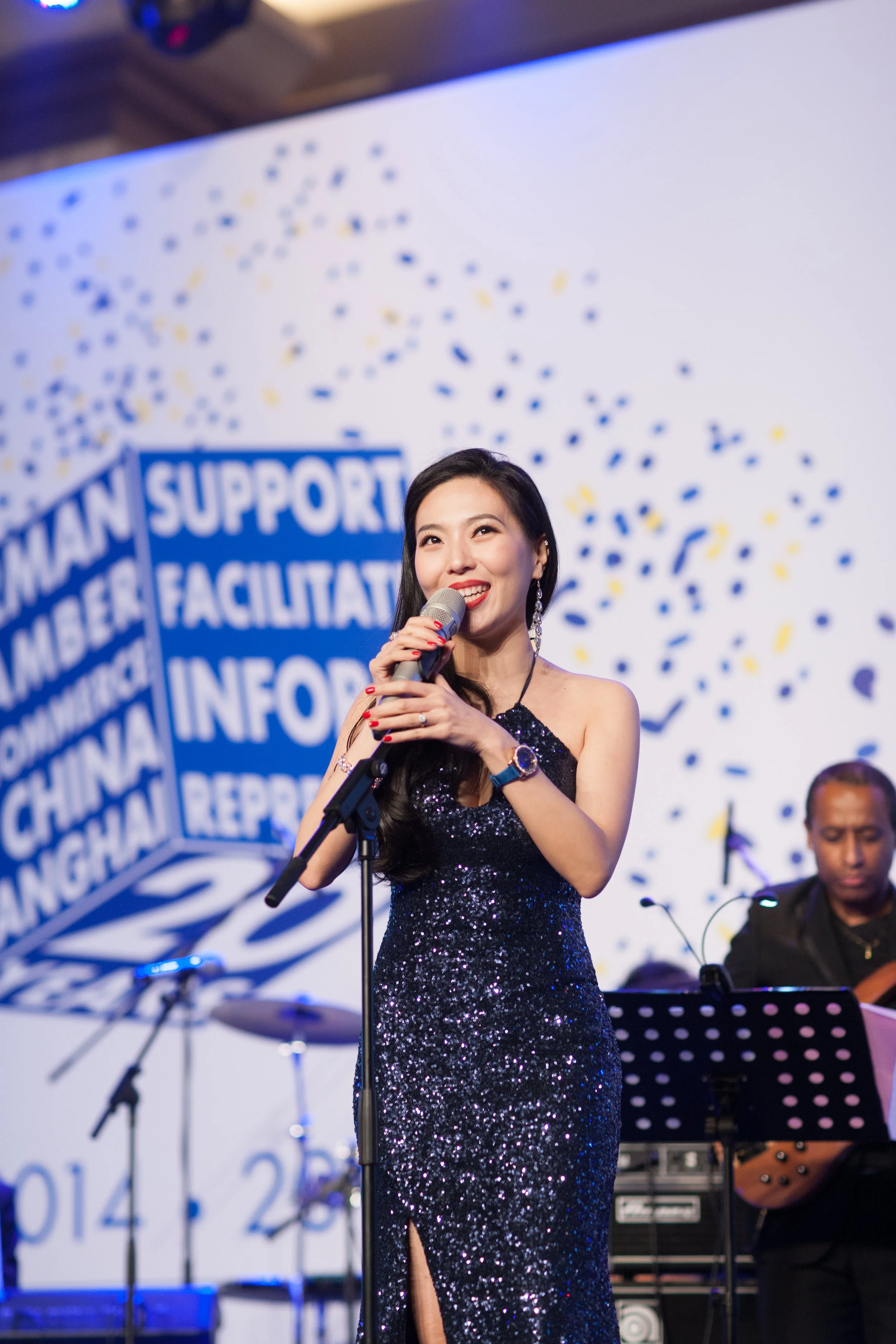
Teresa Lee performing with my Small Big Band at the German Chamber of Commerce's 20th anniversary celebration in Shanghai, 2014. I particularly enjoyed creating arrangements tailored to her voice and musical personality.
Our vocalist was the lovely Teresa Lee, who was married to pianist Oleg Roschin.
Teresa brought another dimension to the orchestra.
I particularly enjoyed writing arrangements tailored to her voice, taking care to match her vocal range, musical personality, and expressive qualities.
For me, arranging for a singer has always been about more than providing orchestral accompaniment.
The arrangement should support the interpretation, complement the singer's natural strengths, and create a musical conversation between the vocalist and the orchestra.
Working with Teresa gave me another opportunity to explore this approach.
Twenty Years of the German Chamber — 2014
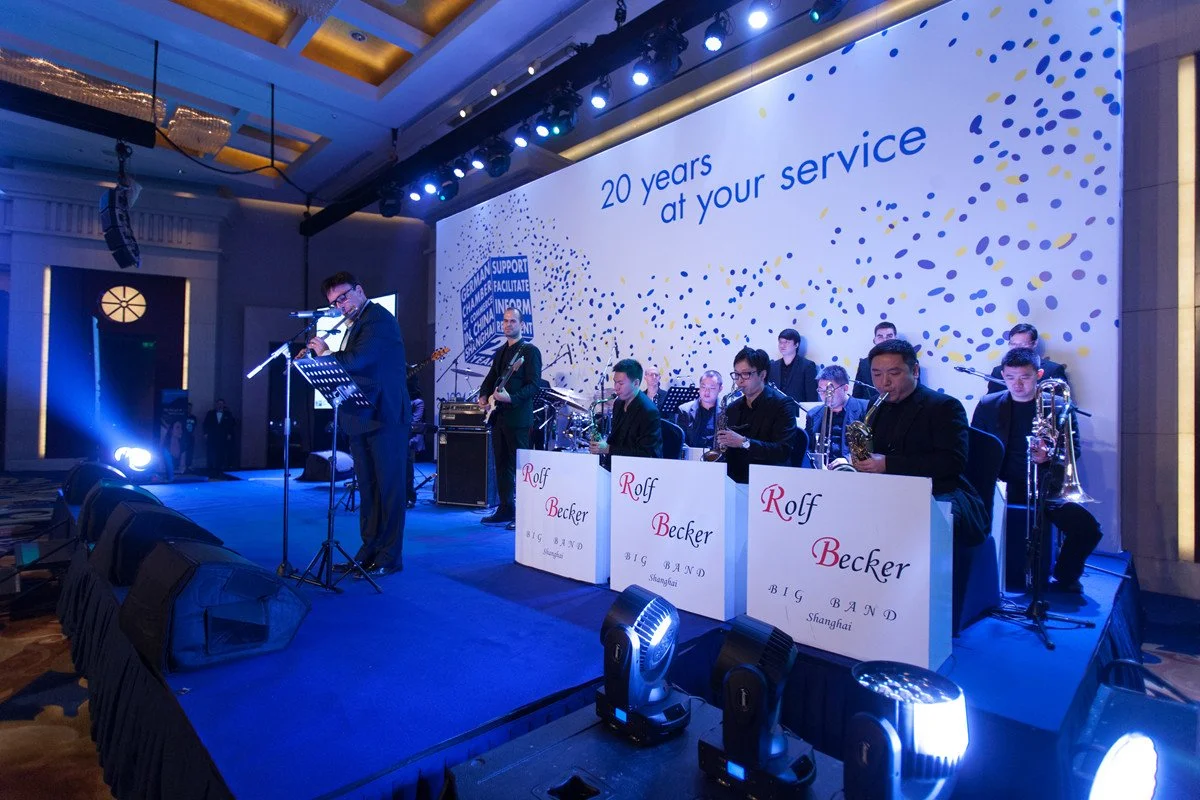
Performing on flute with my Small Big Band at the German Chamber of Commerce's 20th anniversary celebration in Shanghai, 2014. The ensemble performed under the name Rolf Becker Big Band Shanghai.
One memorable engagement took place in 2014, when the Small Big Band performed at the celebration of the 20th anniversary of the German Chamber of Commerce in Shanghai.
It was particularly rewarding to present the ensemble in a setting that brought together two important aspects of my musical life in China: my work with jazz orchestras and my long-standing involvement in major international business and cultural events.
Several photographs from that evening have survived, showing the band performing under the name Rolf Becker Big Band Shanghai, with Teresa as our featured vocalist.
They also document the remarkable musicians with whom I had the pleasure of sharing the stage.
Why I Continued Performing
There is something important I would like to explain.
Throughout my years in Shanghai, I never depended financially on my performances with the various orchestras.
My principal professional income came—and continues to come—from composing and arranging music for publishers, as well as working on television and film productions.
Performing with a big band was therefore never primarily about earning my living.
Of course, I always believed that the musicians deserved to be paid fairly for their work, and I made every effort to secure engagements that allowed me to compensate them appropriately.
But my personal motivation was different.
I simply loved making music with outstanding players and singers.
There is something deeply satisfying about hearing an arrangement that began as an idea in my imagination come alive through the musicians on stage.
And there is nothing quite like the feeling of receiving applause from an appreciative audience, knowing that both my work as a composer and arranger and the collective performance of the orchestra have reached the listeners.
Those moments were what made the effort worthwhile.
One Chapter Ends — Another Continues
Looking back, my departure from the original JZ All Star Big Band was certainly disappointing.
But it also encouraged me to explore new musical possibilities.
The Small Big Band allowed me to develop a different orchestral sound, reconnect with musicians I admired, and continue doing what I enjoyed most: writing music and bringing it to life on stage.
My relationship with JZ, however, was far from over.
What had begun in 2006 would develop into a long, sometimes complicated, on-and-off professional relationship with the club and particularly with its owner, Ren.
But that is another story.
Stay tuned if you would like to discover how long that relationship lasted—and what happened along the way.
Chapter 4 —The Birth of the JZ All Star Big Band
Following the success of Jazzy Mozart in April 2006, the Shanghai Jazz Orchestra came to an unexpected end. But a meeting with guitarist Lawrence Ku opened the door to a new beginning. In this personal account, Rolf Becker recalls how the JZ All Star Big Band was founded, how it received its name, and how Saturday nights at JZ Club became a celebrated part of Shanghai's jazz scene.
How the Shanghai Jazz Orchestra came to an end — and a new chapter began in August 2006
The End of a Promising Orchestra
Following the success of our Jazzy Mozart concert at Shanghai Concert Hall on April 9, 2006, I had every reason to believe that the Shanghai Jazz Orchestra was moving toward a promising future.
We had accomplished something special. Bringing together jazz musicians, classical players, and different musical traditions had required considerable preparation, arrangements, rehearsals, and, above all, the commitment of everyone involved.
The concert had been a success, and I was already thinking about how we could build upon that experience.
Unfortunately, things developed differently.
Shortly after the concert, the manager of the Shanghai Jazz Orchestra visited my wife and me at our home, accompanied by his wife and brother.
He was enthusiastic about the concert.
“The Big Band performance was a huge success,” he told me, “and you, as its conductor, are famous now.”
That was certainly flattering, but I was more interested in what would happen next.
He wanted me to start preparing a new concert program for another radio and television production. It sounded like an exciting opportunity — until we discussed the financial arrangements.
Once again, there was no reasonable payment available for the musicians or myself.
I had already invested an enormous amount of time and energy in preparing the orchestra, writing arrangements, rehearsing, and developing its musical identity. I was willing to continue that work, but not under conditions that failed to recognize the musicians' professional contributions.
When I contacted the players, their reaction was clear. They were no longer willing to continue under the proposed financial conditions.
Neither was I.
And so, despite its considerable potential, the Shanghai Jazz Orchestra came to an end.
I was deeply disappointed.
We had made real musical progress, and I believed that with regular rehearsals and further performances, the orchestra could have developed into an outstanding ensemble.
But without a sustainable foundation, even the most promising musical project eventually reaches its limits.
At that moment, I had no particular desire to start all over again.
An Unexpected Proposal
Fortunately, someone else had a different idea.
Lawrence Ku, the guitarist I had previously invited as a guest soloist for our Shanghai Jazz Orchestra concerts, contacted me and asked whether we could meet.
Lawrence had been closely involved in Shanghai's jazz scene, and he knew many of the musicians working in the city.
During our meeting, he suggested forming another Big Band.
This time, however, the orchestra would bring together both Chinese and international musicians living and working in Shanghai.
I wasn't immediately convinced.
After everything that had happened with the Shanghai Jazz Orchestra, I was reluctant to invest another enormous amount of work in a project that might eventually face the same problems.
I explained my concerns to Lawrence.
First, a good Big Band cannot develop simply by gathering seventeen musicians for an occasional performance. It needs regular rehearsals, a consistent repertoire, and a clear musical direction.
Second, the players must have opportunities to perform. Rehearsals alone are not enough. An orchestra develops through the experience of playing together in front of an audience.
And finally, there was the question of payment.
I wanted the musicians — and myself — to receive reasonable compensation for their professional work.
Lawrence listened carefully.
Then he told me something that changed the entire conversation.
He had already spoken with the founder and owner of a jazz club called JZ. The club was interested in offering the new Big Band a regular Saturday-night engagement.
That was a very different proposition.
For the first time, we were discussing an orchestra with a potential home, a regular performance schedule, and the opportunity to develop through continuous work.
I began to reconsider.
Who Gave the JZ Big Band Its Name?
Toward the end of our conversation, Lawrence asked me a question that would become an important part of the band's history.
“It's great that you're willing to start this Big Band. How do you want to call it? The Rolf Becker Big Band?”
I thought about it for a moment.
Of course, having an orchestra named after its conductor is not unusual in jazz. But I felt that this new ensemble should represent something broader.
We wanted to bring together some of the finest musicians working in Shanghai, regardless of nationality. And if JZ Club was going to become our regular home, why not acknowledge that relationship in the band's name?
I replied:
“Since JZ Club will be the home of this Big Band, why don't we call it the JZ All Star Big Band? After all, we'll have some of the most talented players in town.”
And that was how the name came about.
It wasn't the result of a marketing campaign or a decision made after the orchestra became successful.
It was simply an idea that emerged during my conversation with Lawrence Ku.
The name JZ All Star Big Band was used from our very first performance in August 2006.
A New Home on Fuxing Road
Following our conversation, Lawrence arranged a meeting with Ren — better known among Shanghai's jazz musicians as Lao Ren — the founder of JZ Club.
We discussed the practical arrangements and agreed that the Big Band would perform regularly on Saturday nights.
Our starting time was rather unusual: 11:30 p.m.
There was, however, a very practical reason.
Many of the jazz musicians already had earlier engagements on Saturday evenings. Some were playing in hotels, restaurants, or other venues around Shanghai.
The classical musicians who joined us often had orchestral concerts that finished around 10 p.m.
Starting at 11:30 gave everyone enough time to finish their earlier commitments and make their way to JZ Club.
It wasn't necessarily the most comfortable schedule, but it worked.
And most importantly, we now had something the Shanghai Jazz Orchestra had never been able to establish: a regular performance opportunity.
Building the Band, One Rehearsal at a Time
We began rehearsing every Tuesday at 1 p.m.
From the beginning, I wanted the orchestra to develop its own musical identity.
I brought along some original Big Band charts, including arrangements from the Count Basie Orchestra's repertoire. These provided valuable reference points for ensemble playing, articulation, phrasing, dynamics, and the rhythmic precision that makes a Big Band swing.
But much of our repertoire consisted of arrangements I wrote specifically for the musicians in our new ensemble.
That was an important part of my approach.
Rather than expecting the orchestra to master technically demanding arrangements immediately, I wanted to build its capabilities gradually.
I considered the strengths of individual players, the balance between sections, and the challenges we needed to address.
As the musicians became more familiar with one another, I could introduce increasingly sophisticated arrangements.
Week by week, the orchestra began to develop.
The saxophone section became more unified. The brass players learned to phrase and articulate together. The rhythm section grew more comfortable supporting a large ensemble.
And perhaps most importantly, the musicians began to understand one another musically.
A Big Band is not simply a collection of individual players.
It is an ensemble in which everyone must listen, react, and contribute to a common musical interpretation.
That takes time.
But we were making progress.
Saturday Night Was Big Band Night
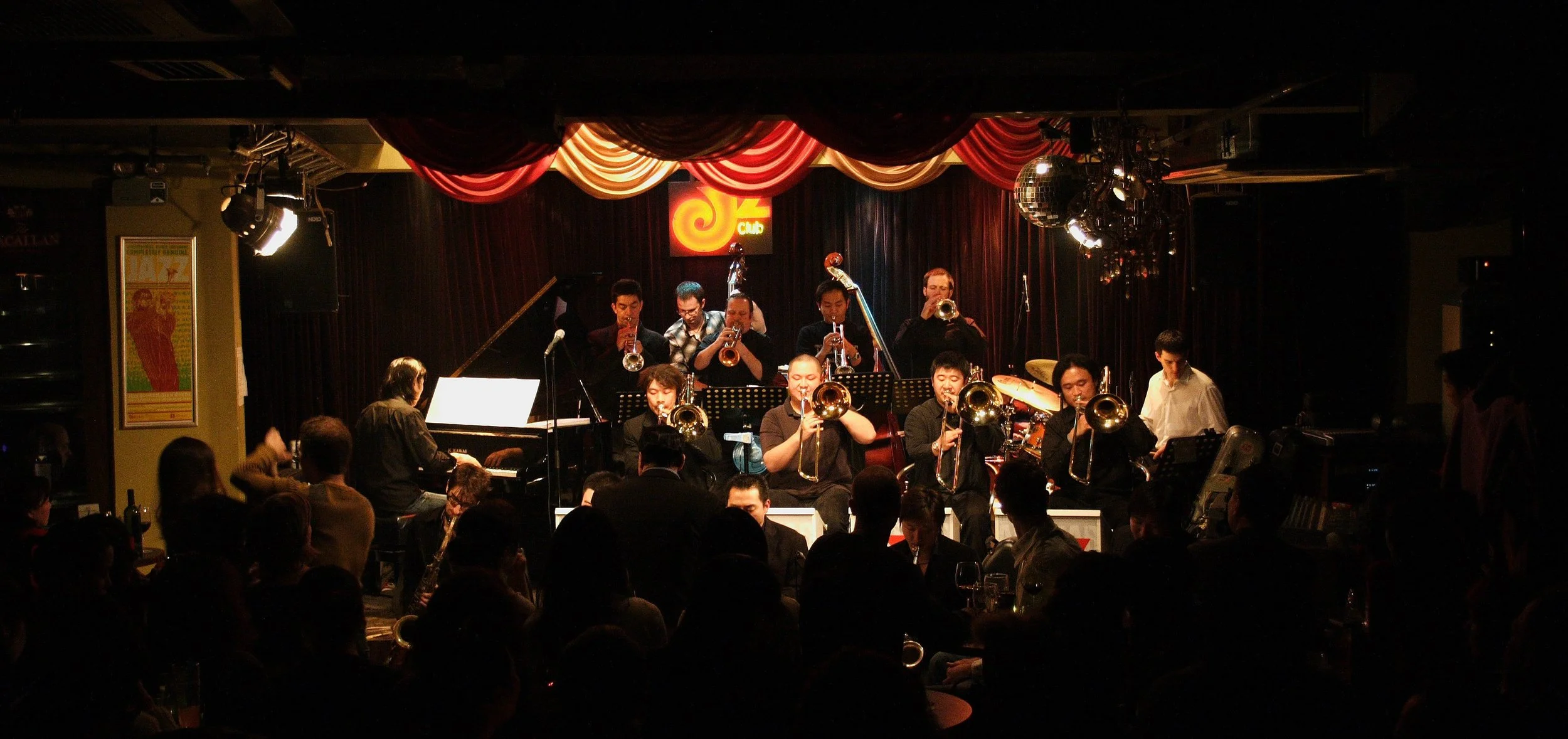
Rolf Becker conducting the JZ All Star Big Band at JZ Club on Fuxing Road, Shanghai, during the orchestra's early years.
What happened next exceeded my expectations.
The audience response was extraordinary.
After only a short time, JZ Club on Fuxing Road became packed whenever the Big Band performed.
People lined up outside, waiting to get in.
Word spread quickly throughout Shanghai's growing jazz community.
Saturday night was Big Band night at JZ.
The club itself was hardly designed to accommodate a full-sized Big Band.
The stage was simply too small.
We had to place the saxophone section on the floor directly in front of the stage, while the other musicians occupied whatever space was available.
As conductor, I stood practically among the audience.
The first standing tables were immediately behind me.
There wasn't much room to move, and the atmosphere could become rather warm and crowded.
But that intimacy was also part of the experience.
The audience wasn't watching the orchestra from a distant concert hall seat. They were standing just a few steps away from the musicians, surrounded by the sound of trumpets, trombones, saxophones, and the rhythm section.
The energy was remarkable.
For me, it was particularly rewarding to see the musicians enjoying themselves and the audience responding so enthusiastically.
After the disappointment of losing the Shanghai Jazz Orchestra, I finally felt that we were building something sustainable.
Two Voices, Two Personalities
As the orchestra developed, I also wanted to expand our repertoire by featuring vocalists.
I brought in two wonderful performers and began writing arrangements specifically for them.
The first was Arlene Estrella, a gifted singer whose musical personality brought a special quality to our performances.
Arlene was a wonderful colleague, and I remember her with great affection. Sadly, she has since passed away.
Arlene Estrella performing with the JZ All Star Big Band at JZ Club on Fuxing Road, Shanghai. This archival photograph captures the crowded stage, trombone section, and intimate atmosphere of the band's early performances.
The second was Danny Woody, an accomplished drummer and singer who was also the music director at the Portman Ritz-Carlton Hotel on Nanjing Road.
Danny's schedule was particularly demanding.
After finishing his earlier performance, he would make his way to JZ Club to join us for the late-night Big Band show.
Danny Woody, drummer, vocalist, and music director at the Portman Ritz-Carlton Hotel in Shanghai, was one of the featured singers with the JZ All Star Big Band during its early years.
That was typical of the dedication many of our musicians brought to the project.
Both singers contributed their individual musical personalities, and I enjoyed writing vocal arrangements that suited their voices and styles.
Their performances added another dimension to our Saturday-night concerts.
From a New Beginning to an Established Orchestra
Over the following months, the JZ All Star Big Band continued to improve.
The regular rehearsals were paying off. Our repertoire expanded, the ensemble became more confident, and the musical interaction between the players grew stronger.
What had begun as a proposal during a conversation with Lawrence Ku was becoming an established part of Shanghai's jazz scene.
Approximately a year and a half after our first performances, an introduction video was produced to present the orchestra.
The featured piece was “Magic Flea,” associated with the Count Basie Orchestra.
Lawrence Ku took on two roles in the video.
Besides being our guitarist, he also appeared as the master of ceremonies, introducing the band.
Looking back at that recording today, I am reminded of how much we had achieved in a relatively short time.
The orchestra had developed from a newly assembled group of musicians into an ensemble with its own character, repertoire, and loyal audience.
And for me personally, it represented something equally important.
The end of the Shanghai Jazz Orchestra had been disappointing, particularly after the success of Jazzy Mozart.
But that disappointment had led to an unexpected opportunity.
Instead of abandoning the idea of developing a professional Big Band in Shanghai, I had been given the chance to begin again — this time with regular rehearsals, a permanent home, and musicians who shared my enthusiasm.
The JZ All Star Big Band had found its place in the city.
And our story was only beginning.
Archival Video — JZ All Star Big Band: “Magic Flea”
An early promotional recording of the JZ All Star Big Band, featuring Lawrence Ku as both master of ceremonies and guitarist. The video documents the orchestra's musical development during its early years in Shanghai.
This historical recording has been preserved from the original video source. Its picture quality reflects the limitations of the surviving archival footage.
From the Archives — Splanky (Live at JZ Club)
A rare live recording of the early JZ All Star Big Band performing “Splanky”, the Count Basie classic composed by Neal Hefti.
Recorded in the intimate atmosphere of Shanghai's JZ Club, this performance captures the energy of the musicians, their improvisations, and the enthusiastic audience.
At the conclusion of the performance, I can be heard introducing the featured soloists — another personal reminder of those formative years of big band jazz in Shanghai.
An authentic musical document from an important chapter in Shanghai's modern jazz history.
To be continued in the next chapter of Shanghai Big Band History.
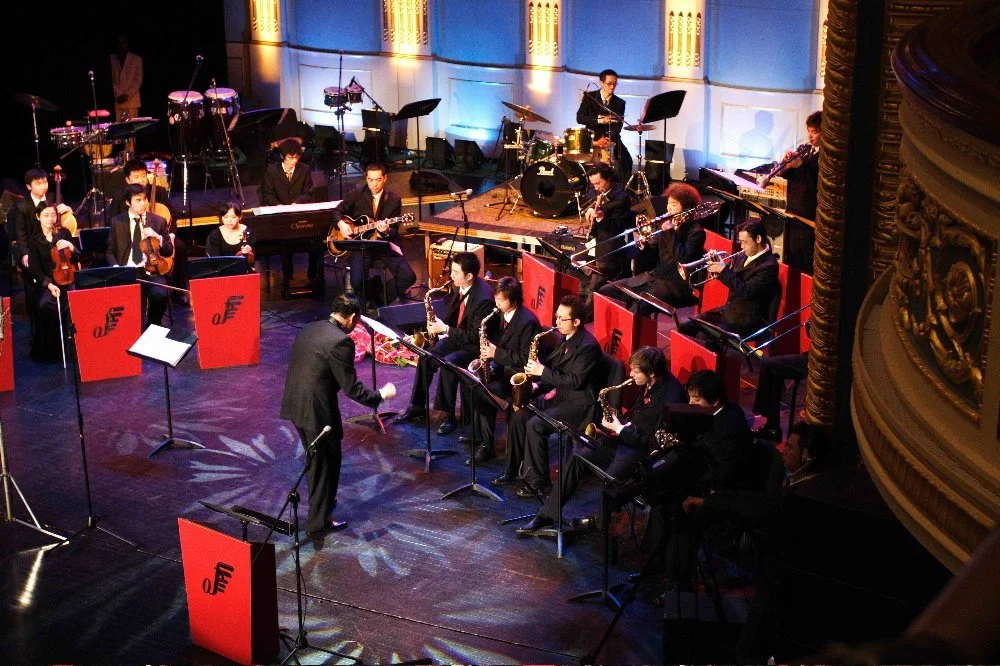
Chapter 3 — Jazzy Mozart — When Classical Music Met Jazz in Shanghai
In April 2006, Rolf Becker brought Mozart, big band jazz, Latin rhythms, and strings together at Shanghai Concert Hall. Discover the story behind Jazzy Mozart, its remarkable musicians, unexpected orchestral challenges, and the live performances that made this concert a memorable chapter in Shanghai's jazz history.
April 9, 2006 | Shanghai Concert Hall
An ambitious musical experiment, an unexpected personnel crisis, and a concert that brought Mozart, big band jazz, Latin rhythms, and strings together on one stage.
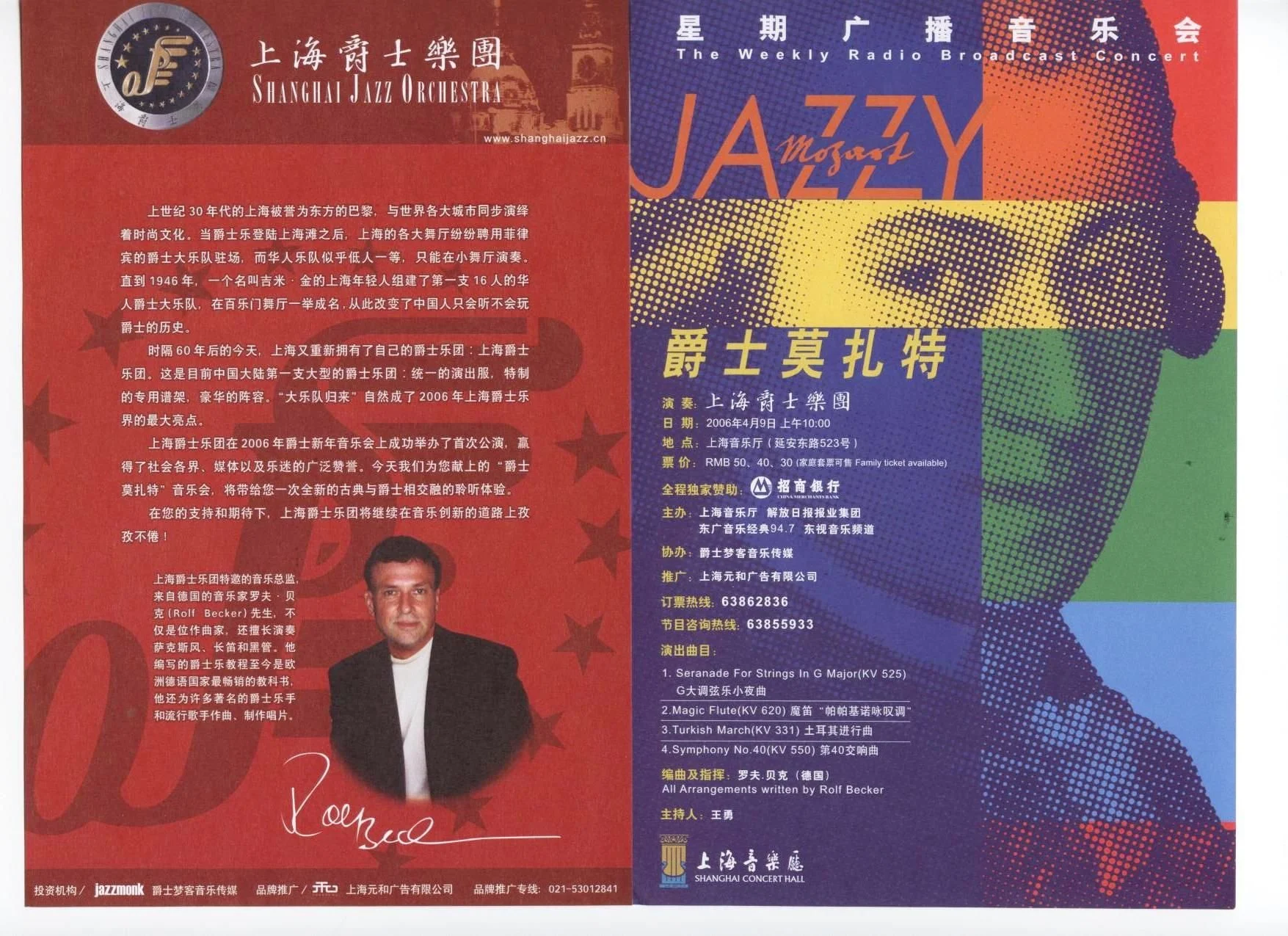
Original promotional flyer for Jazzy Mozart, presented by the Shanghai Jazz Orchestra at Shanghai Concert Hall on April 9, 2006. The program featured arrangements by Rolf Becker celebrating Mozart's 250th anniversary.
A Concert Inspired by Mozart's 250th Birthday
In 2006, the musical world celebrated the 250th anniversary of Wolfgang Amadeus Mozart's birth.
For me, it presented an opportunity to explore something I had always found fascinating: the relationship between classical composition and jazz.
By that time, I had been working with the Shanghai Jazz Orchestra, developing arrangements and exploring ways to present big band music to audiences in China.
The idea behind Jazzy Mozart was to create a concert that would bring different musical traditions together without sacrificing their individual character.
Rather than simply placing a swing rhythm beneath Mozart's melodies, I wanted to explore how his musical ideas could be transformed through jazz harmony, improvisation, Latin rhythms, and contemporary orchestration.
The concert took place on April 9, 2006, at Shanghai Concert Hall, bringing together the Shanghai Jazz Orchestra, a string ensemble, and Latin percussionists.
It was broadcast by Shanghai Media Group (SMG), preserving a remarkable record of this period in Shanghai's developing jazz scene.
Mozart Through a Jazz Arranger's Eyes
Mozart's music offers an extraordinary foundation for creative arranging.
His melodic clarity, harmonic movement, and rhythmic vitality make it possible to explore different musical languages while retaining the identity of the original composition.
For this concert, I developed four arrangements based on the movements of Eine kleine Nachtmusik.
Each arrangement approached Mozart from a different stylistic perspective.
Together, they formed a musical journey from classical Vienna into the world of big band jazz and Latin American rhythms.
1. Let's Start With Mozart
The opening movement established the central idea of the project: Mozart's familiar musical language presented through a different orchestral and rhythmic perspective.
The challenge was to preserve the recognizability of the original while introducing the harmonic colors, articulation, and ensemble textures of jazz.
Let's Start With Mozart — from Jazzy Mozart, Shanghai Concert Hall, April 9, 2006.
2. Romance in Salzburg
The second movement offered an opportunity to explore a more lyrical side of the project.
Here, melodic expression and orchestral color were particularly important.
The combination of jazz instruments and strings allowed me to approach Mozart's musical material with a different sense of phrasing, harmonic atmosphere, and instrumental balance.
Romance in Salzburg — from Jazzy Mozart, Shanghai Concert Hall, April 9, 2006.
3. Menuetto Cubana
With Menuetto Cubana, the musical journey moved toward Latin American rhythms.
This was one of the central attractions of the project: exploring how Mozart's music could interact with rhythmic traditions far removed from eighteenth-century Vienna.
The Latin percussion group added another dimension to the orchestra, bringing different rhythmic colors and performance energy to the stage.
Cuban percussionist and singer Felix Ramón Niebla López was among the musicians contributing to this distinctive musical combination.
Menuetto Cubana — Mozart meets Cuban and Latin rhythmic influences.
4. Stringsy Samba
The fourth movement continued the exploration of Latin American musical influences, this time through the rhythmic character of samba.
The interaction between the strings, big band, and percussion created an opportunity to bring together the different ensemble elements that had shaped the concert.
For me, this combination was at the heart of Jazzy Mozart: using arranging as a creative bridge between musical traditions.
Stringsy Samba — the fourth movement of the Jazzy Mozart suite.
Two Weeks Before the Concert — An Unexpected Crisis
With Jazzy Mozart approaching, the arrangements were written, and preparations for the performance at Shanghai Concert Hall were underway.
Then, approximately two weeks before the concert, an unexpected conflict threatened to disrupt the entire production.
Our lead trombonist had a dispute with the lead alto saxophonist and decided to leave the Shanghai Jazz Orchestra.
Unfortunately, the situation did not end there.
The other trombonists were his students, and when their teacher left, they followed him.
Suddenly, I had lost the entire trombone section.
For a big band arranger, this was a serious problem. My arrangements had been written for a conventional four-part trombone section consisting of three tenor trombones and one bass trombone.
The trombones were an integral part of the orchestration, providing harmonic depth, rhythmic accents, contrapuntal lines, and the characteristic middle and lower brass colors of the ensemble.
With only two weeks remaining before the concert, replacing four experienced trombonists was practically impossible.
I eventually managed to find two replacement players, but the orchestra was still missing an essential voice.
Canceling the concert was not an option.
I needed another solution.
Toby Mak and the Flugelhorn —
Turning a Crisis into a Musical Opportunity
Rather than attempting to reproduce the original trombone section with insufficient personnel, I began considering a different orchestral approach.
My solution was to replace the lead trombone voice with a flugelhorn.
This was not simply a matter of handing the trombone part to a trumpet player. The flugelhorn is a B-flat transposing instrument with a different playing range, articulation, and tonal character.
I had to rewrite the lead trombone material, transpose and adapt passages for the flugelhorn, and adjust the remaining brass voicings to achieve a convincing orchestral balance.
In a way, the idea reminded me of Glenn Miller's distinctive orchestral sound.
Miller had developed a recognizable ensemble color by placing the clarinet above the saxophone section, creating a different tonal blend from conventional big-band writing.
My own solution was born out of necessity rather than a search for a new signature sound, but the underlying principle was similar: changing the instrumentation could produce a different and musically effective orchestral texture.
Fortunately, Toby Mak stepped in to play the flugelhorn.
Toby proved to be exactly the musician we needed.
He performed the specially adapted parts with remarkable precision and musical sensitivity. His warm flugelhorn sound blended beautifully with the remaining trombones, and he contributed wonderful solos that added another expressive dimension to the performance.
What had initially seemed like a serious setback gradually became an interesting musical feature of the concert.
The combination of flugelhorn and the reduced trombone section created a different brass color from the one I had originally imagined.
And most importantly, it worked.
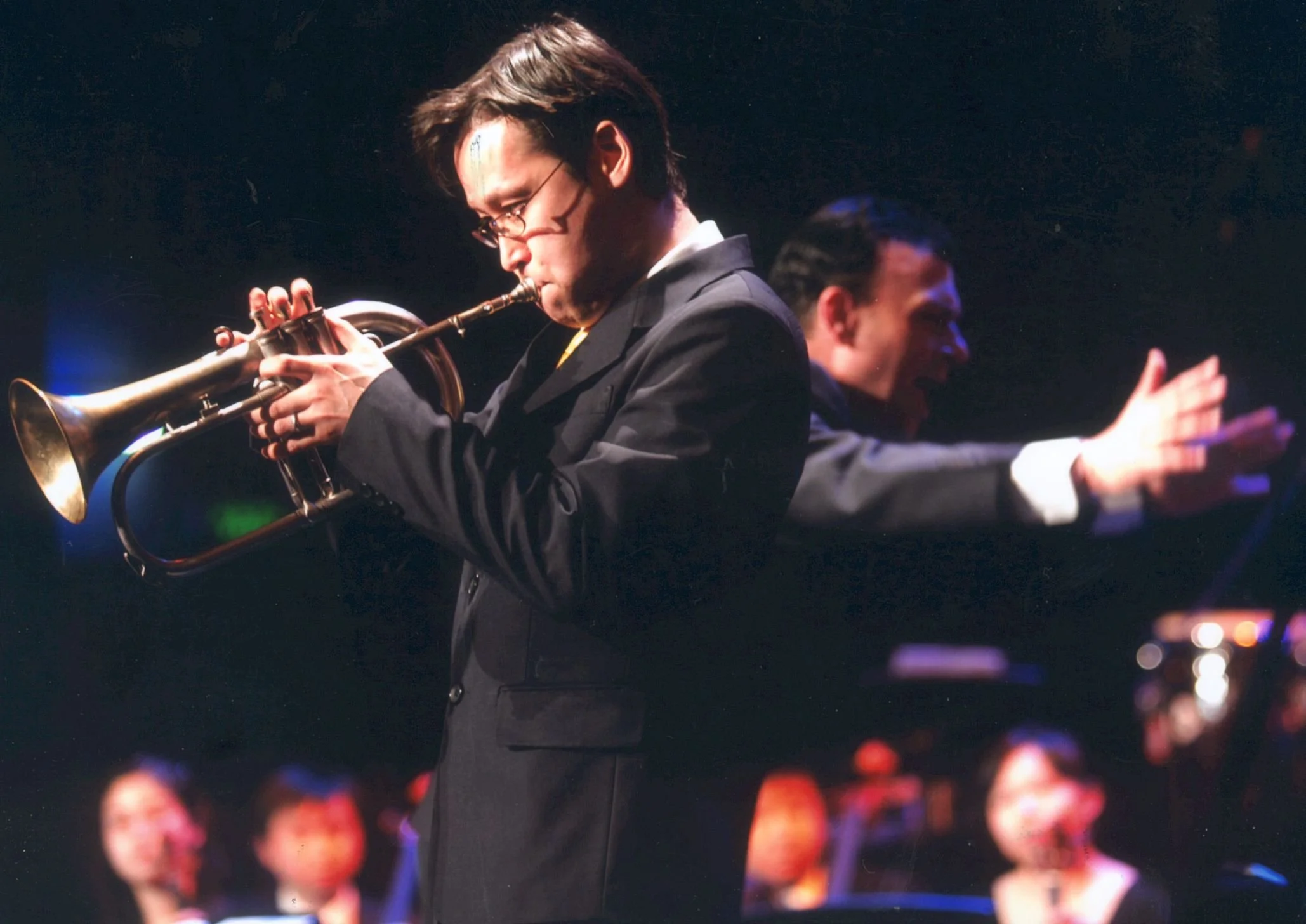
Toby Mak performing on flugelhorn during Jazzy Mozart, with Rolf Becker conducting in the background. Shanghai Concert Hall, April 9, 2006.
Looking back, I remain particularly grateful to Toby for his professionalism, flexibility, and outstanding musicianship.
This experience also reinforced something I have always believed about arranging: writing music is only one part of the profession.
A successful arranger must understand the musicians, their instruments, and the practical realities of live performance.
Sometimes, an unexpected problem forces us to reconsider an orchestration entirely.
And occasionally, the solution produces something we might never have discovered under normal circumstances.
Wolfie Meets Charlie
Beyond the four movements of Eine kleine Nachtmusik, the concert also included Wolfie Meets Charlie.
The title itself suggests the encounter between two musical worlds: Wolfgang Amadeus Mozart and the jazz tradition associated with Charlie Parker.
For me, it represented another aspect of the concert's artistic concept — allowing classical inspiration and the language of bebop to meet in a contemporary big band setting.
Wolfie Meets Charlie — a meeting of classical inspiration and bebop.
Coco Zhao — From Mozart to Chinese Jazz
One of the featured vocalists of Jazzy Mozart was Coco Zhao, whose performance added another dimension to the concert's musical diversity.
For his interpretation of Mozart's Air Papageno, I created an arrangement that began with a Bossa Nova feel before transitioning into Swing. The arrangement also incorporated scat-singing passages, allowing Coco to interact with the Big Band in a distinctly jazz-oriented setting.
As a special addition to the program, Coco performed The Moon Speaks to My Heart, a song widely known and loved throughout Asia. Although unrelated to Mozart, it provided a connection between the concert's international musical concept and Chinese popular music.
Coco Zhao subsequently established himself as a prominent jazz vocalist, particularly through his distinctive approach to incorporating Chinese musical traditions into jazz.
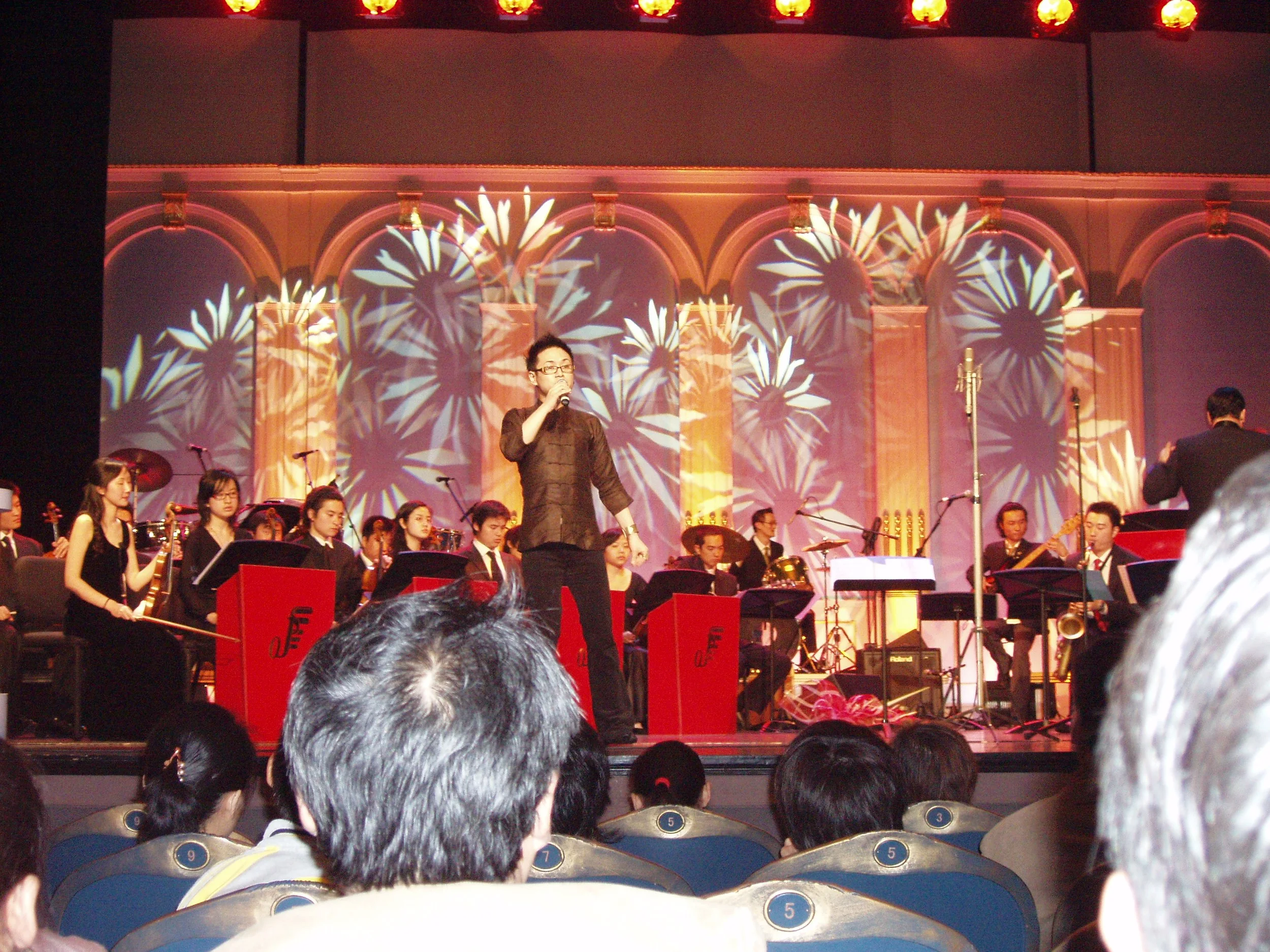
Chinese jazz vocalist Coco Zhao performing with the Shanghai Jazz Orchestra during Jazzy Mozart at Shanghai Concert Hall, April 9, 2006.
Coco Zhao performs Papageno's Aria from Mozart's The Magic Flute, arranged and conducted by Rolf Becker. The arrangement moves from Bossa Nova into Swing, featuring scat singing with the Shanghai Jazz Orchestra. Recorded live at Shanghai Concert Hall on April 9, 2006, as part of Jazzy Mozart.
The Musicians Behind the Music
A project of this scale depends on the musicians who bring the written arrangements to life.
The Shanghai Jazz Orchestra was joined by strings and Latin percussion, creating an ensemble that could move between different musical styles.
Among the musicians was lead trumpeter Lance Goerner, who also performed on the Electronic Valve Instrument (EVI), adding an unusual instrumental color to the production.
The participation of musicians from different backgrounds reflected something I valued greatly about working in Shanghai: the opportunity to bring together performers with different musical experiences and traditions.
The concert was not simply about combining instruments. It was about creating a shared musical language.
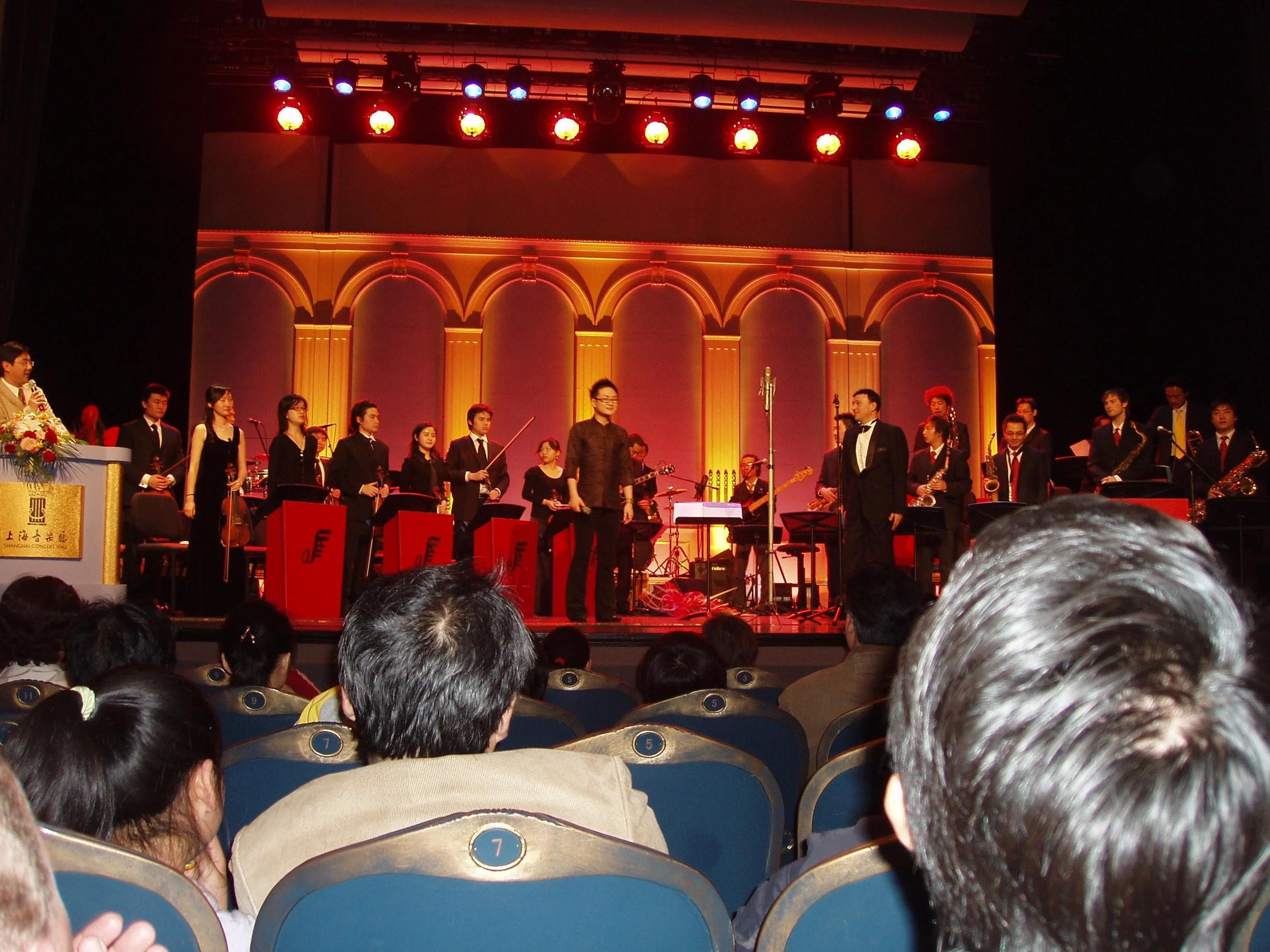
A memorable finale: The Shanghai Jazz Orchestra and guest vocalist Coco Zhao gathered on stage at Shanghai Concert Hall following the final notes of Jazzy Mozart, April 9, 2006.
Preserving the Original Concert Recordings
The surviving footage of Jazzy Mozart comes from the original 2006 television broadcast.
Although the recordings are not technically perfect by today's standards, they remain important historical documents.
They capture the musicians, arrangements, and atmosphere of a concert that formed a significant part of my early musical years in Shanghai.
Archival recording note:
"The surviving 2006 broadcast recording contains occasional audio overload and a slight discrepancy between picture and sound. These limitations belong to the archival source and do not reflect the musical performance."
From the Concert Stage to the Music Library
One of my continuing objectives with MusicMyLanguage is to make professional arrangements available to musicians, conductors, and educational ensembles.
The Jazzy Mozart project represents the same philosophy that guides much of my arranging work: respecting the original musical material while exploring new possibilities through orchestration, harmony, rhythm, and ensemble color.
Selected arrangements from my catalog can be explored through my music library, with score previews, instrumentation information, and purchasing options available through the following platforms.
A Full House at Shanghai Concert Hall
A view of the sold-out audience at Shanghai Concert Hall during Jazzy Mozart on April 9, 2006 — a memorable evening that brought classical music, big band jazz, and Latin rhythms together on one stage.
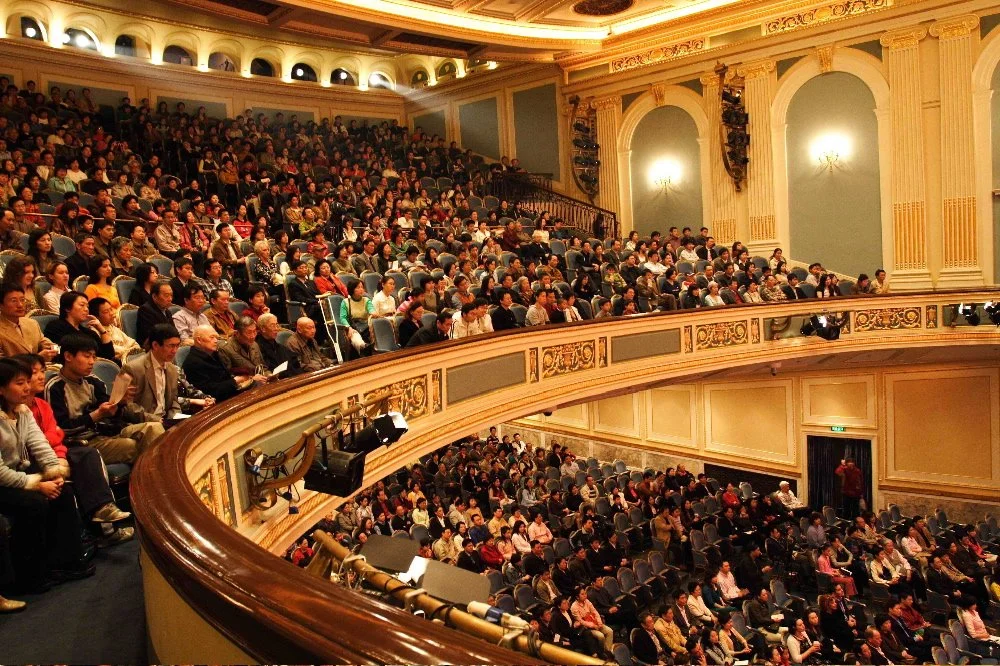
A sold-out audience at Shanghai Concert Hall during the Jazzy Mozart concert on April 9, 2006.
Looking Back — and Moving Forward
Looking back, Jazzy Mozart remains a particularly memorable project from my early years in Shanghai.
It brought together classical music, jazz, Latin percussion, and orchestral writing in a way that reflected both my musical background and the international character of the city's developing music scene.
The concert also marked an important turning point.
Despite the artistic success of the project, the future of the Shanghai Jazz Orchestra soon became uncertain.
What followed would lead to a new musical collaboration, a different orchestra, and the beginning of another important chapter in my Shanghai years.
That next chapter would become the story of the JZ All Star Big Band.
Continue reading: The Birth of the JZ All Star Big Band →
Previous chapter: Shanghai Jazz Orchestra (2005–2006)
Discover how the Shanghai Jazz Orchestra emerged as an important part of Shanghai's developing big band scene, leading to the Jazzy Mozart concert.
MusicMyLanguage | Composition • Arranging • Conducting • Music Education
Chapter 2 — The Shanghai Jazz Orchestra: A New Beginning (2005–2006)
From Club Shanghai to the Shanghai Jazz Orchestra: Rolf Becker recalls the orchestra's beginnings, its sold-out New Year's concerts in January 2006, and the musical journey that led to Jazzy Mozart.
Shanghai Big Band History — Part Two | By Rolf Becker
A New Opportunity
When my engagement as musical director of the Club Shanghai Big Band ended in February 2005, I certainly did not expect that the story of this orchestra would continue in quite the way it did.
The musicians, however, had other ideas.
Later that year, drummer Billy Pan and several of his colleagues became involved in establishing a new ensemble: the Shanghai Jazz Orchestra. Some of the musicians had previously performed with me at Club Shanghai, while others were newly recruited.
This was not simply the old Club Shanghai Big Band operating under a different name. The Shanghai Jazz Orchestra was a new organization with its own management and ambitions.
In autumn 2005, Billy Pan approached me and asked whether I would return as the orchestra's conductor. He also mentioned that two Chinese New Year concerts were already being planned for January 2006.
I accepted the invitation.
It was an opportunity to continue the work we had started at Club Shanghai, but this time within an organization dedicated to developing a concert Big Band.
Continuing Where We Had Left Off
When I returned to rehearsals, I quickly realized that we would have to continue more or less where we had left off.
Although a few new musicians had joined the ensemble, the overall musical level had not improved significantly during my absence.
This was not particularly surprising. Most of the players came from musical backgrounds in which jazz had played only a minor role, if any.
The experience gained during our Club Shanghai rehearsals and performances had provided a foundation, but developing a convincing Big Band required much more than reading the correct notes.
Swing phrasing, articulation, rhythmic precision, ensemble balance and stylistic understanding were all essential elements of the musical language we were trying to establish.
Nevertheless, we now had a specific goal: preparing the orchestra for its first public concerts in January.
That gave our rehearsals a clear direction.
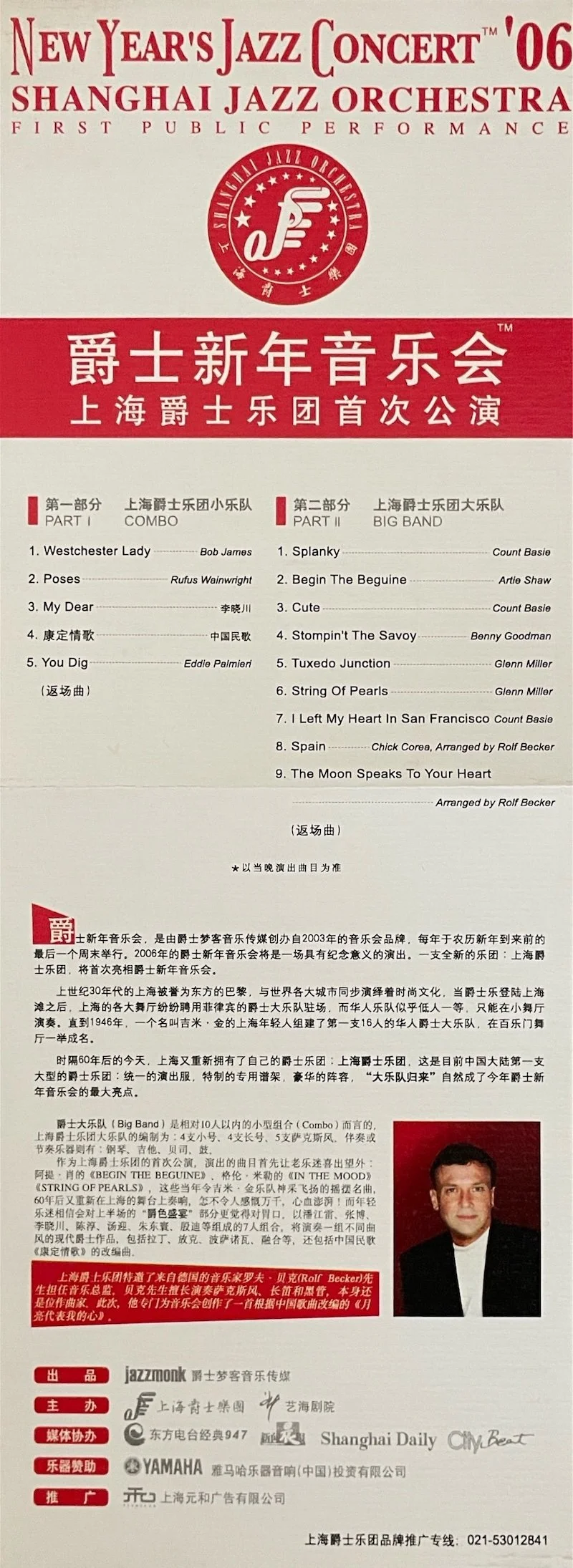
Original program for the Shanghai Jazz Orchestra's New Year's Jazz Concert in January 2006, announcing the ensemble's first public performance and documenting the repertoire, including my arrangements of Spain and The Moon Speaks to Your Heart.
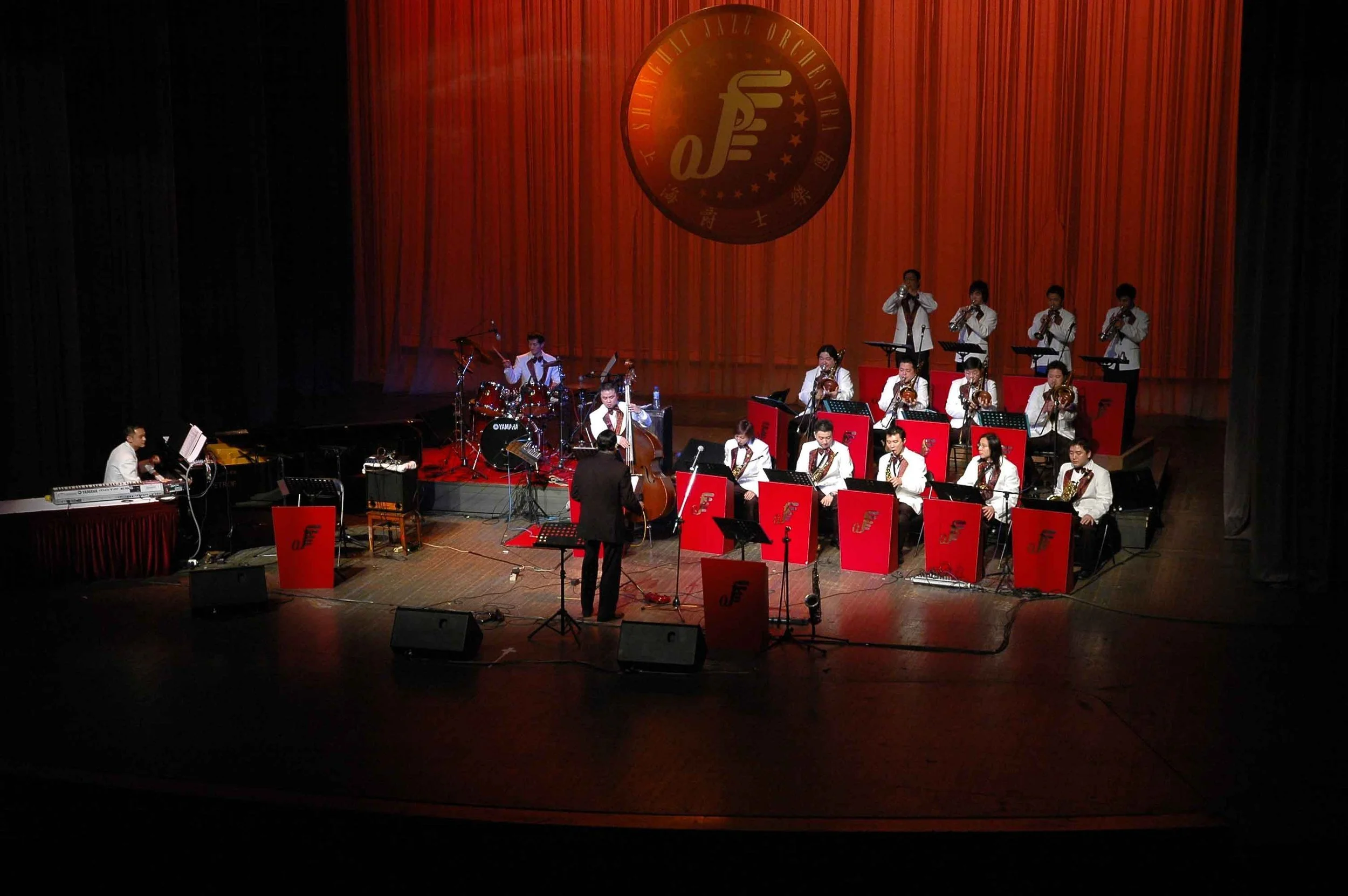
Orchestra photograph: The Shanghai Jazz Orchestra performing at Yi Hai Theater, Shanghai, January 2006. Rolf Becker conducting.
Choosing the Right Repertoire
As I began planning the program, two considerations guided my decisions.
The first was the orchestra itself.
I had to select or prepare music that would challenge the musicians without exceeding their capabilities. An overly ambitious repertoire might have been musically interesting on paper, but it would not necessarily have produced a convincing performance.
The second consideration was our audience.
At that time, many Chinese concertgoers had relatively little experience with jazz, particularly with the traditions of the American Big Band.
I wanted to present a program that would introduce this musical world in an accessible and entertaining way.
For that reason, I decided to concentrate much of the repertoire on the Golden Era of Big Band music.
Glenn Miller's In the Mood was an obvious choice. Its memorable melodies, characteristic swing rhythm and unmistakable orchestral sound made it an excellent introduction to the traditional Big Band.
Another selection was Begin the Beguine, closely associated with Artie Shaw and his orchestra.
This particular piece presented an interesting practical challenge.
The arrangement required a clarinet solo, but none of our saxophonists provided clarinet doubling. Consequently, I performed the clarinet solo myself.
It was one of those situations in which being both a conductor and an instrumentalist proved particularly useful.
Introducing a Different Side of Jazz
Although I wanted the concerts to be accessible, I also felt it was important to introduce something beyond the familiar swing repertoire.
For that purpose, I selected Chick Corea's Spain.
This was the one jazz chart in the program that ventured significantly beyond the traditional Big Band repertoire.
To feature the composition properly, I invited the talented guitarist Lawrence Ku to join us as guest soloist.
Lawrence was not a regular member of the Shanghai Jazz Orchestra, but his musicianship made him an excellent addition to the concerts.
Our collaboration would continue a few months later when he returned as a guest musician for Jazzy Mozart at Shanghai Concert Hall.
The inclusion of Spain reflected an important part of my approach to programming: I wanted to respect the orchestra's current abilities and the audience's musical experience without limiting our artistic ambitions to familiar material.
Bringing the Swing Era to the Stage
The concerts were not intended to be purely musical presentations.
I also wanted to recreate some of the atmosphere associated with the great Big Band era, when swing music was closely connected with dancing and entertainment.
A couple of swing dancers therefore joined us on stage, adding a visual and theatrical element to the performances.
Their appearance helped bring the music to life in a different way.
For an audience that might not have been familiar with the history of swing, the combination of a live Big Band and dancers provided an immediate connection to the music's original cultural setting.
It was a relatively simple addition to the program, but an effective one.
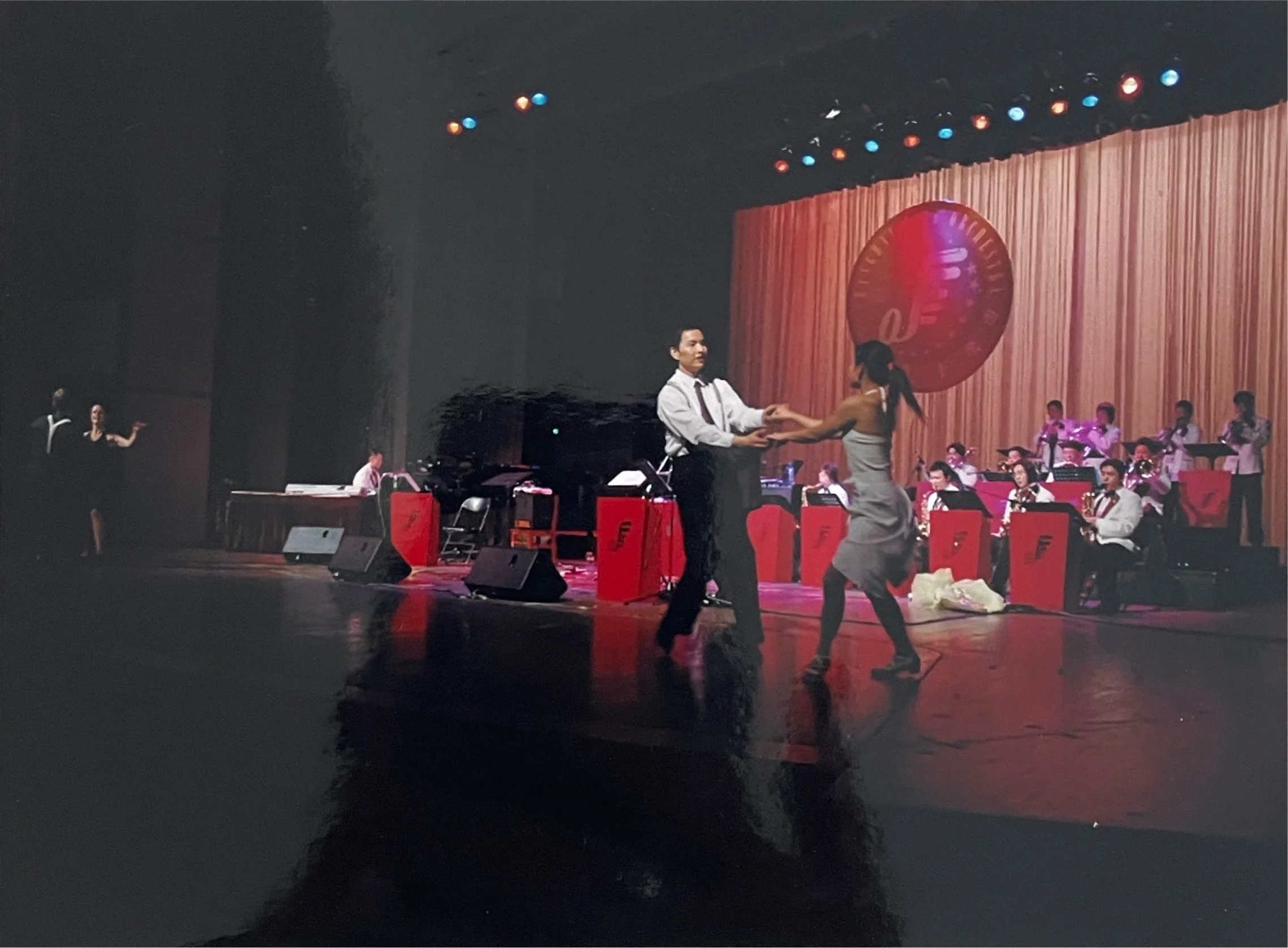
Swing dancers performing on stage with the Shanghai Jazz Orchestra during the New Year's Jazz Concert in January 2006.
January 20–21, 2006:
The First Public Performances
The Shanghai Jazz Orchestra's first public concerts took place on January 20 and 21, 2006, at Yi Hai Theater in Shanghai.
The performances were presented as the New Year's Jazz Concert '06, with the orchestra advertised as making its first public appearance.
The original promotional poster listed me as Musical Director and featured Lawrence Ku as guest guitarist.
Both concerts were sold out.
For me, this was particularly encouraging.
Only a few months earlier, we had been working to develop an orchestra whose musicians were still becoming familiar with the language of jazz. Now we were performing before full houses.
The audiences responded enthusiastically.
They enjoyed the music, appreciated the show elements and called for encores.
Of course, the orchestra still had considerable room for improvement. But the success of those two evenings demonstrated that our efforts had been worthwhile.
More importantly, they showed that there was an audience in Shanghai interested in experiencing this kind of music.
The Shanghai Jazz Orchestra had taken an important step forward.
Concert poster: Original promotional poster for the Shanghai Jazz Orchestra's first public concerts, January 20–21, 2006.
Growing Public Attention
The concerts also attracted attention beyond the concert hall.
One particularly valuable document from this period is a newspaper article by Yu Bingxia titled Revival of Jazz Slow but Steady, published in China Daily.
The article discussed the development of jazz in Shanghai and introduced the newly established Shanghai Jazz Orchestra.
It also documented the orchestra's January performances and my involvement as its musical supervisor.
Looking back, I consider this newspaper coverage an important part of the orchestra's early history.
It provides a contemporary record of a time when establishing a professional Chinese Big Band was still an unusual undertaking.
The musicians had created a new organization, we had successfully presented our first public concerts, and the orchestra was beginning to attract wider attention.
Newspaper article: “Revival of jazz slow but steady,” by Yu Bingxia, China Daily, January 2006. Contemporary reporting on the emergence of the Shanghai Jazz Orchestra.
From the Swing Era Toward Mozart
The success of the January concerts gave us confidence.
It also appears to have helped create the circumstances for a much more ambitious project.
Shortly afterward, the Shanghai Jazz Orchestra's manager approached me with an interesting question:
Could I rewrite Mozart's music into swing?
My answer was yes.
But the more I considered the idea, the more I realized that simply transforming Mozart's compositions into conventional swing arrangements would be too limiting.
I began thinking about a broader musical concept.
Rather than presenting Mozart exclusively through the language of traditional swing, I wanted to explore the possibilities of bebop, contemporary jazz, salsa and other Latin styles.
I would select the Mozart compositions myself and develop arrangements that connected the original classical material with these different musical traditions.
The project would also require a considerably expanded ensemble, combining the Shanghai Jazz Orchestra with guest musicians, Latin percussion and strings.
What began as a relatively straightforward question would eventually become Jazzy Mozart, performed at Shanghai Concert Hall on April 9, 2006.
But that story deserves a chapter of its own.
Explore the Shanghai Big Band History
Previous chapter: Club Shanghai Big Band (2004) — Where It All Began
Discover how Shanghai's first Club Shanghai Big Band came together and laid the foundation for the developments described in this chapter.
Next chapter: Jazzy Mozart (2006) — A New Musical Adventure
Discover how jazz, classical music, Latin rhythms, and a full orchestra came together for an ambitious concert at Shanghai Concert Hall on April 9, 2006.
Chapter 1 — Club Shanghai Big Band (2004): Where It All Began
In 2004, Rolf Becker assembled Shanghai's Club Shanghai Big Band from locally recruited musicians. Discover the remarkable six-week preparation, an unusual opening night, and the events that eventually led to the Shanghai Jazz Orchestra.
From Club Shanghai to Jazzy Mozart — The Birth and Evolution of a Shanghai Big Band, 2004–2006
By Rolf Becker
A New Beginning in Shanghai
When I moved to Shanghai with my wife, Amira, in June 2004, I certainly didn't anticipate that within a few months I would be conducting a 17-piece Big Band in one of the city's most remarkable venues.
I had visited Shanghai for the first time in February 1999. By 2004, the city was changing at an extraordinary pace. International businesses, hotels, restaurants and cultural institutions were expanding, and Shanghai was rediscovering parts of its cosmopolitan heritage.
Jazz had been part of that heritage long before my arrival. During the 1920s and 1930s, Shanghai had developed a vibrant entertainment scene, with dance orchestras performing in hotels, ballrooms and nightclubs.
But recreating that musical atmosphere with a contemporary, locally recruited Big Band would prove to be an entirely different challenge.
An Unexpected Invitation
In late summer 2004, I was introduced to Lily Ho, the former Hong Kong actress and owner of a new establishment called Club Shanghai.
The introduction came through the deputy general manager of a Shanghai hotel.
Lily was preparing to open an ambitious entertainment venue on the upper floor of the historic Shanghai Concert Hall. The concept combined fine dining, live entertainment and dancing, recalling the elegance of the American and Shanghai Big Band eras.
The culinary side of the operation was entrusted to German chef Stefan Stiller, while the musical program was to feature a full-size Big Band performing six evenings a week.
Lily asked whether I would be interested in assembling the orchestra and taking responsibility for its musical direction.
Naturally, I was intrigued.
However, there was one very specific condition.
The orchestra had to consist entirely of local Chinese musicians. I would be the only foreigner.
This arrangement was connected to the employment permissions under which the establishment operated.
I accepted the challenge and became the club's music director and Big Band leader.
At that moment, neither Lily nor I could have anticipated how much work would be necessary before the orchestra could perform convincingly.
Finding Seventeen Musicians
The management organized auditions through newspaper advertisements, contacts at music conservatories and musicians working in classical orchestras.
There was certainly no shortage of instrumental talent in Shanghai.
Many of the musicians who auditioned had excellent technical training, a beautiful instrumental sound and strong sight-reading abilities.
What was largely missing, however, was familiarity with the language of jazz.
Most applicants had been educated in the classical tradition. Swing phrasing, jazz articulation, rhythmic placement and the characteristic sound of a Big Band were unfamiliar territory.
Only a handful had meaningful experience with jazz. I particularly remember one trombonist who already understood something about jazz brass playing.
This presented an interesting dilemma.
Should I recruit musicians who had some knowledge of jazz but weaker instrumental or sight reading skills? Or should I select accomplished instrumentalists and teach them how to play this music?
I chose the second option.
I was convinced that good instrumental technique, musical discipline and the ability to read music accurately would provide a solid foundation.
The jazz language could be developed through rehearsals, careful instruction and suitable arrangements.
It was an ambitious decision, especially considering the limited time available.
Six Weeks to Build a Big Band
Once the musicians had been selected, the real work began.
I quickly realized that simply placing conventional American Big Band arrangements on the music stands would not produce the results we needed.
The musicians had to become familiar with an entirely different musical vocabulary.
Swing was not merely a matter of playing written eighth notes differently. It involved articulation, ensemble precision, rhythmic flexibility, balance, phrasing and, perhaps most importantly, learning to listen to one another in a new way.
The brass section needed to develop the characteristic attacks, releases and dynamic shapes of jazz ensemble playing.
The saxophone section had to learn how to phrase as a single musical unit.
The rhythm section faced its own challenges, particularly in establishing a convincing swing feel.
I therefore began writing arrangements specifically for the musicians I had recruited.
These were not simply simplified versions of standard charts. They were designed around the actual strengths and limitations of the players while gradually introducing the stylistic demands of Big Band music.
In effect, I was simultaneously arranging, rehearsing, conducting and teaching.
We had approximately six weeks between the first rehearsals and the club's soft opening.
Six weeks to transform a group of predominantly classically trained musicians into a functioning Big Band.
Looking back, it was an extraordinary undertaking.
Shanghai Concert Hall, home of Club Shanghai in 2004. Historical Club Shanghai Big Band photograph from the personal archive of Rolf Becker; composite illustration.
November 1, 2004 — The Soft Opening
The soft opening of Club Shanghai took place on November 1, 2004.
By that date, the orchestra had made considerable progress.
Nevertheless, there was an uncomfortable reality: after six weeks of intensive preparation, I considered only three pieces ready to be performed at an acceptable professional standard.
Three pieces.
For a venue expecting live Big Band entertainment over the course of an evening, that was hardly an ideal situation.
But I was unwilling to present music that the orchestra could not yet perform convincingly.
The result was one of the more unusual opening evenings of my career.
During approximately two hours, we performed those same three pieces repeatedly.
It was certainly not the kind of opening program I would have designed under normal circumstances.
Yet the experience demonstrated something important: the musicians were capable of learning this musical language, provided they received the necessary guidance and rehearsal time.
The foundation had been established.
Now we needed to build upon it.
From Rehearsal Room to Ballroom
Over the following weeks, the orchestra continued to improve.
The musicians gradually became more comfortable with jazz phrasing and the rhythmic character of swing.
The arrangements became more demanding, the ensemble more confident, and the band's collective sound began to develop.
What had initially been a group of capable individual instrumentalists was slowly becoming a musical ensemble with a shared identity.
For me, this was the most rewarding part of the experience.
I had always enjoyed working with musicians who were willing to explore unfamiliar territory, and the Club Shanghai players demonstrated that dedication.
The process also confirmed something I have believed throughout my professional life: musical development depends not only on talent, but on the quality of instruction, the suitability of the repertoire and the willingness to listen and learn.
The Club Shanghai Big Band was beginning to demonstrate what could be achieved with locally recruited musicians in Shanghai.
New Year's Eve — A Special Performance
The most memorable engagement of this period came on New Year's Eve, December 31, 2004.
Lily Ho had invited approximately twenty guests associated with a Hong Kong ministry to Shanghai for a special celebration.
The evening was intended to be an important occasion for Club Shanghai, and the Big Band was a central part of the entertainment.
By this time, the orchestra had progressed considerably beyond its difficult soft opening.
The performance was successful.
For me, it was an encouraging moment, not only because the guests enjoyed the music, but because it demonstrated how far the musicians had come in a relatively short period.
Only weeks earlier, we had been struggling to prepare enough material for an opening evening.
Now we were providing the musical centerpiece for an important gala.
I was proud of what the musicians had accomplished.
Unfortunately, the success of that evening did not guarantee the future of the orchestra.
An Unexpected Ending
Behind the scenes, financial considerations were becoming increasingly important to the management.
Without my knowledge, Lily Ho approached one of the orchestra's musicians about taking over the leadership of the Big Band.
The intention was to reduce expenses.
In February 2005, I was dismissed from my position as music director and conductor.
Stefan Stiller also lost his position for financial reasons.
Naturally, I was disappointed.
I had invested an enormous amount of time and energy in assembling the orchestra, writing the arrangements and developing the musicians.
But the decision was made.
The musician selected to continue the orchestra did not have the necessary experience to maintain its musical development.
Within a few months, the Club Shanghai Big Band itself was dismissed.
It was a disappointing conclusion to a project that had begun with such ambition.
Nevertheless, the story did not end there.
The Unexpected Legacy
Although the Club Shanghai Big Band ceased to exist, the experience had brought together a group of musicians who had acquired valuable experience performing Big Band repertoire.
Most of them wanted to continue.
Through an agent, these musicians became involved in the formation of a new orchestra: the Shanghai Jazz Orchestra.
This was a separate organization, established and registered independently of me.
I was not involved in its founding or registration.
However, the musicians' previous experience at Club Shanghai had created a connection between the two ensembles.
In autumn 2005, I was contacted by drummer Billy Pan, who invited me to work with the newly established Shanghai Jazz Orchestra.
The orchestra had already recruited additional musicians.
I accepted the invitation, and a new chapter began.
This time, the objective was no longer to provide nightly entertainment in a restaurant and ballroom.
We were preparing an orchestra for public concert performances.
The first major engagements would take place at the Shanghai Art Theatre on January 20 and 21, 2006, as part of the Chinese New Year celebrations.
Only a few months later, we would present one of the most ambitious projects of my career:
Jazzy Mozart, performed at Shanghai Concert Hall on April 9, 2006, in celebration of Mozart's 250th birthday.
But that story belongs to the following chapters.
Looking Back
More than twenty years later, I still regard the Club Shanghai Big Band as an important starting point in my musical life in China.
The project was challenging, occasionally frustrating and ultimately short-lived.
Yet it demonstrated that Shanghai possessed the instrumental talent and musical potential to develop a convincing modern Big Band tradition.
What was required was experience, dedicated rehearsal, appropriate repertoire and the opportunity to perform.
The Club Shanghai Big Band provided an early opportunity to bring those elements together.
Its significance lies not in how long it existed, but in what followed.
Sometimes the most important musical projects are not the ones that survive. They are the ones that make something else possible.
Next chapter: The Shanghai Jazz Orchestra — A New Beginning, 2005–2006.
Explore more historical photographs:
Visit my Rolf Becker Photo Gallery for additional documentation of my work with Shanghai's Big Bands, including the Shanghai Jazz Orchestra and the 2006 concerts.